
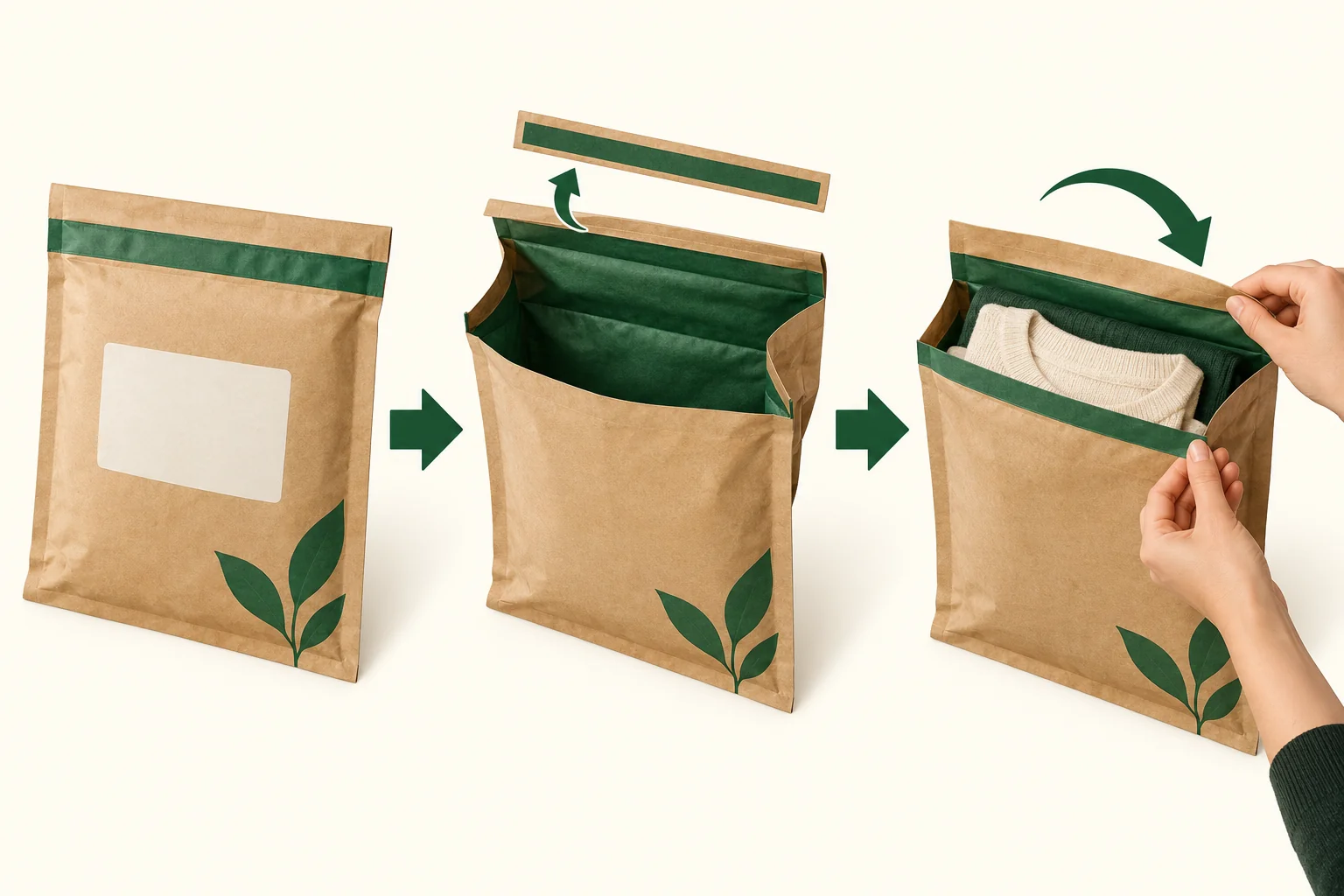
This is a packaging concept. The actual material, opening feature and both closure stages must be identified in the supplier proposal.
Request the complete return sequence
PaperPak’s eCommerce mailer range describes a zipper-style tear strip and two adhesive strips, with one used for the outward closure and another for return use. Its Everyday Mailer flyer confirms those features. That is a specific structural reference, not a statement that every returnable paper bag uses them.
For a dual-strip proposal, ask for a drawing identifying the first strip, tear path, second strip and each receiving surface. Confirm their positions and the customer sequence on the actual project sample.
State whether the same contents are returned or a different packed configuration is expected. Include all inner wrap and backing. The return job can create a different filled envelope from the outward parcel.
Compare the paper mailer brief when only one closing stage is required. Here, keep the second stage as an explicit construction and user-action question.
Review what survives first opening
Close the sample as proposed, then follow the customer opening instruction. Photograph the resulting bag before rearranging the contents or edges. Identify which surface is expected to perform the next closure.
For a hypothetical gift accessory return, the customer may replace the product in its inner wrap before using the second closing area. Review that complete returned envelope and the available joining surface.
Ask how the outward label and return label are handled. A second closure does not by itself solve a conflicting label or an obscured address. Keep those surface and instruction decisions separate.
Use a return-stage record
Keep all states on the same sample identity. A fresh second bag should not stand in for the used return stage.
| Stage | Closure construction in the supplier drawing | Evidence |
|---|---|---|
| First closing | First adhesive strip and its receiving surface | Loaded outward state |
| First opening | Located tear path and customer action | Used bag immediately afterwards |
| Return loading | Complete returned contents | Filled used-bag view |
| Second closing | Second strip, remaining liner and receiving surface | Same bag before and after closing |
| Label change | Outward and return surface plan | Address visibility in return state |
Keep the second strip unused during outward packing and first opening. Check its position and the remaining receiving surface immediately after the tear action. If the proposed mechanism differs from the reference, identify it as a separate configuration rather than assuming this dual-strip instruction applies.
Make the user instruction specific
In the hypothetical record, name the first opening O1 and second closure S2. Ask the supplier what O1 must preserve for S2. If the intended opening damages that area, the sequence needs a revised proposal.
Keep the supplied state, packing responsibility and any protective inner pack attached to the brief. Changes to the opening feature can reopen the return instruction even if the outside artwork stays unchanged.
Any repeated-use, sealing or distribution requirement needs a separately agreed evaluation. This record concerns one proposed outward-and-return sequence without promising reusable performance across unspecified conditions.
Send both journeys as one configuration
Submit first-opening views, returned contents, second-closure questions, quantity and destination through Get a Quote. The minimum is 500 pieces per design. Final construction, sample scope and commercial terms require project confirmation.