

The EU Packaging and Packaging Waste Regulation (PPWR), Regulation (EU) 2025/40, began applying on 12 August 2026, with provisions phased over time. A small brand preparing packaging for the EU should identify the responsible business operator, map the packaging components and intended markets, then check which documentation and requirements apply to that exact package. The application date is not a single deadline for every PPWR obligation.
Key points
- PPWR is an EU packaging regulation, not a voluntary certificate.
- A box can include several packaging levels: sales packaging, grouped packaging and transport packaging.
- Supplier data is useful only when it describes the actual components and version being purchased.
- The responsible importer or other economic operator needs to confirm which obligations apply to the transaction.
What changed in 2026?
The European Commission says Regulation (EU) 2025/40 entered into force in February 2025 and its rules began to apply on a phased basis from 12 August 2026. The regulation creates a common EU framework for packaging and packaging waste. Specific requirements can have their own application dates, transition arrangements, delegated acts or implementing guidance. Use the regulation and current Commission guidance for the provision that matches your packaging; do not assume every rule applied in the same way on 12 August.
Sources: European Commission: New EU rules on packaging enter into application; Regulation (EU) 2025/40 on EUR-Lex; European Commission PPWR FAQ, 3 August 2026.
Which packaging components should a buyer map?
List each component that goes with the product: the immediate box or pouch, any insert, a bag or tissue layer, labels, grouped packaging and the outer transport packaging. Note the intended function of each part and whether a separate business adds, fills or places it on the EU market. Do not assume a decorative inner box and a shipping carton are treated as the same packaging component.
Scroll horizontally if columns extend beyond the view.
| Component | Details to request from the supplier | Why it helps the next review |
|---|---|---|
| Product or sales packaging | Finished dimensions, material family, component weight, closure and any coating | Identifies the main package and material data to verify |
| Insert, sleeve or divider | Material, weight, whether removable, and how it fits the outer box | Keeps separate parts visible in the package specification |
| Label, ink or finish | Substrate, adhesive/ink/finish family and where it is applied | Makes the decorated component easier to identify and assess |
| Group or shipping pack | Components, packed dimensions, quantity and destination route | Separates product presentation from transport packaging |
These are useful information fields for a buyer’s brief, not a universal PPWR document list. Specific legal records and responsible parties depend on the role, package, market and applicable provision.
What supplier information should go in a packaging brief?
Ask the supplier to identify the material and revision for each component, provide dimensions and weight for the final configuration, and describe any claim they make about recyclability, reusable design or recycled content. Ask what evidence supports that statement, which version of the material it covers, and whether the evidence applies to the complete packaging combination rather than only one component.
Compare like with like. A quotation that names a board family but omits dimensions, coating, insert, print method or delivery state is not directly comparable to a quotation that includes those details. Record the destination market, expected order configuration and which business in the chain will review regulatory duties. The seller or importer responsible for placing a package on the EU market should verify its obligations against the current law and guidance.
The official Commission guidance for Regulation (EU) 2025/40 explains selected provisions and implementation questions. It is a useful starting point, not a product-specific compliance decision. Check the current version and any subsequent official guidance when the packaging specification or market changes.

AI-assisted concept illustration. The boxes help organize a packaging brief; actual classification and PPWR obligations depend on the package and responsible business.
What should a small brand verify before approving a package?
- Destination: Will the package be placed on the EU market? Record the countries and the importing/selling business.
- Package levels: List the product package, grouped pieces and outer transport pack separately.
- Component data: Request the material, weight, size and revision for each part, including labels, coatings and inserts.
- Claims and evidence: Match each supplier claim to a defined package part, specification and supporting evidence.
- Responsibility: Have the responsible EU importer or compliance owner confirm which PPWR requirements and documents apply to the actual role and package.
- Change control: Recheck the information if material, artwork, construction, supplier, market or delivery configuration changes.
For a broader starting point, use the supplier brief checklist and the packaging sample approval checks. Packrivo’s current site focuses on jewelry, candle and gift packaging; this PPWR article is general buyer education and does not add regulatory review to the service offer.
Questions buyers ask
Does PPWR apply to all packaging on the same date?
No. The European Commission says PPWR began applying on 12 August 2026 on a phased basis, and particular provisions have their own dates or conditions. Confirm the specific requirement against Regulation (EU) 2025/40 and current official guidance.
Is a supplier’s “EU compliant” statement enough?
The phrase alone does not identify the packaging components, business role, provision or evidence covered. Ask for the material/version data and the supporting records, then have the responsible importer or compliance owner check the applicable obligation.
Does PPWR require one general packaging certificate?
This guide does not identify a single voluntary certificate as proof of every PPWR obligation. Check the regulation’s conformity, documentation and responsibility requirements for the specific packaging and economic operator.
Can a supplier decide our EU obligations?
A supplier can provide package and material information. The business responsible for placing packaging on the market should confirm its own obligations for the product, destination and role, using current official guidance or qualified regulatory advice.
Do small brands have the same rules as every other business?
Do not assume an exemption or lighter duty from company size alone. Check the exact provision and how it defines the relevant business role or exception before relying on it.
Keep component data separate from the applicable legal date
As of 16 October 2026, the Commission describes PPWR application as phased from 12 August 2026. That date starts an applicability review; it does not complete every packaging obligation. The invented map below separates supplier information from the business role, provision and date the responsible market reviewer must identify.
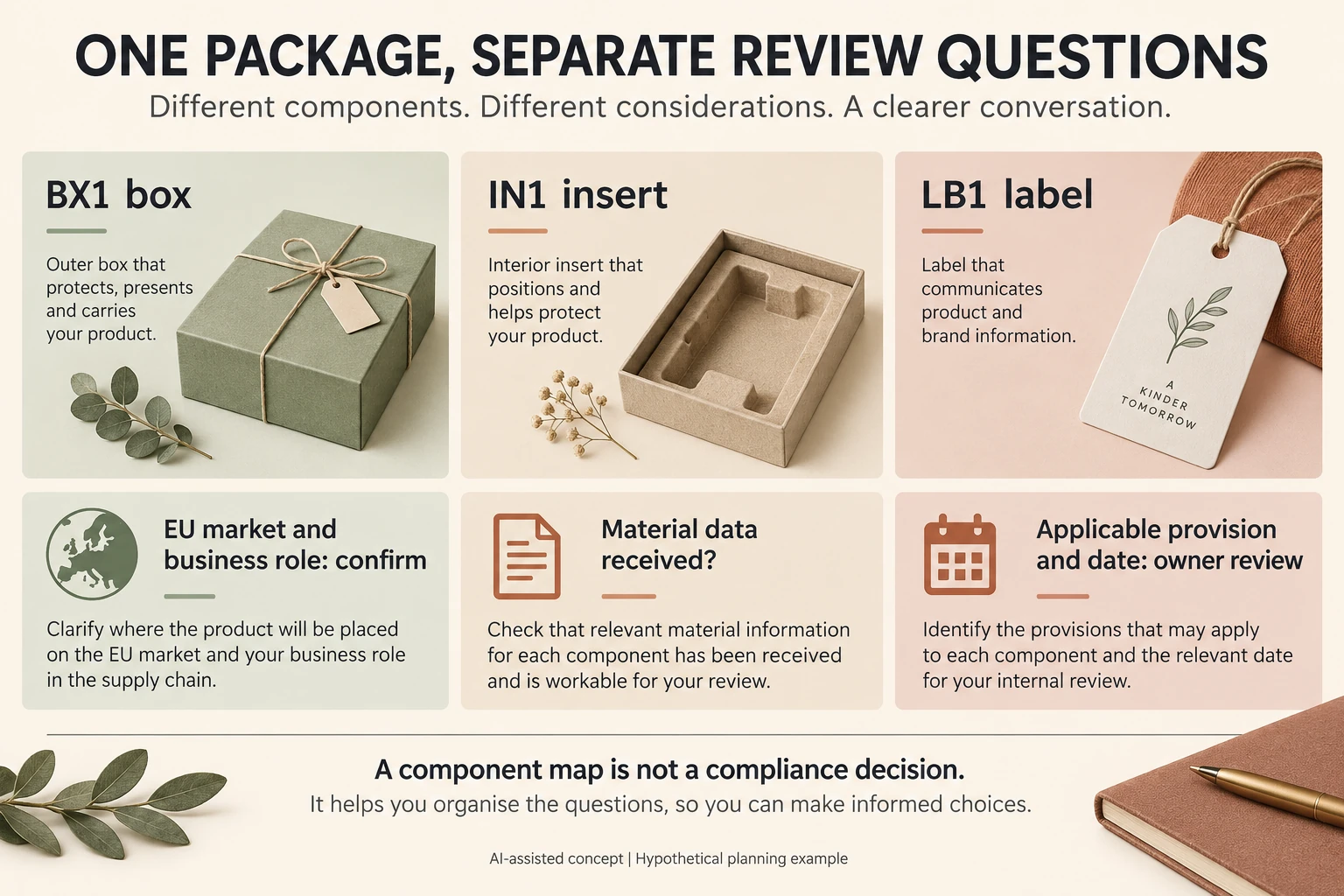
Scroll horizontally if columns extend beyond the view.
| Reference | Invented information | Missing answer | Next review |
|---|---|---|---|
| BX1 box | Paperboard family named | Exact grade, mass and supplied revision | Supplier specification contact |
| IN1 insert | Removable component proposed | Material, mass and installed configuration | Supplier specification contact |
| LB1 label | Attached label proposed | Substrate and attachment | Print/material contact |
| EU transaction | EU destination proposed | Business role, provision and applicable date | Responsible market reviewer |
A board sheet for BX1 does not close the IN1 or LB1 rows. Keep the document's component reference and ask for the missing specifications without treating receipt as acceptance. Record the document date, actual review date and legal application date separately. A date printed on a material sheet does not determine when a legal duty applies.
The generic illustration includes a box, insert and hanging label. Its decoration and cord are not an exhaustive bill of materials or a legal classification. Identify all actual supplied parts in your own record. The worksheet establishes no universal document list, exemption, conformity result or Packrivo regulatory service. The Commission announcement was checked on 16 October 2026; transaction-specific duties still need current-law review.
Download the EU PPWR packaging checklist record (.csv). HYPOTHETICAL rows are invented examples. Use ACTUAL_BLANK for permitted project inputs; replace that row label only when recording actual facts. Empty evidence, observation and date fields mean unknown or not performed, never acceptance. Keep checkpoints and revisions separate.
Send the component map, intended destination and unresolved responsibility questions. Have the responsible market reviewer identify the applicable obligations. Prepare the identified scope for a Packrivo inquiry. Packrivo coordinates independent suppliers. These records establish no supplier offer, service availability or MOQ exception; its published baseline is 500 pieces per product/design.