

A packaging reorder checklist should begin with the last approved configuration and the current request. Retrieve the product, box, insert, artwork and evidence references, then identify what changed. Ask for current supplier confirmation before relying on an old price, sample or delivery statement.
The aim is a repeatable request with visible gaps. An old invoice can identify a transaction without describing the exact version that was reviewed. The word reorder does not guarantee identical production or create an automatic order.
Build the packaging reorder checklist from the approved baseline
Retrieve the structural drawing, material proposal, artwork file and sample or proof reference used for the earlier decision. Include their versions, dates and the person who approved each scope. Keep a missing reference open instead of choosing the newest file merely because its filename looks familiar.
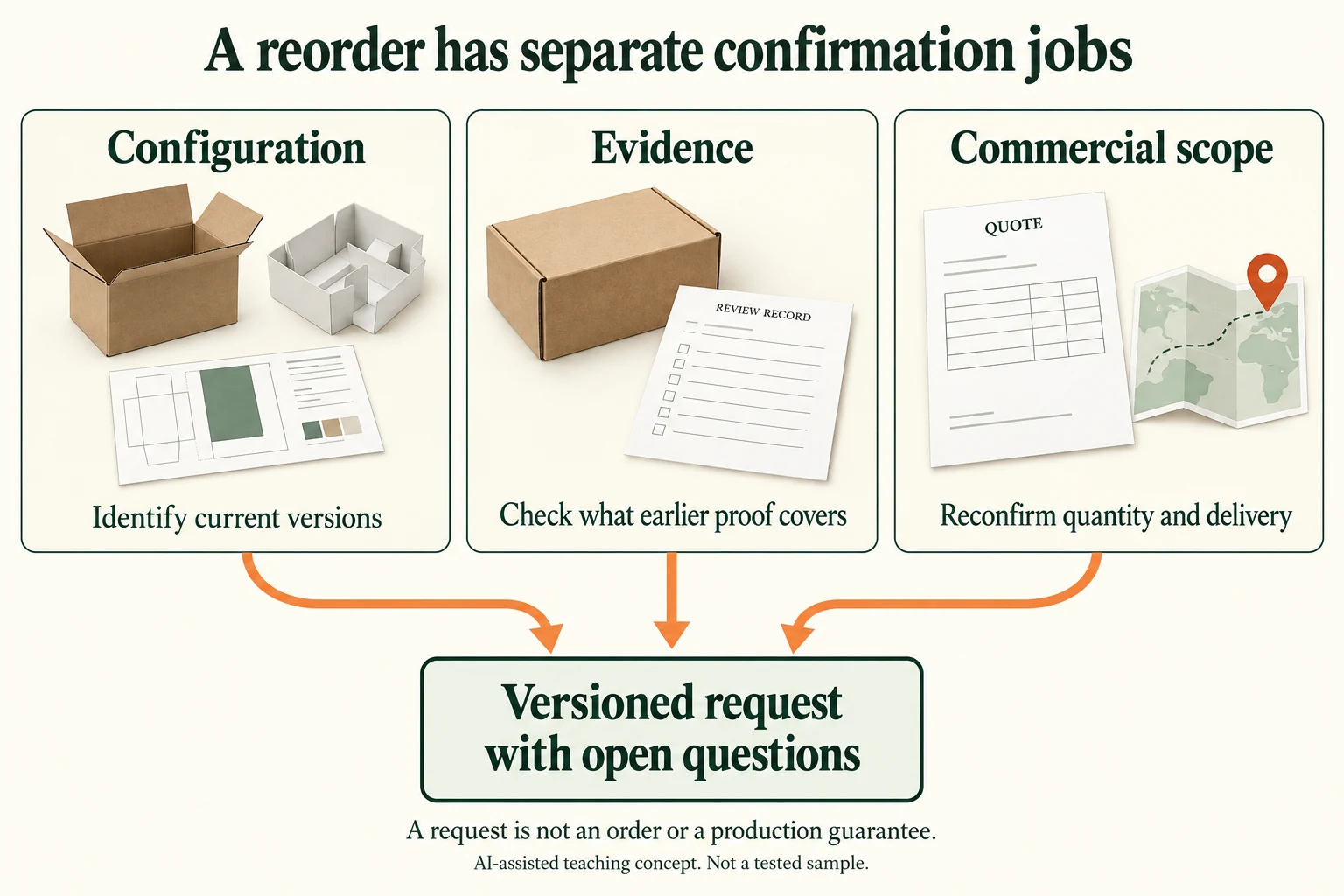
Separate a technical approval from a commercial document. A physical sample record may concern loaded fit, while an artwork proof concerns placement and copy. Neither document necessarily identifies today’s purchase quantity, destination or permitted commercial terms.
Scroll horizontally if columns extend beyond the view.
| Baseline field | Reference to retrieve | Current comparison |
|---|---|---|
| Product and contents | Version, packed geometry and accessories | New dimensions, lid or included item |
| Packaging | Box, insert, material and closure references | Changed construction or substitution |
| Artwork | Exact accepted file and scope | Changed wording, market or finish area |
| Evidence | Sample, proof or report and reviewed configuration | Questions the earlier evidence still answers |
| Commercial request | Dated offer, unit and delivery basis | Current quantity, destination and conditions |
The artwork handoff checklist helps locate the accepted file and its linked drawing. Do not quietly replace the earlier baseline when a new proposal arrives; retain both so the difference is traceable.
Describe each change before requesting a repeat
Write one change per row and connect it to the affected component. A taller jar lid concerns the complete loaded height. New care copy concerns the actual text and its placed layout. A new destination concerns delivery and may also alter the distribution question.
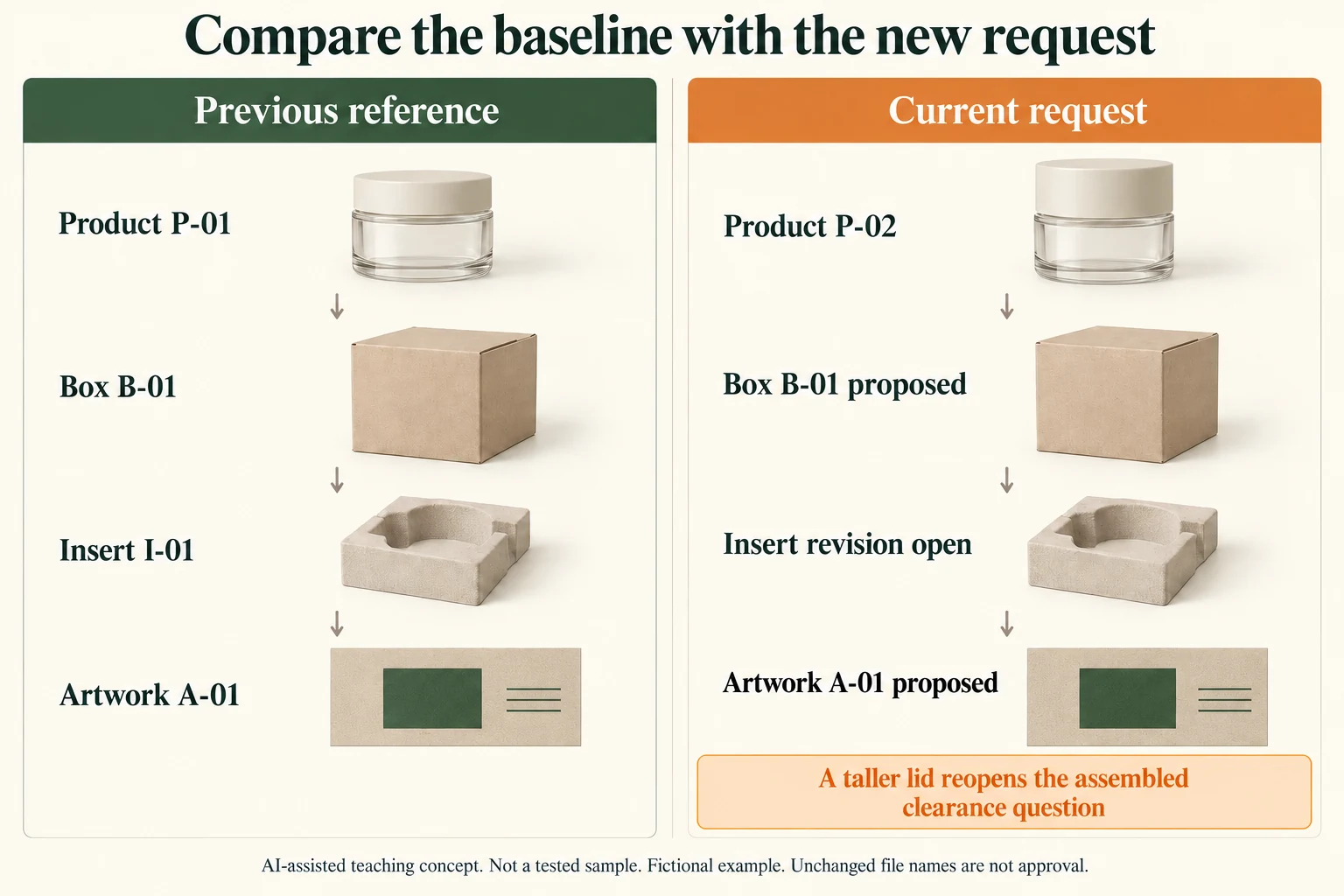
The diagram’s references are fictional. Product P-02 has an illustrated taller lid, while box B-01 and artwork A-01 are only proposed for reuse. The insert decision remains open. Repeating a code in the current column does not mean the earlier approval covers the changed gift.
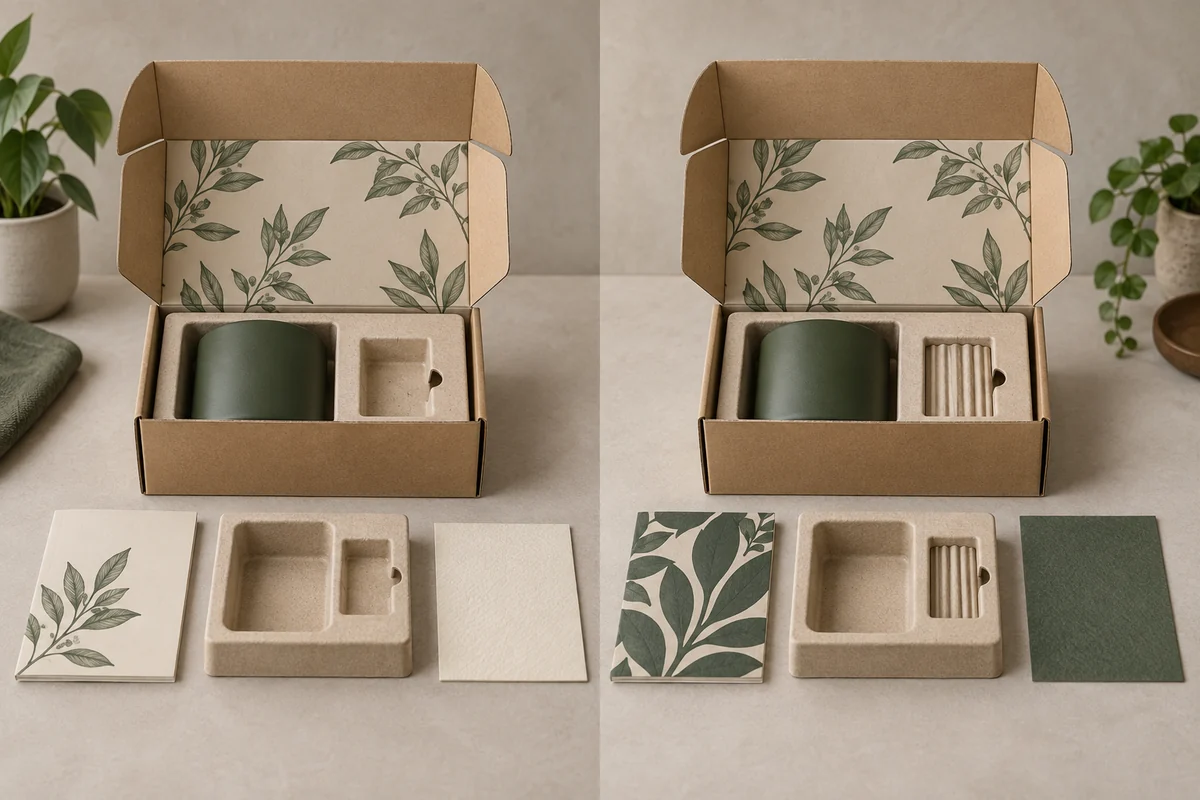
The retained concept compares different insert and printed-component arrangements. It contains no approved revisions or stock record. Use actual references in your own change list rather than treating a similar-looking picture as a repeat specification.
Assign each open question to its evidence owner
For a geometry change, ask the supplier which assembled interfaces need another review. Retain the actual product or identified substitute used. For an artwork change, confirm the current wording owner, file and proof scope before releasing output.
ISTA’s packaged-product retesting guidance identifies product, package and process changes relevant to repeating its evaluations. It also distinguishes changes unrelated to potential performance. Use the actual change and previous evaluation scope with the responsible technical reviewer; this checklist does not choose a test or issue a transport approval.
A wording correction does not automatically mean the whole transport evaluation must restart. Equally, unchanged graphics cannot preserve evidence for a changed support or delivery configuration. Record why a piece of prior evidence remains applicable, or what must replace it.
Work through a hypothetical taller-lid reorder
Assume an earlier fictional presentation used product P-01, box B-01, insert I-01 and artwork A-01. The brand now requests P-02 with a taller lid. It would like to keep the exterior artwork but has not reviewed the new loaded configuration.
The product row changes first. Ask for the new occupied height and compare the assembled support position and closed-lid clearance. Keep the insert revision open until a proposal exists. The original box remains a candidate; the example does not conclude that it must be enlarged or that the old insert can be retained.
Separately confirm whether artwork A-01 still has the correct copy and fits the proposed structural drawing. Reusing its file depends on those facts, not on its matching color. Record any new proof or physical sample decision against the resulting configuration.
Download the reorder change record CSV. The hypothetical product, box and artwork rows preserve both references and leave the new fit decision open. Blank rows accept actual supplier responses and evidence IDs.
Reconfirm the purchase scope separately
State the current quantity and design split, currency, destination, supplied state and any requested schedule. Ask the supplier to identify the current offer and its exclusions. Keep the new response beside the earlier quotation rather than overwriting it.
Record the named delivery place and the exact Incoterms rule and version where used. The US ITA overview explains their defined delivery responsibilities and their limits. An Incoterm does not supply the complete goods specification or every sale condition.
Send the baseline, change list and unanswered commercial fields through a packaging reorder project inquiry. Packrivo coordinates sourcing and project questions with independent suppliers; the inquiry is not a stock portal, purchase instruction or repeat-production guarantee.
Questions about packaging reorders
Can I reuse the old sample decision?
Retain it as evidence for its identified configuration and checks. Compare the new request before deciding which observations remain relevant.
Does an unchanged filename establish the right artwork?
Check the actual file revision and accepted copy against the current drawing. A familiar name alone cannot resolve a version conflict.
What if only the order quantity changes?
Keep the technical baseline visible and request current commercial confirmation. Quantity grouping, supplied state or process proposals may differ under the new offer.
Does a reorder guarantee the same appearance and fit?
No guarantee follows from that description. Agree the current specification, evidence and acceptance responsibilities with the relevant parties.
Key takeaways
- Retrieve the actual accepted references before describing a repeat.
- Map changes to affected evidence and responsible reviewers.
- Keep technical review and current purchase confirmation separate.
Source scope: ISTA’s public retesting guidance and the ITA overview were checked 16 October 2026. Their scopes do not approve this fictional reorder or settle its commercial terms. No inventory, repeat-production result or supplier quotation has been verified.