
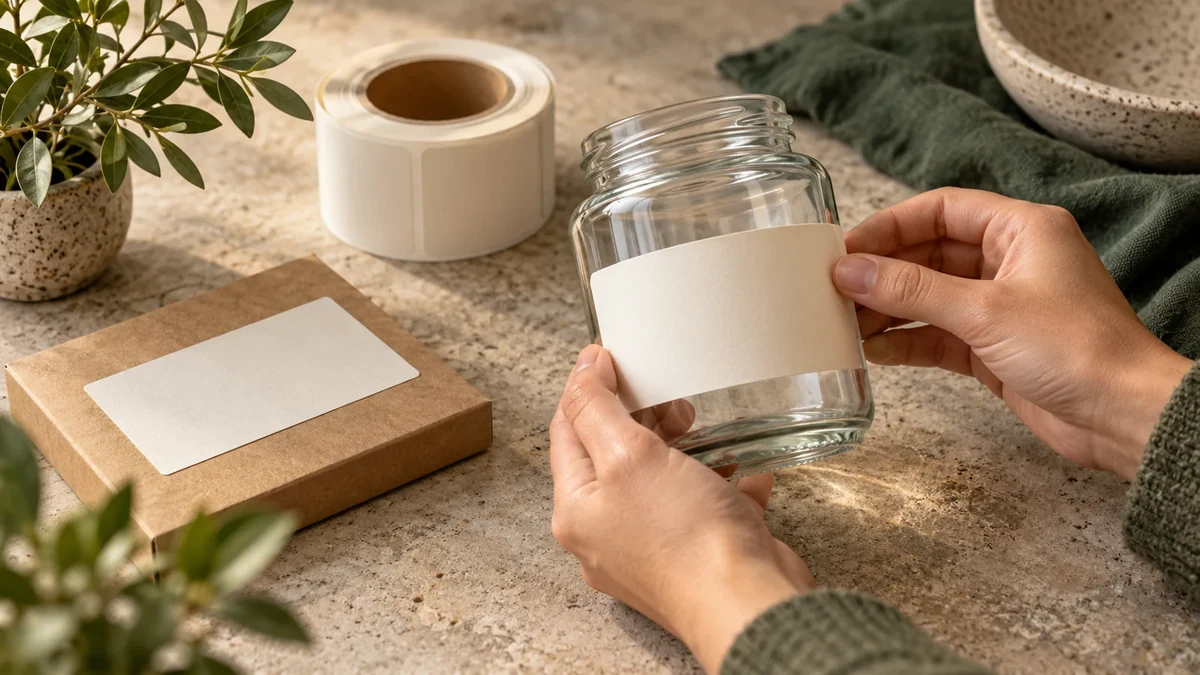
To plan label adhesion for packaging, describe the actual surface, how the label is applied and what happens afterward. Ask the supplier to propose an identified label construction and a sample review for those conditions.
In this guide
- Describe the surface the adhesive will meet
- Separate application conditions from later use
- Agree the candidate and review before applying samples
- Use the worksheet to resolve an illustrative gift-pack decision
- Complete a label use record without inventing acceptance limits
- Send the current configuration for review
A label that looks right on a flat proof still needs an application decision. A small gift brand may use similar artwork on a coated box, a glass jar and a folded tissue seal. Keep a separate record for each use, even when the graphics match.
Describe the surface the adhesive will meet
Start with the component that receives the label. Record its material, surface finish, shape and label position. “Paper box” leaves open whether the label meets an uncoated sheet, a printed surface, a coating or a wrapped outer layer.
Photograph the proposed position and send a sample of the actual finished component when that can be agreed. If its construction is unknown, mark it as an input for the packaging supplier. Avoid assigning a material from a concept image.
Avery Dennison’s pressure-sensitive material guidance explains why the receiving surface matters to adhesive contact. Its examples concern technical applications, so they aren’t a recommendation for your gift box or jar.
Record whether the label sits on a flat panel, curves around a container or bridges two surfaces. Include its finished size and position relative to edges, seams and folds. A supplier needs that geometry alongside the material description.
Surface preparation also needs an owner. Ask the component and label suppliers to agree a suitable preparation method for the actual finish. Describe dust, handling residue or other conditions they should consider; don’t select a solvent or cleaning process without checking compatibility.
The Packrivo label directions can help you describe the format. Keep the receiving component’s finish in the same brief so a shape choice doesn’t replace the adhesion question.
Separate application conditions from later use
Write down what happens at the packing bench before describing delivery or storage. Who applies the label, by hand or with equipment? What are the proposed surface and surrounding conditions, and how is the label positioned?
Then describe its later use. A label applied in one environment may be handled, stored or displayed in another. Record the expected conditions and the role of the label: identification, decoration, a removable instruction or bridging a closure.
Avery Dennison’s adhesive glossary distinguishes application temperature from service temperature. It also describes initial tack and ultimate adhesion separately. Those terms help frame a supplier question, but they don’t supply universal limits or a review time for every construction.
Ask the supplier which product-specific instructions apply, including application method, conditions and the interval before each observation. Keep the proposed timing with the identified face material, adhesive and liner. Don’t turn a supplier’s instruction for one candidate into a rule for all labels.
Unused-label storage belongs in the record too. Avery Dennison’s February 2026 storage bulletin discusses protection from dust and environmental changes. Request storage instructions for the finished labels you will receive instead of copying a generic temperature or shelf-life figure.
If the choice is mainly about the packing operator or delivery format, use the existing roll and sheet application checklist. The adhesion record answers the separate question of how that proposed label meets the actual surface.
Agree the candidate and review before applying samples
Give each supplier proposal a construction reference and version. Ask it to identify the face material, any finish, adhesive, liner and label dimensions. A phrase such as “permanent label” still needs the proposed material details and intended use.
Agree who applies the candidates, which finished components they use and what gets recorded. The supplier should explain the proposed application and evaluation method. Decide in advance how observations will lead to acceptance, another review or a revised proposal.
Use these four groups to organize the discussion. They are planning fields, not a test standard or acceptance limits.
On a small screen, scroll the table horizontally to see every column.
| Record group | Buyer supplies | Supplier confirms | Keep with the review |
|---|---|---|---|
| Receiving surface | Actual component and position | Surface information needed | Component version |
| Application | Operator and packing conditions | Method and applicable instructions | Application record |
| Candidate | Size and artwork reference | Identified label construction | Candidate reference |
| Later use | Expected handling and exposure | Proposed evaluation and timing | Observations and decision |
Describe observations plainly. “One edge lifted after the recorded handling step” is more useful than “adhesive failed” without a method or condition. Photograph the position and keep the candidate identity with the observation.
When comparing candidates, record the variables you intend to hold constant and any changes the supplier proposes. If the receiving finish, preparation or application method changes, identify that difference before comparing results.
A practical sample review covers its agreed conditions and configuration. Wider resistance, sealing or other performance claims need suitable supporting evidence and a defined evaluation. A short observation on one package doesn’t establish every later use.
Use the worksheet to resolve an illustrative gift-pack decision
Consider a hypothetical brand with the same logo on a coated gift box and a glass candle jar. The buyer has selected artwork, but the two receiving finishes and application positions are different. This is a planning example, not a completed Packrivo project.
The buyer would create two records and provide the actual components. For the box, the record identifies its finished outer surface and whether the label bridges a fold. For the jar, it identifies the container surface, curve and label position.
Each supplier response should identify the proposed construction and explain the review method for its intended use. The same logo doesn’t justify copying an adhesion decision from the box onto the jar. An unresolved finish or application condition stays an open input.
Download the label adhesion review worksheet (.csv). The file contains field names and blank spaces for your project, supplier answers, references and next actions. It doesn’t include invented readings, preset limits or sample approvals.
Fill the receiving-surface and intended-use fields first. Send them with the artwork size and component references, then ask the supplier to complete the construction and review fields. After an agreed review, add the observations and a decision tied to that candidate.
Bring those records to a Packrivo packaging brief. A clear surface description and review question give a person enough context to help organize the next supplier discussion.
Complete a label use record without inventing acceptance limits
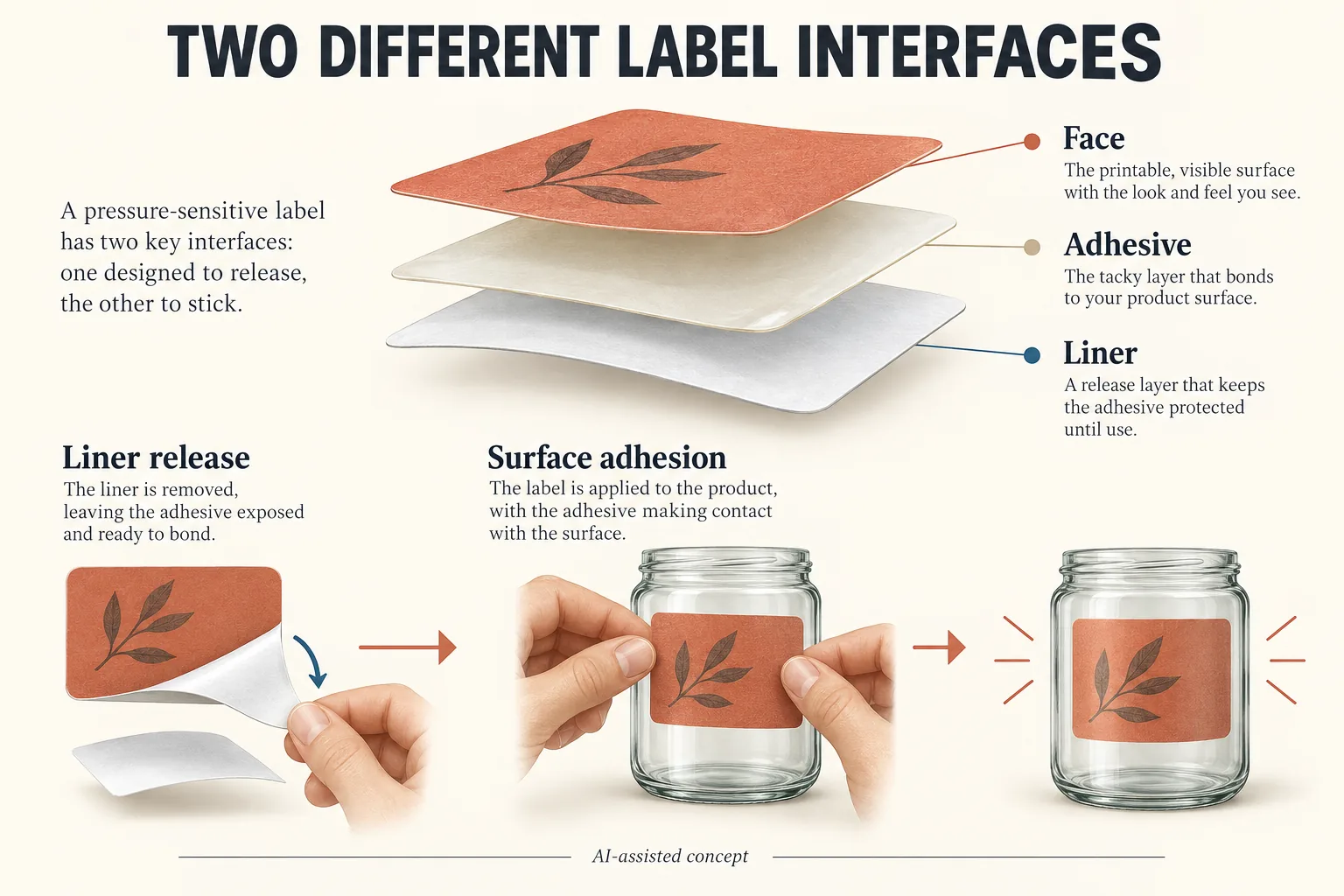
The following pair of hypothetical entries shows why one logo can require two reviews. It contains no adhesive recommendation or preset test result. Replace every component and condition with the actual intended project.
| Field | Gift box record B1 | Candle jar record J1 |
|---|---|---|
| Receiving surface | Printed coated lid; finish reference needed | Actual glass jar; coating identity needed |
| Geometry | Flat panel; label stays within face | Curved side; outline and seam position needed |
| Application | Hand application at packing bench | Proposed hand or equipment route to identify |
| Later use | Retail handling and storage to describe | Handling, storage and exposure to describe |
| Supplier reply | Identify face, adhesive, liner and instructions | Identify separate candidate and instructions |
| Observation | Pending agreed review | Pending agreed review |
Keep application temperature and later service conditions in different fields. Obtain the applicable limits and instructions for the identified offered construction. Do not copy a number from a different adhesive grade merely because both are called permanent.
Agree the observation points with the supplier before comparison. Name who applies the labels, the actual finished component, the preparation method permitted for that finish and the interval before each check. Record edge lift, wrinkles, movement or residue by location. Avoid diagnosing a material defect from a photograph alone.
The liner release record handles dispensing before bonding. The removable label review adds time-in-place and the intended removal result. The candle label placement map supplies the geometry for a jar candidate. Keep those evidence scopes linked to the same construction revision.
Download the label adhesion for packaging project record (.csv). The file has named planning fields and blank project rows. It contains no preset acceptance limits or approved results.
Send the current configuration for review
Bring the completed record, actual product or component references, requested quantity by design and destination to Packrivo’s packaging inquiry. Name the specific open decision above so the next sourcing discussion can address it. Packrivo coordinates sourcing questions; material, sample, price and delivery terms need project confirmation.