
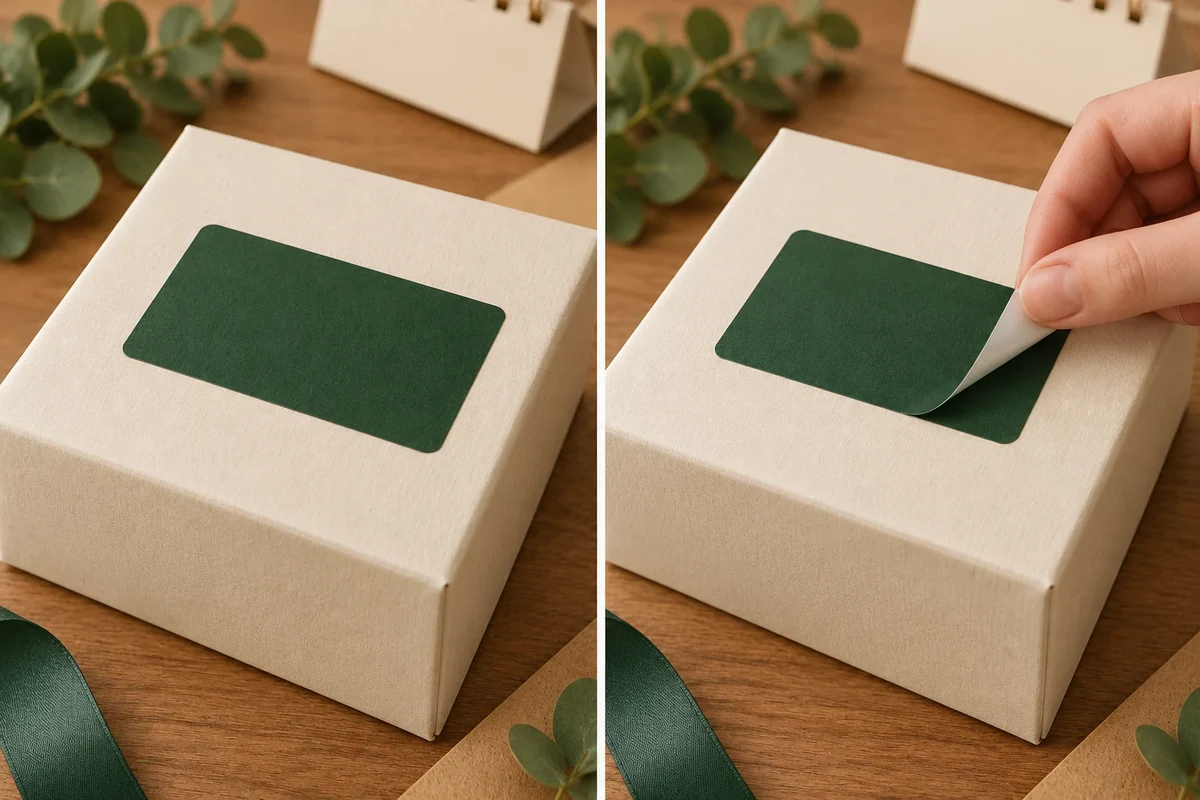
Before requesting a removable label, record the actual receiving surface, intended time in place and removal action. Review residue, label condition and surface appearance separately on an identified sample. A label described as removable still needs confirmation for the proposed surface and use conditions.
This method begins with the end of the label’s job. Decide what the customer or staff member should do when removing it, then ask the supplier to propose an identified construction for that use.
Describe the surface and removal purpose
Avery’s adhesive comparison distinguishes removable and repositionable categories and identifies surface-related limitations in its own products. That supports asking a specific use question, not assuming every removable label performs alike.
Record the actual finished receiving surface, including coating or wrap where relevant. A label on bare glass and one on a printed paper lid have different review inputs. Keep them in separate records even when the artwork is identical.
State why the label is removed. A temporary price sticker, closure label and reusable-container identifier can have different expectations for label condition and surface appearance after removal.
The label adhesion guide covers application and use. This sheet adds a narrower end-state record for removal instead of repeating that wider brief.
Agree the time and action to review
Provide the expected time between application and removal. If the range is broad, name the different review conditions with the supplier. Avoid selecting a convenient short trial and treating it as evidence for a much longer use.
Ask the supplier for instructions suited to the candidate label and actual surface. Do not improvise solvents, heat or sharp tools as a general removal recommendation. If the intended customer action is hand peeling, state that requirement clearly.
Record application conditions as context, but keep the removal questions separate. An application problem and residue after a later removal are different observations. The supplier needs both if they occur.
Use a removal condition and result sheet
Make one record for each candidate and use condition. Photograph the surface before applying the label where practical.
| Field | Condition to record | Result to keep |
|---|---|---|
| Receiving surface | Material, finish and component revision | Starting surface image |
| Label identity | Candidate construction and sample ID | Supplier reference |
| Time in place | Application and removal dates or agreed interval | Actual recorded interval |
| Removal action | Supplier instruction and intended user | Action performed and any deviation |
| Residue | Named location and viewing condition | Visible residue, none observed or uncertain |
| Surface and label | Separate post-removal views | Visible surface change and label condition |
Use ‘none observed under this view’ when that is the evidence. It is more accurate than converting a visual check into a guarantee of residue-free removal in all conditions.
Follow a hypothetical gift-lid sticker
Suppose a brand wants a temporary price sticker on a wrapped gift lid. The customer is expected to peel it by hand after purchase. The buyer records the actual lid wrap, candidate label and intended interval before asking for a sample proposal.
At the agreed review point, the sticker is removed using the confirmed instruction. The record keeps residue and lid appearance in different cells. A clean-looking lid with a torn label answers the surface question differently from the label-reuse question.
If the brand also wants the label reapplied elsewhere, add that as a new use requirement. It should not be assumed from the word ‘removable’. Ask for a candidate and evidence that address the extra action.
When a revised label or wrap is proposed, repeat the relevant condition record. Carrying approval from an earlier material would leave the actual receiving surface unreviewed.
State the post-removal result you need
For the hypothetical price sticker, the brand can require the lid to remain presentable after the intended hand-peel action while allowing the discarded label to tear. A request to reuse the label would add another requirement. Put both end-state choices into different fields so the supplier does not have to infer them.
Call the receiving lid surface R1 and the candidate label L1. Record the actual interval and the instruction followed at removal. If the label is removed earlier than planned, mark the result as covering that shorter condition rather than the full intended use.
A useful question is: ‘Please propose a label for R1 under the stated interval and hand-removal action, and confirm the review instructions.’ It connects the candidate to the actual surface and use. A generic removable-label name leaves those conditions unresolved.
Keep residue and surface appearance in separate post-removal views. A light change in the printed surface may need a different discussion from visible adhesive residue. Record what can be seen without assigning a cause. The next review should name the condition and candidate revision rather than repeat an unsupported claim of clean removal.
Send the end-state requirement
Bring the sheet, surface reference and intended removal action to Packrivo’s enquiry. Ask for a proposal and review scope tied to those conditions. Keep any unconfirmed removal interval or surface construction visible until the responsible supplier responds.
Reapplication adds a second receiving-surface decision
Keep the original price-sticker example's end state explicit. DISCARD21 requests removal from wrapped lid R1 while allowing the discarded label to tear if that is the actual agreed requirement. REUSE21 adds another request: the removed L1, with offered adhesive A1, is proposed for a second receiving surface R2. Neither route has an actual result, and R2's material and finish are deliberately unspecified.
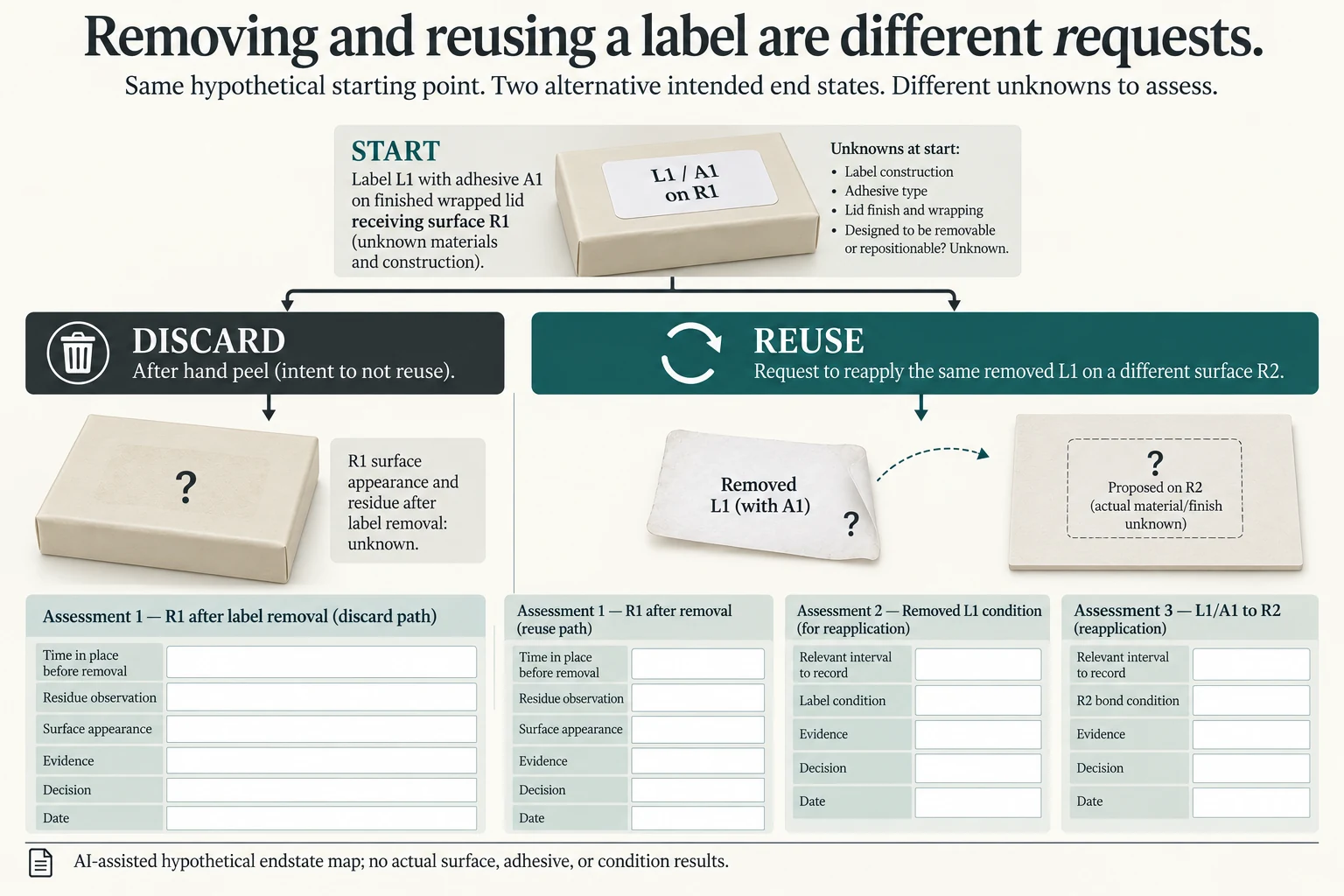
Scroll horizontally if columns extend beyond the view.
| Hypothetical configuration | Named object | Relationship | Input or next scope |
|---|---|---|---|
| REUSE21 | L1_A1 | proposed reapplication to | R2 |
Both routes still need R1 residue, R1 surface appearance and removed-label condition recorded separately. Reuse then adds the L1/A1-to-R2 reapplication relationship. A presentable first lid does not show that the removed label can be read, handled or bonded at the second destination. A label remaining intact is not evidence of the new surface bond either. Ask for a candidate and instructions addressing that complete use rather than transferring a removable category name into a repositioning claim.
Retain the actual time in place and supplier-confirmed hand-removal instruction. An early removal covers its shorter condition, not the longer intended interval. If the wrap, receiving finish, adhesive or method changes, create another condition record. The original bare-glass and printed-paper examples remain separate surface choices; identical artwork is not a reason to combine their removal evidence.
The worksheet leaves actual interval, surface construction, method, observations, decisions and evidence empty. It contains no solvent, heat or tool recommendation and no default residue-free claim. The buyer can decide whether a discard-only requirement is enough or whether the extra reuse scope is worth requesting. Any acceptance must identify the actual label, adhesive, receiving surfaces and conditions it covers.
Download the removable label removal conditions record record (.csv). It includes the original table fields and scenarios alongside the added relationships. HYPOTHETICAL rows are editorial examples or required review scopes, not actual records. Actual quantity, configuration, component and file identities, materials, process, specification, copy, method, condition, observation, owner, decision, evidence and dates are blank. ACTUAL_BLANK is a separate empty starting row; enter permitted project evidence before using an actual record. A blank means unknown.
Use the Label Adhesion for Packaging Needs Surface and Use Details for its separate question. Use the Liner Release and Final Label Adhesion Need Separate Review Records for its separate question.
References apply to the materials, processes or guidance named in each source. Worked configurations and dimensions are teaching examples, not tested specifications or production limits. Use the project’s material specification, drawing and formed sample for approval.
Discuss this packaging specification with Packrivo. We coordinate independent suppliers. MOQ: 500 pieces per product/design; illustrative quantities are not production offers. Confirm materials, samples, price and timing for your project.