
Record paperboard grammage and caliper separately, with units and a named grade for each. Grammage describes mass per area; caliper describes thickness. Ask for both on the proposed material sheet and keep unknown values open. Matching one property doesn’t establish that two boards have the same construction or fit.
For a Paperboard Insert, request the proposed grade, grammage and caliper as separate fields. Do not treat a matching grammage as confirmation of the insert thickness or finished fit.
A reply that says ‘350 gsm board’ answers one material question. It leaves thickness, grade identity and measurement basis unresolved. You can make that gap visible before it becomes a hidden assumption in a carton drawing.
Keep the two properties in different cells
Holmen’s paperboard technical information defines grammage in grams per square metre and thickness separately, with micrometres and caliper points used on specification sheets. This supports separate records; it doesn’t provide a universal conversion from gsm to thickness.
Write the unit beside the value. A number without its unit should remain unresolved until the source confirms it. Preserve the supplier’s original unit in one cell even if your team adds a converted value in another.
Ask whether a stated value is nominal, a specification range or a measurement from the proposed sample. Those are different forms of evidence. A measurement belongs to the identified piece and method, while a specification belongs to the named material and version.
The existing insert material guide starts with the component’s form. This worksheet deals with a narrower comparison after a particular paperboard component is under discussion.
Build a two-property supplier comparison sheet
Use one row for each proposed grade and one column for each property. The empty prompts below show the information to collect; they aren’t material specifications.
| Field | Proposal A | Proposal B | Evidence needed |
|---|---|---|---|
| Grade identity | Maker and grade name | Maker and grade name | Dated specification sheet |
| Grammage | Value and g/m² unit | Value and g/m² unit | Nominal value or agreed range |
| Caliper | Value and original unit | Value and original unit | Thickness specification or named measurement |
| Converted unit | Calculation and original value | Calculation and original value | Unit conversion checked separately |
| Component revision | Drawing and sample ID | Drawing and sample ID | Material linked to the right proposal |
| Unresolved item | Missing property or basis | Missing property or basis | Owner and next question |
Add a separate note for coatings, laminations or other proposed layers. Ask whether the stated thickness describes the base board or the complete material used in the component. Don’t silently combine the descriptions.
Keep the original data source attached. If one reply is copied into several brief versions, carry its date and grade identity with it. A material name can change while a familiar number remains in the spreadsheet.
Compare a hypothetical tray proposal
Suppose a gift brand is comparing two paperboard tray proposals. Both replies state the same grammage. Proposal A also gives caliper and a named grade; Proposal B leaves caliper blank. The comparison result is ‘thickness unresolved for B’, not ‘boards equivalent’.
The buyer sends a question asking for B’s grade sheet and thickness basis. Until the reply arrives, the team avoids treating the two tray wall envelopes as identical. This is a document decision, not a finding from a physical test.
If both values become available but differ, record the difference without choosing a winner from the numbers alone. Ask which drawing and fold design each supplier has proposed for that material.
For a frame tray, the later sample review should identify the board used in the folded walls and the matching closure. The worksheet gives that review a traceable starting point. It doesn’t establish that one caliper delivers better protection.
Keep measurement and acceptance separate
A buyer may measure a sample as a useful observation. Record the instrument, location, sample state and unit with that observation. Ask the supplier for an agreed method if the measurement will become an acceptance criterion.
Don’t average unrelated layers or use a folded wall reading as the thickness of a single board sheet. Name what was measured. If the sample includes wrap or doubled layers, describe the complete interface rather than pretending it is a material-sheet value.
The dimension acceptance guide helps define the measurement agreement. Use it when a property from this worksheet is about to become a pass condition.
Make the comparison status explicit
In the hypothetical tray sheet, call the proposals A and B and assign each a material record. A has a named grade sheet with both properties. B has a grammage-only email reply. Write ‘documented’ for A’s caliper source and ‘awaiting grade sheet’ for B’s, rather than entering zero or copying A’s value into the blank.
Keep a status field beside each property: supplied, unconfirmed or superseded. When B’s new sheet arrives, preserve the earlier reply as part of the source trail but use the new version in the active comparison. This shows what changed without making a later reader reconstruct the email sequence.
A useful outgoing question is: ‘Please confirm the grade and thickness basis for proposal B used on tray drawing T2.’ It names the proposal, property and component. A reply giving another grammage number leaves the thickness question open.
If one source uses micrometres and another uses points, retain their original units and check the conversion separately. A converted display field should identify its original value so a rounding choice doesn’t erase the source. The comparison is ready for the next material discussion when both properties have traceable origins; it still leaves fit and performance to their own sample review.
Send the missing-property question
Bring the completed sheet, original grade references and component drawing to your packaging enquiry. Highlight any unknown caliper, ambiguous unit or unconfirmed layer scope. Packrivo can help organize supplier questions; the responsible source still needs to confirm the proposed material and sample evidence.
Convert thickness units while preserving the two properties
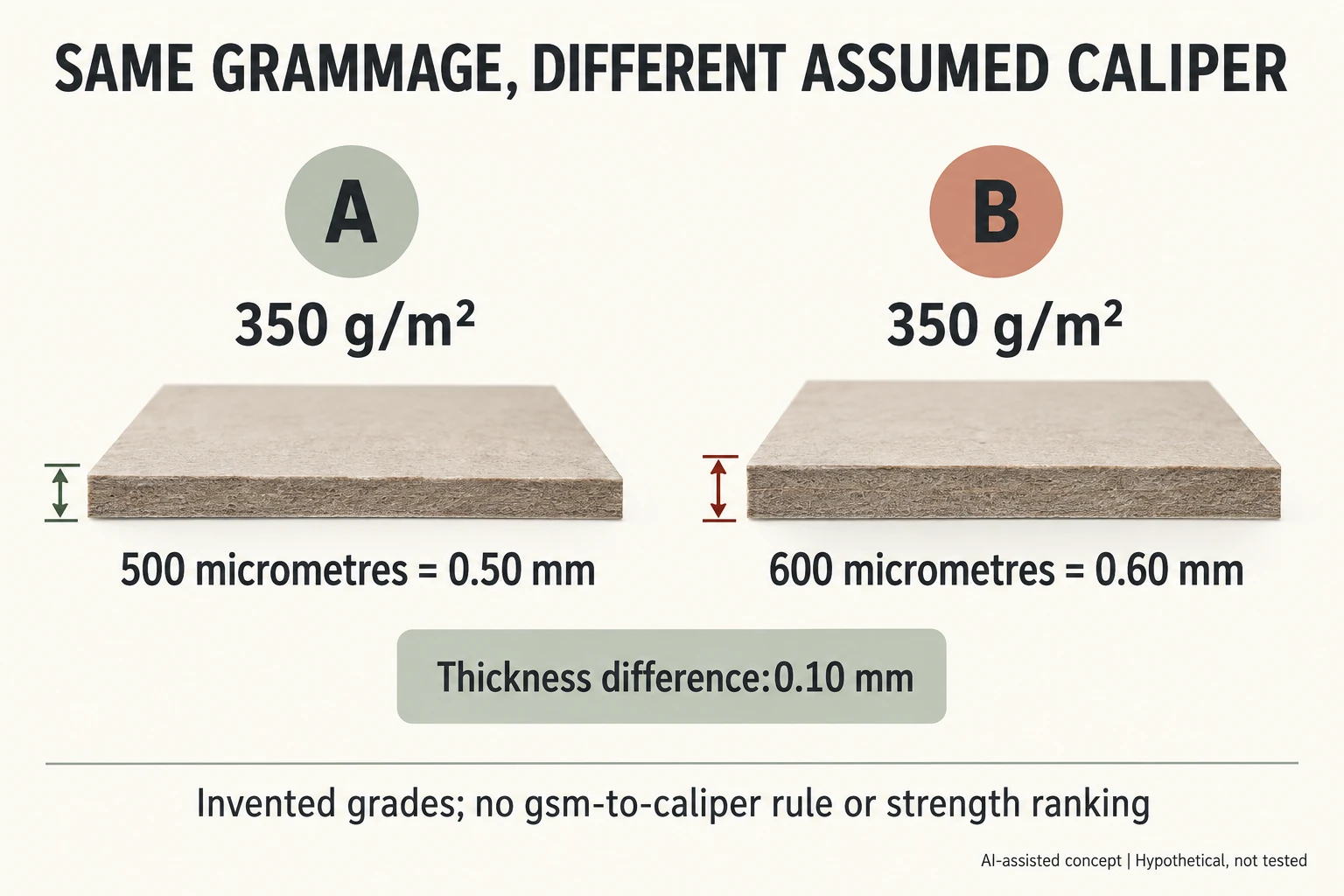
Assume invented single-sheet grades A-H and B-H both have grammage 350 g/m², while caliper is 500 micrometres for A-H and 600 for B-H. Those thicknesses are 0.50 and 0.60 mm, a 0.10 mm difference. No manufacturer's grades or measured samples are represented.
Scroll horizontally if columns extend beyond the view.
| Invented grade | Grammage | Caliper as assumed | Converted caliper |
|---|---|---|---|
| A-H | 350 g/m² | 500 micrometres | 0.50 mm |
| B-H | 350 g/m² | 600 micrometres | 0.60 mm |
| Difference | No grammage difference assumed | 100 micrometres | 0.10 mm |
Dividing micrometres by 1,000 changes the thickness unit. It does not derive thickness from grammage. The non-scale swatches depict one sheet each, not a folded tray wall, and their appearance is not evidence of actual density, strength or composition.
Retain original values, units, grade-sheet revision and whether each entry is nominal or measured. If the proposed component uses doubled walls, wrap or coatings, identify those separately instead of calling its complete wall thickness single-board caliper. Holmen's technical terminology supports the property distinction, not these invented numbers or a choice of the better tray. Fit, folding and performance remain separate reviews.
Download the paperboard grammage vs caliper record (.csv). HYPOTHETICAL rows are invented examples. Use ACTUAL_BLANK for permitted project inputs; replace that row label only when recording actual facts. Empty evidence, observation and date fields mean unknown or not performed, never acceptance. Keep checkpoints and revisions separate.
Send both original property/unit fields with the actual grade sheet and component-layer scope; leave missing data unfilled. Packrivo coordinates independent suppliers. These records establish no supplier offer, service availability or MOQ exception; its published baseline is 500 pieces per product/design.