
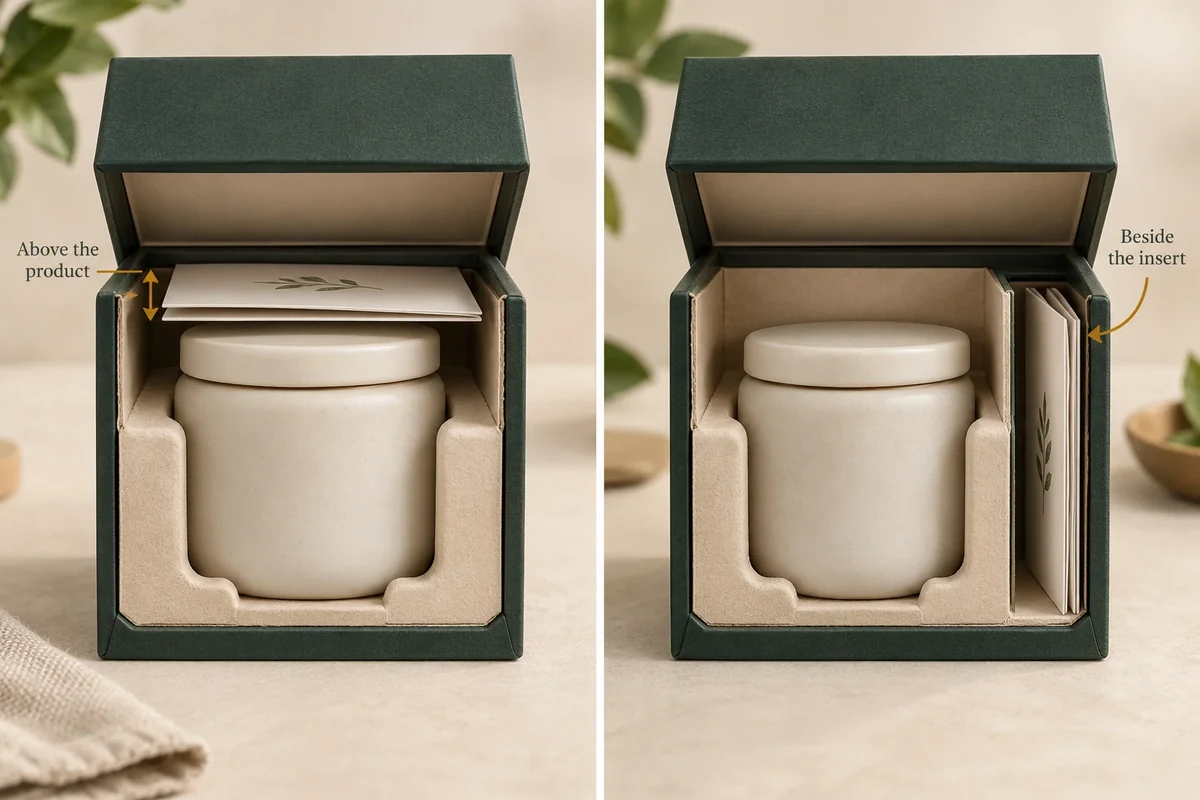
AI-assisted concept cover. Open the cover at full size.
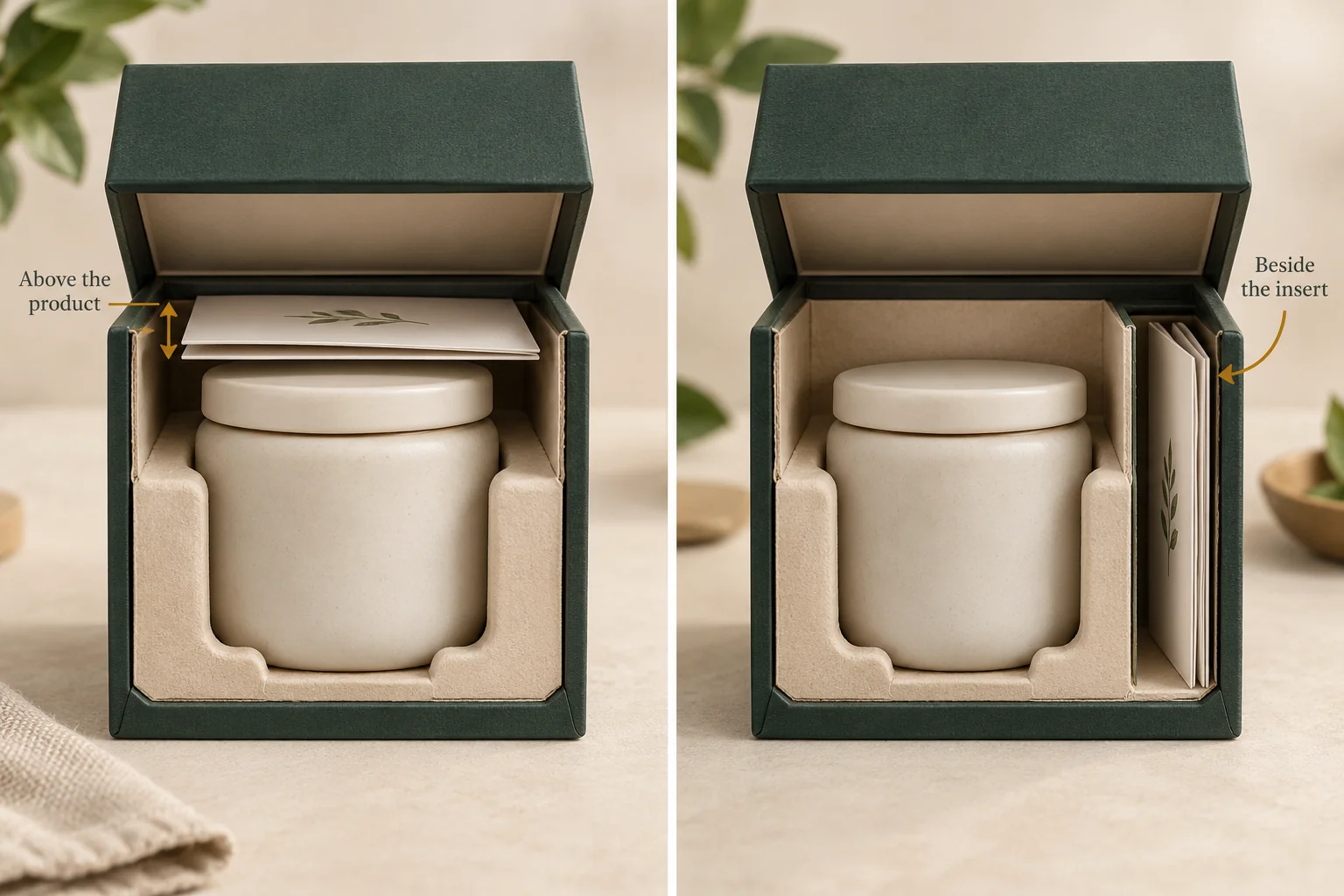
Recheck a gift box as a complete pack whenever you add or change a care card. Record the card's finished folded size, position and loading order, then review lid clearance, product contact and removal. Keep the product and packaging versions fixed while comparing placements so the result explains the card's effect on the arrangement.
A card can occupy space above the product, behind an insert or inside a separate pocket. Those positions answer different packing needs. Choosing the smallest-looking card doesn't establish which placement lets the box close and gives the customer access to the instructions.
Describe the card in its packed state
Measure the card after cutting and folding, rather than taking its page size from the artwork file. Record thickness as supplied if known, the number of folds and any envelope or attachment. A flat sheet and a folded booklet with the same outside dimensions occupy different arrangements.
Use a plain identifier for the physical version, such as CARD-C2. Keep its copy revision alongside it. A spelling correction might leave the physical shape unchanged; adding a translated panel or another fold may require a new fit review. State which change you are evaluating.
Mark the intended card position on a photograph of the empty pack. Show which face the customer sees first and whether the card should come out before the product. A direction such as "include inside" leaves those decisions to the person assembling the sample.
Use the jewelry insert measurement guide to establish the underlying product arrangement. Your card review starts with that identified configuration and asks what the added paper component changes.
For artwork preparation, Adobe's trim and bleed guidance distinguishes the finished cut boundary from artwork beyond it. Keep the physical card dimensions separate from the artwork's bleed area when sending the fit brief.
Compare placements one change at a time
Begin with the pack without the proposed card and document the loading sequence. Add the card in one candidate position, then repeat that sequence with the same product, insert and box. Observe where the card moves or meets another component during closing and opening.
Compare a second position only after recording the first. If you change the box height and card position together, the next sample may work, but you won't know which change addressed the problem. Keep the first trial focused enough to support a specific supplier question.
A card placed above a pendant can affect the space below the lid. A card tucked behind an insert can change how that insert seats or how the customer retrieves it. Neither position is automatically preferable. Describe the proposed function and ask for a representative complete sample.
This worksheet is an original planning tool for a hypothetical pendant pack. It lists observations to make rather than test outcomes.
| Candidate | Card position | Loading question | Closing question | Removal question |
|---|---|---|---|---|
| A | Above the displayed pendant | Does the card rest where intended? | Does it contact the lid or raised setting? | Can it be lifted without pulling the chain? |
| B | Behind the insert | Can the insert seat with the card there? | Is the packed height altered? | Can the customer find and retrieve it? |
| C | Separate pocket | Is the pocket included in the supplied design? | Does the pocket affect a fold or closure? | Is the opening reachable? |
Choose a candidate based on the recorded interaction and the presentation you want. Keep unresolved material or structural changes in a separate column. The supplier can then explain whether the chosen placement needs a revised insert, pocket or drawing.
Check the loading sequence as well as the final appearance
Ask the intended packer to assemble the candidate from the state in which the components will arrive. Record the order of product, card and insert placement. An attractive final arrangement may still require the packer to lift a fragile piece twice or reopen a secured insert.
Watch the card while closing the box. Note any bowing, trapping at a seam, movement toward a hinge or pressure on the product. Record the location and the action that produced it. Avoid converting an observed catch into a diagnosis before the supplier reviews the construction.
Open the complete pack and follow the intended customer sequence. Check whether the card hides the lifting point, catches on a clasp or blocks access to a product. Keep the removal observation separate from the closing observation; one can be acceptable while the other remains open.
Review the same arrangement with every product variant that will use it. The multi-SKU fit matrix gives those separate records a home. A card placement checked with a low pendant should not silently cover a taller setting or different chain arrangement.
If transport evidence already exists, ask whether the added component changes its scope. ISTA's retesting guidance identifies product, package and process changes as relevant to the retest decision. A card fit trial records handling observations; any transport evaluation needs its own agreed method.
Release a card placement someone can repeat
Write the selected card ID, position and loading order into the packing instruction. Add a clear photograph of the arrangement and name the sample reviewed. A sentence such as "CARD-C2 above the insert, removed before the pendant" is easier to repeat than an unlabelled photograph.
Keep physical placement approval separate from copy approval. The fit reviewer may accept the folded card while the text owner still needs to approve wording. Name both decisions so a physically suitable sample doesn't release unfinished instructions.
The informational card direction is a starting point for describing the paper component. Keep its finished shape and proposed placement in the same request.
Bring the chosen arrangement and remaining questions to Packrivo's packaging inquiry. Include the actual card, product and packaging dimensions where available. The next discussion should be about an identified addition to the pack and the evidence needed to accept it.
Separate local gap arithmetic from a complete fit decision
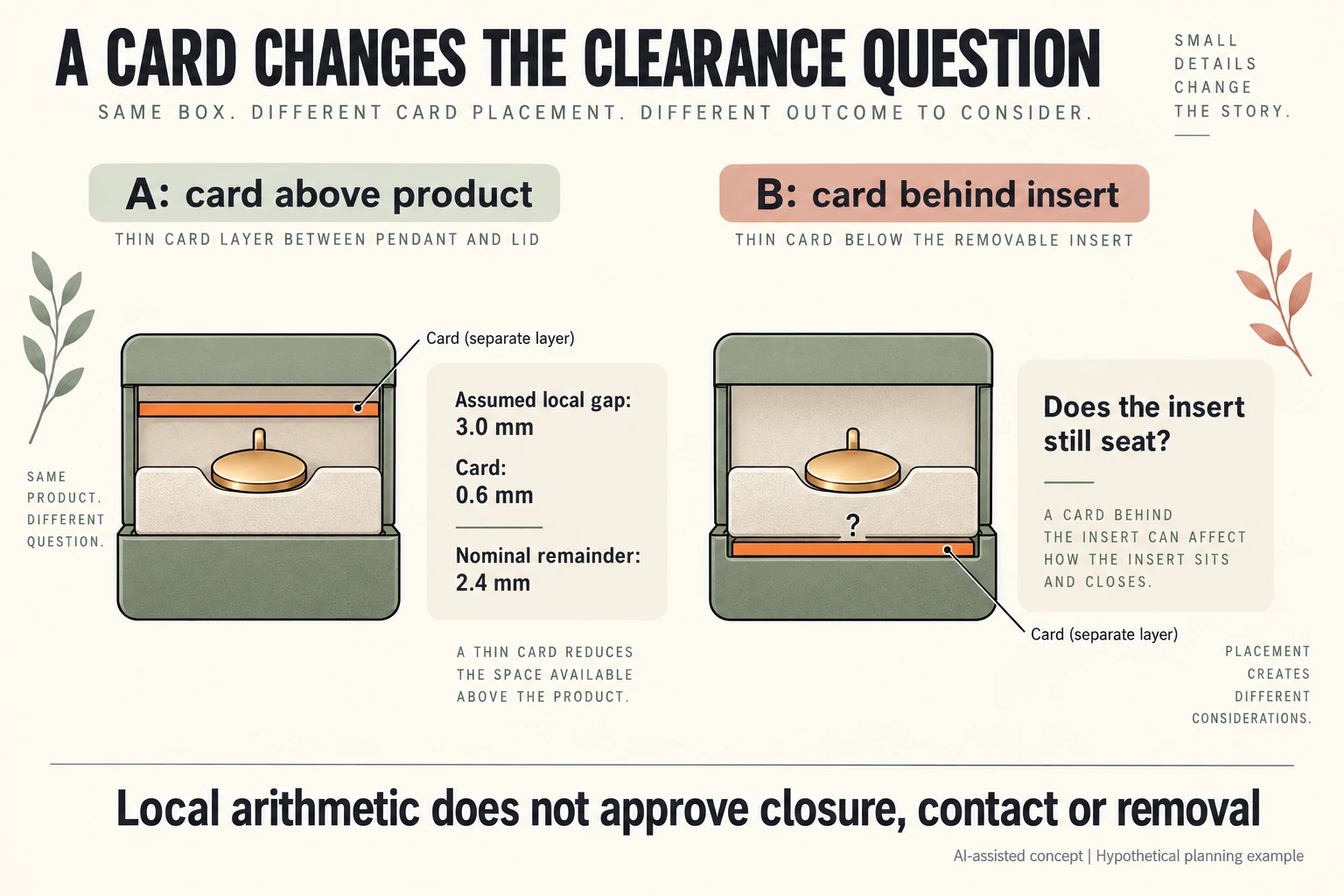
For an invented pendant pack, assume a local closed-lid gap of 3.0 mm above one high point and folded card C2 thickness of 0.6 mm. Placing C2 there leaves a nominal 3.0 – 0.6 = 2.4 mm at that one point. No physical pack has been measured or accepted.
Scroll horizontally if columns extend beyond the view.
| Candidate | Assumed input | Arithmetic or gap | Separate physical review |
|---|---|---|---|
| A: above product | Local gap 3.0 mm; card 0.6 mm | Nominal 2.4 mm | Bowing movement contact removal unreviewed |
| B: behind insert | Same card; seating effect unknown | No new gap calculated | Seating and retrieval unreviewed |
| Both | Same identified box insert pendant | No clearance target | Closing/opening not performed |
The subtraction assumes the card occupies that location without changing the other surfaces. It is not the minimum gap across the pack and does not account for bowing or movement. This example sets no tolerance or acceptable clearance.
Candidate B changes the input question. If the card alters insert seating, the earlier local gap cannot simply be reused. Record actual seating and product height first; leave B's gap and remainder blank until those inputs exist. The non-scale sections show layer order only. Keep lid closing, card retrieval and product removal as separate dated observations. Both trial rows remain unperformed, regardless of A's positive nominal number. Physical placement and copy approval retain separate owners.
Download the care card gift box fit record (.csv). HYPOTHETICAL rows are invented examples. Use ACTUAL_BLANK for permitted project inputs; replace that row label only when recording actual facts. Empty evidence, observation and date fields mean unknown or not performed, never acceptance. Keep checkpoints and revisions separate.
Send the folded card, placement candidates, actual local measurements and separate closure, contact and removal questions. Prepare the identified scope for a Packrivo inquiry. Packrivo coordinates independent suppliers. These records establish no supplier offer, service availability or MOQ exception; its published baseline is 500 pieces per product/design.