
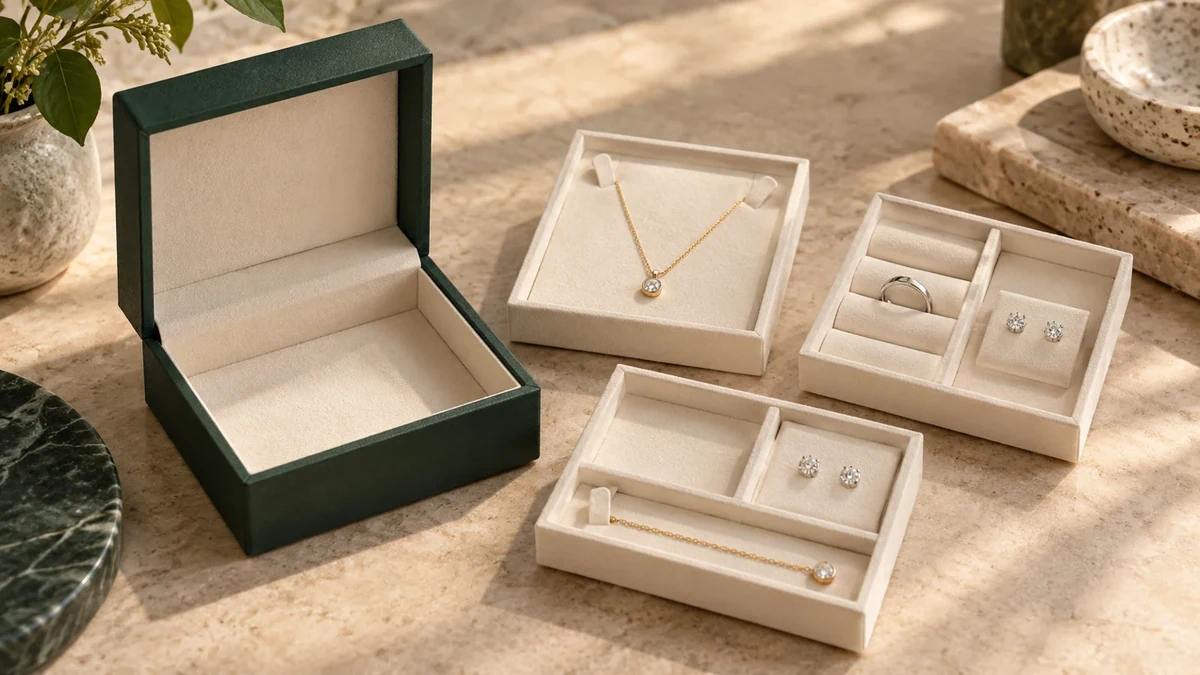
Multi-SKU jewelry packaging needs a separate fit record for every product and packing configuration. Compare the packed envelope, contact points, loading and removal, lid closure and accompanying cards before deciding which parts of the packaging can be shared.
In this guide
A shared outer box can be a useful direction to explore. Keep its proposed dimensions separate from the insert and artwork configurations, so a common appearance doesn’t hide different packing requirements or order quantities.
Record the packed envelope for each jewelry SKU
Give every SKU its own identifier and product version. Measure the item as it will be packed, including backing cards, wraps, posts, clasps and any other components that occupy space. Record dimensions with their units and the proposed orientation.
The largest jewelry piece won’t always describe the most demanding configuration. A smaller item may have a protruding post, an access requirement or a card positioned above it. Keep those details in the row rather than reducing the family to one maximum length and width.
Use the existing jewelry insert measurement checklist for the individual measurements. The matrix adds a different step: comparing those records across SKUs without losing the contact and handling requirements.
Identify surfaces the insert may touch and areas you want kept clear. Describe how the packer loads the item and how the customer removes it. If the intended contact material is still open, ask the supplier to propose it for review.
Include the card configuration in each row. Its folded size, position and orientation can affect the complete pack even when the jewelry dimensions stay the same. Keep final copy and artwork versions separate from the physical space the card occupies.
Compare configurations before sharing components
Assign a configuration reference to each proposed combination of outer box, insert, jewelry orientation and card. One SKU may need several configurations during planning. The reference tells the supplier and reviewer which complete arrangement a question concerns.
For the outer box, distinguish exterior dimensions from the usable interior. Ask how the supplier defines those dimensions and what the proposed insert occupies. Keep the box drawing version with the matrix; a name such as “small jewelry box” isn’t a dimensional reference.
Review four questions for every row:
- Can the intended item and all accompanying components be loaded in the proposed order?
- Which surfaces are in contact, and which need clearance?
- Can the customer reach and remove the item as intended?
- Does the complete configuration allow the proposed lid and closure to work as reviewed?
Ask the supplier which components it proposes to share and which would change. That could mean one outer drawing with separate inserts, or different outer sizes where a shared interior would leave unresolved questions. Treat either as a proposal to examine.
Explore the existing jewelry box directions after the packing requirements are visible. Compare the opening and configuration against the matrix, rather than choosing a structure solely from its product name.
Keep approvals row-specific. A decision for a necklace configuration covers the identified necklace, box, insert and card versions. Other rows remain open until their own review scope is addressed, even if the outer drawing is shared.
If transport evaluation is part of the project, agree its scope separately from the fit review. ISTA’s guidance on retesting a packaged product identifies product, package and process changes as relevant considerations. A completed fit matrix doesn’t claim an ISTA result or establish transport protection.
Keep MOQ and design quantities separate from fit
Packrivo’s starting MOQ is 500 pieces per product / design. Record the requested quantity beside each proposed packaging design. The combined number of jewelry pieces doesn’t by itself establish how the packaging order will be grouped.
A shared outer size can still involve different inserts, print files, finishes or supplied components. Ask the supplier to identify the proposed product and design breakdown, quantities and scope in writing. Don’t assume every jewelry SKU becomes one packaging design, or that every configuration can be combined automatically.
For example, requesting quantities for several jewelry SKUs gives the supplier useful demand information. It still needs to say which packaging components share a specification and which have separate design requirements. Keep that response alongside the fit matrix.
The 500-piece MOQ planning worksheet addresses that quantity discussion. Any exception to Packrivo’s starting policy needs an agreed written scope; a proposed common box is not an exception by itself.
Ask for a revised breakdown when an insert or artwork configuration changes. This lets the buyer compare the current proposal without carrying forward quantities based on a different design.
Work through a hypothetical jewelry family
Consider an illustrative family containing a necklace, a pair of stud earrings and a ring. The buyer wants a similar outside presentation. These are fictional planning entries, not client SKUs, reviewed samples or measured Packrivo results.
The matrix keeps each product’s open questions visible. This compact example shows the type of information to record; its product envelopes would still need actual measurements.
On a small screen, scroll the table horizontally to see every column.
| Illustrative SKU | Packed envelope includes | Configuration to discuss | Open review question |
|---|---|---|---|
| Necklace N | Chain, clasp and backing card | Box, support and card position | Loading and removal of chain |
| Earrings E | Pair, posts and backing card | Cutouts and space above posts | Contact and complete closure |
| Ring R | Ring and proposed wrap | Support and finger access | Positioning and removal |
The buyer would send real product records and ask the supplier to propose configurations. A common outer drawing may remain a candidate while the insert layouts differ. Each row identifies what needs a physical review before a shared-component decision.
Suppose the buyer later changes the necklace backing card. The record would update that input and mark the affected configuration for another review. It wouldn’t alter an unrelated ring decision without identifying a connection between the changes.
The matrix also makes unanswered supplier replies easier to handle. “All fit” needs a configuration reference, review method and decision scope. Ask which rows were reviewed and what evidence supports the response before closing their actions.
Download the multi-SKU jewelry fit matrix (.csv). It has blank rows for SKU and product versions, packed dimensions, contact and access needs, box and insert references, card configuration and the next review action. No row contains a default measurement or passed result.
Complete the product-input fields first, then keep supplier proposals and sample decisions against the same rows. Take that versioned matrix to a Packrivo packaging brief so the next discussion can address the open configurations rather than restarting from the outside box appearance.
Use shared component IDs to make the fit matrix concrete
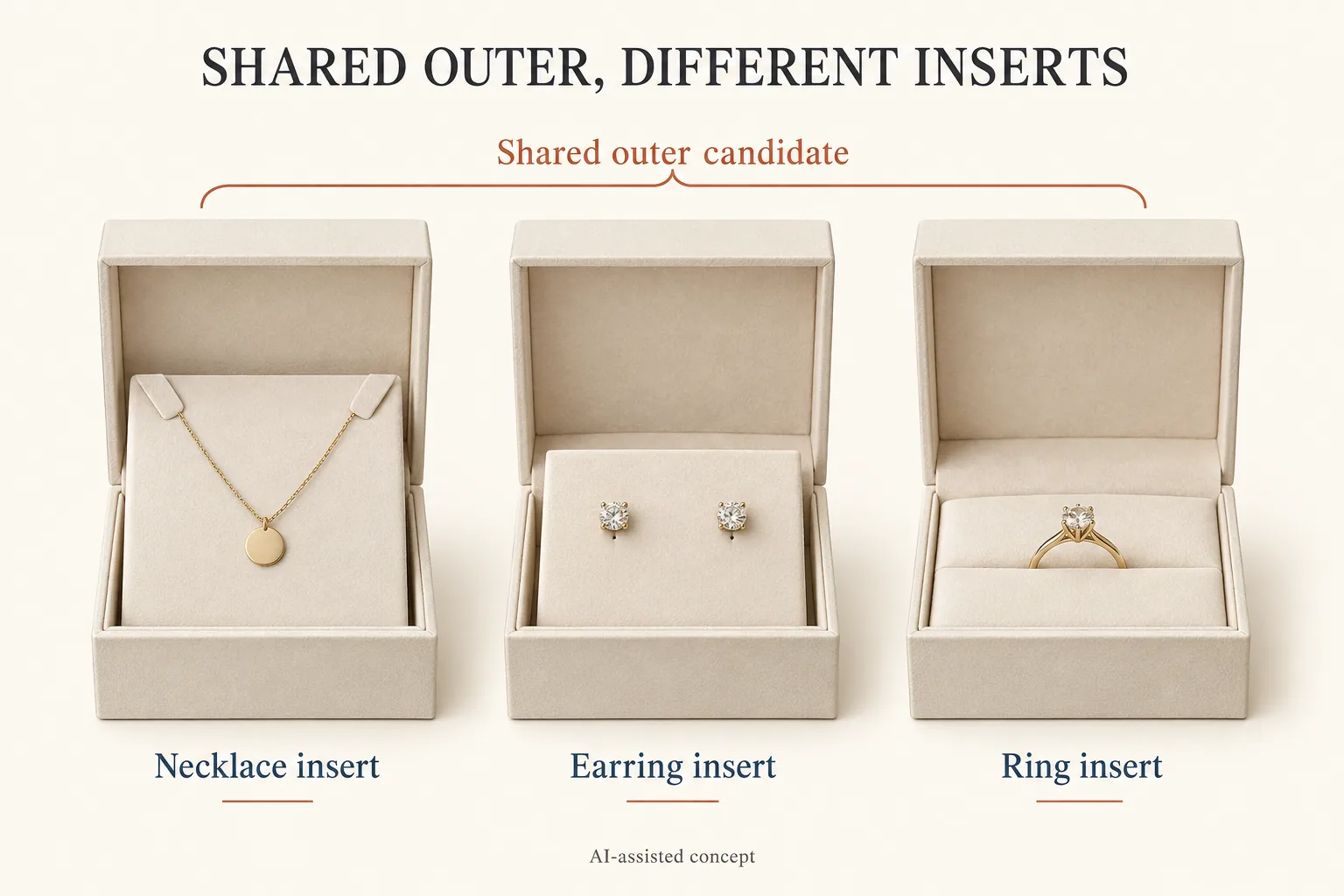
Do not give each row a completely new box ID when the proposal is actually a common outer drawing. Reusing the same reference makes the shared candidate visible. Give distinct inserts their own identifiers and keep their review outcomes separate.
| Hypothetical SKU | Outer candidate | Insert candidate | Open question |
|---|---|---|---|
| Necklace N1 | BOX-A / drawing D2 | INS-N / drawing N3 | Chain route and backing-card removal |
| Stud earrings E1 | BOX-A / drawing D2 | INS-E / drawing E2 | Post space beneath the display face |
| Ring R1 | BOX-A / drawing D2 | INS-R / drawing R4 | Setting height and grip for removal |
This table proposes three arrangements; it does not show that BOX-A fits any of them. Measured envelopes, usable interior and loaded samples still decide whether the common outer remains suitable. An earring post below the face and a ring setting above it create different depth questions even when their visible widths are small.
When one row changes, identify the dependency. A different necklace card may affect INS-N only, or it may force a BOX-A depth change affecting all three rows. Ask the source to identify which drawings change before retaining the other review decisions.
Once configurations are physically accepted, use the packing component matching map to keep the approved inserts with the right products. The fit matrix chooses arrangements; the packing map controls their later selection. Neither record proves transport protection or authorizes combining MOQ quantities.
Download the multi SKU jewelry packaging project record (.csv). The file has named planning fields and blank project rows. It contains no preset acceptance limits or approved results.
Send the current configuration for review
Bring the completed record, actual product or component references, requested quantity by design and destination to Packrivo’s packaging inquiry. Name the specific open decision above so the next sourcing discussion can address it. Packrivo coordinates sourcing questions; material, sample, price and delivery terms need project confirmation.