
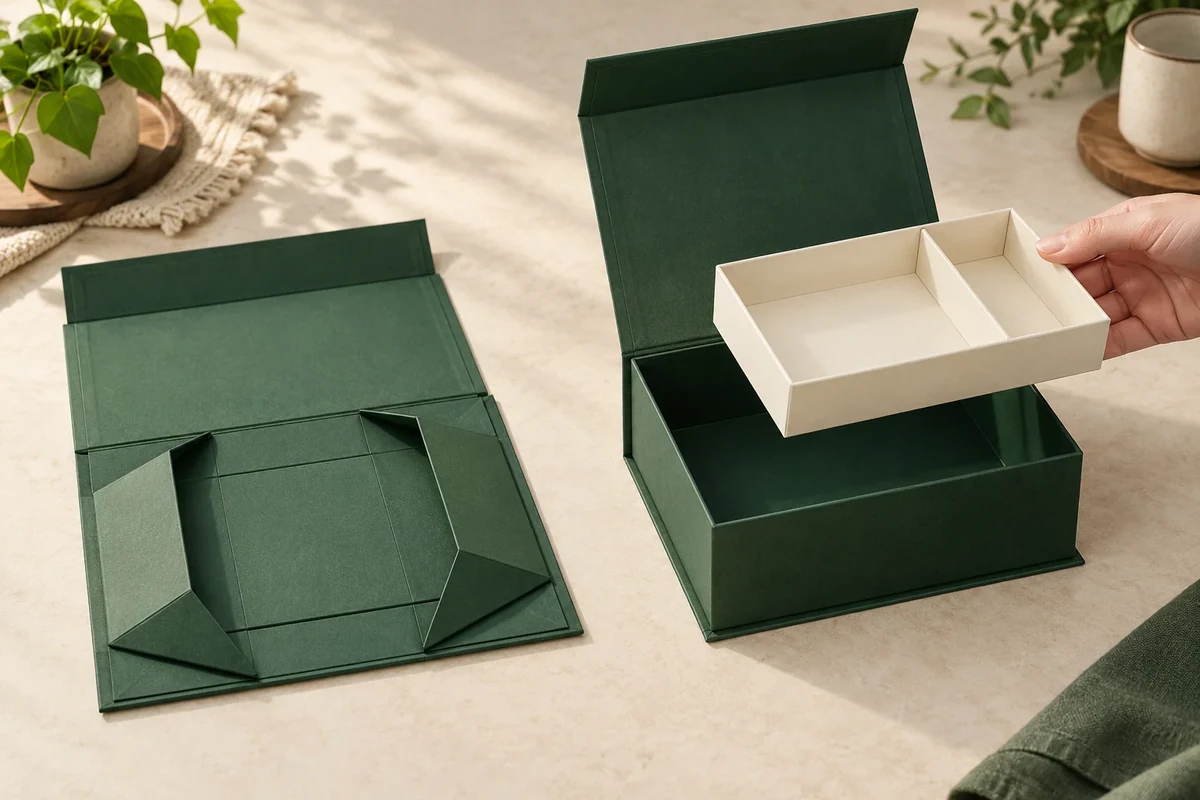
AI-assisted concept cover. Open the cover at full size.
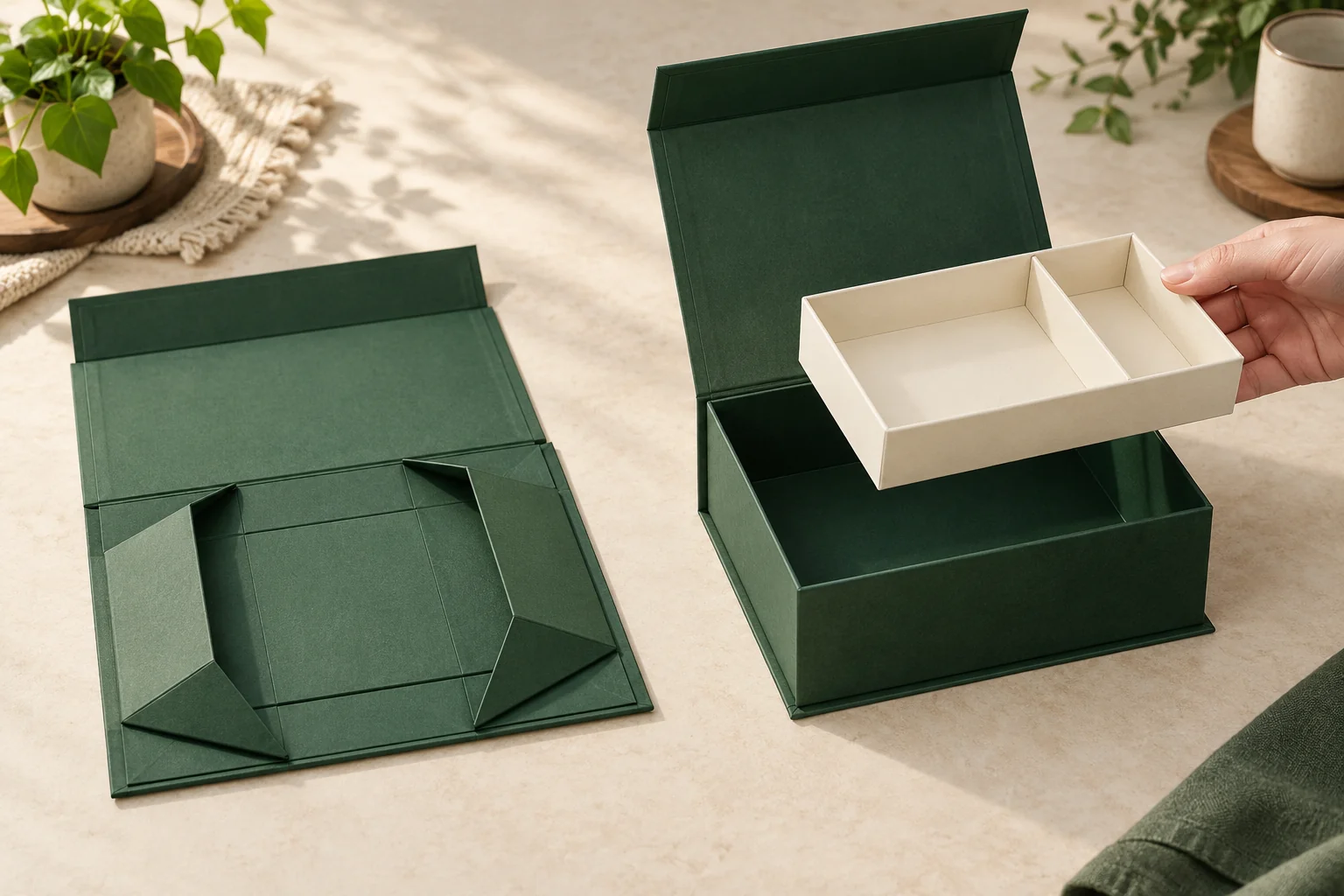
Trial a collapsible gift box from the delivered state using the proposed instructions, included parts and intended packing operator. Record each forming, fastening and insert-fitting task before checking the complete pack. The trial should identify missing instructions, supplies and handovers, with any closure or fit decision tied to the sample actually assembled.
The first review often begins with a box someone else has already formed. That sample can be useful for presentation, but it leaves open how your team will reach the same state after receiving bundles of flat components. Begin the assembly review at the receiving point.
Make an arrival-state inventory
Ask the supplier to identify what arrives collapsed, partly formed or separate. Record whether fastening parts, inserts, sleeves or other accessories are included in the same delivery. A list of components should match the proposed packed carton contents rather than only the finished product photograph.
Keep one untouched arrival-state sample for comparison where practical. Photograph the package before unfolding it and identify the sample version. If a supplier demonstration uses a different construction, note that difference before treating its instructions as applicable.
Gather the instructions and any supplies specified for the proposed construction. Ask which tools or consumables the buyer must provide. If an adhesive flap is involved, request its application requirements; if the construction uses another fastening method, document that method instead.
3M's adhesive characteristics guidance describes pressure-sensitive adhesive contact and dwell as relevant concepts. It does not supply assembly pressure or waiting times for your gift box. Use the identified construction's instructions when planning those steps.
The delivery scope guide helps assign who owns the work. This trial addresses a narrower question: whether the proposed instructions and supplied parts explain the actual operations at your packing bench.
Run the sequence without silently fixing it
Use the intended operator and a suitable working area. Ask the person to follow the supplied sequence, starting with the received state. Record where they need clarification or choose a different movement to make the next step possible.
Avoid hiding a missing instruction through expert assistance. If a supplier representative demonstrates a corner detail, add that explanation to the record and request an updated instruction. A process that works only when someone remembers an undocumented demonstration remains difficult to hand over.
Keep the product and insert aside until the instructions call for them. Note whether forming the box before fitting the insert changes access, or whether the operator needs to secure a component while another is held in place. State the observed interaction rather than guessing a standard assembly order.
Use this original step record for one representative candidate. Complete the operation names from the actual construction; the examples below are prompts, not mandatory steps for every collapsible box.
| Operation | Instruction or part needed | Record during the trial | Owner of the next action |
|---|---|---|---|
| Unfold and form | Identified arrival state | Fold orientation and unclear movements | Supplier instruction owner |
| Secure proposed fastening | Included part and applicable method | Missing supplies or access difficulty | Construction contact |
| Seat the insert | Correct insert version | Loading order and seating observations | Fit reviewer |
| Add contents | Product and accessory references | Extra handling and component contact | Packing owner |
| Close and reopen | Complete assembly | Closure, access and removal observations | Approval owner |
If you record time, state how many boxes were assembled, by whom and under which conditions. A short first trial identifies work; it doesn't establish a production packing rate. Separate instruction clarification from any later capacity study.
Observe the transitions between tasks
Examine the moment when an operation becomes difficult to reverse. Securing a flap, seating a fixed insert or adding a closure component may change access to another part. Ask whether the next operation is intended to happen before that transition.
Record temporary holding needs. The operator may need a clean staging surface or a way to keep formed boxes separate from unfinished ones. Confirm any material-specific waiting or handling requirements with the supplier before deciding how that staging will work.
Load the actual product and accessories, then close and reopen the sample. The assembled box may look correct while the insert or care card changes closure behaviour. The sample review guide gives the resulting fit and opening observations a separate acceptance record.
For a hypothetical gift box, an operator might discover that fitting the insert after a fastening step limits access to its corners. The supplier could propose a revised sequence or a changed component. Record which alternative is being trialled and repeat the affected operations with the named candidate.
Treat surface marks, distorted folds or a catching closure as observations to investigate. Keep their locations and the step that preceded them. A first trial does not by itself identify whether the cause is the instruction, material, sample construction or handling.
Give the next operator a repeatable handover
Update the instruction with the selected sequence and photographs of any confusing detail. Identify the box, insert and fastening versions covered. State which supplies are included and which your packing team must provide, with an owner for unresolved requirements.
Ask another intended operator to review the clarified instructions if that is feasible within the project. Record any remaining questions. This is a practical handover check, with its scope stated, rather than a guarantee that every future packer will perform identically.
If a collapsible magnetic box is under consideration, keep its particular forming and closure details in the trial. A magnetic closure does not describe every other assembly operation.
Send the arrival-state inventory, step record and open questions through Packrivo's packaging inquiry. The next supplier discussion can focus on the actual assembly task and the evidence needed to move from a demonstration to usable packing instructions.
Log the instruction gap before adding a missing assembly step
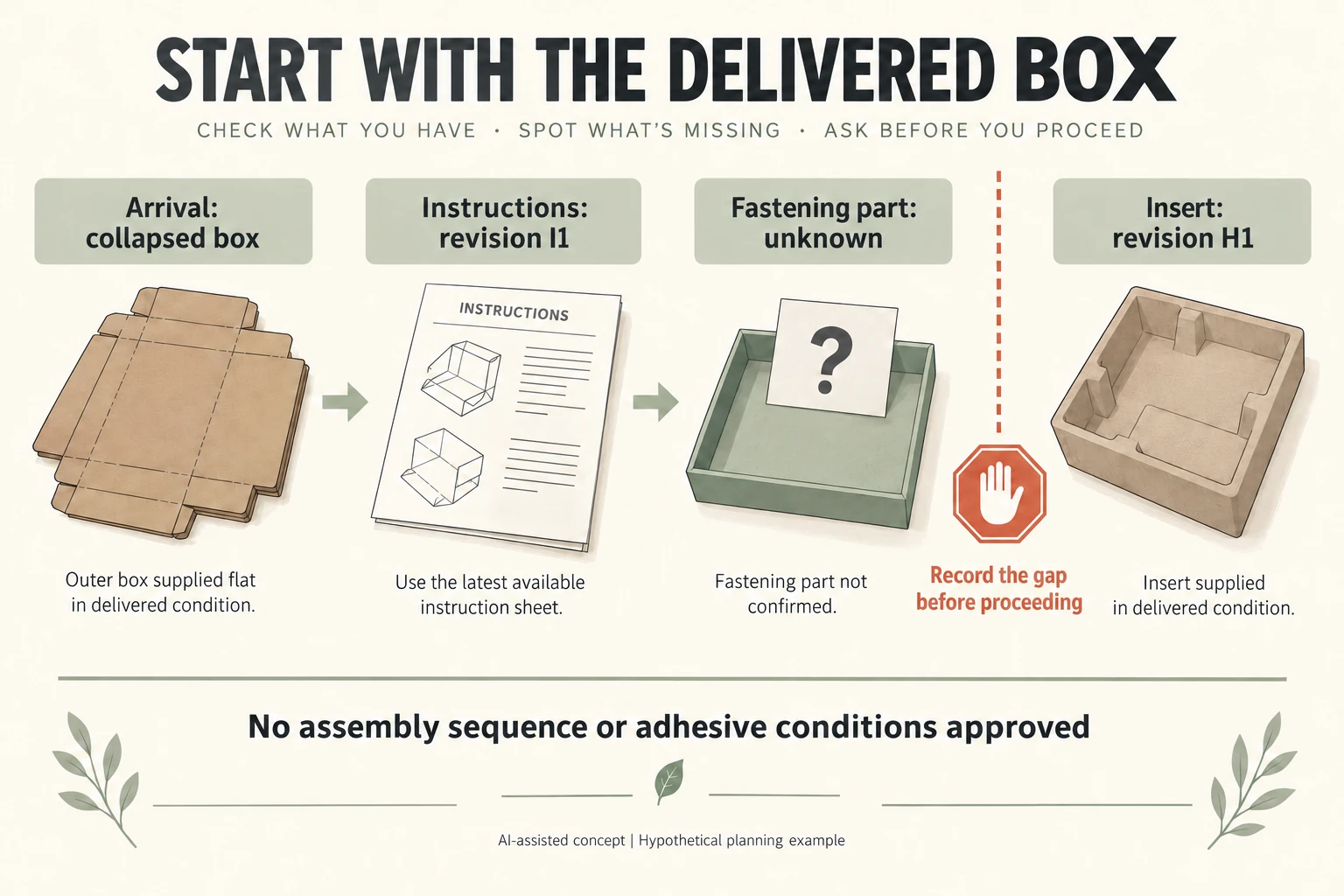
For invented collapsible box B1, the proposed delivered-state description names insert H1 and instruction I1 but leaves fastening unidentified. This is an unresolved planning input, not an observed shipment discrepancy. The construction contact must identify the method and required supplies before that operation can be trialled.
Scroll horizontally if columns extend beyond the view.
| Stage | Invented input | Missing answer | Avoid assuming |
|---|---|---|---|
| Arrival | B1 collapsed; H1 separate | Actual carton contents and revisions | A finished photo describes receipt |
| Forming | I1 proposed | Applicable folding sequence | An expert demonstration applies to I1 |
| Fastening | Method unknown | Included part and conditions | Glue, tape or hardware is specified |
| Insert fitting | H1 identified only | Access before and after fastening | Either order works |
| Complete pack | Checks planned | Named sample and observations | Appearance proves fit |
In an actual trial, record the first action attempted without assistance, the instruction location consulted and any explanation later supplied. If a helper demonstrates a corner detail, retain that intervention and request a revised instruction. Do not recast the first attempt as an unassisted success.
The empty question-mark tray specifies no fastening part or adhesive. The diagram stations organize questions rather than prescribe an approved sequence. Once the method is clarified, repeat affected operations with matching part and instruction revisions. Keep closure and product removal as separate observations. The sheet establishes no packing rate, pressure, dwell time or staffing requirement.
Download the collapsible gift box assembly trial record (.csv). HYPOTHETICAL rows are invented examples. Use ACTUAL_BLANK for permitted project inputs; replace that row label only when recording actual facts. Empty evidence, observation and date fields mean unknown or not performed, never acceptance. Keep checkpoints and revisions separate.
Send the arrival-state description, instruction revision and unresolved fastening or access questions before arranging the actual trial. Prepare the identified scope for a Packrivo inquiry. Packrivo coordinates independent suppliers. These records establish no supplier offer, service availability or MOQ exception; its published baseline is 500 pieces per product/design.