
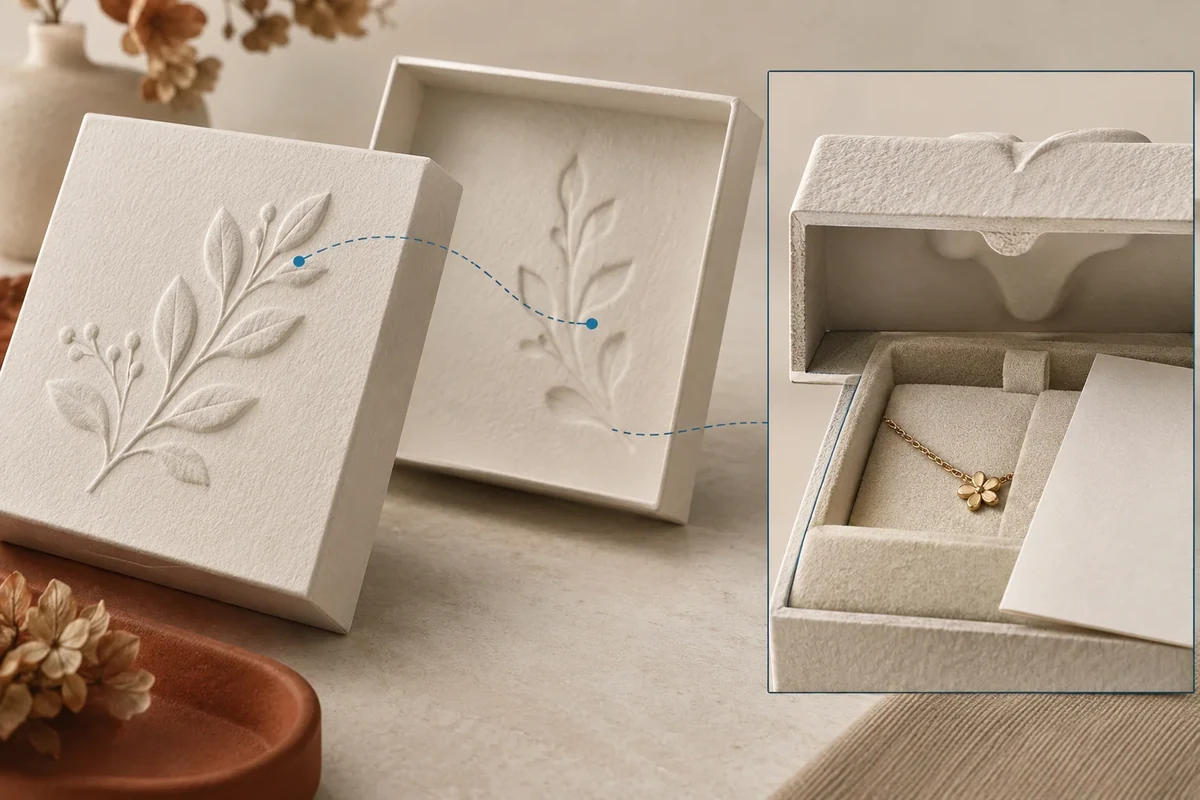
Map the back surface of an embossed panel before fixing the relief location. Identify what touches that surface after converting, including an insert, product, card or another stacked panel. Review the actual relief and those contacts together so the appearance decision does not leave an unresolved internal clearance.
Record relief on both faces of the panel
The original Holmen embossing explanation describes shaping paperboard using a stamp and counter-die, with restrictions linked to board construction. It also discusses preserving relief during stacking. Use that context to request the offered board, tool and relief proposal rather than assuming a universal depth.
Give the embossed object and panel a stable identity. Show the front appearance and the corresponding back area on the drawing. Mark a fold, edge or internal component that approaches that back area after the box is formed.
Keep the proposed relief sample and board grade attached to this map. If the early appearance sample uses a different material, record the substitution and retain the final-board question. An attractive front image alone does not identify the formed panel’s internal contact.
Identify what occupies the space behind the relief
The FSEA designer guide explains embossing die/counter identities and artwork considerations. It supports naming the tool proposal, not a universal gap behind every embossed gift panel.
Place the insert, card and actual product in their final arrangement. Locate any contact with the back of the relief when the box is loaded and closed. If another panel lies against it during flat delivery or stacking, record that state separately from the customer’s opened pack.
Ask the converter or finisher which relief/tool or layout field should be reviewed at the located contact. The buyer may keep the position, request an internal clearance proposal or choose another appearance location. Each option should stay tied to the same board and formed state.
Use a front and back contact map
This original Packrivo aid uses hypothetical panel and component IDs.
| Feature or state | Example record | Question to resolve |
|---|---|---|
| Emboss E1 | Brand mark on lid panel L1 | Offered relief/tool and board identity |
| Back area | Corresponding region beneath E1 | What touches it after forming? |
| Insert I1 | Finished holder below the lid | Actual loaded clearance/contact |
| Card C1 | Care card position near rear panel | Does the card occupy the relief space? |
| Supplied stack | Prepared panels in their delivered state | What relief-contact state needs reviewing? |
| Next decision | Retain or change the named interface | Finisher response and buyer approval reference |
Review an illustrative lid and holder
Imagine an embossed lid on a jewelry gift box. The front relief is the intended visual detail, but the holder or care card may approach its back area when the lid is seated. Draw that relationship before asking for a deeper or differently positioned effect.
The finisher can explain the actual tool/board proposal, while the holder converter can return the relevant height or layout. Review the complete resulting sample and record which contact is accepted. Keep appearance approval and holder clearance linked, without treating either one as proof of a tested packaging outcome.
Handoff the two-sided decision
The drawing-change method records the affected panel and linked insert. The sample revision record keeps replacement relief evidence connected to the configuration.
The designer identifies the relief object. The finisher confirms the tool and board-related proposal. The packing or holder owner returns actual contact evidence, and the buyer decides the accepted arrangement. Those named responsibilities make the next review more specific than a general request to improve embossing.
Bring the front/back map, complete contents and located clearance question to your packaging brief. MOQ is 500 pieces per design; the effect, sample scope and commercial conditions are confirmed for the project.
A card move and a relief move reopen different relationships
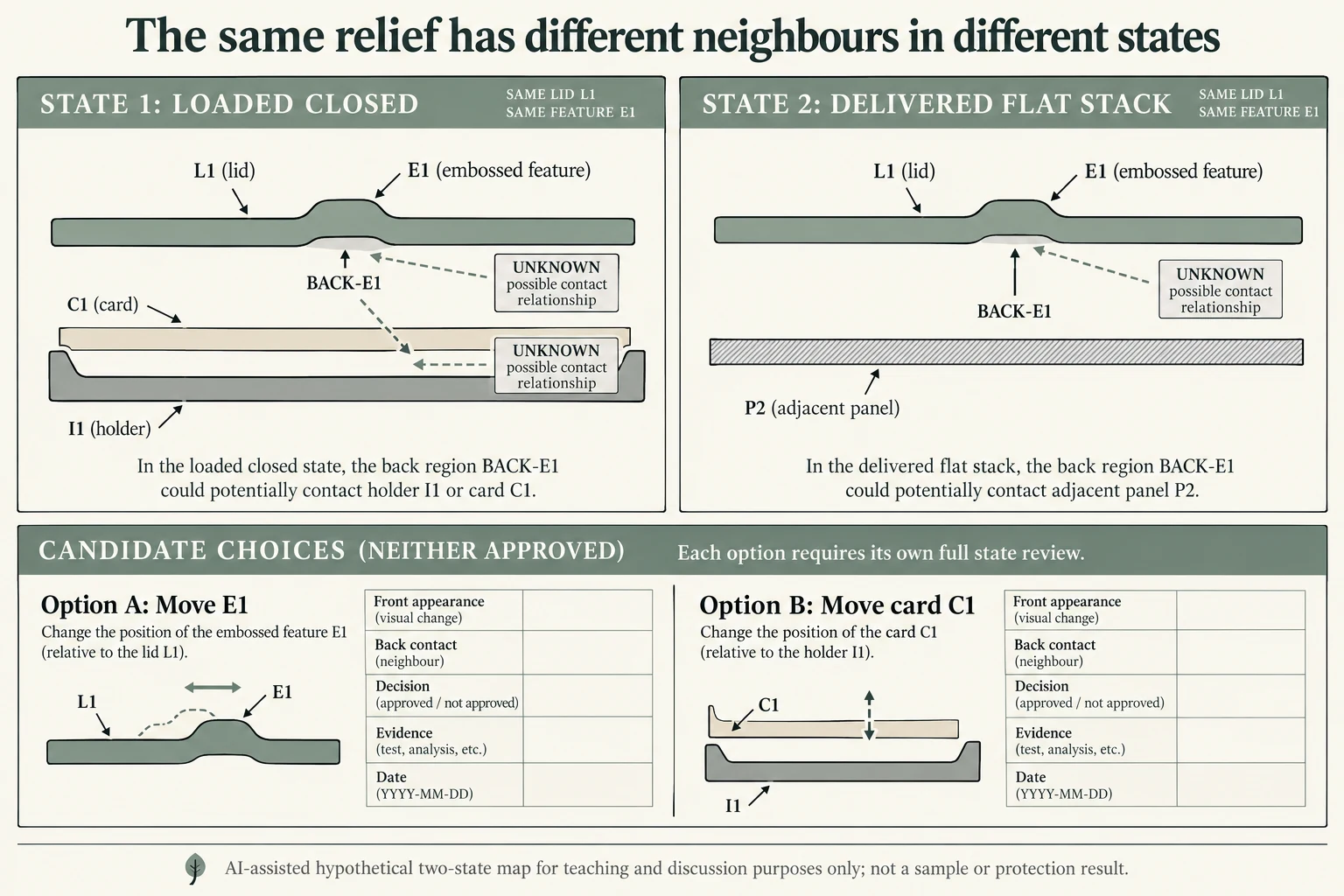
The original E1/L1 example has two distinct state questions. In a loaded closed box, BACK-E1 may approach holder I1 or card C1. In a delivered flat stack, it may approach adjacent panel P2 instead. An answer about the card in the loaded pack cannot establish what happens between delivered panels. Keep these source-target relationships separate even though they refer to the same embossed feature.
Scroll horizontally if columns extend beyond the view.
| Hypothetical configuration | Named object | Relationship | Input or next scope |
|---|---|---|---|
| BASE20 | E1 | located at | Z1 |
| BASE20 | C1 | located at | POS1 |
| BASE20 | BACK-E1 | possible contact | I1 |
| BASE20 | BACK-E1 | possible contact | C1 |
| BASE20 | BACK-E1 | possible contact | P2 |
| MOVE_RELIEF20 | E1 | located at | Z2 |
| MOVE_RELIEF20 | C1 | located at | POS1 |
| MOVE_RELIEF20 | BACK-E1 | possible contact | I1 |
| MOVE_RELIEF20 | BACK-E1 | possible contact | C1 |
| MOVE_RELIEF20 | BACK-E1 | possible contact | P2 |
| MOVE_CARD20 | E1 | located at | Z1 |
| MOVE_CARD20 | C1 | located at | POS2 |
| MOVE_CARD20 | BACK-E1 | possible contact | I1 |
| MOVE_CARD20 | BACK-E1 | possible contact | C1 |
| MOVE_CARD20 | BACK-E1 | possible contact | P2 |
Compare two hypothetical alternatives to BASE20: MOVE_RELIEF20 relocates E1 from zone Z1 to Z2 while leaving card position POS1 unchanged; MOVE_CARD20 retains E1 at Z1 but proposes card position POS2. These are layout identities, not dimensions or actual modifications. The relief move changes the front appearance and corresponding back location. The card move changes an internal arrangement but does not remove the separate delivered-stack question.
Request the relevant complete arrangement for each proposal. Revisit BACK-E1 to I1, BACK-E1 to C1 and BACK-E1 to P2 under their own states, alongside the front appearance. If the supplier changes board or tool during the proposal, record that too. A front-facing sample on substitute material does not silently settle the final-board relief or internal contact, and a loaded clearance view does not prove transport protection.
The CSV maps both original contact states and the two new alternatives explicitly. No relief depth, minimum clearance or acceptable contact pressure is assigned. Actual contact, method, decision, evidence and dates are empty. The buyer receives a concrete choice of evidence requests: relocating the visual feature and reviewing its new neighbours, or moving a card while retaining the relief and checking the changed internal arrangement. Neither proposal is accepted by the diagram.
Download the embossing back surface clearance map record (.csv). It includes the original table fields and scenarios alongside the added relationships. HYPOTHETICAL rows are editorial examples or required review scopes, not actual records. Actual quantity, configuration, component and file identities, materials, process, specification, copy, method, condition, observation, owner, decision, evidence and dates are blank. ACTUAL_BLANK is a separate empty starting row; enter permitted project evidence before using an actual record. A blank means unknown.
Use the Foil, Embossing or Spot UV: Choose by the Effect Needed for its separate question. Use the Link Component Approvals Before Releasing the Whole Set for its separate question. Use the Packaging Sample Revisions: Compare Versions Before Approval for its separate question.
Source scope checked 16 October 2026. References cover only the named materials, processes or guidance. Added configurations and geometry are hypothetical, not supplier specifications, tests or production approval; they set no universal tolerances or machine limits. Confirm the actual material, process, drawing and formed sample for the project.
Discuss this packaging specification with Packrivo. We coordinate independent suppliers. MOQ: 500 pieces per product/design; illustrative quantities are not production offers. Confirm materials, samples, price and timing for your project.