
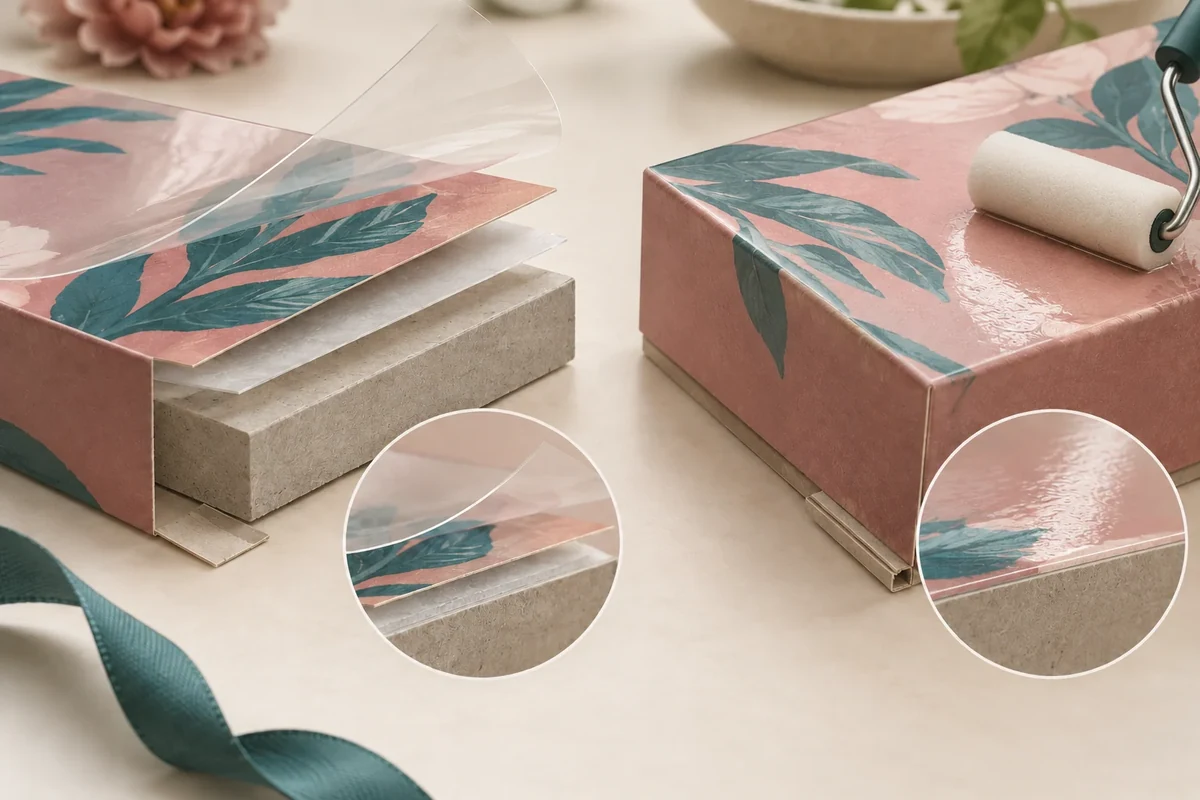
Record lamination and varnish as different surface constructions in the packaging BOM. Identify each component face, film or coating grade, adhesive proposal and converting interface. A finish name should lead to a layer description that can be compared, sampled and revised without changing the rest of the pack silently.
Describe the layer on the named face
Holmen’s film-lamination explanation describes film joined to paperboard with adhesive, including thermal films with preapplied adhesive. This supports asking for the film and adhesive construction. It does not identify the grade offered for your particular box.
The coating technical reference separately identifies an applied UV coating, substrate recommendations and application fields for one grade. Use this distinction to keep a film laminate and an applied varnish/coating in separate proposal rows, even when both are described as gloss.
Name the component and face before recording the finish. A box exterior, lid interior, printed band and separate care card may have different layers. Include the base grade and printed surface underneath, so the proposal can be checked at the correct interface.
Keep adhesive and converting questions with the layer
Ask whether the offered film carries its own adhesive or uses a separately applied adhesive. Request the film/adhesive identities and the process scope relevant to that component. For a varnish or coating, request its actual grade and application proposal rather than assuming a visible sheen defines the construction.
Locate folds, cut edges, glue faces and any product-contact surface beside the layer. Ask the printer/converter to confirm which interfaces need a sample or another technical response. Keep grade-specific suitability and any required material-claim evidence separate from a generic finish preference.
When a supplier proposes changing from a film to a coating, record that as a layer-stack change. It may affect more than the appearance name. Retain the old and new proposals so the buyer can see which faces, processes and follow-up questions changed.
Use a surface-layer BOM worksheet
This original Packrivo table uses hypothetical components and leaves technical values to the actual proposal.
| Component/face | Proposed construction | Evidence and next owner |
|---|---|---|
| Gift lid outside | Printed board plus film F1 and offered adhesive | Printer supplies film/adhesive grade reference |
| Gift base outside | Applied coating V1 on printed board | Printer/finisher confirms coating grade |
| Glue face J1 | Named bonding area beside the finish | Converter confirms layer exclusion or joint proposal |
| Turned edge E1 | Layer relationship after converting | Review final formed sample |
| Product contact | Actual gift/holder surface nearby | Buyer supplies finish/contact restrictions |
| Changed proposal | Film F1 replaced by coating V2 on named face | Retain accepted BOM and revised evidence |
Compare a hypothetical gloss proposal
Imagine two responses for a candle gift-box exterior. One names a gloss film laminate; the other names an applied gloss coating. Put them in separate construction rows and ask for each grade and process reference. The similar finish word should not hide a different BOM.
The buyer can then compare the actual appearance evidence and the fold/glue interfaces that matter to this box. If only one response has a defined joint or sample state, keep the missing field open. A broad statement that both options are gloss does not resolve it.
Approve a named layer stack and sample
Use the material-claim evidence guide if an environmental or other material statement is being proposed. A visual finish sample does not by itself supply that evidence. The drawing-change record keeps affected faces and joints visible when a layer changes.
The printer or finisher identifies the layer grade and process. The converter responds about the actual forming and bonding interfaces. The buyer approves a particular visible/sample state and records any open claim question. Keep the BOM revision alongside the artwork and drawing revision.
Share the surface-layer table, actual contents and unresolved proposal fields through the packaging brief. MOQ is 500 pieces per design; offered materials, sampling and commercial conditions are confirmed for the project.
Keep the unchanged base outside the lid-layer substitution
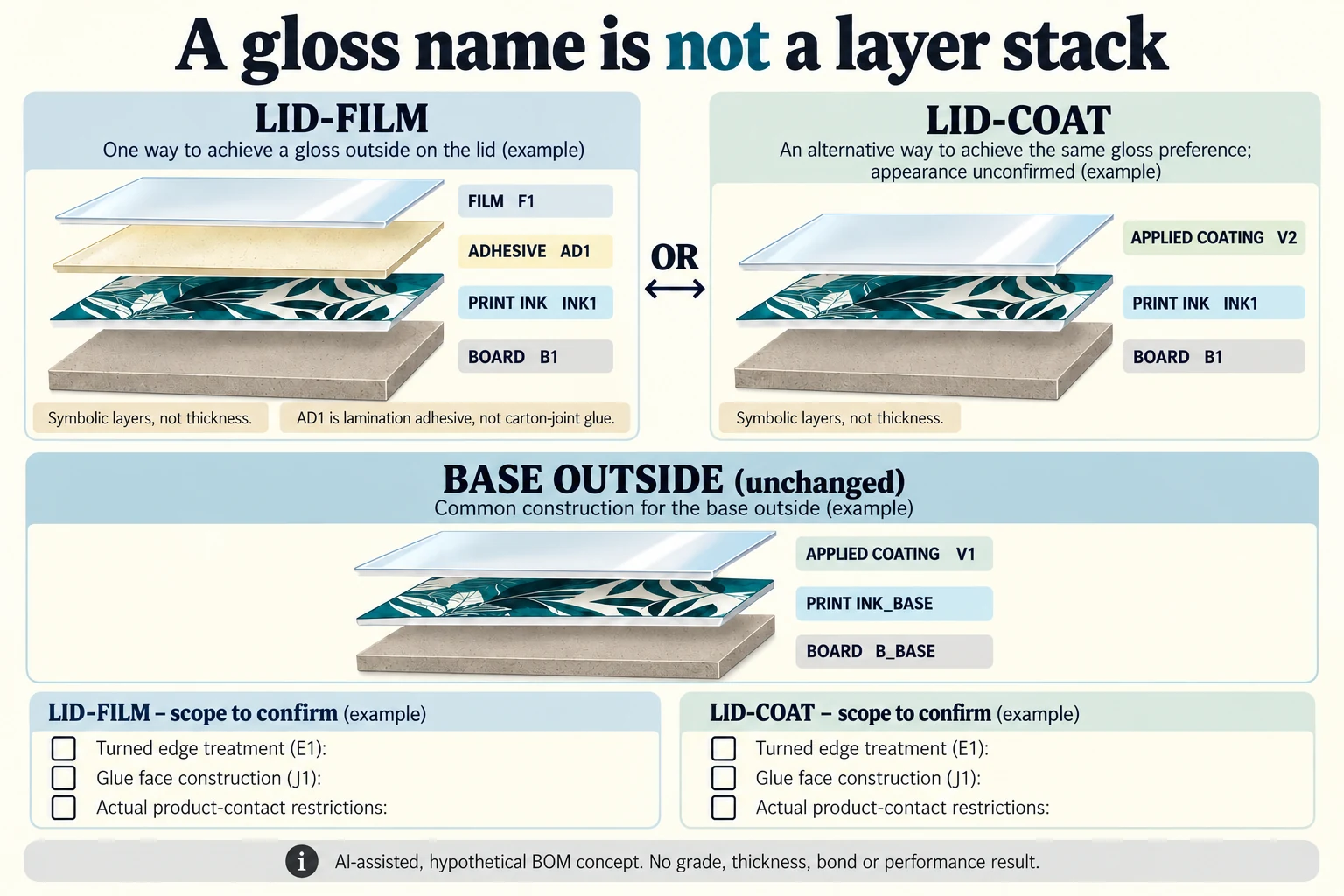
Extend the fictional BOM by assigning LID_FILM21 to a proposed B1 board, INK1 print, separate lamination adhesive AD1 and film F1. LID_COAT21 is an alternative on that same lid face: B1 and INK1 with applied coating V2. It does not include F1 or the separate lamination adhesive AD1 in this hypothesis. AD1 is not the adhesive used to join the carton; that joint remains its own question.
Scroll horizontally if columns extend beyond the view.
| Hypothetical configuration | Named object | Relationship | Input or next scope |
|---|---|---|---|
| LID_FILM21 | BOARD_B1 | layer in | LID_OUTSIDE; 1 layer ordinal not thickness |
| LID_FILM21 | PRINT_INK1 | layer in | LID_OUTSIDE; 2 layer ordinal not thickness |
| LID_FILM21 | LAM_ADH_AD1 | layer in | LID_OUTSIDE; 3 layer ordinal not thickness |
| LID_FILM21 | FILM_F1 | layer in | LID_OUTSIDE; 4 layer ordinal not thickness |
| LID_COAT21 | BOARD_B1 | layer in | LID_OUTSIDE; 1 layer ordinal not thickness |
| LID_COAT21 | PRINT_INK1 | layer in | LID_OUTSIDE; 2 layer ordinal not thickness |
| LID_COAT21 | COATING_V2 | layer in | LID_OUTSIDE; 3 layer ordinal not thickness |
| BASE_UNCHANGED21 | BOARD_B_BASE | layer in | BASE_OUTSIDE; 1 layer ordinal not thickness |
| BASE_UNCHANGED21 | PRINT_INK_BASE | layer in | BASE_OUTSIDE; 2 layer ordinal not thickness |
| BASE_UNCHANGED21 | COATING_V1 | layer in | BASE_OUTSIDE; 3 layer ordinal not thickness |
| LID_COAT21 | LID_OUTSIDE | layer membership | NO_FILM_F1_OR_LAM_ADH_AD1_IN_THIS_HYPOTHESIS |
Keep BASE_UNCHANGED21 separate, with its own B_BASE, INK_BASE and coating V1 identities. Replacing the lid's film does not replace the base's coating or prove that the two faces now look alike. The drawing can use the same gloss preference for both proposals while the actual appearance and grade fields remain unknown. Layer ordinals in the download identify symbolic order, not thickness or a manufacturing recipe.
Ask which offered film route applies before completing the lid-film record: separately applied adhesive or a preapplied thermal construction. Those alternatives still need actual grade and process identities; they are not interchangeable simply because both include a film. For the coating candidate, request the actual applied grade and sample state rather than borrowing a film specification.
Review E1's converted edge, J1's bonding relationship and product-contact restrictions under each affected face. A new sample may answer one visual question while its joint or material-claim evidence remains open. The buyer's output is a face-by-face replacement list and evidence request, including a clear no-change entry for the base. A similar finish word supplies neither a common BOM nor proof that an old claim document covers the substituted construction.
Download the packaging film varnish layer BOM record (.csv). It includes the original table fields and scenarios alongside the added relationships. HYPOTHETICAL rows are editorial examples or required review scopes, not actual records. Actual quantity, configuration, component and file identities, materials, process, specification, copy, method, condition, observation, owner, decision, evidence and dates are blank. ACTUAL_BLANK is a separate empty starting row; enter permitted project evidence before using an actual record. A blank means unknown.
Use the Packaging Material Claims Need a Defined Evidence Scope for its separate question. Use the Packaging Dieline Changes Need an Impact Record for its separate question.
References apply to the materials, processes or guidance named in each source. Worked configurations and dimensions are teaching examples, not tested specifications or production limits. Use the project’s material specification, drawing and formed sample for approval.
Discuss this packaging specification with Packrivo. We coordinate independent suppliers. MOQ: 500 pieces per product/design; illustrative quantities are not production offers. Confirm materials, samples, price and timing for your project.