
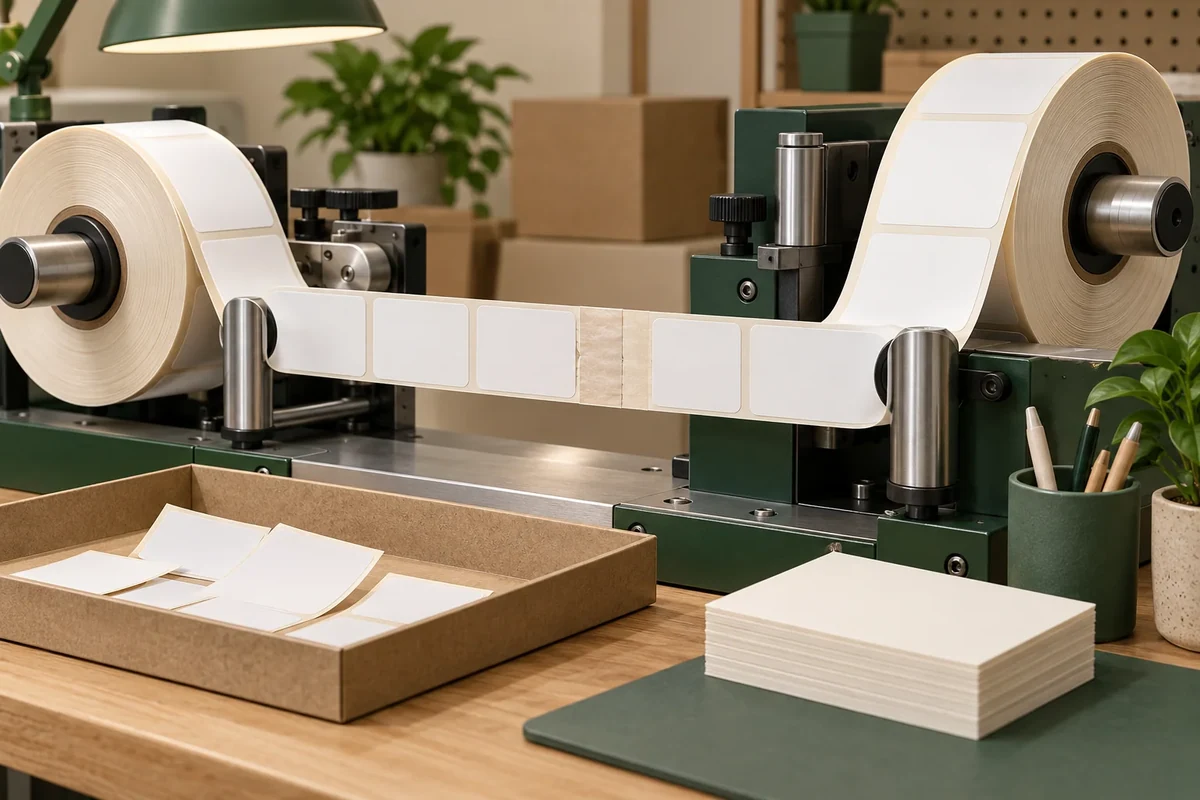
Give every label-roll changeover an outgoing roll ID, incoming roll ID and any known splice marker or affected-label range. Keep the applicator’s actual requirements with that event. This preserves an answerable handoff when a roll changes, without repeating the earlier core and winding-direction selection.
Separate the roll specification from the change event
The original Shibuya Hoppmann L200A manual includes label/web and splice conditions for that machine. It demonstrates that splice compatibility is equipment-specific. The actual operator and converter should use the selected machine’s applicable instructions; this worksheet does not prescribe machine setup or repair.
The existing roll-or-sheet label guide helps select the application and roll format. A changeover event adds a different record: which roll leaves, which roll enters and how any splice or uncertain label section is identified.
Record the roll and lot labels provided with the delivery, the artwork/configuration revision and the intended applicator. Keep missing information explicit. If the roll contains a marked splice or the supplier states a splice condition, attach that actual description rather than guessing where it occurs.
Preserve the affected range without diagnosing the machine
Ask the packing owner to name the event and the observation that prompted it. The event may be an ordinary roll replacement or a question about a marked splice. Record which labels or units are affected if that information is known, and say when the range is still uncertain.
Use the project’s agreed status and owner for labels awaiting review. The qualified operator handles the machine-related confirmation, while the label converter confirms the offered web/splice construction. A supervisor or buyer decides what further evidence is needed for the affected packout.
Retain the previous roll identity and its event record when the new roll begins. Overwriting the old ID with the new one loses the link between an observation and the labels that were actually used.
Use a roll-change and splice-event table
This original Packrivo record uses hypothetical rolls, not actual production or customer data.
| Event field | Illustrative entry | Next confirmation |
|---|---|---|
| Outgoing roll | Roll R1, drawing LP1 | Retain its lot/configuration label |
| Incoming roll | Roll R2, expected same configuration | Check supplier identification before use |
| Applicator | Selected model and manual reference | Qualified operator confirms applicable requirements |
| Splice marker | Supplier-marked point SP1 if present | Converter confirms construction and identification |
| Affected range | Known labels/units or explicitly unresolved | Packing owner records available evidence |
| Disposition | Named review/hold/release decision | Authorized project owner and date |
Resolve a hypothetical unclear changeover
Imagine a new roll enters while the earlier roll has a marked splice question. Keep R1’s observation linked to R1, even if R2 appears to apply normally. The next response should identify the splice condition and affected range rather than simply saying the new roll is working.
If the range cannot be established, retain that uncertainty and ask the responsible packing owner what trace information is available. The buyer can then decide which evidence or additional review is required, without treating a new roll as proof that every earlier unit is acceptable.
Handoff the event with the correct owner
Use the label adhesion and surface-condition method for the separate applied-label question. The acceptance record keeps requirement, evidence and disposition visible when the affected units need review.
The converter supplies roll/web facts. The qualified operator confirms the selected machine requirements. The packing owner records the event and affected items, and the named project decision owner resolves their status. Keep these responsibilities in the record rather than inserting generic operational instructions.
Share the roll IDs, actual splice description and unresolved event fields through your packaging brief. MOQ is 500 pieces per design; the label construction, sample scope and commercial conditions are confirmed for the project.
Trace a changeover without inventing the splice's affected quantity
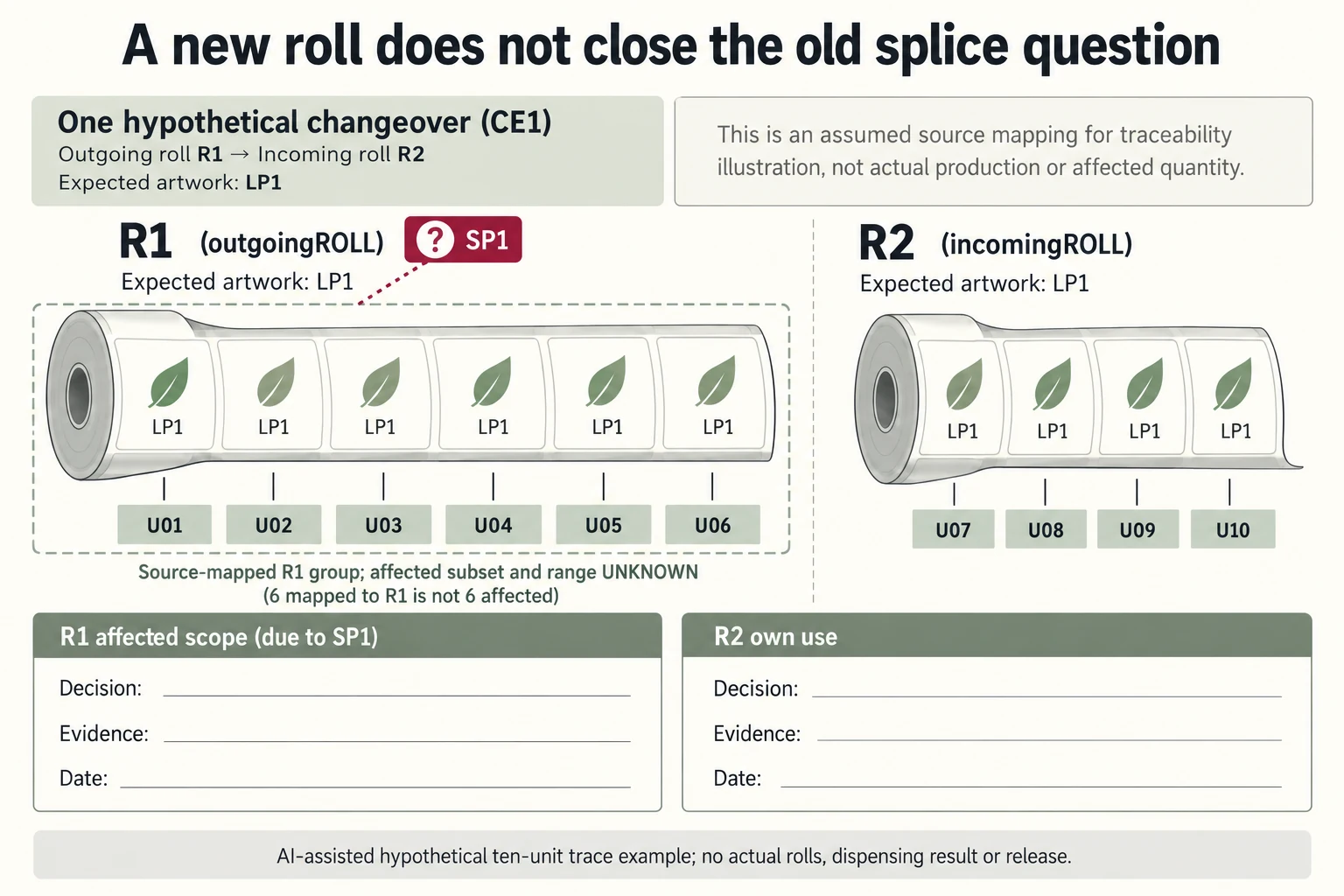
Consider one invented trace plan for CE1: six label-unit references U01 to U06 are assigned to outgoing R1, and four U07 to U10 to incoming R2. Both use expected artwork LP1. These ten references demonstrate a source map, not ten production scenarios, a real delivery, an inspection sample or a measured application result. Each mapping carries one hypothetical unit; the roll totals are six and four.
Scroll horizontally if columns extend beyond the view.
| Hypothetical configuration | Named object | Relationship | Input or next scope |
|---|---|---|---|
| CE1 | U01 | assumed source roll | R1; 1 hypothetical label-unit |
| CE1 | U02 | assumed source roll | R1; 1 hypothetical label-unit |
| CE1 | U03 | assumed source roll | R1; 1 hypothetical label-unit |
| CE1 | U04 | assumed source roll | R1; 1 hypothetical label-unit |
| CE1 | U05 | assumed source roll | R1; 1 hypothetical label-unit |
| CE1 | U06 | assumed source roll | R1; 1 hypothetical label-unit |
| CE1 | U07 | assumed source roll | R2; 1 hypothetical label-unit |
| CE1 | U08 | assumed source roll | R2; 1 hypothetical label-unit |
| CE1 | U09 | assumed source roll | R2; 1 hypothetical label-unit |
| CE1 | U10 | assumed source roll | R2; 1 hypothetical label-unit |
| CE1 | R1 | mapped unit count | CE1; 6 hypothetical label-units |
| CE1 | R2 | mapped unit count | CE1; 4 hypothetical label-units |
| CE1 | CE1 | mapped unit count | R1|R2; 10 hypothetical label-units |
Let the splice question SP1 belong to R1, with the affected subset still unknown. The assumed source count of six does not mean all six were affected, and it does not establish where the affected range starts or ends. Keep those different fields separate. The mapper can show which roll a reference belongs to while leaving the actual splice extent unresolved.
Request the converter's actual splice identification and the packing owner's trace information for R1. A statement that R2 appears to apply normally does not release R1's earlier scope. It also does not create a complete R2 use decision; that roll needs its own applicable requirements and evidence. The CSV therefore retains separate affected-scope and own-use rows for each roll alongside the event, artwork and SP1 relationships.
This is a traceability example, not a machine instruction. Core, winding and web requirements remain with the selected applicator's qualified owner and actual manual. No splice tape, setup, repair procedure, application speed or general label tolerance is prescribed. Enter real roll and lot identities, observations and dates only when supported; a new roll must not overwrite the outgoing roll's unresolved question.
Download the label roll changeover splice trace record record (.csv). It includes the original table fields and scenarios alongside the added relationships. HYPOTHETICAL rows are editorial examples or required review scopes, not actual records. Actual quantity, configuration, component and file identities, materials, process, specification, copy, method, condition, observation, owner, decision, evidence and dates are blank. ACTUAL_BLANK is a separate empty starting row; enter permitted project evidence before using an actual record. A blank means unknown.
Use the Roll or Sheet Labels: Choose the Application Format for its separate question. Use the Liner Release and Final Label Adhesion Need Separate Review Records for its separate question. Use the Incoming Packaging Inspection: Check the Batch Before Packing for its separate question.
Source scope checked 16 October 2026. References cover only the named materials, processes or guidance. Added configurations and geometry are hypothetical, not supplier specifications, tests or production approval; they set no universal tolerances or machine limits. Confirm the actual material, process, drawing and formed sample for the project.
Discuss this packaging specification with Packrivo. We coordinate independent suppliers. MOQ: 500 pieces per product/design; illustrative quantities are not production offers. Confirm materials, samples, price and timing for your project.