
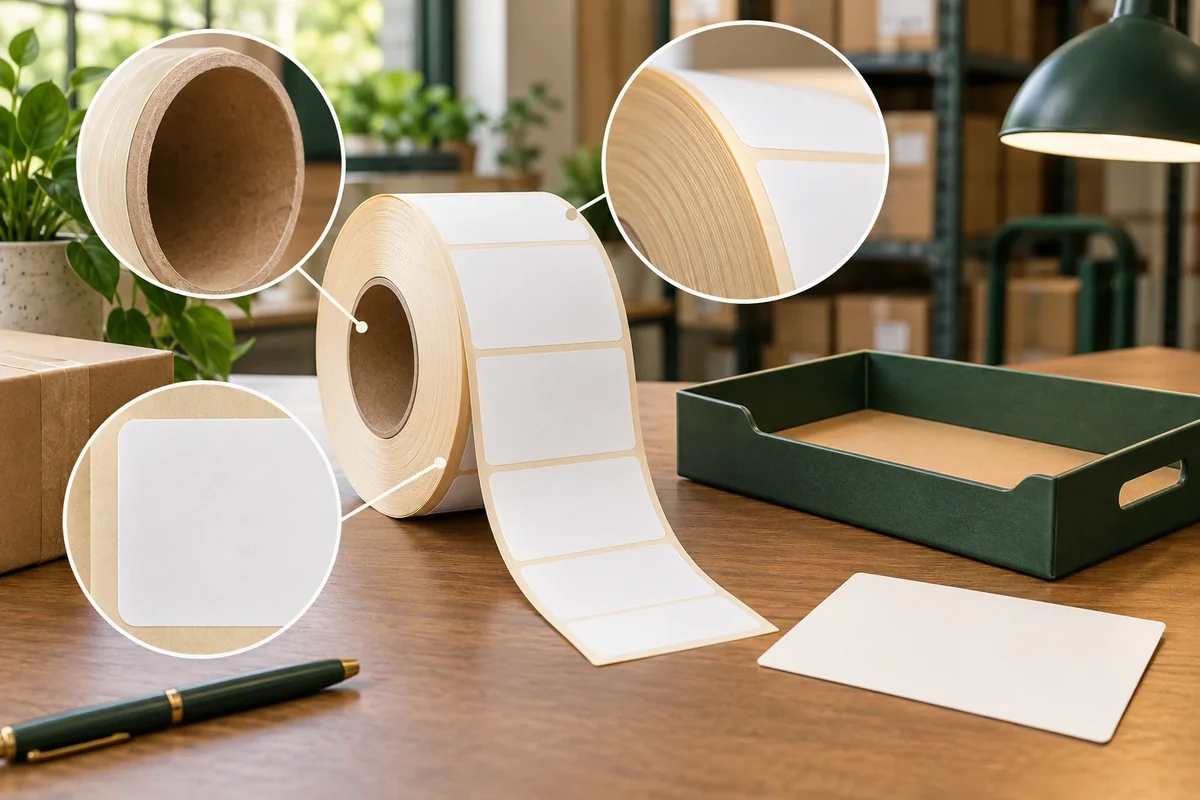
Check received label rolls against their expected identity and visible condition before application begins. Record the roll, lot, artwork and web references, then locate any core, edge, liner or face issue. Keep the release decision with a named owner; visual receipt checks do not establish the final applied bond.
Identify the roll before inspecting its condition
The original UPM liner explanation describes the backing that carries and protects the adhesive through converting and application. This helps separate liner condition from label-face appearance. It is not a general receipt-inspection or release standard.
Match the delivery identification to the expected label configuration. Record the artwork revision, roll/lot identity and available supplier web drawing. Check which fields are present and which remain unknown before the roll is taken to the intended application area.
Preserve the roll label and any actual splice information supplied with it. A matching artwork name alone does not establish that the liner, adhesive or web arrangement is the expected proposal. Ask the converter to identify those components when the receipt record leaves them unclear.
Locate visible issues at the roll and web
The L200A label/web manual identifies equipment-specific web and dispensing conditions. Use the selected machine’s actual applicable reference for the application question, with a qualified owner confirming it. A visual receipt photograph is a different evidence type.
Inspect and record the visible core, roll edges, liner and label faces using the project’s agreed receipt method. Describe a crushed core, damaged edge, unclear identification or another actual observation at its location. Keep the packaging condition and photographs with the roll ID.
Where a visible issue or identity mismatch requires review, record the affected quantity or range if known. Keep an uncertain range explicitly open and assign the next owner. Avoid diagnosing the cause from a receipt image or releasing the roll because only its printed face appears correct.
Use a label-roll receipt register
This original Packrivo table illustrates a roll awaiting an identity/condition decision.
| Receipt field | Hypothetical entry | Next action |
|---|---|---|
| Expected configuration | Artwork LP1 and offered web W1 | Match supplier delivery identity |
| Roll/lot | Received roll R1, lot field supplied or missing | Converter confirms unresolved identifiers |
| Core and edges | Located visible condition and photo R1-P1 | Packing owner records actual observation |
| Face/liner | Specific surface or backing area reviewed | Keep layer identity with the evidence |
| Affected range | Known quantity or unresolved extent | Name who confirms the range |
| Disposition | Hold/review/release under project decision | Record authorized owner and evidence used |
Resolve an illustrative received-roll mismatch
Imagine a roll arrives with the expected printed design but no liner or web reference visible on its delivery information. Retain the face/artwork match and the missing fields separately. The next converter response should identify the offered construction rather than asking the buyer to infer it from the color of the backing.
If a visible edge condition also needs review, keep it attached to that roll. The application owner can decide what further inspection or trial is required under the actual equipment plan, while the buyer retains the disposition and its evidence. A later successful label application should be recorded as another observation, not used to rewrite the receipt record.
Keep receipt, dispensing and adhesion evidence separate
The roll-or-sheet guide records the intended application arrangement. Use the adhesion and surface-condition method when the label is assessed on the actual product. The acceptance record provides the project requirement/evidence/decision structure.
The receiver records roll identities and visible condition. The converter confirms the offered construction. The qualified application owner addresses machine-specific questions, and the named decision owner resolves the roll’s use status. Keep the evidence for each role visible.
Bring the receipt record, actual photos and missing roll fields to your packaging brief. MOQ is 500 pieces per design; label construction, sample scope and commercial details are confirmed for the project.
Close an identity gap and a condition question on their own scope
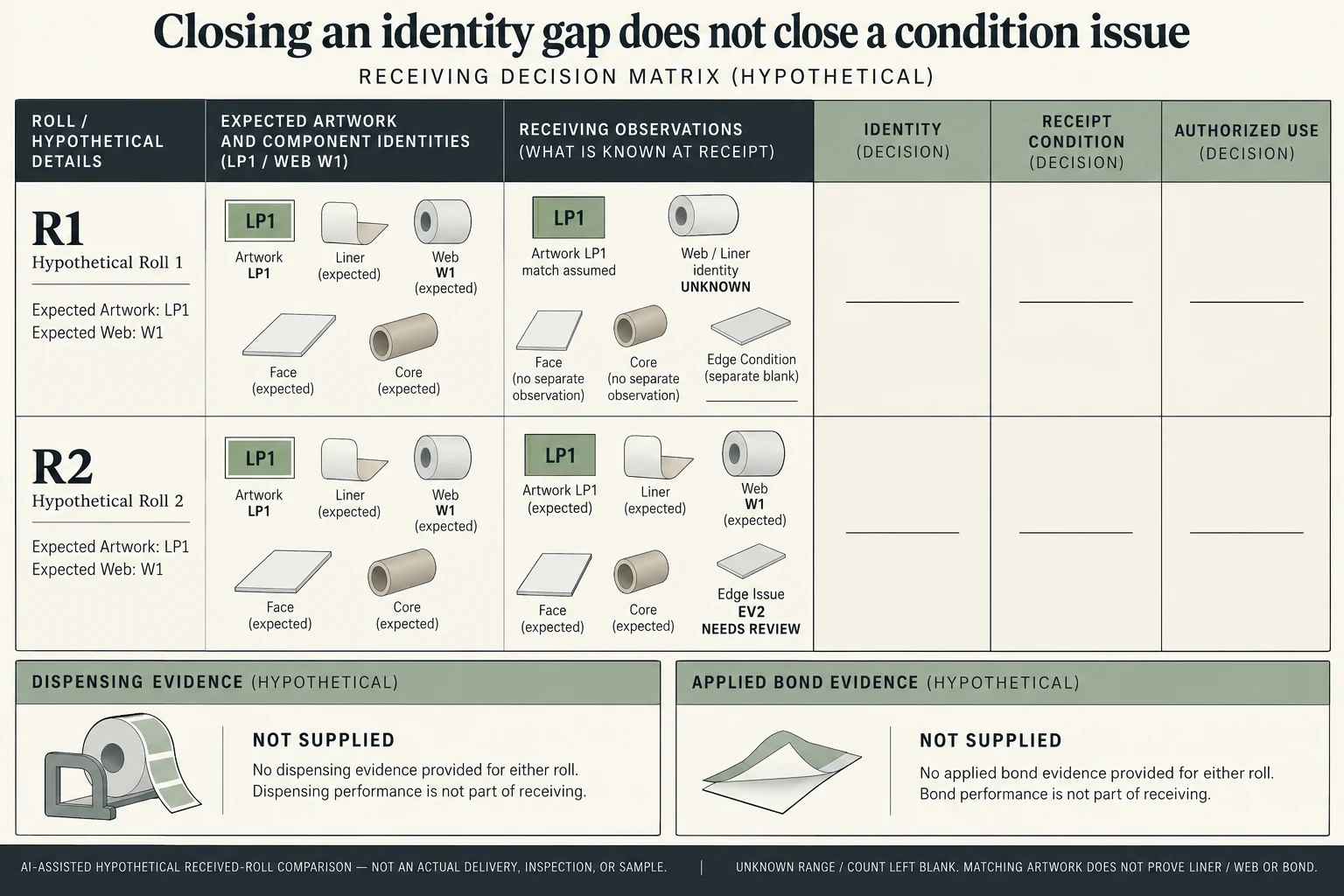
Extend the original received R1 example with a second hypothetical roll R2, both expected to match artwork LP1 and offered web W1. R1 illustrates the artwork-only match with missing web/liner identity. R2 illustrates a separate edge question EV2 requiring review. These are different open issues in an invented receiving comparison, not actual delivered rolls or classified defects.
Scroll horizontally if columns extend beyond the view.
| Hypothetical configuration | Named object | Relationship | Input or next scope |
|---|---|---|---|
| TWO_ROLL_RECEIPT | R1 | hypothetical gap | WEB_LINER_IDENTITY |
| TWO_ROLL_RECEIPT | R2 | hypothetical gap | EDGE_QUESTION_EV2 |
| SCOPED_GAP_CLOSURE | IDENTITY | does not close | CONDITION |
| SCOPED_GAP_CLOSURE | CONDITION | does not close | IDENTITY |
If new documents resolve R1's construction identity, close only that gap under the actual references received. They do not decide an unreviewed core, edge, liner or face condition. Conversely, a response about EV2 on R2 cannot populate missing construction fields merely because the printed face looks familiar. Keep identity, receipt condition and authorized use as three separate fields for each roll.
Record the affected extent when known and retain uncertainty when it is not. No count or range is assigned to EV2 here. The named project owner applies the actual requirement and receipt method to decide which roll and scope may proceed. A complete-looking response for one roll should not become a combined release covering another roll's unresolved field.
Dispensing and final applied bond remain separate evidence types. A subsequent application observation may be useful under its own configuration and conditions, but it must not rewrite the earlier receipt facts. The download gives R1 and R2 independent identity, condition, use, dispensing and bond requests. Actual lot IDs, observations, equipment applicability, decisions and dates remain empty; this comparison supplies neither an inspection sampling plan nor a universal roll-release standard.
Download the label roll receipt identity condition inspection record (.csv). It includes the original table fields and scenarios alongside the added relationships. HYPOTHETICAL rows are editorial examples or required review scopes, not actual records. Actual quantity, configuration, component and file identities, materials, process, specification, copy, method, condition, observation, owner, decision, evidence and dates are blank. ACTUAL_BLANK is a separate empty starting row; enter permitted project evidence before using an actual record. A blank means unknown.
Use the Incoming Packaging Inspection: Check the Batch Before Packing for its separate question. Use the Roll or Sheet Labels: Choose the Application Format for its separate question. Use the Liner Release and Final Label Adhesion Need Separate Review Records for its separate question.
Source scope checked 16 October 2026. References cover only the named materials, processes or guidance. Added configurations and geometry are hypothetical, not supplier specifications, tests or production approval; they set no universal tolerances or machine limits. Confirm the actual material, process, drawing and formed sample for the project.
Discuss this packaging specification with Packrivo. We coordinate independent suppliers. MOQ: 500 pieces per product/design; illustrative quantities are not production offers. Confirm materials, samples, price and timing for your project.