
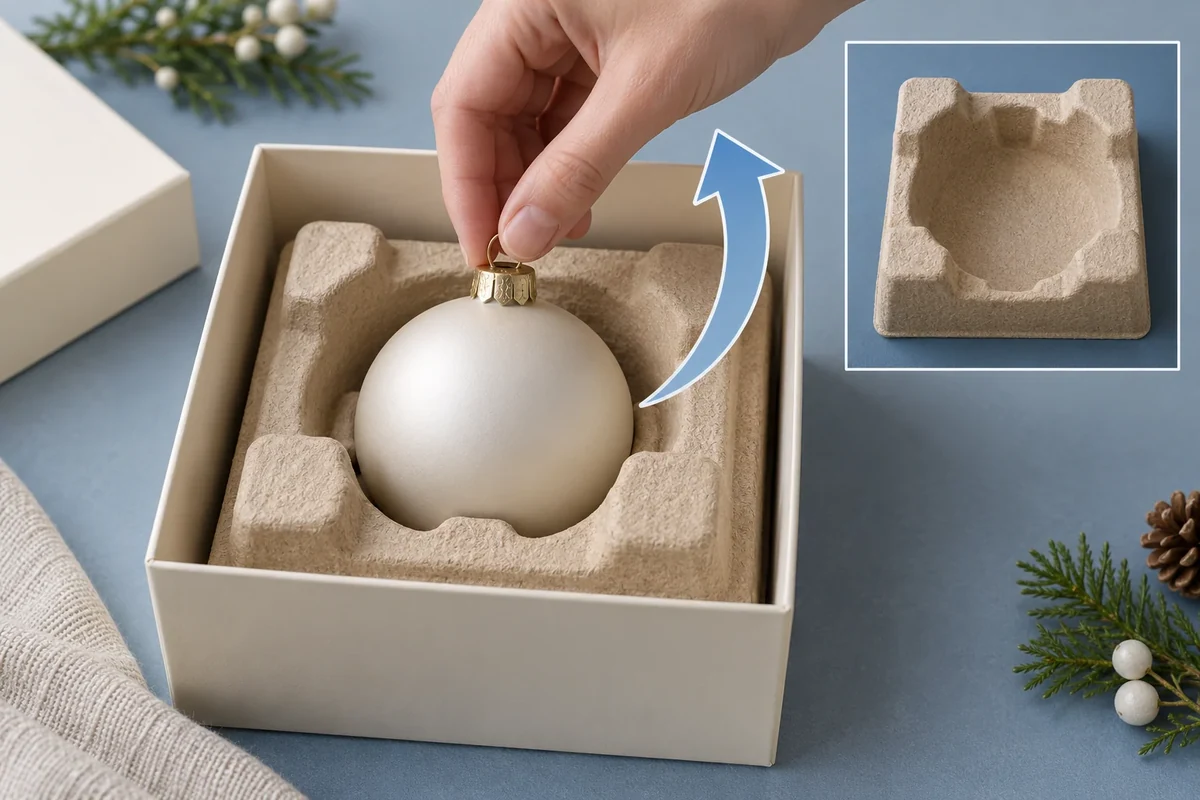
Review the release direction of a proposed pulp cavity with the product and holder installed as intended. Mark the contact points, starting grip and path out of the cavity. A product fitting into a concept recess does not show whether the customer can remove it through the same route.
This original sketch is a communication tool for a supplier proposal. It doesn’t prescribe tooling angles or claim a moulded-pulp component is verified for the product.
Identify the actual formed-part proposal
The moulded-pulp maker reference describes formed parts such as trays and end supports. That establishes a material/form context, not the fit or release geometry of a small gift cavity. Ask for the actual drawing and sample.
Name the product, holder and installed outer-pack state. Identify which surfaces are intended to touch and which remain open questions. Include any inner wrap that sits between the product and cavity.
Use the insert material guide for broader form selection. The release sketch begins after a specific cavity proposal is under discussion.
Draw touchpoints and a starting grip
Mark each proposed touchpoint on a side or sectional view. Show where fingers can reach before the product is moved. A gap visible in an isolated holder may be covered by the outer box wall or another item.
Draw the intended exit path and any change of direction. Keep supporting hands or a removal feature visible if they belong to the use. Avoid diagnosing the cause of difficult removal from a photograph alone.
| Release field | Input | Observation |
|---|---|---|
| Installed state | Holder, product and outer-pack identities | Complete starting view |
| Touchpoints | Named product/cavity surfaces | Section and located photos |
| Starting grip | Finger route before movement | Hand access view |
| Exit path | Direction and stages | Actual removal sequence |
| Changed action | Extra tilt, support or moved part | Deviation retained |
| Next proposal | Located supplier response | Revision and recheck state |
Keep contact with a cavity wall separate from an inaccessible grip. They can produce different questions even when the product ultimately comes out.
Follow a hypothetical ornament cavity
Suppose a gift ornament sits in a proposed pulp holder inside a box. The opening view looks acceptable, but the customer grip is near the surrounding wall. The buyer sketches that installed state rather than demonstrating removal from the loose holder.
A reviewer lifts the ornament along the intended route and records the point where another movement is needed. The sketch names touchpoint CP1 and starting grip GP1. No cause or production setting is assigned from that observation.
The supplier is asked to assess CP1/GP1 on the actual cavity proposal. A revised sample may change access, contact or another feature; those changes remain separately identified.
Preserve the useful comparison conditions
Ask: ‘Please review GP1 and the intended exit path with holder H1 installed in box B1.’ It names the configuration. A loose material swatch cannot answer the installed release question.
Keep product orientation, inner wrap and outer-wall state fixed when comparing revisions. If one changes, record the new condition before describing the result as a cavity-only change.
A clear removal observation does not establish retention, cushioning or repeated-use performance. Those requirements need their own agreed evaluation. The sketch locates the human action and the next source question.
Send the installed release job
Bring touchpoint views, starting grip and the complete removal sequence through Packrivo’s enquiry. Keep the next response tied to the actual proposed component, followed by review of the relevant revised sample.
Removing the loaded holder first creates another release job
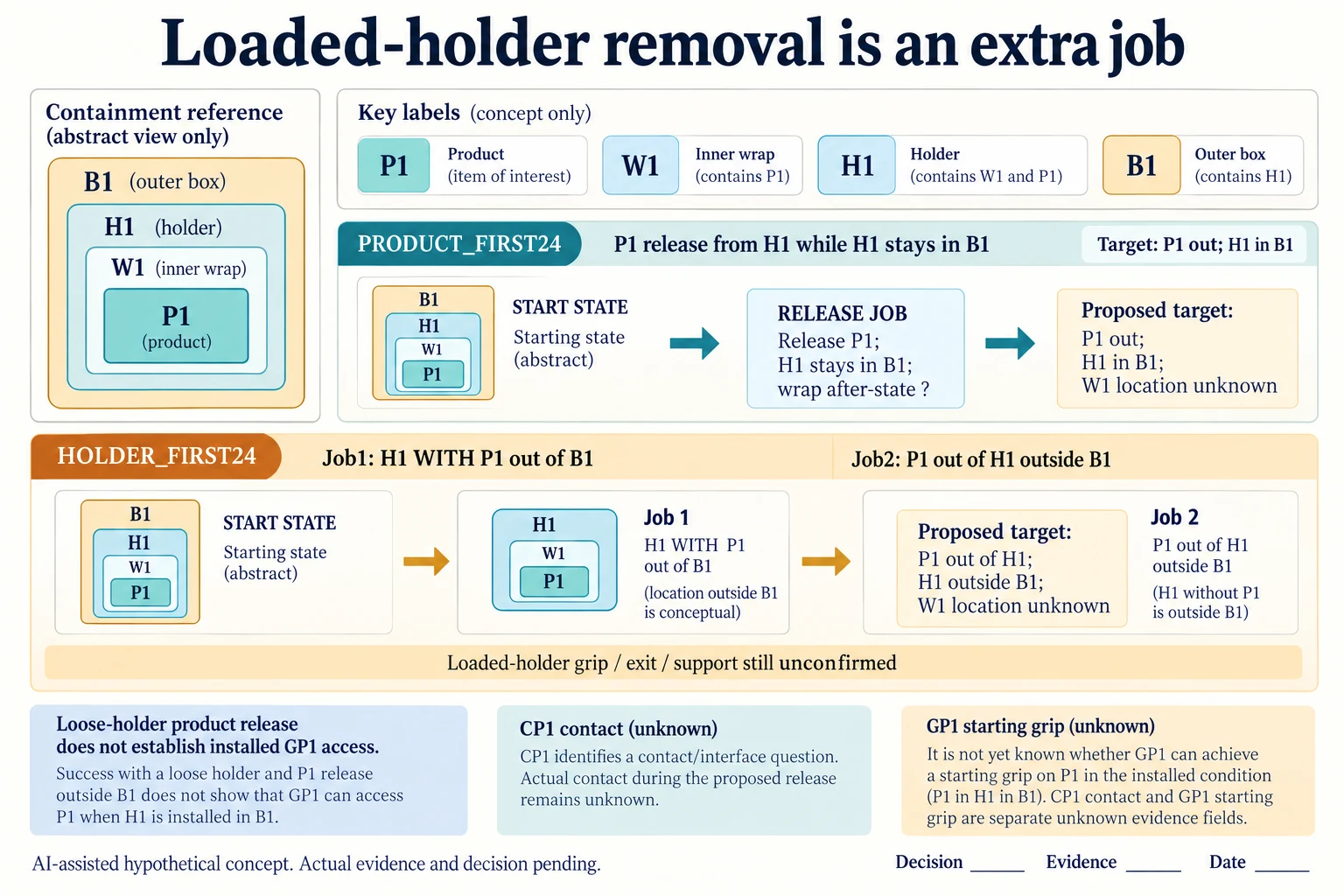
Keep an invented starting configuration P1 inside pulp holder H1, with inner wrap W1, installed in box B1. PRODUCT_FIRST24 asks whether P1 can leave H1 while H1 stays inside B1. HOLDER_FIRST24 proposes taking the loaded H1/P1 arrangement out of B1 before releasing P1 from H1 outside the box. Both aim to make the product available, but the second proposal introduces another object movement and a different product-release condition.
Scroll horizontally if columns extend beyond the view.
| Hypothetical configuration | Named object | Relationship | Input or next scope |
|---|---|---|---|
| PRODUCT_FIRST24 | P1 | proposed movement | OUT_OF_H1_WHILE_H1_IN_B1 |
| HOLDER_FIRST24 | H1_WITH_P1 | proposed movement | OUT_OF_B1 |
| HOLDER_FIRST24 | P1 | proposed movement | OUT_OF_H1_OUTSIDE_B1 |
| HOLDER_FIRST24 | H1_WITH_P1 | requires | LOADED_HOLDER_GRIP_EXIT_AND_SUPPORT |
The CSV gives each movement its own source container, target state and job reference. PRODUCT_FIRST24 has one proposed product-release job. HOLDER_FIRST24 has a loaded-holder removal job followed by a product-release job. Its first job requires a way to grip, move and support H1 with P1 still present; no tab, grip location or ability to perform that work is assumed. A loose-holder demonstration begins after that extra job and therefore cannot close the original installed GP1 question.
Keep CP1 contact and GP1 starting access separate in both requests. A change that exposes a grip does not, by itself, describe the cavity contact during travel. Conversely, a changed cavity interface can leave the outer wall in the same place. Name the holder’s final position as well: a product outside H1 while H1 remains in B1 differs from a product outside an already removed holder. Leave W1’s after-state open until the actual sequence identifies it; do not assume the wrap stays with H1.
Rollguard’s source identifies formed pulp applications, including trays and end supports; it does not supply this small gift’s release geometry. Request the actual formed component, complete contents and intended sequence. A selected route still needs its own evidence, and neither proposed sequence establishes retention, cushioning, repeated use or a tooling angle.
Download the pulp cavity installed release sequence record (.csv). It includes the original table fields and scenarios alongside the added relationships. HYPOTHETICAL rows are editorial examples or required review scopes, not actual records. Actual quantity, configuration, component and file identities, materials, process, specification, copy, method, condition, observation, owner, decision, evidence and dates are blank. ACTUAL_BLANK is a separate empty starting row; enter permitted project evidence before using an actual record. A blank means unknown.
Use the Packaging Insert Materials: Choose the Form Before the Name for its separate question. Use the Jewelry Box Insert Fit: Seven Measurements Before Sampling for its separate question. Use the Place the Removal Tab Where the Customer Can Reach It for its separate question.
Source scope checked 16 October 2026. References cover only the named materials, processes or guidance. Added configurations and geometry are hypothetical, not supplier specifications, tests or production approval; they set no universal tolerances or machine limits. Confirm the actual material, process, drawing and formed sample for the project.
Discuss this packaging specification with Packrivo. We coordinate independent suppliers. MOQ: 500 pieces per product/design; illustrative quantities are not production offers. Confirm materials, samples, price and timing for your project.