
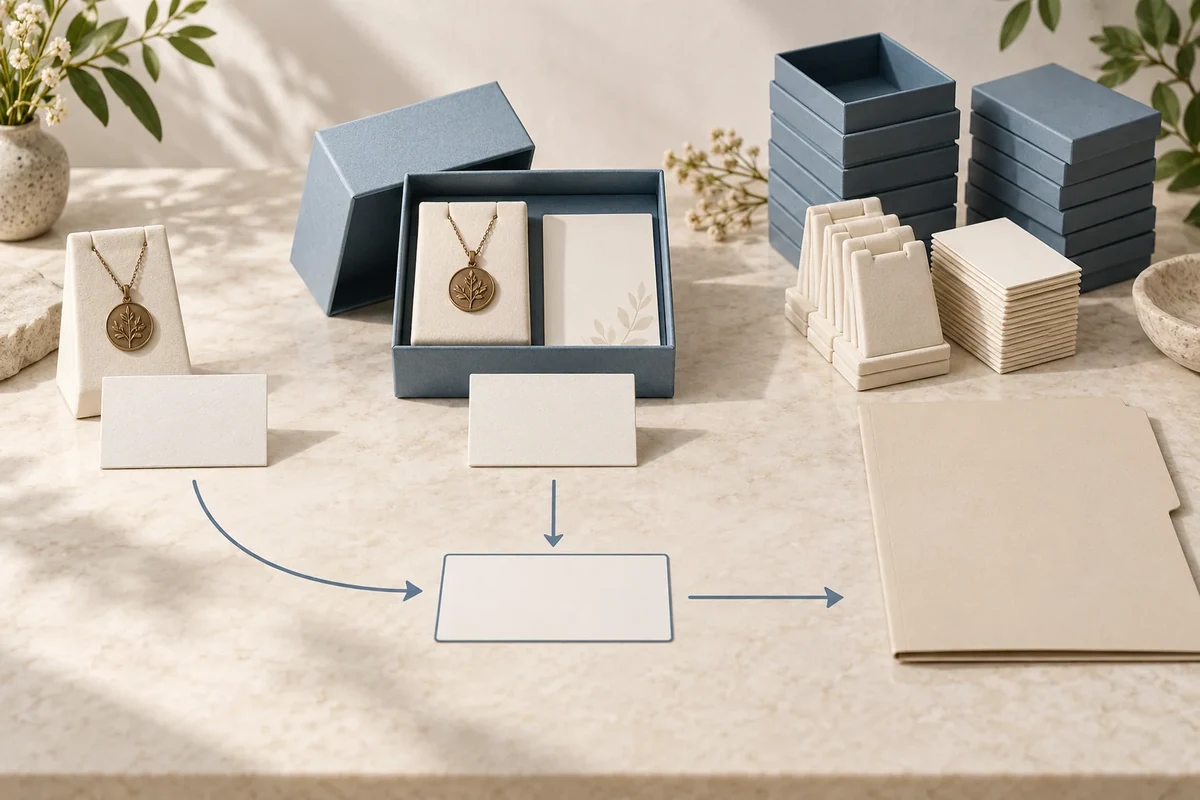
Separate requested sample configurations and trial quantities from the production order lines they may inform. Name whether a sample line is one component or a complete set, what it is meant to review and which evidence is required. This scope record clarifies sampling without changing Packrivo’s 500-piece-per-design production policy.
Give the sample a purpose and a unit
This is an original Packrivo scope worksheet. Sample quantity, availability, price and delivery are actual supplier questions; the table does not promise a free sample or a commercial exception.
List the configuration requested for review and the unit being counted. A separate insert, a printed card and a complete gift set can be different sample lines. State what each line is meant to answer, such as holder removal, card placement or the loaded closure.
Record the production component/design reference separately. A small requested trial quantity is a sampling input, while the intended production design and quantities have their own confirmed terms. Keep both visible before treating a response as a complete offer.
Connect sampling to the evidence needed for the decision
Use the quote comparison method for component/unit scope, and the sample approval guide for identifying what the sample should demonstrate. Those are upstream project methods, not an external standard governing sample-order lines.
Identify which actual product and primary packaging are needed for the review. If the sample substitutes material, print or another component, name the substitution and the remaining question. A trial component can answer a specific geometry issue while leaving the complete set unresolved.
Ask the supplier to confirm the offered sample state and quantity against each requested purpose. Keep missing commercial or preparation fields open. The buyer should be able to see which sample line supports which decision before authorizing the next arrangement.
Use a sampling and production line map
The hypothetical example below separates a holder trial from a complete-set review. Quantities remain requested fields awaiting confirmation.
| Line role | Illustrative entry | Purpose and next confirmation |
|---|---|---|
| Sample S1 | Holder I1, component unit | Review actual product removal; confirm offered trial quantity |
| Sample S2 | Complete gift set PK1 | Review holder/card/loaded lid together |
| Sample contents | Actual product plus supplied primary pack | Buyer identifies what must be sent for review |
| Production P1 | Box design BX1 and intended order line | Keep production quantity/terms separate |
| Production P2 | Holder I1 design/reference | Confirm component grouping and accepted version |
| Evidence gate | Named sample/drawing decision before next instruction | Buyer records accepted evidence and open scope |
Resolve an illustrative component-only sample response
Imagine a supplier offers a holder trial while the buyer’s main question concerns the card under the closed gift-box lid. Record the holder trial as one offered sample line and the complete closure question as a separate open line.
The next response should explain whether the box/card/holder combination will also be supplied or assembled for review. The buyer can proceed with a clearly scoped holder trial without pretending that it approves the complete set. Keep the eventual production design references linked to the accepted configuration.
Handoff the sample instruction and production scope separately
The buyer defines the decision and actual contents. The supplier confirms the sample construction, unit and commercial scope. The packing owner identifies any local assembly required for review, and the buyer retains the evidence supporting the next instruction.
Keep the production order lines visible even while sampling is incomplete. Packrivo’s minimum is 500 pieces per design; sample requests and their actual terms are confirmed independently within the project. Neither an example quantity nor a sample photo settles production scope.
Bring the sample/production line map and unresolved offered fields to your packaging brief. Packrivo helps prepare the question, coordinate responses and keep the accepted sample configuration attached to its intended production lines.
Count sample components without turning the plan into a production order
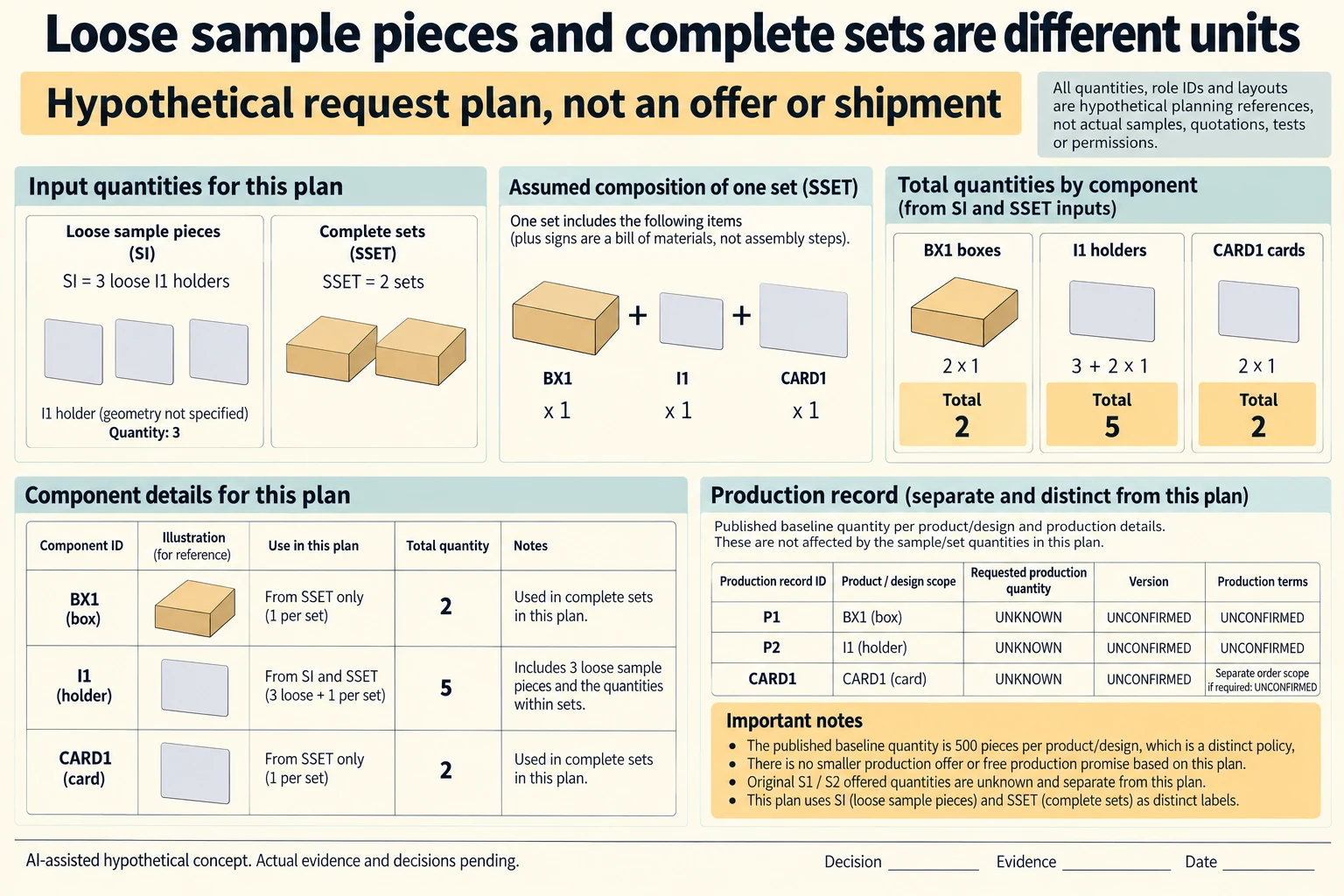
Keep the original S1 holder-only and S2 complete-set questions with their offered trial quantities still unknown. Then create a separate invented REQUEST_PLAN25: three loose I1 holder samples plus two SSET samples. Assume each SSET contains one BX1 box, one I1 holder and one CARD1. These are requested planning counts, not agreed sample availability, prices, a shipment or an exception to production policy.
Scroll horizontally if columns extend beyond the view.
| Hypothetical configuration | Named object | Relationship | Input or next scope |
|---|---|---|---|
| REQUEST_PLAN25 | SI | assumed requested quantity | LOOSE_I1; 3 holder samples |
| REQUEST_PLAN25 | SSET | assumed requested quantity | COMPLETE_SET; 2 set samples |
| REQUEST_PLAN25 | BX1 | assumed per set | SSET; 1 pieces/set |
| REQUEST_PLAN25 | I1 | assumed per set | SSET; 1 pieces/set |
| REQUEST_PLAN25 | CARD1 | assumed per set | SSET; 1 pieces/set |
| REQUEST_PLAN25 | BX1 | calculated from | PLAN_SET_QTY*SET_BOM_BX1; 2 pieces |
| REQUEST_PLAN25 | I1 | calculated from | PLAN_LOOSE_QTY+PLAN_SET_QTY*SET_BOM_I1; 5 pieces |
| REQUEST_PLAN25 | CARD1 | calculated from | PLAN_SET_QTY*SET_BOM_CARD1; 2 pieces |
| PRODUCTION25 | P1_BX1 | requires | CONFIRMED_PRODUCTION_QTY_AND_VERSION |
| PRODUCTION25 | P2_I1 | requires | CONFIRMED_PRODUCTION_QTY_AND_VERSION |
| PRODUCTION25 | CARD1 | requires | SEPARATE_ORDER_SCOPE_IF_REQUIRED |
The component arithmetic is now explicit: boxes 2×1=2, holders 3+2×1=5 and cards 2×1=2. The CSV links each total to the loose-sample count, set count and relevant per-set component row. Counting the three holders and two complete sets as five identical sets would overstate the boxes and cards. Conversely, counting only the two assembled sets would omit the three separate holder trials.
Keep production P1 for BX1 and P2 for I1 in separate rows with confirmed production quantities and accepted versions still required. Do not add these sample counts to a purchase order by assumption. CARD1 also needs its own order-scope question if required; it is not silently included in the box price. The published baseline remains 500 pieces per product/design, while actual sampling terms require project confirmation.
Match each sample line to its decision before discussing release. A loose holder trial can address its named removal question without closing the card-under-loaded-lid review for PK1. Identify the actual product, primary pack, omitted materials and any local assembly needed. Neither a sample photo nor this count calculation proves the full configuration, production readiness or an offered commercial arrangement.
Download the sample component production line planning record (.csv). It includes the original table fields and scenarios alongside the added relationships. HYPOTHETICAL rows are editorial examples or required review scopes, not actual records. Actual quantity, configuration, component and file identities, materials, process, specification, copy, method, condition, observation, owner, decision, evidence and dates are blank. ACTUAL_BLANK is a separate empty starting row; enter permitted project evidence before using an actual record. A blank means unknown.
Use the Sample Fee Credits Change the Comparison Only When Their Conditions Match for its separate question. Use the Custom Packaging Sample: Approval Checks That Matter for its separate question. Use the Link Component Approvals Before Releasing the Whole Set for its separate question.
Source scope checked 16 October 2026. References cover only the named materials, processes or guidance. Added configurations and geometry are hypothetical, not supplier specifications, tests or production approval; they set no universal tolerances or machine limits. Confirm the actual material, process, drawing and formed sample for the project.
Discuss this packaging specification with Packrivo. We coordinate independent suppliers. MOQ: 500 pieces per product/design; illustrative quantities are not production offers. Confirm materials, samples, price and timing for your project.