
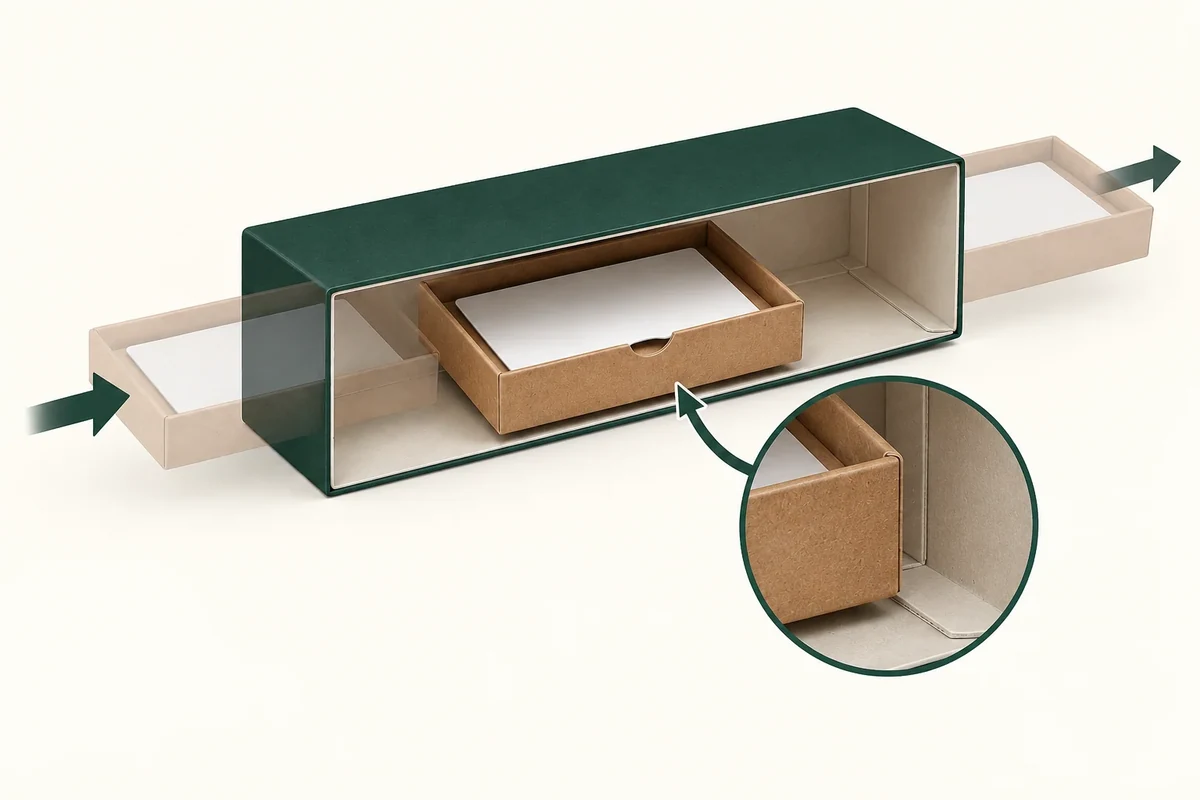
Map the sleeve seam against the loaded tray’s travel and record contact at entry, midway and removal. Keep seam-side contact separate from general clearance elsewhere in the sleeve. A closed fit photo can miss a local obstruction that appears only while the tray moves past the prepared seam.
This is a narrow diagnosis record for the moving interface. It helps a supplier locate the question before the buyer requests a larger sleeve, another board or a different finish.
Locate the seam on the actual sleeve
PackMojo’s tray and sleeve reference describes a two-piece construction with a sliding tray. That supports reviewing movement between components. Your supplier must confirm the actual seam and fold construction for the proposed sleeve.
Ask for a view of the sleeve interior and identify the prepared seam. Mark it on a simple cross-section or open working sketch. If the joining detail is hidden, request clarification instead of assigning it from the outside photograph.
Label the tray’s leading end and customer pull end. State which direction it enters and whether removal uses the same end. A contact map loses meaning if the tray is reversed between trials without a note.
The sample revision guide keeps the broader version trail. This map adds specific locations along one tray’s travel.
Observe movement in named stages
Load the actual tray with its product, holder and cards. Place the sleeve in the intended orientation. Follow the proposed entry route without squeezing or twisting the sleeve as an unrecorded workaround.
Pause near the mouth, midway and the final position. On removal, record where a contact begins or ends. Use a wider view to locate it and a closer view to show the seam relationship.
Mark contact away from the seam separately. A high product point against the roof is a different issue from a tray edge against an internal overlap. Both may occur in one sample, but they deserve different questions.
Use a seam and travel issue map
Draw the sleeve as a simple tunnel with the seam side labelled. Add the action record below without assigning unverified friction values.
| Stage | Location | Parts meeting | Evidence |
|---|---|---|---|
| Entry | Sleeve mouth and seam side | Leading tray edge and prepared overlap | First-contact image |
| Midway | Named point along travel | Tray perimeter and sleeve interior | Position and movement note |
| Closed | Final seated position | Tray and remaining envelope | Closed configuration view |
| Removal | Customer pull route | Same parts during exit | Contact onset and release |
| Other contact | Roof, opposite side or contents | Named separate interface | Separate issue ID |
Include drawing, seam and loaded-tray revisions. A new sleeve paired with an old tray should be treated as a new comparison configuration.
Follow a hypothetical seam-side obstruction
Suppose a folded tray carrying a gift card enters a sleeve smoothly at the mouth but catches midway near the seam side. The buyer records the exact travel stage and keeps the loaded tray orientation fixed.
The supplier is asked to compare that point with the seam proposal. The buyer doesn’t enlarge all sleeve dimensions immediately. If another contact appears at the roof, it receives a separate issue row rather than being labelled as the same seam problem.
A revised proposal may alter the seam, tray edge or another part. The map identifies what changed and which stage needs another check. The later sample is reviewed along the same route with the same complete contents.
Log a changed grip as part of the travel evidence
For the hypothetical sleeve, name the midway seam contact T2-S and the roof contact T2-R if both exist. Keep separate image references. That naming gives the supplier two located interfaces instead of one general complaint that the drawer is tight.
If a reviewer twists the tray to pass T2-S, record the changed action and the original obstruction. A workaround can be useful evidence, but it should not replace the intended route in the comparison. Ask whether the proposed construction should accommodate that action or be revised for the original one.
A precise question is: ‘Please review T2-S on the current sleeve and loaded tray, and identify the seam-related response.’ If the supplier proposes another board as well as another seam, record both changes. The next sample needs the same product configuration to support a useful comparison.
Keep a revised tray paired with its actual sleeve, even if the components carry familiar names. A contact disappearing under a different pairing doesn’t close the original configuration automatically. The map should say which pair and route were reviewed and which evidence remains open.
Send the located movement question
For a frame-tray configuration, the frame tray and sleeve direction adds the frame perimeter to the moving envelope. Use its component brief alongside this localized issue map.
Send the seam sketch, loaded configuration and stage images through Packrivo’s enquiry form. Ask for a response tied to the actual contact point. The map is an observational method, not a friction test or a repeated-use rating.
Keep each sleeve and tray pairing in its own travel record
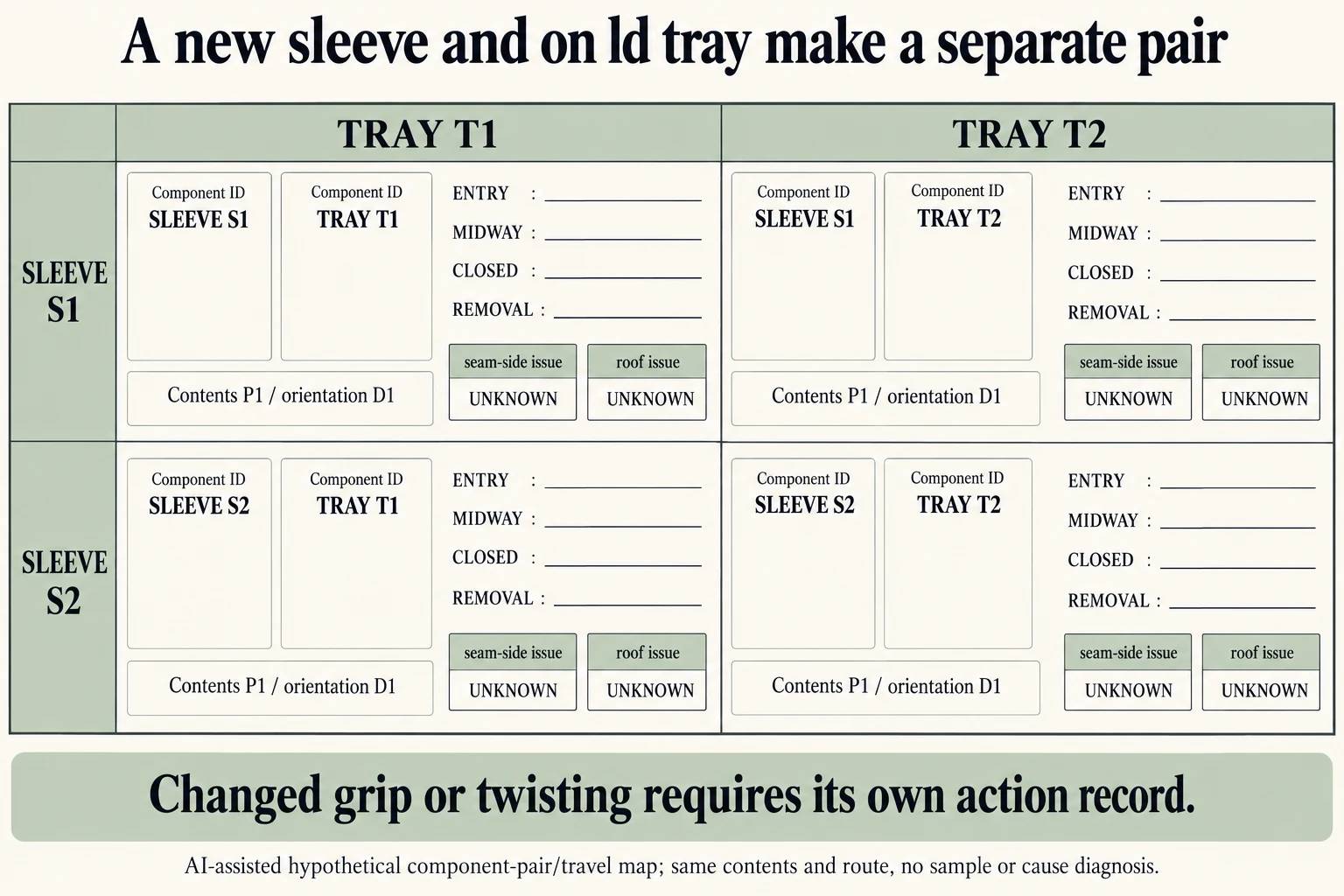
A proposal changing sleeve S1 to S2 does not establish what happened with every tray. Build a four-pair planning matrix: S1/T1, S1/T2, S2/T1 and S2/T2. Keep complete contents P1 and orientation D1 named in every row. These are proposed comparison configurations, not four fabricated fit tests or a claim that all pairings are useful production options.
Scroll horizontally if columns extend beyond the view.
| Hypothetical configuration | Named object | Relationship | Input or next scope |
|---|---|---|---|
| S1_T1 | S1_T1 | uses sleeve | S1 |
| S1_T1 | S1_T1 | uses tray | T1 |
| S1_T2 | S1_T2 | uses sleeve | S1 |
| S1_T2 | S1_T2 | uses tray | T2 |
| S2_T1 | S2_T1 | uses sleeve | S2 |
| S2_T1 | S2_T1 | uses tray | T1 |
| S2_T2 | S2_T2 | uses sleeve | S2 |
| S2_T2 | S2_T2 | uses tray | T2 |
For each selected pair, separate entry, midway, closed and removal observations. At every stage keep the seam-side question distinct from the roof question. A record for the original T2-S seam-side location should not absorb a T2-R roof contact simply because both occur while the tray moves. The CSV therefore gives each pair, stage and interface its own evidence request.
Ask which exact pair a supplier's returned photograph or action record represents. A new sleeve with a new tray can be reviewed as that complete candidate, but cannot retrospectively close the old S1/T1 issue. If the purpose is to understand the effect of only one component change, retain the other component, contents and route and document any difference. A changed material or prepared seam belongs in that identity too.
Keep a twist, squeeze or altered grip under its own action record instead of hiding it when the tray eventually passes. The matrix supports a specific next reply about a named pair and stage; it supplies no friction value, universal clearance or causal diagnosis. Actual contact onset, release, method, decision and evidence remain blank until the appropriate complete configuration is reviewed.
Download the sleeve seam tray travel contact map record (.csv). It includes the original table fields and scenarios alongside the added relationships. HYPOTHETICAL rows are editorial examples or required review scopes, not actual records. Actual quantity, configuration, component and file identities, materials, process, specification, copy, method, condition, observation, owner, decision, evidence and dates are blank. ACTUAL_BLANK is a separate empty starting row; enter permitted project evidence before using an actual record. A blank means unknown.
Use the Packaging Sample Revisions: Compare Versions Before Approval for its separate question. Use the Describe Surface Scuffs Before Requesting a Finish Change for its separate question.
References apply to the materials, processes or guidance named in each source. Worked configurations and dimensions are teaching examples, not tested specifications or production limits. Use the project’s material specification, drawing and formed sample for approval.
Discuss this packaging specification with Packrivo. We coordinate independent suppliers. MOQ: 500 pieces per product/design; illustrative quantities are not production offers. Confirm materials, samples, price and timing for your project.