
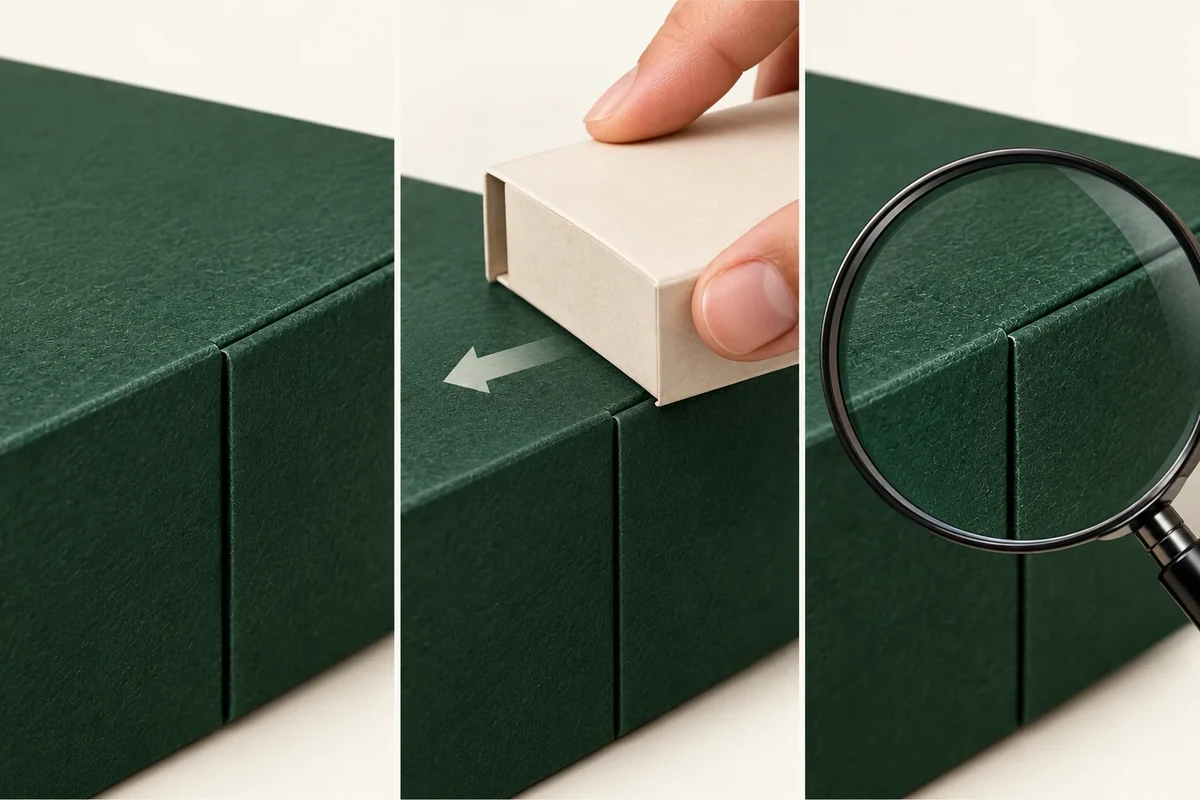
Describe a packaging scuff by the named surface, location and action that preceded it before requesting a different finish. Keep a before view, an after view and the sample revision together. A visible mark is an observation; it doesn’t establish the cause or prove that a proposed coating will solve it.
A request for ‘anti-scuff packaging’ can skip the useful information. The supplier needs to know where the mark appeared, what that surface is and how it was handled. Start with a located record instead of a treatment name.
Name the surface that carries the mark
Record the component and face, such as the sleeve’s inside rear seam area or the lid’s outside front panel. Include the proposed substrate, print and finish if known. If the surface construction is unclear, make that the first question.
Holmen’s technical information treats surface roughness and surface strength as separate properties. That distinction supports keeping a buyer’s visible scuff observation separate from material-sheet properties or technical test results.
Use a simple map with a location ID. A wide photograph should show where that ID sits on the component. A close-up alone can be hard to relate to the drawing.
The print finish brief is useful when a treatment is being proposed. This record comes before that choice, so the proposed change has a defined problem to address.
Record the action before the mark
Describe what happened to the sample before the mark was noticed. Examples include sliding a loaded tray, stacking two empty lids or moving the pack on a counter. Keep the words factual and avoid diagnosing friction, pressure or abrasion without evidence.
State whether the surface already had a mark in the starting view. If there is no starting photograph, record ‘starting condition not documented’. That gap matters because the after view cannot show when the mark appeared.
Keep repeated actions within a named review scope. Don’t invent a number of rubs or an improvised pass rule and present it as a standard. If a repeatable test is needed, ask the responsible party to agree its method and acceptance criteria.
Use a named-surface observation form
Make one record for one sample and one location. Use separate rows or records for different faces.
| Field | Entry to record | Evidence |
|---|---|---|
| Location | Component, face and marked area ID | Wide and close views |
| Surface | Substrate, print and proposed finish | Supplier description or unresolved question |
| Starting state | Visible condition before action | Before photo or declared gap |
| Action history | Named handling step and contents | Short sequence description |
| Observed mark | Position, shape and viewing condition | After photo under stated light |
| Next response | Cause assessment or candidate revision | Supplier reply linked to record |
Separate a mark on an outside panel from a mark at a moving seam. They may call for different construction or handling questions even if the same green artwork makes them look similar.
Work through a hypothetical sleeve mark
Suppose a brand reviews a loaded tray in a printed sleeve. After removal, the reviewer notices a pale mark on the sleeve near its internal seam. The starting condition was photographed, and the mark wasn’t visible in that view.
The buyer records the tray and sleeve revisions, loaded contents and the single removal action used. A contact map identifies the seam location. The supplier is asked to review that interface before a new exterior finish is requested.
If a candidate revision changes the seam position, record that as a construction change. If it changes the surface treatment, record that instead. A later comparison should use the same action and contents so the observation remains useful.
A revised sample with no visible mark under the stated view can close that observation scope. It doesn’t prove unlimited wear resistance or protection across every handling condition.
Separate a located mark from a candidate treatment
For the hypothetical sleeve observation, call the seam-side mark M1 and keep the preceding tray action A1. The material field identifies the proposed surface; the cause field remains open. This gives a later candidate treatment a defined observation to address.
If the supplier proposes both a seam change and a finish change, record them as two different revision items. A revised sample can then be compared with A1 and the same contents. An attractive outside image alone does not tell the buyer which interface was changed.
A precise request is: ‘Please assess M1 after A1 on sleeve S1 and state the candidate change and evidence needed.’ That invites a responsible review without instructing the supplier to add an unspecified coating. If the starting condition was not recorded, include that gap in the request.
Keep visual acceptance under stated conditions separate from any required repeatable test. If a technical evaluation becomes necessary, its agreed method and criteria should have their own record. The observation form can supply the location and action context without pretending it already measures abrasion resistance.
Give the supplier the located issue
Send the surface description, before-and-after views, action history and open question through Packrivo’s packaging enquiry. Ask for a response tied to the actual location. The next sample should identify what changed and what evidence is needed to review that change.
A combined seam and finish revision cannot isolate either change
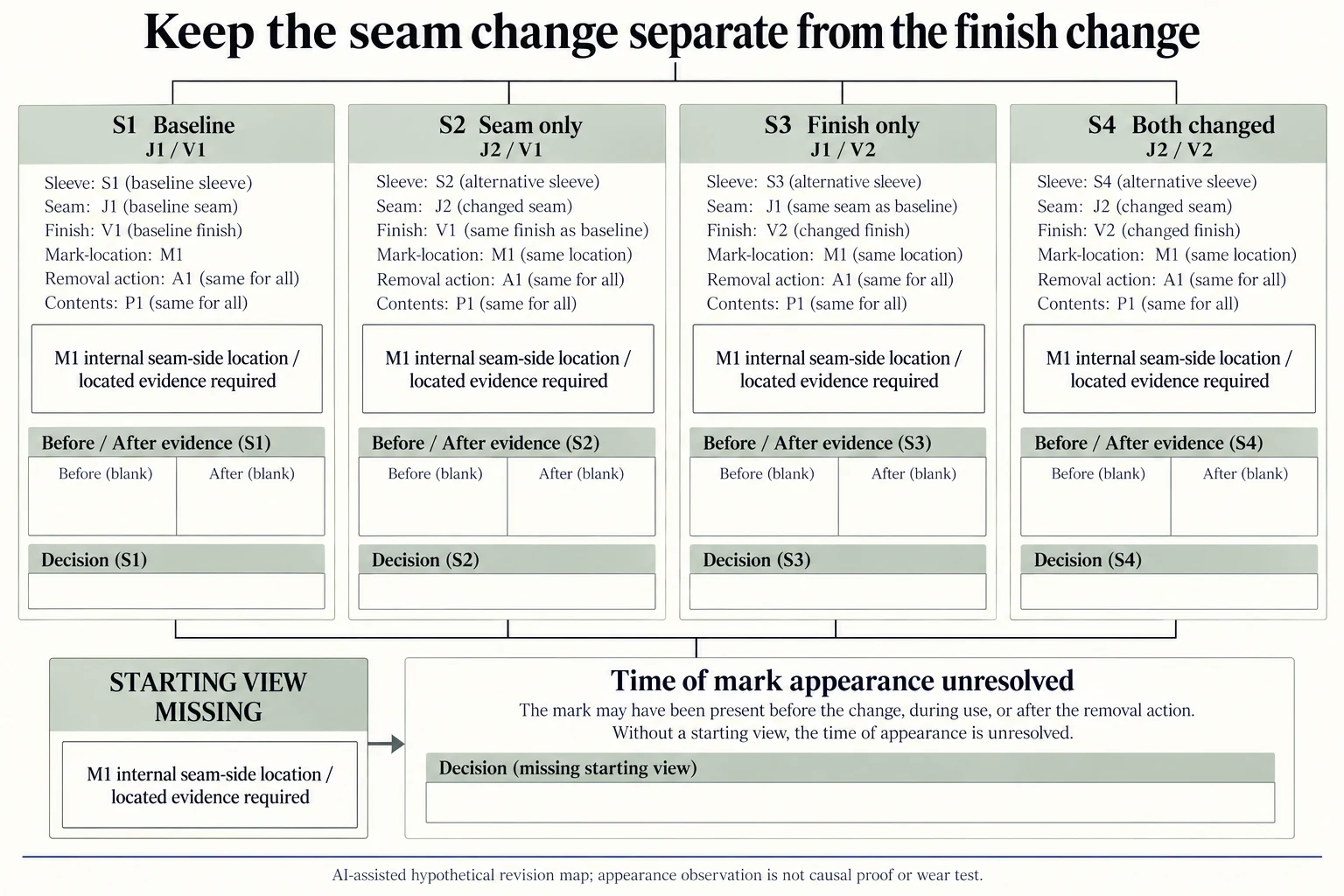
Use the original fictional internal sleeve mark M1 after loaded-tray removal A1. Name the baseline S1/J1/V1. S2 proposes J2 while retaining V1; S3 retains J1 while proposing V2; S4 proposes both J2 and V2. The contents P1 and named A1 remain comparison inputs in all four configurations. No candidate has been observed to improve the mark.
Scroll horizontally if columns extend beyond the view.
| Hypothetical configuration | Named object | Relationship | Input or next scope |
|---|---|---|---|
| S1 | S1 | uses seam | J1 |
| S1 | S1 | uses finish | V1 |
| S2 | S2 | uses seam | J2 |
| S2 | S2 | uses finish | V1 |
| S3 | S3 | uses seam | J1 |
| S3 | S3 | uses finish | V2 |
| S4 | S4 | uses seam | J2 |
| S4 | S4 | uses finish | V2 |
S2 requests evidence of the changed seam relationship under the same action. S3 requests evidence for the new surface proposal while the seam stays identified. S4 can be reviewed as a complete candidate, but its difference from S1 cannot by itself tell the buyer which changed field accounts for a visible result. If contents, grip or orientation changes too, record that new configuration before drawing even a limited comparison.
Keep the starting view's status independent of the revision. When M1 was not visible in the fictional starting photograph, that is a located appearance statement under that view. When the starting condition is undocumented, the time of mark appearance remains unresolved. An attractive after image cannot reconstruct it. The download keeps those evidence conditions separate rather than treating a missing before view as an absence of a mark.
The buyer's output is a comparison request naming the candidate, location, action and missing evidence. Actual before/after observations, methods and decisions remain blank. The original single removal action is not a rub-cycle standard, and a favorable appearance observation would not establish unlimited wear or transport protection. A required technical test needs its own agreed method and criteria; this record locates the question without prescribing a finish cure or test count.
Download the packaging surface scuff observation record record (.csv). It includes the original table fields and scenarios alongside the added relationships. HYPOTHETICAL rows are editorial examples or required review scopes, not actual records. Actual quantity, configuration, component and file identities, materials, process, specification, copy, method, condition, observation, owner, decision, evidence and dates are blank. ACTUAL_BLANK is a separate empty starting row; enter permitted project evidence before using an actual record. A blank means unknown.
Use the Map Sleeve Seam Contact During Tray Travel for its separate question. Use the Packaging Sample Revisions: Compare Versions Before Approval for its separate question.
References apply to the materials, processes or guidance named in each source. Worked configurations and dimensions are teaching examples, not tested specifications or production limits. Use the project’s material specification, drawing and formed sample for approval.
Discuss this packaging specification with Packrivo. We coordinate independent suppliers. MOQ: 500 pieces per product/design; illustrative quantities are not production offers. Confirm materials, samples, price and timing for your project.