
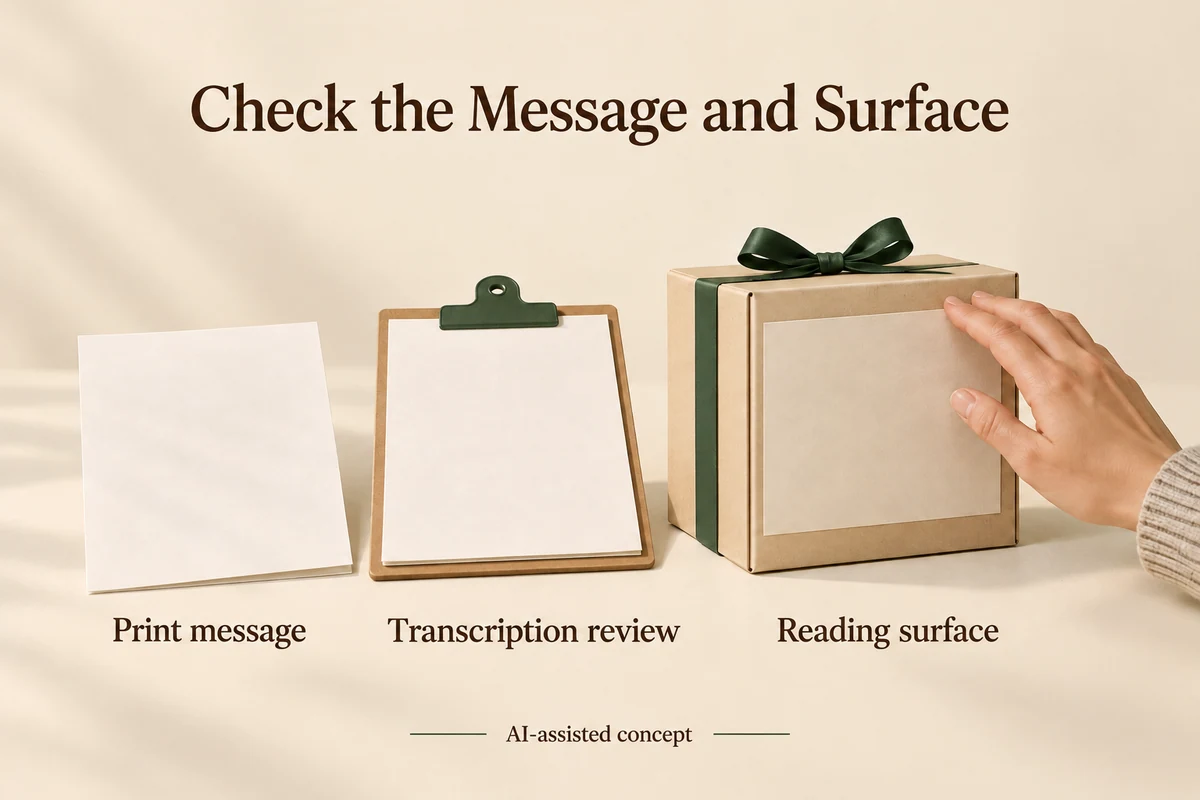
Braille on gift packaging needs two kinds of evidence: the raised information must represent the intended message correctly, and its physical reproduction must be readable by touch. A dot-shaped font or an embossed decorative pattern cannot establish either result.
For a brand exploring this option, first identify the information a braille reader needs. Then obtain a code-specific transcription review and a physical reading proof. The example below is hypothetical; no braille artwork, sample or reader evaluation has been produced.
Give written information a different job from an opening cue
An embossed logo can provide decoration. A tactile marker can help a customer find a pull tab. Braille communicates linguistic information. State which job the feature is intended to perform before choosing its production method.
The accessible gift-packaging guide addresses locating, gripping, opening and removing the gift. Those actions do not establish that a raised product identifier conveys correct words or numbers.
Braille also serves people who read it. Ask the intended users which information routes help them; a braille feature alone does not address every blind or partially sighted recipient’s needs.
Keep the print message and braille code identifiable
Suppose a brand wants the hypothetical identifier “Candle Gift Set 02” on its carton in braille. The brand must approve that exact message before transcription. The identifier is an example, not a real product or approved braille string.
Check source characters carefully. RNIB’s transcription guidance identifies errors such as using a letter in place of a numeral or a superscript zero instead of the proper degree symbol. A visually similar source character can give the transcription process the wrong input.
Name the reading language and ask a qualified transcriber which code and contracted or uncontracted approach fit the message. For English, the International Council on English Braille publishes the Rules of Unified English Braille, Third Edition, 2024. Its numeric mode and contraction rules require more than replacing each print character with a dot-shaped character.
“Set 02” therefore needs a code-specific review of the letters and number. Do not select contracted braille merely to squeeze the message onto a small panel. The transcriber should resolve that choice for the intended content and readers. UEB does not replace the braille code required for a different reading language.
A braille font is a display tool, not transcription approval
RNIB’s braille-font guidance warns that changing an ordinary print font to a braille font can produce incorrect numbers or contracted braille. It distinguishes simulated on-screen dots from a method that produces raised braille.
Ask the qualified reviewer to compare the transcribed message with the approved print source using an appropriate braille representation or reading medium. Retain the language, code, edition, contraction decision, source revision and accepted transcription file. If software is used, keep its relevant version and transcription-table identity with the record.
The brand can request this evidence without claiming to read braille itself. An apparently plausible Unicode string or screenshot should remain a reference until the appropriate content review is complete. RNIB also notes that rule updates and software updates may occur at different times.
Evaluate the intended raised reading surface
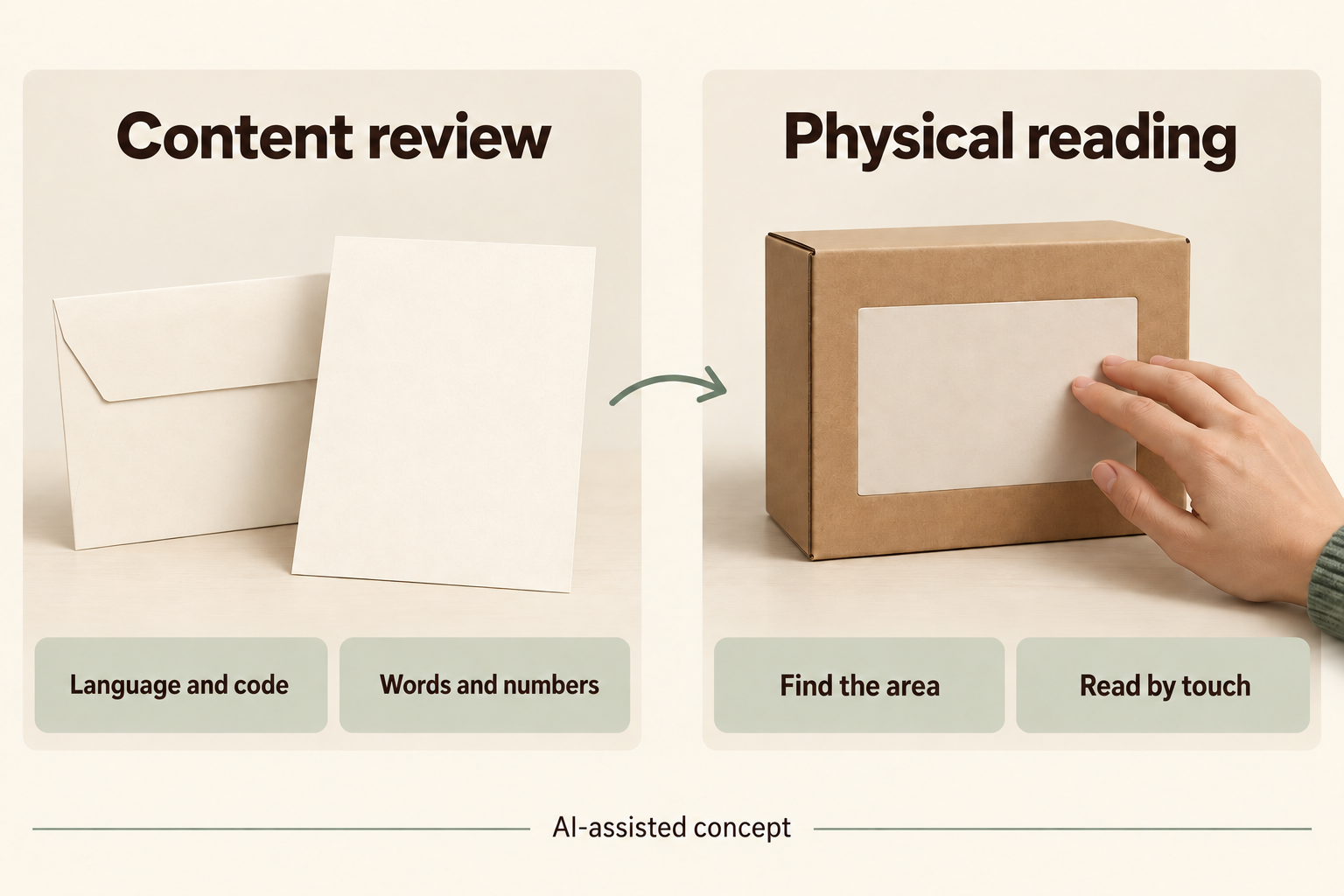
A correctly transcribed message still needs suitable physical reproduction. Ask the proposed producer to identify the offered surface and process, then prepare a proof or sample representing that packaging construction. A screen enlargement cannot show what a finger will encounter.
With appropriate specialist input and relevant braille readers, examine whether the feature can be found, whether its information can be followed by touch and whether adjacent relief, folds or components interfere. Record the configuration and what was actually observed. These are project planning questions, not a prescribed test method or certification result.
The transcriber may need to check the produced copy for content or reproduction errors as well. Keep that code review distinct from feedback about finding and reading the feature during use.
RNIB’s font page gives a size example for a particular swell-paper application. It is not a universal dot-size requirement for gift boxes or labels. Obtain physical specifications from the appropriate specialist and proposed process; this guide supplies no manufacturing dimensions or tolerances.
Match each error to the decision it changes
| Evidence or issue | Decision to reopen |
|---|---|
| The brand changes “Set 02” to “Set 03” | Review the revised source and its transcription; the old number approval does not cover it |
| Numbers or contractions were produced by a simple font change | Obtain code-specific transcription and proofreading before accepting the content |
| Correct content exists only as a screen image | Keep physical readability unresolved; request the appropriate raised proof |
| The produced message is difficult to locate or follow | Review the position, surrounding features and physical production, then evaluate the revised configuration |
| A raised opening marker is labeled as braille | Identify it as an action cue; initiate transcription only if written information is required |
For the hypothetical carton, accepting the print message closes only the source-wording decision. The braille code choice, reviewed transcription and physical reading evidence remain open. Moving an accepted message to another panel can reopen physical reading conditions even when its wording stays the same.
Bring the message, reading language, proposed packaging surface and unresolved specialist questions to the packaging brief. Packrivo can coordinate those packaging questions; the qualified transcriber, producer and relevant readers provide their respective evidence. No braille production, specialist capacity or accessibility certification service is established by this article.
Sources accessed 9 October 2026. RNIB’s cited pages display no publication date; the ICEB page identifies the 2024 rulebook and later technical guidance updates. The short identifier and review sequence are hypothetical editorial planning aids. No transcription, physical proof, user study or legal accessibility conclusion has been approved here. Any accompanying illustration is an AI-assisted concept and must not be used as braille artwork.
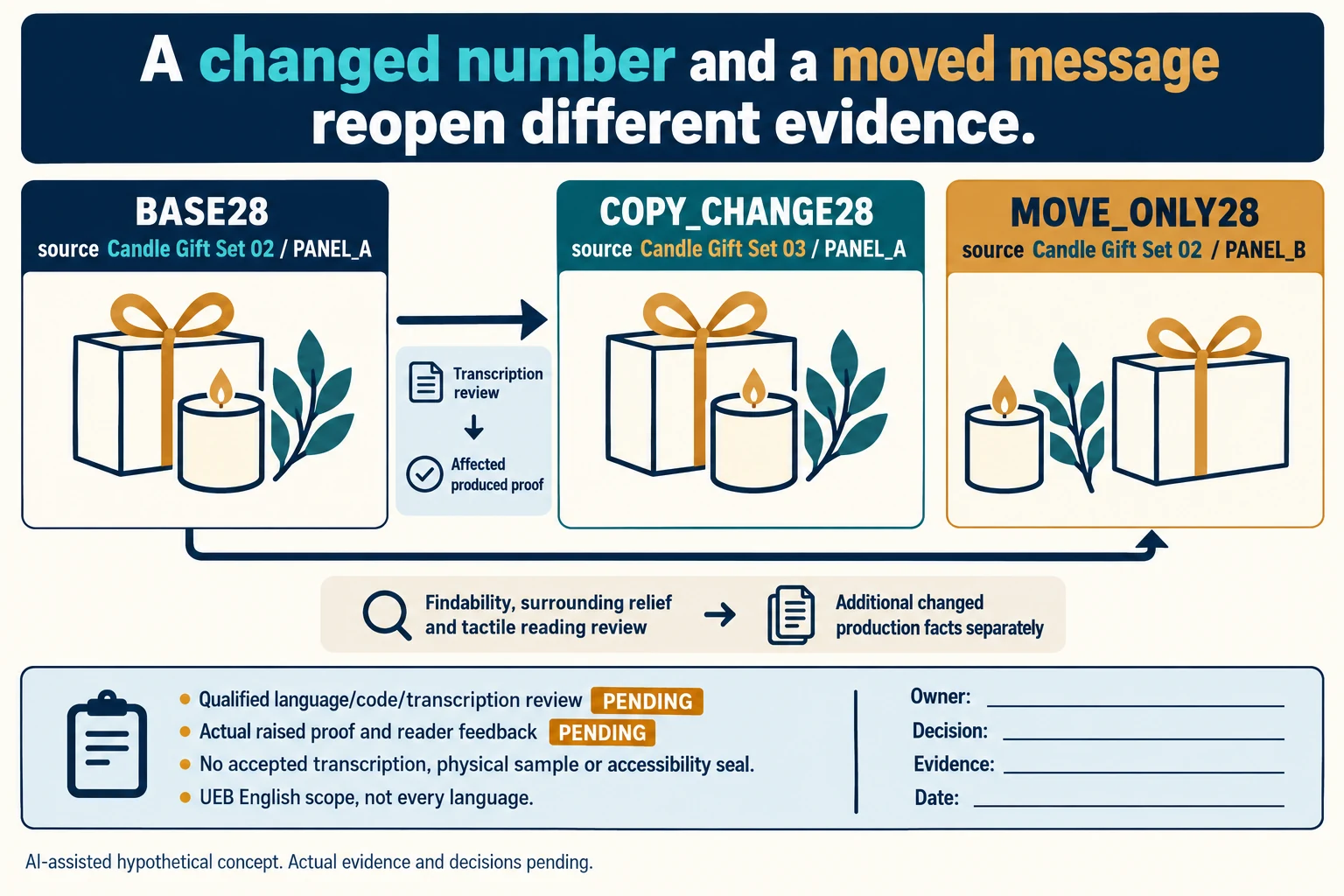
A changed number and a moved message reopen different evidence
Use print text only to compare three hypothetical requests. BASE28 names “Candle Gift Set 02” on PANEL_A. COPY_CHANGE28 substitutes “Candle Gift Set 03” on that panel. MOVE_ONLY28 retains the Set 02 wording but proposes PANEL_B. These are source and location tokens, not approved wording, transcribed braille or produced packaging.
Scroll horizontally if columns extend beyond the view.
| Hypothetical configuration | Named object | Relationship | Input or next scope |
|---|---|---|---|
| BASE28 | BASE28 | assumed print source | Candle Gift Set 02 |
| BASE28 | BASE28 | assumed panel | PANEL_A |
| COPY_CHANGE28 | COPY_CHANGE28 | assumed print source | Candle Gift Set 03 |
| COPY_CHANGE28 | COPY_CHANGE28 | assumed panel | PANEL_A |
| COPY_CHANGE28 | 02_TO_03 | reopens | SOURCE_AND_TRANSCRIPTION_PLUS_AFFECTED_PHYSICAL_PROOF |
| MOVE_ONLY28 | MOVE_ONLY28 | assumed print source | Candle Gift Set 02 |
| MOVE_ONLY28 | MOVE_ONLY28 | assumed panel | PANEL_B |
| MOVE_ONLY28 | SAME_WORDS_NEW_PANEL | reopens | FINDABILITY_SURROUNDING_RELIEF_AND_TACTILE_READING |
| BOTH28 | DOT_FONT | does not establish | CORRECT_TRANSCRIPTION_OR_RAISED_READABILITY |
| ENGLISH28 | UEB | does not replace | OTHER_LANGUAGE_REQUIRED_CODE |
The number change needs a revised source decision and code-specific transcription review, followed by review of the affected produced copy. An earlier transcription tied to 02 does not answer 03. Preserve the source characters as text: the leading zero is part of the invented identifier, and a similar-looking letter is not the same character. No dot pattern, Unicode braille string or automatic font conversion is supplied here.
Moving unchanged wording primarily reopens finding and reading the feature in its new surroundings. Folds, nearby relief, access and the offered process may differ on another panel. Any actual content or process change identified during that move needs its own review too; unchanged wording does not establish that a new physical surface reproduces it correctly. Retain any earlier content evidence under its exact scope rather than relabel it as a new tactile proof.
Ask the qualified transcriber for the reading language, code, edition and applicable updates, contraction decision and accepted source-to-transcription relationship. The ICEB page lists the 2024 UEB rulebook alongside later technical guidance, including a July 2025 update. UEB concerns English, and a screen font is not raised reading evidence. The producer and relevant readers still need to evaluate the intended physical construction under an appropriate arrangement. An opening cue can retain its different job without being called linguistic braille.
Download the braille packaging source revision panel evidence record (.csv). It includes the original table fields and scenarios alongside the added relationships. HYPOTHETICAL rows are editorial examples or required review scopes, not actual records. Actual quantity, configuration, component and file identities, materials, process, specification, copy, method, condition, observation, owner, decision, evidence and dates are blank. ACTUAL_BLANK is a separate empty starting row; enter permitted project evidence before using an actual record. A blank means unknown.
Use the Accessible Gift Packaging for Limited Dexterity for its separate question. Use the Assign Product Copy Responsibility Before the Packaging Proof for its separate question.
Source scope checked 17 October 2026: RNIB and ICEB sources address transcription and English UEB, including the 2024 rulebook and later listed technical updates. They do not establish another language, a correct font conversion, produced raised dots or tactile-reader acceptance. The added configurations and calculations are hypothetical, with actual evidence and decisions pending.
Discuss this packaging specification with Packrivo. We coordinate independent suppliers. MOQ: 500 pieces per product/design; illustrative quantities are not production offers. Confirm materials, samples, price and timing for your project.