
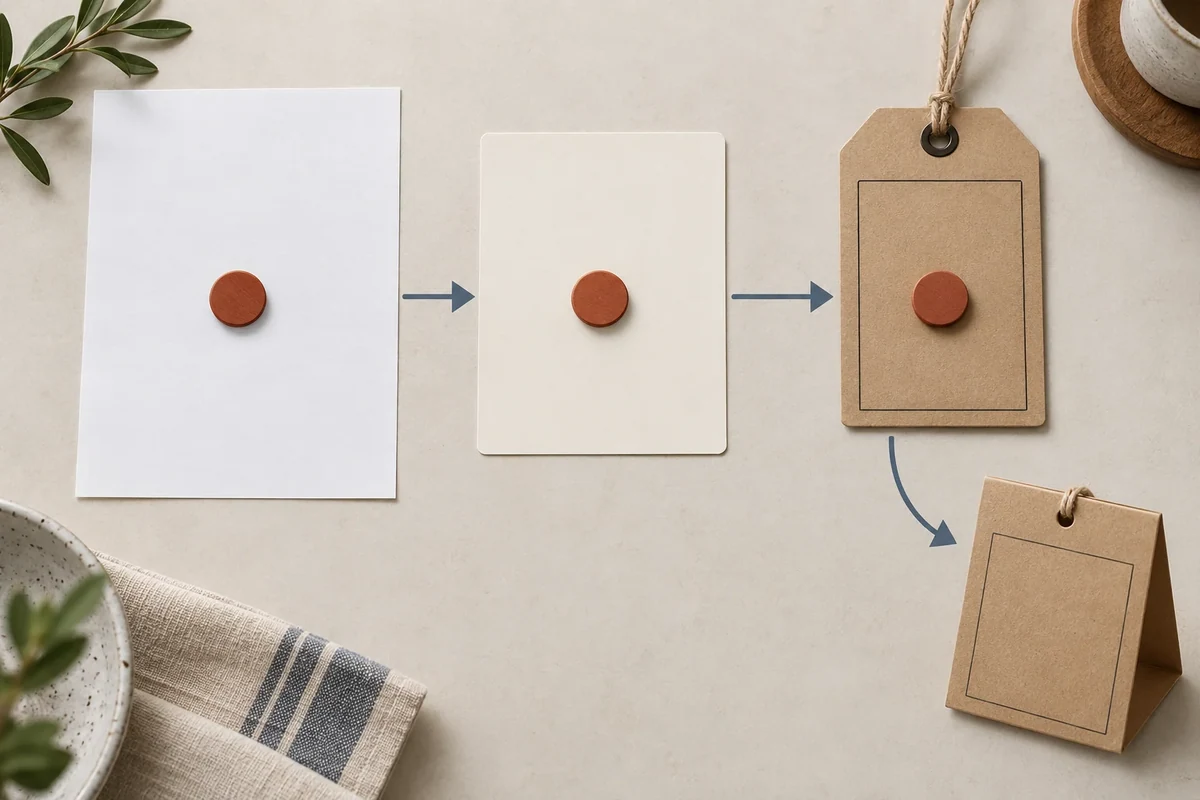
Assign the supplier and approver of each retail-copy block before the packaging proof. Record its version and the decision it covers, then keep wording approval separate from layout and print review. A designer placing text in the right panel does not establish that the supplied wording is correct for the product.
The useful output is a copy-owner map that travels with the artwork. It doesn’t invent product claims or assign professional authority from a job title alone.
Name each supplied text block
Give care copy, product identity, instructions and other required blocks separate IDs. Record who supplied them and the actual version. Keep the original wording through the authorized project process rather than retyping from a blurry image.
Adobe’s packaging workflow description separates design, review and printing/finishing functions. It provides workflow context, not a rule naming your copy owners or confirming legal compliance.
The brand or responsible source should identify the reviewer appropriate for the actual wording. If a specialised requirement exists, record that review scope explicitly rather than relying on a layout proof to settle it.
Use the artwork handoff to connect the accepted wording to the actual file. Content version and artwork version can change at different times.
Keep copy and placement decisions distinct
Record whether the wording is confirmed, provisional or awaiting a named response. The layout can be reviewed while a block remains provisional, but the status should be visible in the file record.
If wording changes after placement, identify the affected panels and proof. A designer should not silently shorten a required instruction to fit space without a responsible content decision.
| Copy field | Entry | Decision/status |
|---|---|---|
| Text-block ID | Named content purpose | Separate from panel name |
| Supplier of wording | Actual responsible source | Version and date |
| Content reviewer | Role and review scope | Confirmed or awaiting response |
| Artwork location | Panel and file revision | Placement review |
| Changed text | Old/new version link | Affected proof to recheck |
| Final handoff | Current confirmed blocks | Unreviewed wording retained as gap |
The table is a project record, not a guarantee that all regulatory or market requirements have been covered. Its job is to make responsibility and evidence explicit.
Follow a hypothetical care-copy change
Suppose a gift brand supplies a care paragraph for a tag. The wording owner later revises one instruction while the designer is arranging the tag artwork. The copy map updates the text version and identifies its panel.
The designer uses that version in the next proof, while the content reviewer confirms the wording under its actual scope. Placement and wording remain separate statuses.
If space becomes tight, the team asks the wording owner about a revision rather than inventing a shorter product promise. The next proof keeps the accepted copy version traceable.
Use a block-specific next question
Ask: ‘Please confirm care block CB2 and its approved wording for artwork revision A3.’ It names the text and file. A general message that the design looks good may leave CB2’s content scope unanswered.
Record which language and market the supplied wording is intended for if relevant. A confirmed block should not be copied to another product or market without its responsible scope being checked.
The original map coordinates supplied facts and approvals. It does not create a certification, approve unsupported product claims or replace a required specialist review.
Send the wording gap
Bring text-block IDs, source versions and unresolved responsibilities through Packrivo’s enquiry. Keep the next response attached to the actual copy and file so an artwork proof does not conceal a missing content decision.
Match the content revision before matching layout to export
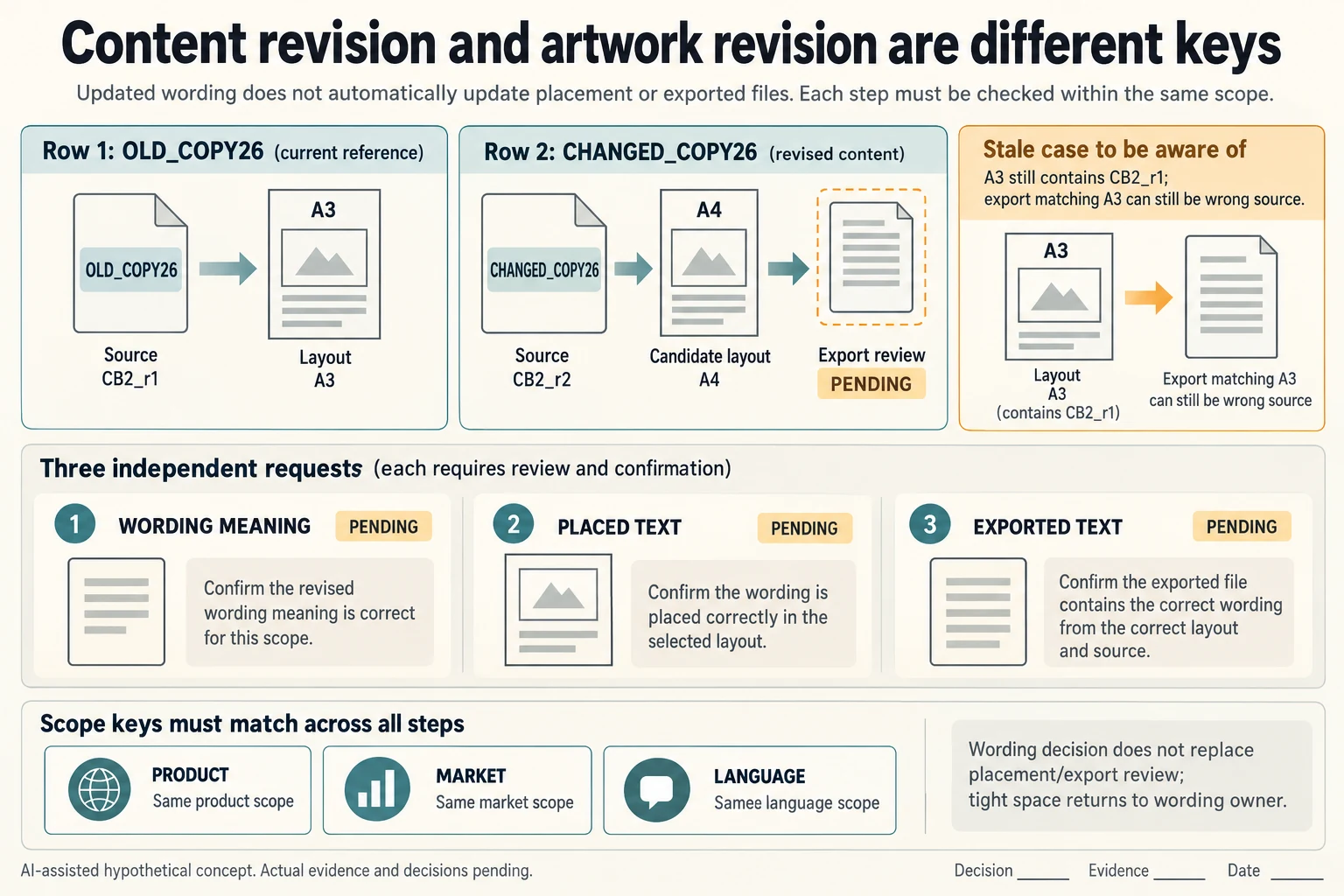
Give the care content block and the artwork separate revision identities. In this invented extension OLD_COPY26 links CB2_r1 to A3; CHANGED_COPY26 proposes CB2_r2 in A4. The identifiers represent source-to-layout associations, not actual care instructions or accepted files. The original wording owner’s change during layout remains a content decision, while the designer’s placement work has its own scope.
Scroll horizontally if columns extend beyond the view.
| Hypothetical configuration | Named object | Relationship | Input or next scope |
|---|---|---|---|
| OLD_COPY26 | OLD_COPY26 | uses content revision | CB2_r1 |
| OLD_COPY26 | OLD_COPY26 | uses artwork revision | A3 |
| CHANGED_COPY26 | CHANGED_COPY26 | uses content revision | CB2_r2 |
| CHANGED_COPY26 | CHANGED_COPY26 | uses artwork revision | A4 |
| STALE26 | A3 | assumed contains | CB2_r1 |
| CHANGED_COPY26 | A4 | candidate contains | CB2_r2 |
| CHANGED_COPY26 | CB2_r2_WORDING_DECISION | does not replace | A4_PLACEMENT_AND_EXPORT_DECISIONS |
| REUSE26 | CB2_r2 | requires match | LANGUAGE |
| REUSE26 | CB2_r2 | requires match | PRODUCT |
| REUSE26 | CB2_r2 | requires match | MARKET |
STALE26 records A3 still containing CB2_r1. Matching an export to that layout would not prove that the newer content was used. First compare the intended source revision with the placed block, then compare the exact export with the reviewed layout and source. A4 containing CB2_r2 is a candidate requiring placement and exported-text review, not a completed correction merely because its revision is newer.
The CSV keeps wording meaning, placed text and exported text as distinct decision requests. Actual wording is empty; no invented care instruction is provided. If the revised block does not fit, return the space problem to the authorized wording owner rather than shorten it silently or invent a performance claim. A job title can identify a contact without proving authority over every text block.
Before reuse, match product, market and language independently. A confirmed source for one scope does not authorize another translation or market statement. Adobe’s packaging workflow explains different design, review and rendering functions; it does not choose the content owner or determine legal wording. The multilingual-proof guide handles meaning, typography and final-size reading after those source responsibilities are established.
Download the packaging copy content artwork revision mapping record (.csv). It includes the original table fields and scenarios alongside the added relationships. HYPOTHETICAL rows are editorial examples or required review scopes, not actual records. Actual quantity, configuration, component and file identities, materials, process, specification, copy, method, condition, observation, owner, decision, evidence and dates are blank. ACTUAL_BLANK is a separate empty starting row; enter permitted project evidence before using an actual record. A blank means unknown.
Use the Multilingual Packaging Proofs Need Three Separate Checks for its separate question. Use the Packaging Artwork Handoff Checklist for Print Approval for its separate question. Use the Packaging Dieline Changes Need an Impact Record for its separate question.
Source scope checked 16 October 2026. References cover only the named materials, processes or guidance. Added configurations and geometry are hypothetical, not supplier specifications, tests or production approval; they set no universal tolerances or machine limits. Confirm the actual material, process, drawing and formed sample for the project.
Discuss this packaging specification with Packrivo. We coordinate independent suppliers. MOQ: 500 pieces per product/design; illustrative quantities are not production offers. Confirm materials, samples, price and timing for your project.