

Define what the customer buys as one fixed gift set before preparing its barcode artwork. Keep that set separate from the individual products inside and from the carton used to transport it. A change to the assortment can require an identity decision even when the outer box and printed design remain unchanged.
GTIN means Global Trade Item Number, GS1’s identifier for a trade item. A barcode can carry that identifier; choosing and checking the symbol is a separate task. This article helps the brand’s barcode owner organize the identity decision, without assigning identifiers or certifying printed barcode quality.
Describe the sold set before the physical layers
Write the fixed contents and quantities of the offer in plain words. State whether customers order the complete assortment as one item or choose its pieces separately. A fitted insert and one outer box do not, by themselves, resolve that commercial identity.
For a hypothetical gift set, Set A contains one Item P and one Item Q as its fixed offer. These are explanatory labels, not real GTINs. Describe the sold set separately from its two constituent products and from any outer transport packaging.
If the offer lets each customer choose a different combination, stop before applying a fixed-assortment example to it. Ask the responsible specialist which identification rules fit the actual offer and trading-partner requirements.
Review a content substitution as an assortment change
Section 2.9 of the GS1 GTIN Management Standard describes a predefined assortment as a fixed bundle of at least two trade items sold together. Replacing, adding or changing a constituent requires a new assortment GTIN. A unique GTIN is also assigned at each existing packaging-hierarchy level above that retail/base unit. Constituent identifiers remain separate from the assortment’s identity.
The PDF reviewed here is release 1.1, ratified in September 2023. Use the applicable current GS1 guidance and market requirements with the brand’s specialist when making a real decision. This explanation is not a substitute for that review.
Compare the offer before comparing artwork files
Consider four hypothetical proposals for a gift brand. No dimensions, prices or identifiers are assumed.
| Proposal | What actually changes | Decision to take to the barcode owner |
|---|---|---|
| Set A still contains Item P and Item Q | The presentation mockup changes | Identify the precise packaging change and check all applicable rules; do not infer a decision from appearance |
| Item Q is replaced by Item R in the fixed set | The assortment’s constituent changes | Review the predefined-assortment change and its existing packaging hierarchy before reusing identity data |
| More units of an unchanged item are included in the fixed set | The quantity within the defined assortment changes | Review section 2.9 for the changed fixed assortment and section 2.3 if legally required declared net content changes; check the affected hierarchy and all other applicable rules |
| Several unchanged Set A units travel in one carton | The shipping grouping is being specified | Distinguish the sold set from the outer grouping and confirm that level’s applicable identification requirements |
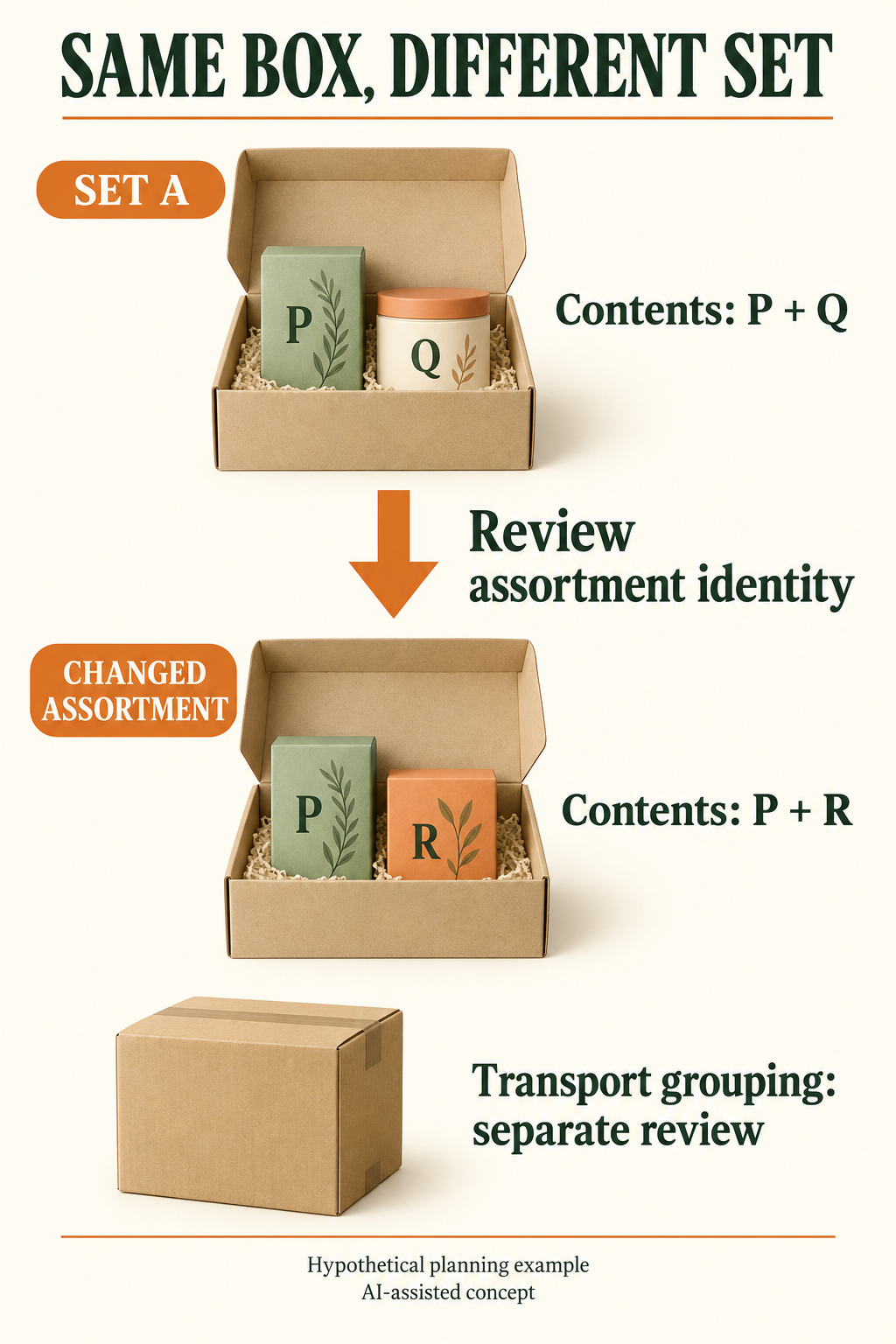
The first row is deliberately unresolved. Other GTIN-management rules can apply to packaging, quantity or product changes; this article does not conclude that every graphic-only change permits an existing identifier.
Adding another Item P to the fixed P-and-Q offer changes its defined composition even though P itself is unchanged. Review the assortment rule in section 2.9 and, where the legally required declared net content changes, section 2.3 as well. Declared net content can include count; these reviews are not mutually exclusive.
Section 2.8 addresses changed case quantities or cases in a predefined pallet configuration. Page 10 requires consideration of all GTIN-management rules when reaching the final decision. Give the specialist the actual offer and level; an unchanged constituent does not mean every level keeps its existing identity.
Connect the identity decision to the packaging revision
Give the artwork owner the approved identity decision for the exact sold assortment. Include the contents description that was reviewed, the artwork revision and the relevant packaging level. An internal nickname such as holiday set should not be the only connection between the commercial offer and its artwork.
If the brand substitutes an item after a box layout has been prepared, keep that substitution visible until the identity review is closed. Changing the product name on a card while carrying over the old symbol image would skip the decision this article addresses.
Once the identity and source data are confirmed, follow the barcode-data artwork handoff. That downstream process checks the source-to-generated-asset relationship. It answers a different question from deciding which sold assortment the source should identify.
Keep the outer carton from replacing the sold-set record
A carton can contain several complete sets or separate components awaiting assembly. Its quantity description cannot resolve the identity of the retail offer. Keep both definitions available to the packing owner so sets and pieces are not treated as interchangeable units.
Ask which higher levels are existing trade items in the relevant hierarchy, and which containers are being identified as logistics units. Do not treat every outer shipping box as the same object or use this assortment explanation to assign a shipment identifier. The responsible specialist must confirm those separate requirements.
Avoid making the designer responsible for interpreting a missing commercial definition. The brand or qualified barcode specialist resolves identity; the packaging and artwork teams use that confirmed decision in their own tasks. A screen scan does not establish correct assortment assignment or physical barcode quality.
Before preparing the final production artwork, compare the approved contents with the actual planned offer one more time. Route a mismatch back to the identity owner. An unchanged box is not evidence that the contents or identification decision stayed unchanged.
Source accessed 9 October 2026. The official PDF’s version and scope are stated above; the explanatory set names and comparison are original hypothetical planning aids. No Packrivo stock product, barcode-allocation service or project compliance result is implied.
Keep pieces per set separate from sets per case
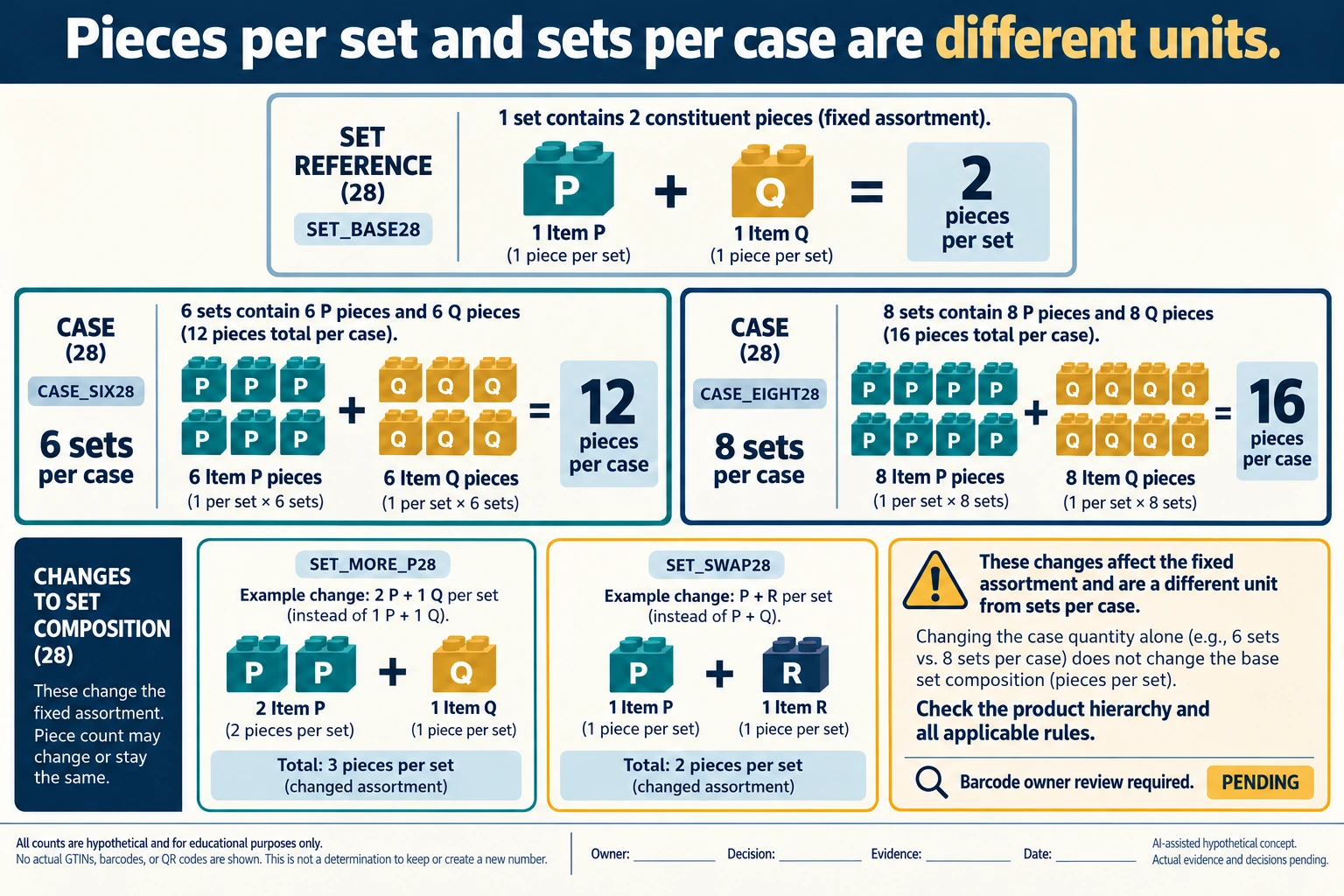
Extend the fictional P-and-Q offer with explicit counting units. SET_BASE28 contains one Item P and one Item Q. CASE_SIX28 holds six complete base sets, so it contains six P pieces and six Q pieces: twelve constituent pieces in six sets. CASE_EIGHT28 holds eight such sets, giving eight P pieces and eight Q pieces: sixteen pieces in eight sets. No identifier is allocated by either calculation.
Scroll horizontally if columns extend beyond the view.
| Hypothetical configuration | Named object | Relationship | Input or next scope |
|---|---|---|---|
| SET_BASE28 | ITEM_P | assumed quantity in set | 1 pieces/set |
| SET_BASE28 | ITEM_Q | assumed quantity in set | 1 pieces/set |
| CASE_SIX28 | SET_BASE28 | assumed case quantity | 6 sets/case |
| CASE_SIX28 | ITEM_P | calculated from | CASE_SIX28_SETS*SET_BASE28_ITEM_P; 6 pieces/case |
| CASE_SIX28 | ITEM_Q | calculated from | CASE_SIX28_SETS*SET_BASE28_ITEM_Q; 6 pieces/case |
| CASE_SIX28 | P_PLUS_Q | calculated from | CASE_SIX28_P+CASE_SIX28_Q; 12 pieces/case |
| CASE_EIGHT28 | SET_BASE28 | assumed case quantity | 8 sets/case |
| CASE_EIGHT28 | P_PLUS_Q | calculated from | CASE_EIGHT28_P+CASE_EIGHT28_Q; 16 pieces/case |
| SET_MORE_P28 | ITEM_P | assumed quantity in set | 2 pieces/set |
| SET_MORE_P28 | ITEM_Q | assumed quantity in set | 1 pieces/set |
| SET_SWAP28 | SET_BASE28 | replaces constituent | ITEM_Q_WITH_ITEM_R |
| CASE_CHANGE28 | SIX_TO_EIGHT_COMPLETE_SETS | does not by itself change | BASE_SET_P_Q_COMPOSITION |
| CASE_CHANGE28 | BASE_UNIT_IDENTITY | requires | OTHER_APPLICABLE_RULES_REVIEW_NO_AUTOMATIC_REUSE |
The CSV retains pieces per set, sets per case and pieces per case as different units. Multiplying six sets per case by one P piece per set gives six P pieces per case. Adding P and Q produces the constituent-piece total, not a new number of complete sets. A carton of twelve separate pieces is not automatically six finished retail offers; the actual composition and assembly state must match.
Compare a changed base offer separately. SET_MORE_P28 contains two P pieces and one Q piece; SET_SWAP28 replaces Q with R. Those alter the defined fixed assortment rather than merely the number of complete unchanged sets in a case. The barcode owner needs the section 2.9 review and, where the legally required declared net content changes, section 2.3 as well. A change from six to eight unchanged complete sets in an existing case level raises the section 2.8 and hierarchy questions without itself changing the base P-and-Q composition.
Apply all relevant GTIN Management rules before deciding which identities change or remain. Nothing here concludes that the base unit automatically keeps its identifier, that every transport carton is a trade-item level, or that a logistics-unit identifier has been assigned. The official standard returned for this research is Release 1.1, ratified September 2023. Keep the identity decision upstream from source-data validation, symbol generation and final printed quality review.
Download the gift set assortment case quantity identity units record (.csv). It includes the original table fields and scenarios alongside the added relationships. HYPOTHETICAL rows are editorial examples or required review scopes, not actual records. Actual quantity, configuration, component and file identities, materials, process, specification, copy, method, condition, observation, owner, decision, evidence and dates are blank. ACTUAL_BLANK is a separate empty starting row; enter permitted project evidence before using an actual record. A blank means unknown.
Use the Confirm Barcode Data Before Sending the Artwork for its separate question. Use the Packaging Freight Quotes: Carton Data to Prepare for its separate question.
Source scope checked 17 October 2026: GS1 GTIN Management Standard Release 1.1, ratified September 2023, covers the stated assortment, net-content and higher-level changes. It is not Digital Link implementation, GTIN allocation or a barcode scan result. The added configurations and calculations are hypothetical, with actual evidence and decisions pending.
Discuss this packaging specification with Packrivo. We coordinate independent suppliers. MOQ: 500 pieces per product/design; illustrative quantities are not production offers. Confirm materials, samples, price and timing for your project.