
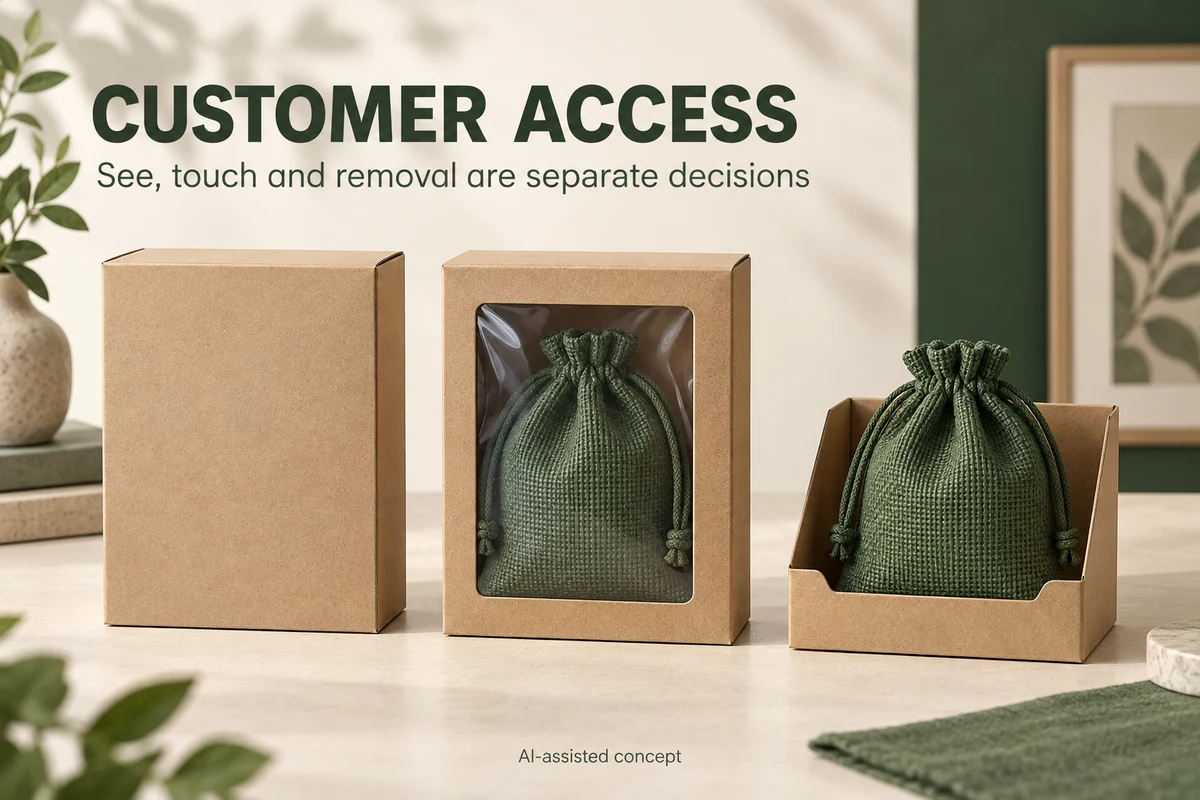
Choose what shoppers should be allowed to do before choosing a retail packaging window. An opaque closed carton asks them to rely on exterior information; a film-covered window lets them inspect the actual product without touching it; an open cutout or display can make touch or removal possible. Each format changes physical access; brand and retailer rules determine which actions are permitted. None of these structures, by itself, establishes tamper evidence, product safety or suitability for a particular retail environment.
Define the four permissions before the structure
Retail packaging should answer four separate questions:
- Record whether shoppers can see the actual item rather than just a photograph or description.
- Distinguish whether a shopper can physically reach a surface or feature from whether the brand and retailer permit that contact. State whether the exposed piece is a demonstrator or saleable stock.
- Check whether the holder permits removal and whether the brand and retailer allow the shopper to withdraw that item.
- Specify what must remain closed, attached, retained or visibly unchanged throughout browsing.
Removing an intact retail carton from a shelf is not the same as removing its contents from the carton. Likewise, seeing an item through transparent film is not permission to touch it.
Record the intended behavior first. A window dimension cannot answer these questions.
Compare three customer-access formats
The table describes starting configurations, not guaranteed properties of every package.
| Retail format | Inspect actual item | Touch actual item | Remove exposed item | Integrity question |
|---|---|---|---|---|
| Closed, opaque retail carton | No, unless opened | No | No, without opening | Will the pack remain closed during browsing? |
| Film-covered viewing window | Yes, through the transparent area | No, through the covered area | No, through the covered area | Will the window and closure remain intact under intended handling? |
| Open cutout or touch-access display | Yes, where exposed | Only if reachable and permitted by the brand and retailer | Only if the holder and brand/retailer policy allow it | What retains the product, and what happens after handling? |
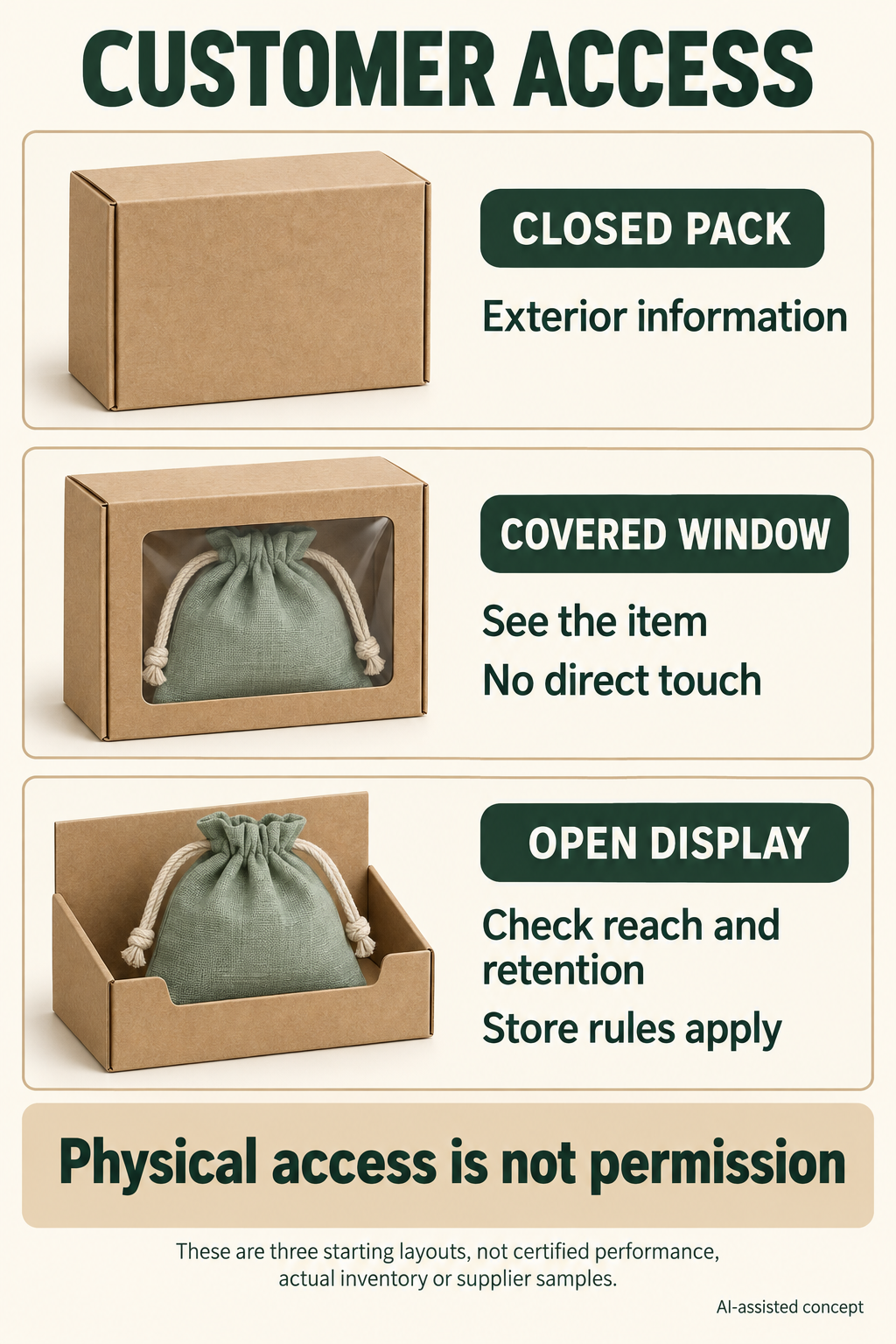
A take-one display may hold individually closed cartons. Shoppers can remove those cartons from the display while the actual products remain inaccessible. Conversely, a small uncovered cutout might allow a finger to reach one product surface without allowing the product to be taken out.
Those distinctions are more useful than classifying every structure with a visible opening as a "window box."
A transparent window provides sight rather than direct contact
Smurfit Kappa’s window packaging description illustrates cartons combining a visibility panel with the surrounding packaging structure. The purpose is to make an enclosed product visible without requiring shoppers to open its pack.
A film-covered opening can be appropriate when a buyer needs to inspect color, shape or arrangement but should not directly handle the contents. The proposed film, attachment, closure and product positioning still require separate confirmation.
An uncovered opening serves a different purpose. Clearpak’s touch-access examples illustrate die cuts that let shoppers feel fabric or interact with an accessible feature. These are examples of possible structures, not evidence that every opening is suitable for every product.
Before requesting a clear window, ask whether the customer needs only a view. If the buying decision depends on texture or physical operation, looking through film may leave that need unanswered.
An open display needs a defined handling rule
Open retail displays can make products easier to reach, but visibility, handling and withdrawal must still be assigned separately.
Smurfit Westrock’s shelf-ready packaging examples show another distinction: an outer case can change from a closed transport configuration into a display configuration at the store. Opening that outer case does not mean its individual sales units are unsealed or intended for testing.
For a proposed open arrangement, decide whether shoppers may touch one display piece, pick up a complete sales unit, operate a demonstration feature or remove an unpackaged product. These actions require different holding and replenishment arrangements.
The retailer also needs to agree on permitted handling. A brand’s design intention alone cannot establish the store’s operating policy.
A hypothetical gift-pouch display changes the choice
Consider a fictional small brand selling fabric gift pouches with a distinctive woven texture.
A closed printed carton can communicate the size, color and intended use through its artwork. It cannot let shoppers inspect the actual weave or feel the fabric without opening the carton.
A covered window reveals part of the real pouch but still prevents direct touch through that window.
An uncovered cutout could expose part of the fabric for touching. However, the brand would need to decide which pieces may be handled, how the pouch stays positioned and how the sales stock is presented after repeated contact.
A different proposal is an open demonstration display containing one clearly identified touch sample, with individually packed saleable pouches beside it. The sample invites handling; the customer selects a separate intact sales unit.
This hypothetical design choice represents no tested merchandising result or improved-sales claim. Whether the retailer accepts a loose demonstrator, and how it is maintained, remains to be confirmed.
Package integrity must be reviewed independently
A visible window does not establish a tamper-evident pack. Nor does an opaque closed carton automatically provide tamper evidence. A customer may be unable to touch the contents and yet still encounter a closure that can be opened and reclosed.
For any proposed format, define what must be checked on the actual configuration: the closure after browsing, the exposed product surface, retention in the holder, handling marks and the state in which goods travel to the retailer. Regulatory or safety claims require their own applicable evidence.
Send an access-first packaging brief
A useful first brief does not need a finished dieline. It should specify:
- Describe the product dimensions, weight, relevant surfaces, sales channel and intended shelf or counter presentation.
- State whether shoppers may see the actual product, touch it, operate a feature or remove it from its holder. Identify the demonstrator or sales stock and mark prohibited actions explicitly.
- Choose whether the arrangement uses individually packaged units, loose products, a dedicated demonstrator or a combination.
- Define what must stay attached or closed, who resets the display and which visible changes would be unacceptable after handling.
- Describe how the goods arrive, what staff remove or open, and how they establish the sales-ready arrangement.
- Ask the supplier to identify the proposed construction, retention method, relevant evidence and physical configuration that needs review before approval.
Include your quantity by design and delivery destination. Packrivo’s stated MOQ is 500 pieces per product/design; prices, production feasibility, lead times, material choices and sample arrangements are project-specific matters for confirmation.
Develop the window only after the access decision
If a film-covered window is the chosen direction, the next design work can use Locate Window Patches Against the Product View to address opening and attachment geometry, followed by Review Window Clarity With the Product Behind It for the actual viewing condition.
Those reviews should not substitute for the original customer-access decision.
Packrivo coordinates packaging sourcing and project questions rather than operating as an owned factory. Bring the chosen access rules and unresolved requirements to the Packrivo packaging brief so the relevant supplier can assess the specific proposal.
Sources accessed 9 October 2026. Manufacturer examples describe possible structures, not Packrivo capabilities or measured results. Physical access and display permissions need confirmation for the actual arrangement; this article establishes no tamper-evidence or safety result.
Write the touch objective without granting permission to touch sale stock
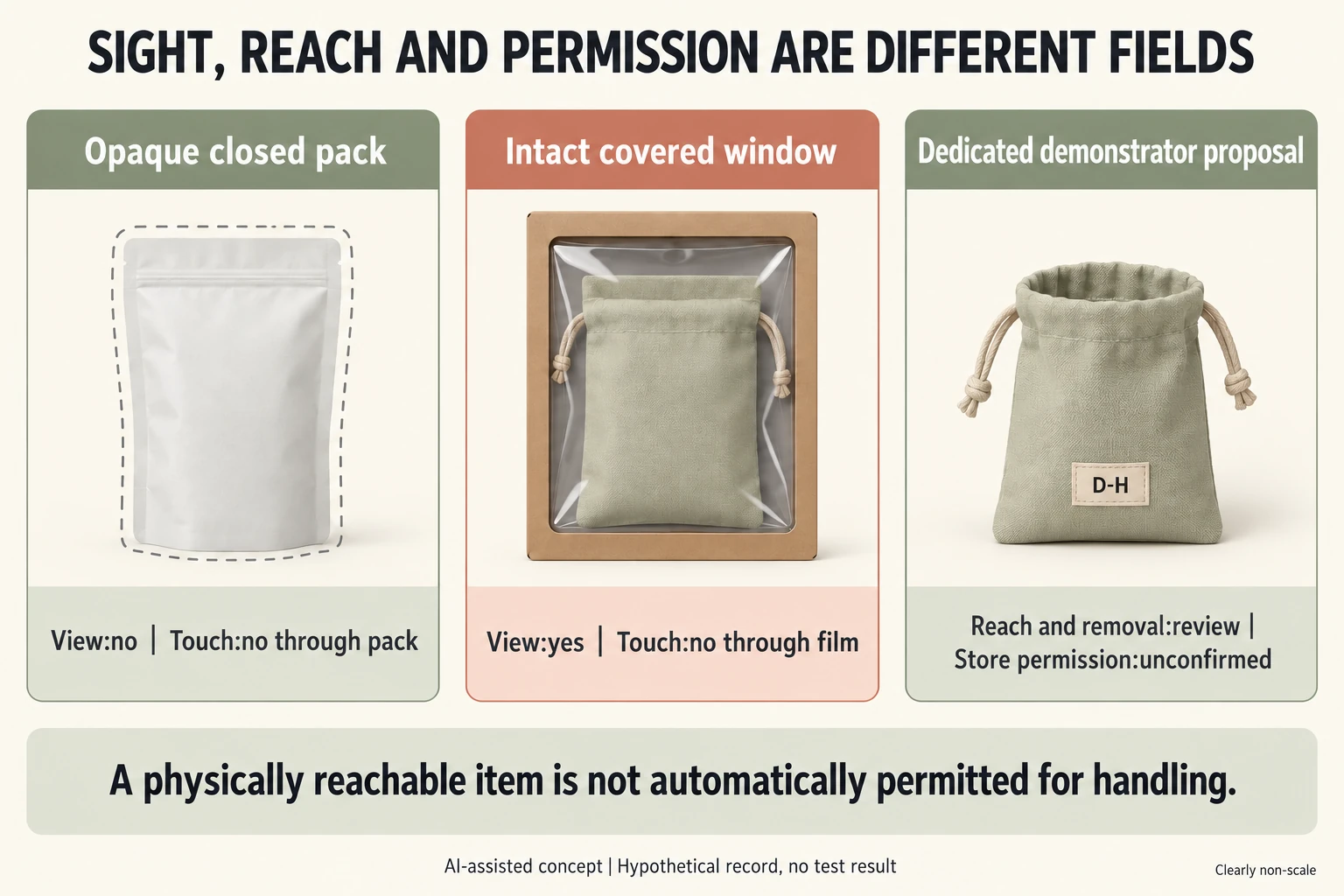
Assume a fictional fabric pouch P-H whose texture matters to the buying decision, while the brand wants saleable units to stay closed. Compare opaque packaging, an intact covered window and a dedicated D-H demonstrator proposal. The same underlying pouch type is intended; retailer permission has not been obtained.
Scroll horizontally if columns extend beyond the view.
| Proposal | Sight of actual pouch | Direct touch through pack | Removal/permission question |
|---|---|---|---|
| Opaque closed | Not through opaque pack | Not through closed pack | Would require a different agreed access route |
| Intact covered window | View through proposed transparent area | Not through intact film | Optical view and integrity still reviewable |
| D-H demonstrator | Exposed sample proposal | Reach/retention to assess | Store permission and reset owner unresolved |
A viewing window does not answer a request to feel the weave. A separately identified demonstrator may address that objective without opening sale units, but only if the actual retention, retailer rules and maintenance arrangement support it.
The opaque icon represents the external enclosure around P-H. The green D-H sample is a proposed demonstrator role; actual inventory and handling permission are unconfirmed. Keep physical reach, permitted touch, permitted withdrawal and required intact state in separate CSV fields. Store approval, actual observations and reset responsibility remain blank. No hygiene, safety, tamper-evidence or sales result is inferred.
Download the retail packaging windows and customer access record (.csv). HYPOTHETICAL rows are invented examples. Use ACTUAL_BLANK for permitted project inputs; replace that row label only when recording actual facts. Empty evidence, observation and date fields mean unknown or not performed, never acceptance. Keep checkpoints and revisions separate.
Send the desired see/touch/remove behavior, sale-stock boundary and unresolved retailer/reset responsibilities before choosing the opening. Packrivo coordinates independent suppliers. These records establish no supplier offer, service availability or MOQ exception; its published baseline is 500 pieces per product/design.