
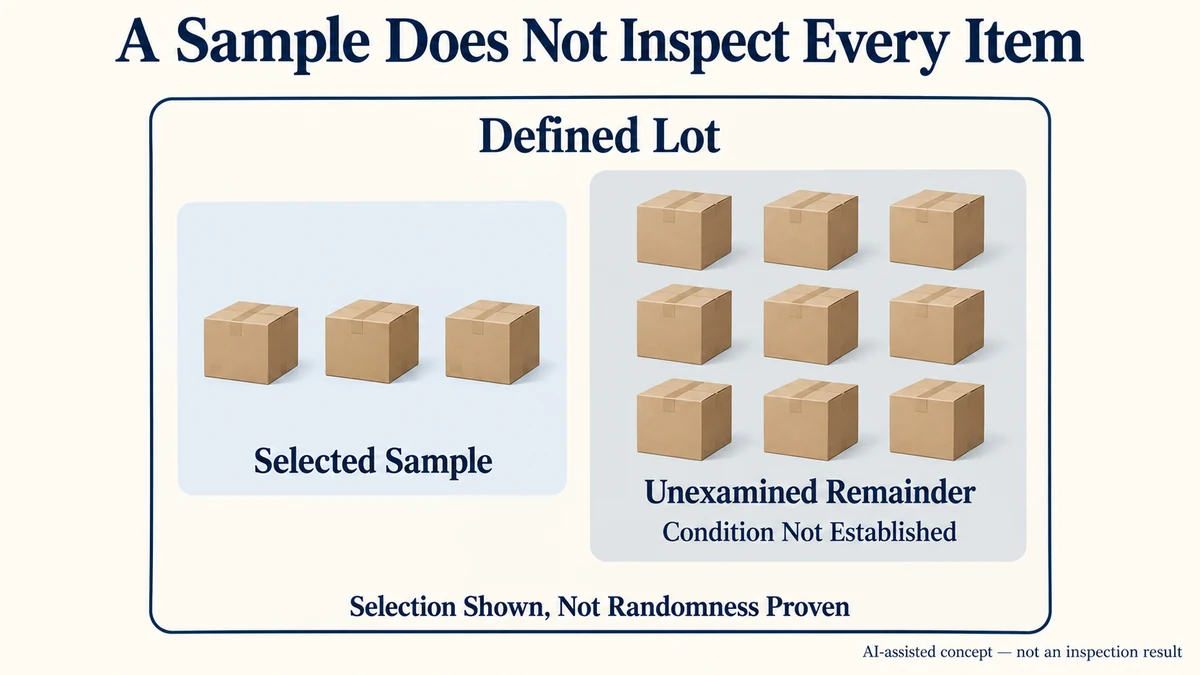
AQL 2.5 does not mean a packaging buyer has agreed to accept 2.5% defective products in every shipment. It also does not mean an inspector must find exactly 2.5% defective items before rejecting a lot.
An AQL designation helps define a statistical acceptance-sampling approach. The actual accept-or-reject decision depends on the agreed sampling plan, what is counted, and how the sample is selected.
For a small jewelry, candle or gift brand, the practical question is whether an inspection instruction describes a real decision rule or simply displays the words “AQL 2.5.”
AQL Describes a Quality Reference, Not a Shipment Allowance
Acceptance sampling uses observations from selected items to decide the disposition of a defined lot. Its primary purpose is not to determine the precise proportion of defective items throughout that lot.
The NIST Engineering Statistics Handbook, Section 6.2.1, makes this distinction between deciding lot acceptability and estimating lot quality.
AQL is one reference used in designing or selecting sampling plans. It is associated with the probability of accepting lots at a designated quality level, not with permission to supply a fixed percentage of nonconforming products.
For example, a statement such as “AQL 2.5 allows 25 defective jewelry boxes in every 1,000” is not a valid interpretation of a sampling result.
A statistical plan may accept a lot containing nonconforming items. It may also reject a lot whose actual nonconforming proportion is below the designated AQL. These possibilities arise because the decision is based on a sample rather than complete knowledge of the lot.
The selected plan’s operating characteristics determine the relevant acceptance probabilities. AQL alone does not provide them.
A Single-Sample Plan Needs a Sample Size and Acceptance Number
A basic attributes single-sampling plan can be written as (n, c):
- n is the number of items selected for inspection.
- c is the maximum number of nonconforming items permitted in that sample for lot acceptance under this particular counting plan.
If the observed number of nonconforming items exceeds c, the lot is rejected under the plan.
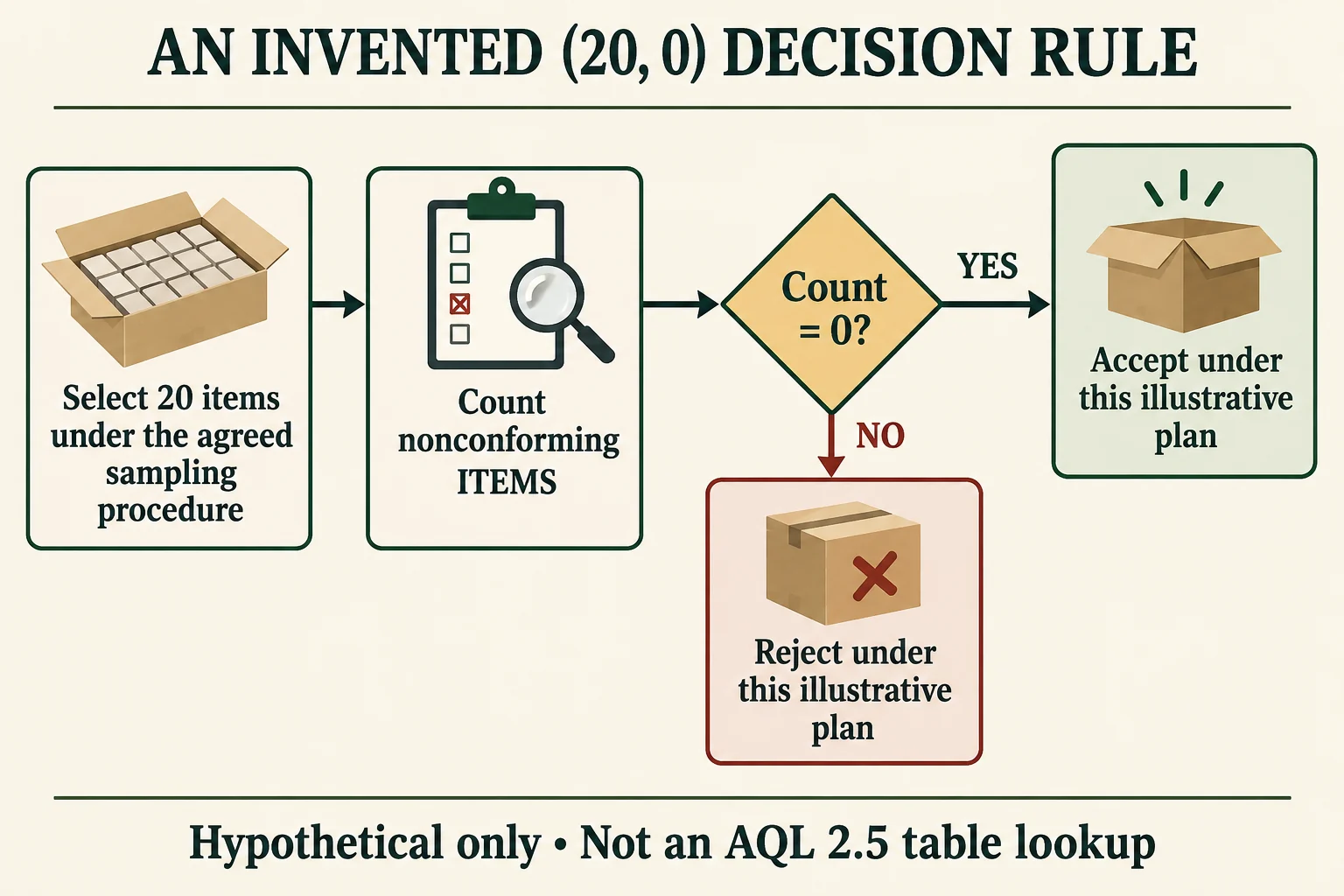
Consider an entirely invented plan, (20, 0).
Twenty items are selected from a defined lot under the assumed valid sampling procedure. The plan accepts the lot if zero sampled items are classified as nonconforming. If one or more sampled items are nonconforming, the plan rejects the lot.
These numbers are for explanation only. They are not recommended for any real packaging order, do not come from an ISO 2859 table, and should not be substituted for an agreed inspection procedure.
The comparison is straightforward:
| Hypothetical sample observation | Meaning under (20, 0) |
|---|---|
| Zero nonconforming items among 20 | Accept the lot under this illustrative plan |
| One nonconforming item among 20 | Reject the lot under this illustrative plan |
The first result does not mean all other items have been examined or proven conforming.
The second result does not mean every item in the lot is defective.
NIST’s Section 6.2.2 describes single-sampling plans, the acceptance number, operating-characteristic curves, and the risks associated with accepting or rejecting lots at different quality levels.
An instruction that says only “inspect to AQL 2.5” leaves the actual plan unresolved. It does not independently establish the sample size, acceptance number, counting basis, sampling procedure or agreed treatment of different nonconformities.
Counting Nonconforming Items Is Different From Counting Defects
The distinction becomes important when one packaging item has several problems.
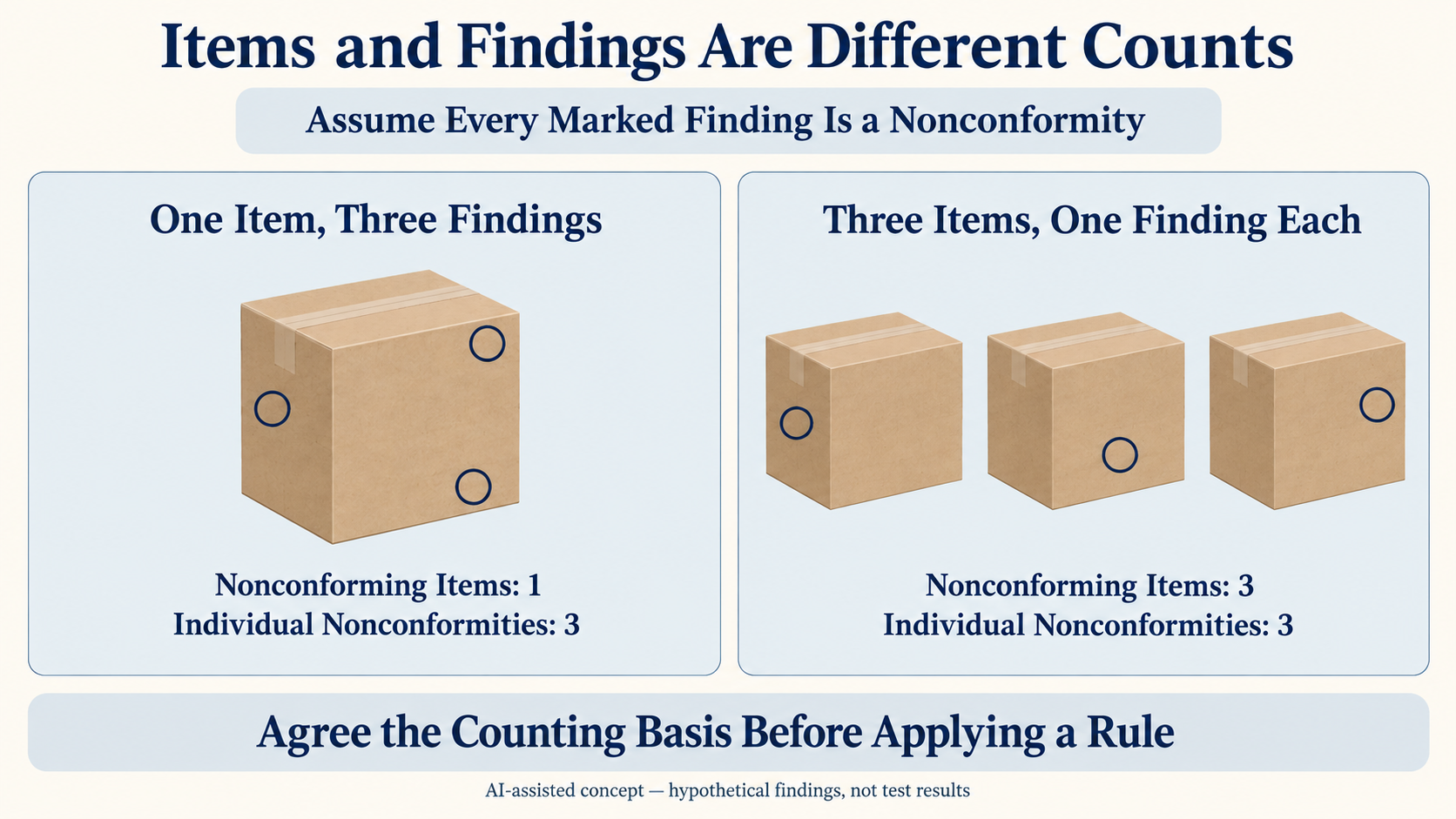
Imagine a hypothetical gift box with two surface marks and one misaligned printed element. Assume, purely for this illustration, that all three observations fail the agreed requirements.
That is one nonconforming box with three individual nonconformities.
If the plan counts nonconforming items, the box contributes one to the sample’s nonconforming-item count. It does not contribute three.
A different plan may count individual nonconformities rather than the number of items containing them. Its counting rules and acceptance criteria must be separately defined.
The same distinction applies to candle cartons with multiple print issues or jewelry boxes showing more than one agreed appearance failure.
Whether an observation is actually a nonconformity, and how it is classified, depends on the applicable agreed requirements. AQL 2.5 by itself does not supply those definitions or establish the significance of each issue.
A buyer should therefore distinguish a report of “three defects” from a report of “three nonconforming boxes.” Those statements may describe very different sample outcomes.
Lot Identity Does Not Prove Valid Sample Selection
A sampling plan needs a defined population from which items are selected.
Identifying that population and choosing a valid sample are different tasks.
A lot reference might establish which production grouping or received quantity is under review. Item identifiers can show which physical pieces were examined. Neither fact alone proves that those pieces were selected according to the statistical procedure.
Suppose an inspector takes 20 attractive-looking jewelry boxes from an accessible, neatly arranged group while ignoring other parts of the defined lot.
Even if those 20 boxes have no observed nonconformities, the selection does not support the random-sampling assumptions of the illustrative plan.
The issue is not whether the inspector recorded the observations carefully. It is whether the selection procedure supports extending a sample-based decision to the intended lot.
If the lot contains different component versions or distinct production groupings, the inspection scope and applicable sampling approach must be resolved rather than silently treating everything as one interchangeable population.
A convenient, handpicked sample cannot become statistically representative merely because the resulting inspection report contains an AQL designation.
A Clean Sample Cannot Establish Zero Defects Throughout the Lot
The uncertainty can be demonstrated with a simple invented probability calculation.
Assume a hypothetical population in which the probability that an independently selected item is nonconforming is 5%. Assume a common probability across selections, and a lot sufficiently large relative to the sample for the binomial approximation to apply.
Under the illustrative (20, 0) plan, the probability of observing zero nonconforming items is:
P(zero observed) = 0.95^20 ≈ 0.3585 = 35.85%
Under those assumptions, a zero-nonconforming-item sample occurs approximately 35.85% of the time, even though the assumed underlying nonconforming-item probability is 5%.
This is arithmetic under a specified hypothetical model. It is not a measurement of an actual packaging lot, an estimate obtained from inspecting a real shipment, or a recommended acceptance plan.
It also does not establish the probability for a handpicked sample or a small finite lot where the model assumptions do not hold.
The calculation illustrates why passing a sample-based plan is different from proving that every item in the lot is conforming.
NIST’s Section 6.2.3.2 explains how the binomial operating-characteristic calculation relates a sampling plan to its probability of lot acceptance, including the assumption that the lot is large compared with the sample.
An accepted lot has met the defined sampling decision rule. It has not received a statistical guarantee of zero nonconforming items.
Reinspection Follows the Original Agreed Procedure
When a sample exceeds the acceptance number, repeatedly drawing new samples until one passes is not a valid substitute for following the agreed rejection procedure.
Repeated sampling changes the effective decision process and can increase the opportunity to obtain a passing result without resolving the original findings.
The appropriate next disposition depends on the actual agreement. It may involve holding the affected lot, investigating the findings, an authorized sorting or corrective process, replacement, or reinspection under explicitly defined conditions.
A fresh inspection result should not erase the original rejection or be treated as automatic acceptance. Any permitted reinspection must follow the original agreed procedure, including its applicable conditions for further examination and disposition.
This distinction matters particularly when a packaging order includes multiple components. A decision about sampled printed sleeves does not automatically determine the acceptability of inserts, lids or completed packs that were outside the inspection scope.
Existing Packaging Records Serve a Different Purpose
Packrivo’s packaging acceptance record explains how requirements, findings, corrective actions and decisions remain connected. The incoming lot reference guide explains how reviewed items retain their source identity, while the incoming damage hold guide addresses observed damage and unresolved affected quantities. Those records help maintain traceability and manage actual findings. They do not select a statistical sampling plan or determine its acceptance probabilities. The separate decision explained here is whether the statistical instruction itself is complete and whether its result is being interpreted within its proper limits.
Complete the AQL 2.5 inspection request before counting
Translate the label into a record that the responsible inspection provider can actually assess. For the invented (20,0) illustration, the counting unit is one box and the counted outcome is the number of nonconforming boxes. Three classified findings on one box still contribute one nonconforming item under that specific rule.
| Instruction field | What the request must identify | Keep unresolved when missing |
|---|---|---|
| Lot and unit | Named grouping and whether one unit is a component or complete set | Do not combine unidentified versions by appearance |
| Plan reference | Applicable procedure and selected rule supplied by its responsible owner | The words AQL 2.5 do not supply n or c |
| Classification | Agreed requirement and method for counting items or individual findings | A visible mark is not automatically a classified nonconformity |
| Selection and disposition | Agreed selection method, result and authorized next action | A clean handpicked sample does not close the statistical decision |
Keep the worked probabilities above attached to their stated independent binomial assumptions. This record adds the missing decision inputs; it does not select an inspection level, reproduce an ISO table or authorize a real lot to be accepted.
Download this article’s project record (CSV). The record includes field definitions, labeled teaching examples and a blank project row. Add source evidence and the details of your actual project.
For a sourcing discussion, send the lot boundary, proposed counting unit and unresolved inspection-rule reference. Packrivo coordinates supplier questions; the responsible technical or commercial parties confirm the actual method, configuration and terms.
An AQL Statement Needs an Agreed Decision Rule
When an inspection proposal states “AQL 2.5,” a packaging buyer should not translate that phrase into a permitted percentage of defective items.
The instruction must identify the applicable inspection procedure and its actual decision rule, including the lot under review, the inspection unit, the basis for classifying and counting nonconformities, and the sampling and acceptance conditions.
Without that information, “AQL 2.5 passed” is an incomplete explanation of what was examined and what decision was reached.
Packrivo can help coordinate packaging specifications and inspection questions with the relevant project parties. Statistical plan selection, technical evaluation and any contractual acceptance decision must remain with the appropriately responsible parties under the actual agreement.
The essential distinction is simple: acceptance sampling produces a conditional decision about a defined lot, not permission for a fixed percentage of defective products or proof that every unexamined item is conforming.
Source scope: The statistical explanations draw on Sections 6.2.1, 6.2.2 and 6.2.3.2 of the NIST Engineering Statistics Handbook, undated public online pages accessed 10 October 2026. This article does not reproduce paid ISO 2859 tables, establish a current ISO edition or claim compliance with any particular inspection standard.