
A protective bag around a household gift item may look like an ordinary packaging component, but a Rhode Island warning decision cannot be made from appearance or the words “plastic bag” on a quotation.
Rhode Island General Laws § 11-9-16 first defines the bags covered by its provision. A separate table then sets warning type sizes. The opened-end diameter used to determine whether a bag falls within the definition is not the same measurement as the length-plus-width total used for the warning type.
A gift brand considering polyethylene protective packaging should resolve those two questions in order, rather than starting with a warning artwork template.
The Statutory Bag Definition Has Cumulative Conditions
Under subsection (a), the relevant definition requires a polyethylene bag intended for household use or for packaging articles intended for household use. It must also have:
- An opened-end diameter greater than 5 inches.
- Film thickness less than 1 mil (0.001 inch).
The definition excludes bags used for food products weighing not more than five pounds. That is a specific exclusion, not an exemption for every bag associated with food.
The provision also refers to standards established under the U.S. Department of Commerce’s commodity standards division for film thickness. The published section does not itself supply a complete measurement procedure.
These conditions should be treated individually.
For example, a supplier describing a protective sleeve as “plastic” has not established its polymer identity. An “OPP” description should not be treated as evidence that the proposed material is polyethylene. Confirm the actual film material rather than assigning a statutory category from a general packaging nickname.
The inequalities also matter. An opened-end diameter of exactly five inches is not greater than five inches. A film thickness of exactly one mil is not less than one mil.
An unresolved material or dimension should remain an unresolved definition question, not become an assumed compliance result.
Opened-End Diameter and Warning Type Size Answer Different Questions
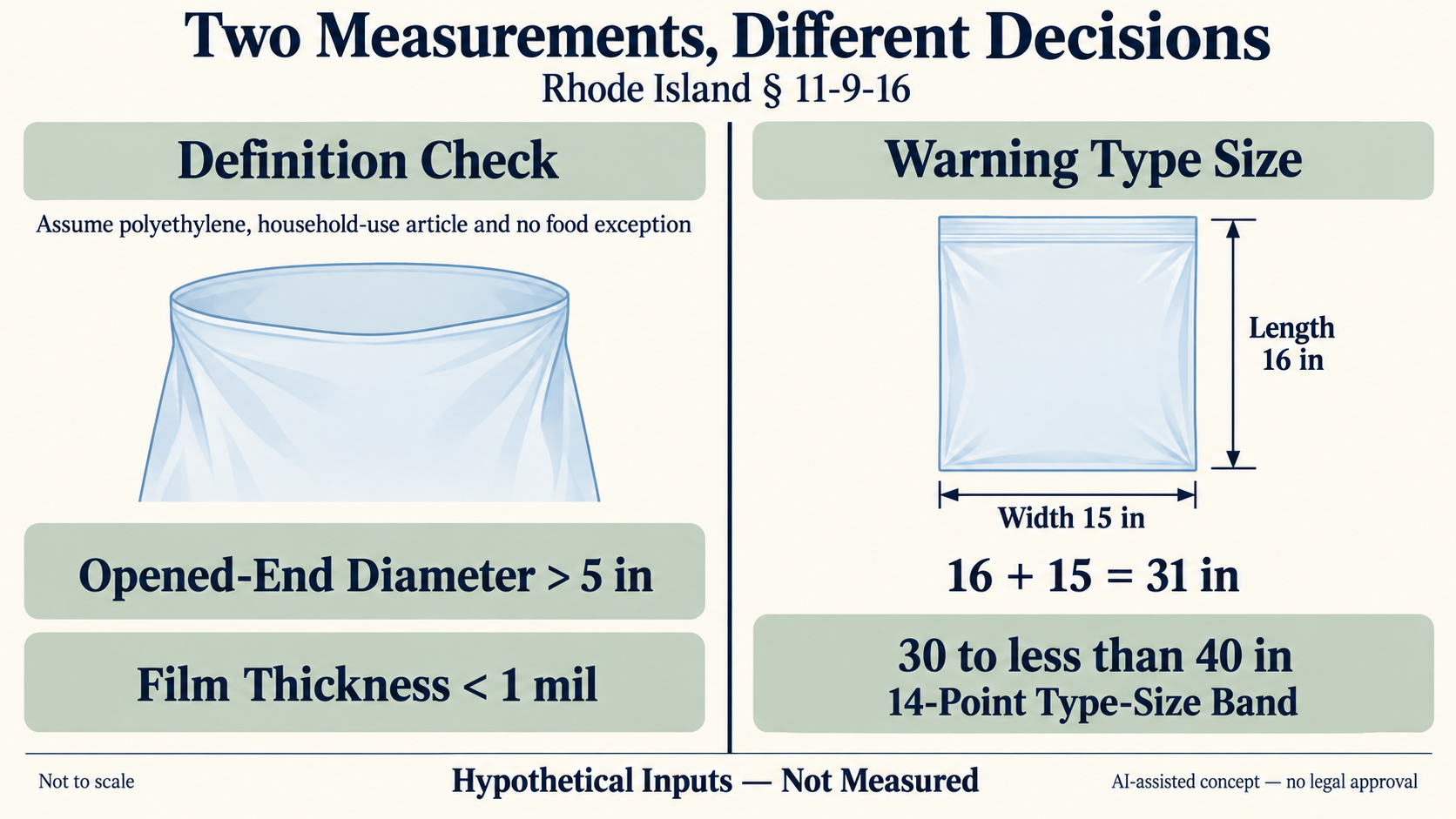
The bag definition uses the diameter at the opened end.
Subsection (c) uses the combined length and width of the bag to determine the warning type-size band.
The statutory table is:
| Combined length + width | Warning type size |
|---|---|
| 60 inches or more | 24 points |
| 40 inches to less than 60 inches | 18 points |
| 30 inches to less than 40 inches | 14 points |
| Less than 30 inches | 10 points |
These are different dimensional tests.
A laid-flat bag width on a quotation does not, by itself, establish the statutory opened-end diameter. The published section does not prescribe a conversion formula between those measurements.
Nor should a buyer infer an opened-end diameter by treating length and width as interchangeable.
For a gusseted or otherwise unusual bag construction, the actual dimensional references need to be clarified before relying on a classification. A dieline may provide useful dimensions without establishing every measurement required by the legal definition.
A Hypothetical 31-Inch Total Selects the 14-Point Band
Imagine a small gift brand preparing a nonfood household article for sale in Rhode Island.
The brand proposes a separate polyethylene protective bag around that article.
For this hypothetical example, assume the following facts are already established:
- The bag material is polyethylene.
- Its intended use is packaging the household article.
- Its opened-end diameter is greater than five inches.
- Its film thickness is less than one mil.
- The stated food-product exclusion does not apply.
These are illustrative assumptions, not physical measurements, supplier declarations or evidence of an actual product.
Now consider the bag’s proposed dimensions:
Length: 16 inches
Width: 15 inches
The warning-size calculation is:
16 + 15 = 31 inches
Thirty-one inches falls within the statutory range beginning at 30 inches and ending below 40 inches.
The relevant warning type-size row is therefore 14 points, subject to the provision’s complete conditions.
The result is a type-size classification for this hypothetical bag. It is not an approval of warning wording, placement, legibility, printing quality or legal applicability to a real transaction.
In particular, the 31-inch combined dimension cannot substitute for the separately assumed opened-end diameter.
The Warning Must Have an Appropriate Path to Each Bag
Section 11-9-16(b) addresses packaging, delivering or selling household-use articles in covered bags, and selling or distributing covered bags for household use.
Subsection (c) permits the required warning to be printed on, attached to, or accompany each bag. It also requires conspicuous presentation in boldface type according to its size table.
A warning therefore does not necessarily have to be printed directly on the polyethylene film. But the selected presentation method must still satisfy the applicable statutory conditions.
The official section supplies warning language and allows substantially equivalent wording. The complete wording and presentation requirements should be reviewed in the original Rhode Island statute, rather than reconstructed from a shortened design example.
There is an important limitation concerning outer wrappers.
The section provides a specific allowance for placing the warning on the outside wrapper of packages of bags intended only for home-processing use, with freezer bags and garbage-disposal bags given as examples.
That narrow provision should not automatically be extended to an ordinary shipping master carton containing protective bags intended to accompany individual gift products.
A master carton used to transport packaging components is not automatically the qualifying home-processing bag wrapper described by the provision.
A Changed Thickness Does Not Establish General Safety
Return to the hypothetical protective bag.
Keep its intended use, polymer identity and other assumed characteristics unchanged, but change one fact: the film thickness is now exactly one mil.
Because subsection (a) specifies thickness less than one mil, that revised bag does not meet this particular definition on the stated assumptions.
Its length and width could still total 31 inches. That arithmetic does not repair the failed definition condition.
This is a narrow legal-scope distinction, not a safety conclusion.
Not meeting this section’s definition does not demonstrate that the bag is safe for household use, exempt from every other applicable requirement, or acceptable under a particular retailer’s or distribution platform’s rules.
Similarly, uncertainty about polymer identity, opened-end diameter or the food-product exclusion should not be converted into a claim of exemption.
Record the Definition Result Before Preparing Warning Artwork
A buyer can turn this analysis into a conditional decision for each proposed bag version.
First, establish the material, intended use, food-exclusion question, opened-end diameter and film thickness using information appropriate to the actual configuration.
If the definition conditions are met, separately establish the length and width, calculate their combined total, and identify the statutory type-size row.
Then determine how the warning is proposed to reach each bag, without assuming that an ordinary master carton qualifies for the narrow home-processing wrapper allowance.
If the physical facts or applicable legal interpretation remain unresolved, keep the warning design decision open rather than treating a draft layout as approval.
After the statutory scope and type-size questions have been resolved, the brand can assign responsibility for the actual warning wording and review the small type against the selected printer’s specifications. Neither artwork workflow replaces the earlier legal definition check.
Packrivo supports packaging sourcing and project coordination. It does not manufacture the bag film or approve legal warning compliance.
Primary legal reference: Rhode Island General Laws § 11-9-16, Plastic bags — Labeling. Official public text accessed October 10, 2026. Its displayed legislative history lists 1959 and 1960 enactments, without a separately displayed current revision date. Application to an actual bag and transaction remains subject to verification.
Carry the bag revision into its warning-carrier layout
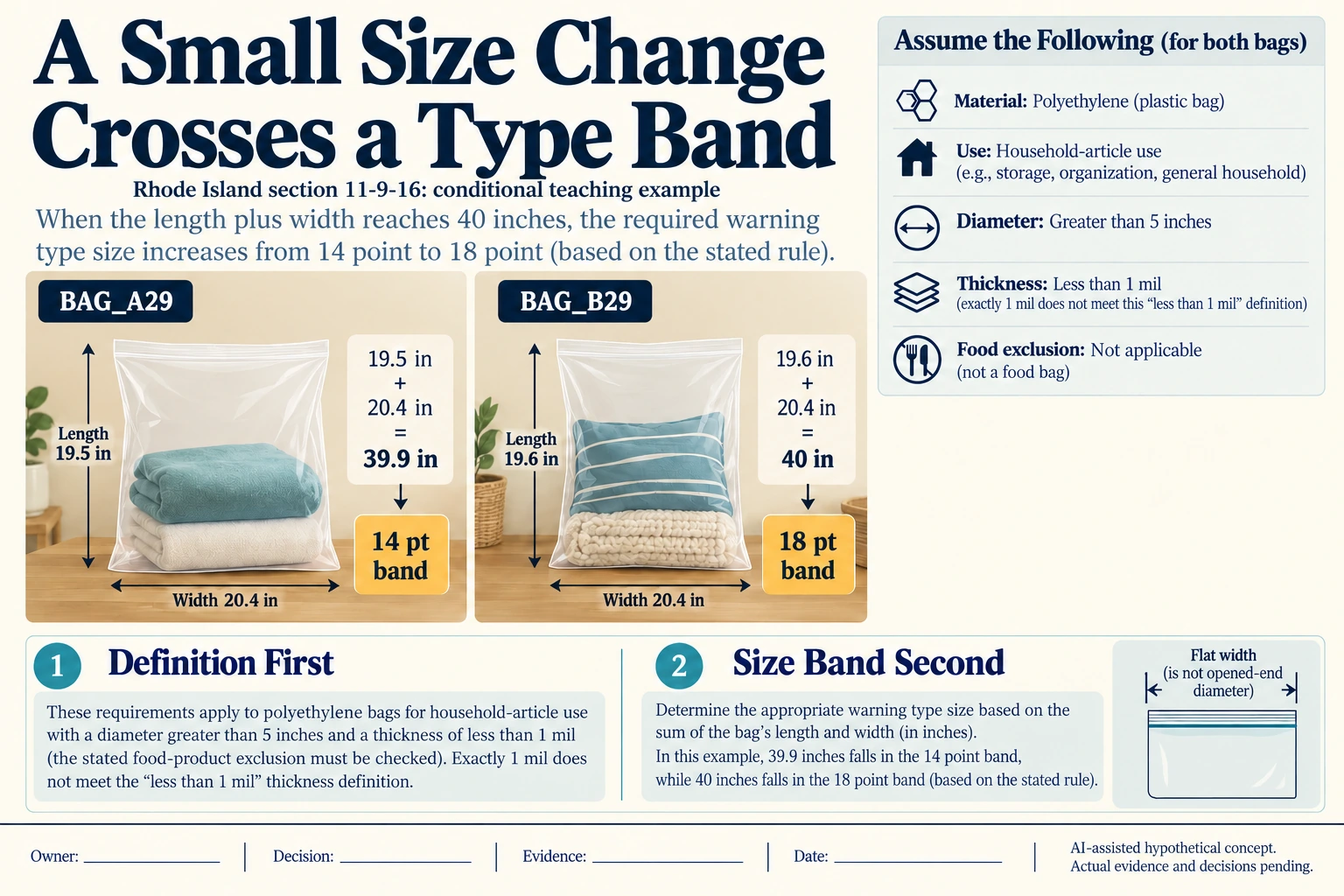
Keep the original 31-inch example intact and examine another invented revision near the 40-inch boundary. For BAG_A29 and BAG_B29, assume polyethylene, household-article use, opened-end diameter greater than 5 inches, thickness less than 1 mil and no applicable food exclusion. These premises establish only the exercise’s definition and use scope; the film and dimensions have not been measured.
Scroll horizontally if columns extend beyond the view.
| Hypothetical configuration | Named object | Relationship | Input or next scope |
|---|---|---|---|
| BAG29 | BOTH_BAGS | assumed | PE_HOUSEHOLD_DIAMETER_GT5_THICKNESS_LT1MIL_NO_FOOD_EXCLUSION |
| BAG_A29 | LENGTH | assumed input | 19.5 in |
| BAG_A29 | WIDTH | assumed input | 20.4 in |
| BAG_A29 | LENGTH_PLUS_WIDTH | calculated from | BAG_A29_LENGTH+BAG_A29_WIDTH; 39.9 in |
| BAG_A29 | WARNING_TYPE_BAND | conditional source table band | 14 pt |
| BAG_B29 | LENGTH | assumed input | 19.6 in |
| BAG_B29 | WIDTH | assumed input | 20.4 in |
| BAG_B29 | LENGTH_PLUS_WIDTH | calculated from | BAG_B29_LENGTH+BAG_B29_WIDTH; 40 in |
| BAG_B29 | WARNING_TYPE_BAND | conditional source table band | 18 pt |
| BAG_C29 | FILM | assumed input | 1 mil |
| BAG_C29 | EXACT1MIL | does not meet | STRICT_LESS_THAN1MIL_DEFINITION |
| BAG_C29 | DEFINITION_NOT_MET | does not establish | GENERAL_SAFETY_OR_OTHER_LAW_EXEMPTION |
| BAG29 | LENGTH_PLUS_WIDTH | does not supply | OPENED_END_DIAMETER |
| BAG_A29 | WARNING_CARD_C1 | proposed for | 14PT_BAND_NOT_ACTUAL_LAYOUT_APPROVAL |
| BAG_B29 | WARNING_CARD_C1 | retained carrier with changed | 18PT_BAND_NOT_ACTUAL_LAYOUT_APPROVAL |
| BAG_B29 | REVISED_WARNING_CARD_C1 | requires | COMPLETE_CONSPICUOUS_BOLD_COPY_AND_PER_BAG_PATH_NO_SHRINK_TO_FIT |
BAG_A29 has length 19.5 inches and width 20.4 inches, totaling 39.9 inches. That falls in the 30-to-less-than-40-inch band with 14-point warning type under the stated provision. BAG_B29 changes length to 19.6 inches while keeping width 20.4 inches, totaling exactly 40 inches. The table’s 40-to-less-than-60-inch band then gives 18 points. Do not round 39.9 to 40 before applying this stated comparison; no statutory dimension-rounding procedure is invented here.
If a further version uses exactly 1 mil film, it fails the definition’s less-than-1-mil thickness condition on the assumed facts. Keeping a 40-inch sum does not repair that condition. Conversely, a large length-plus-width total cannot substitute for the separate opened-end diameter test. Flat width is not converted into diameter, and an unknown polymer or food-exclusion fact stays open.
Carry the changed band into the warning carrier, not straight into approved artwork. Suppose the same proposed attached card C1 is retained for both bag versions: A’s 14-point band cannot become approval for B’s 18-point treatment merely because the card identity stayed the same. Keep the required type band separate from the returned layout, and ask whether that revised card can present the complete required message conspicuously in bold. This example invents no card dimensions, missing words or fit result, and it does not solve a space problem by shrinking the required type. A printer’s file specification cannot override the applicable legal requirement. The warning must still reach each bag through a permitted path; the narrow home-processing wrapper allowance is not assumed for a normal master carton. This is Rhode Island-specific education, not a safety or compliance decision.
Download the plastic bag warning type size boundary revision record (.csv). It includes the original table fields and scenarios alongside the added relationships. HYPOTHETICAL rows are editorial examples or required review scopes, not actual records. Actual quantity, configuration, component and file identities, materials, process, specification, copy, method, condition, observation, owner, decision, evidence and dates are blank. ACTUAL_BLANK is a separate empty starting row; enter permitted project evidence before using an actual record. A blank means unknown.
Use the Small Packaging Type Needs the Selected Printer’s File Specification for its separate question.
Source scope checked 17 October 2026: Rhode Island General Laws section 11-9-16 has cumulative bag-definition/use conditions and a separate length-plus-width warning-type table. Its displayed 1959/1960 legislative history is not a 2026 publication date. No actual warning, legal applicability, general safety or other-state conclusion is supplied. The added configurations and calculations are hypothetical, with actual evidence and decisions pending.
Discuss this packaging specification with Packrivo. We coordinate independent suppliers. MOQ: 500 pieces per product/design; illustrative quantities are not production offers. Confirm materials, samples, price and timing for your project.