
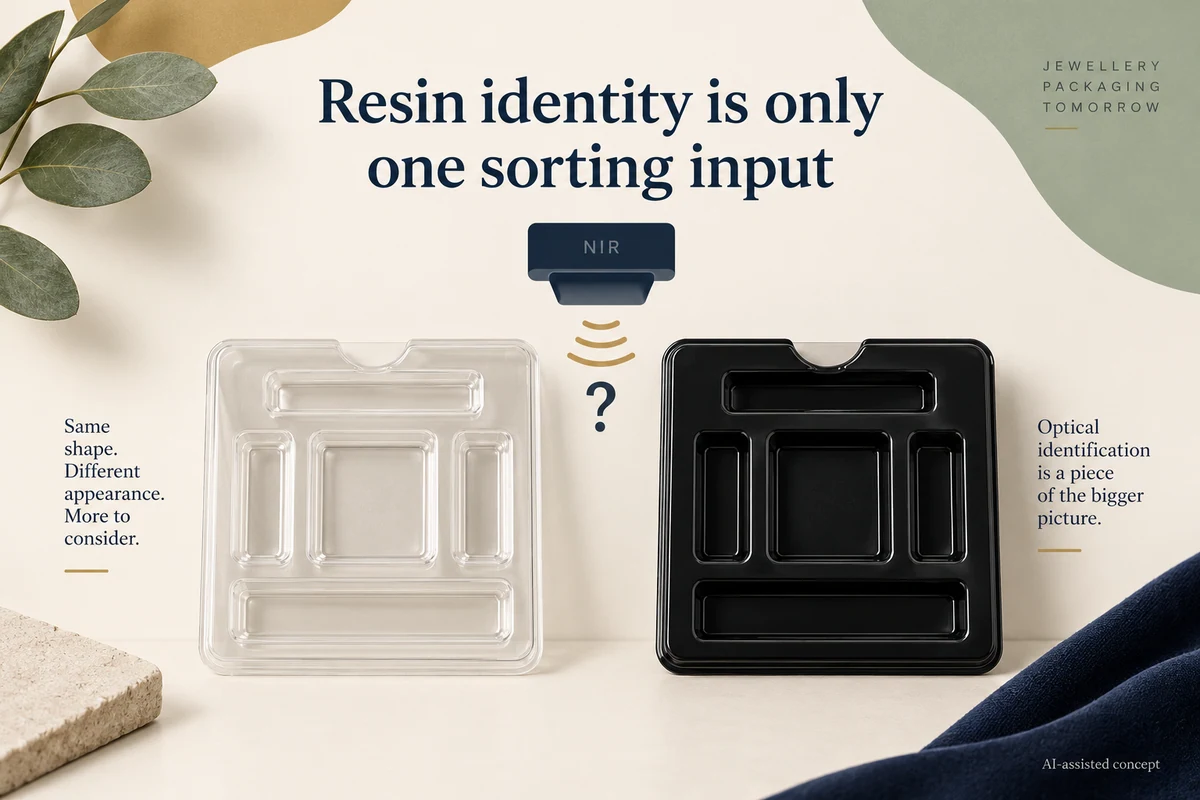
Knowing a plastic insert's base resin doesn't establish that a near-infrared sorter can identify the finished item. Some black colourants interfere with the material signal used by these systems, while specially designed formulations may behave differently.
For a jewelry brand considering a black insert, keep resin identity, colourant and relevant sorting evidence separate. Detectability is also only one part of a recycling route; it doesn't establish local collection or a whole-package recyclability claim.
The sorter reads a material signal
Near-infrared, or NIR, sorting uses information from the plastic's response to illumination. It doesn't simply read the resin code printed on the pack. The Association of Plastic Recyclers' RES-SORT-01 resource explains whole-rigid-package identification and routing in recycling systems.
For the intended sorting step, the system needs usable information from the actual item. A label, coating or colourant can affect what the equipment sees even when the base polymer is correctly identified in the supplier's specification.
Visible-colour sorting and NIR polymer identification are different evaluations. Calling a tray black describes its visible appearance; it doesn't establish its NIR signal or the installed equipment's ability to identify it.
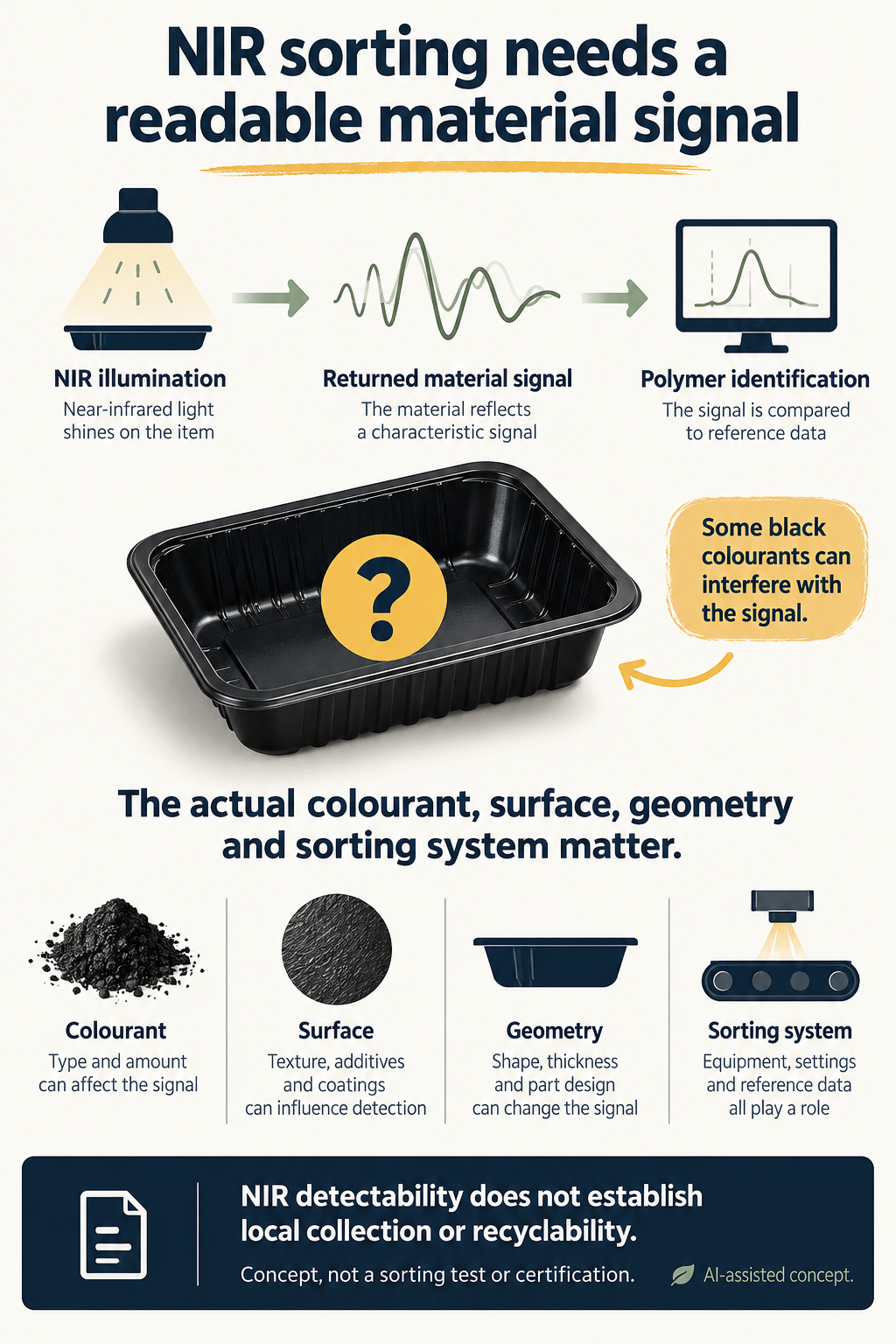
Some black colourants can absorb the relevant signal
APR's resource identifies carbon-black colourants as a particular interference concern. It also discusses black formulations designed to support NIR detection. The existence of those alternatives prevents the blanket conclusion that every black plastic is unsortable.
For an actual proposal, the colourant identity and relevant evidence matter. A supplier's general phrase detectable black needs a defined material and evaluation scope, rather than being accepted as a guarantee for all finished trays and facilities.
No sorting result is assigned to any insert in this article. The diagrams show the information question, not a measured spectrum or a recycling outcome.
Follow a hypothetical clear-to-black revision
Imagine a jewelry brand comparing a clear PET insert with a black PET proposal of the same intended shape. Both supplier descriptions name PET, but the black proposal doesn't identify its colourant or provide relevant sorting evidence. This is a hypothetical document gap, not an examined material pair.
The matching resin names answer one material-identity question. They don't establish equivalent optical identification. The buyer can next ask what the offered colour formulation is and what evidence addresses the actual finished insert.
If the proposal then adds a label covering much of the visible plastic, retain that revision too. A colour-formulation result shouldn't automatically be expanded to a construction with a new covering layer.
The buyer may choose to investigate the proposed formulation, retain a different appearance or change the insert concept. None of those choices establishes an environmental benefit without the relevant complete evidence.
Geometry and collection create further boundaries
The APR PET thermoform resource discusses design considerations for PET thermoformed packaging. Its scope helps identify the relevant item class; it doesn't certify a jewelry tray. Item size, shape and exposed surface can create further sorting questions.
The RecyClass tool provides a separate European technical-recyclability context. Its assessment logic isn't a substitute for actual local collection rules in the United States or United Kingdom, nor an approval of a specific Packrivo configuration.
Even a detectable item may not belong to the relevant local collection stream. Conversely, an accepted collection category doesn't prove that every colourant, shape and assembled layer passes through its sorting and reprocessing route.
Keep the claim attached to its evidence
Packrivo's recycled-content and recyclability guide distinguishes those environmental questions. The component disposal map concerns the final states and a named household programme.
This article adds the optical-identification step between material identity and a functioning recovery route. A resin name alone cannot close it.
Before adopting customer-facing wording, identify the actual insert, colourant, coverings, relevant sorting evidence and destination route. Keep a proposal for NIR detectability narrower than a claim that the whole gift pack is recyclable.
A detectable formulation does not follow every revised insert
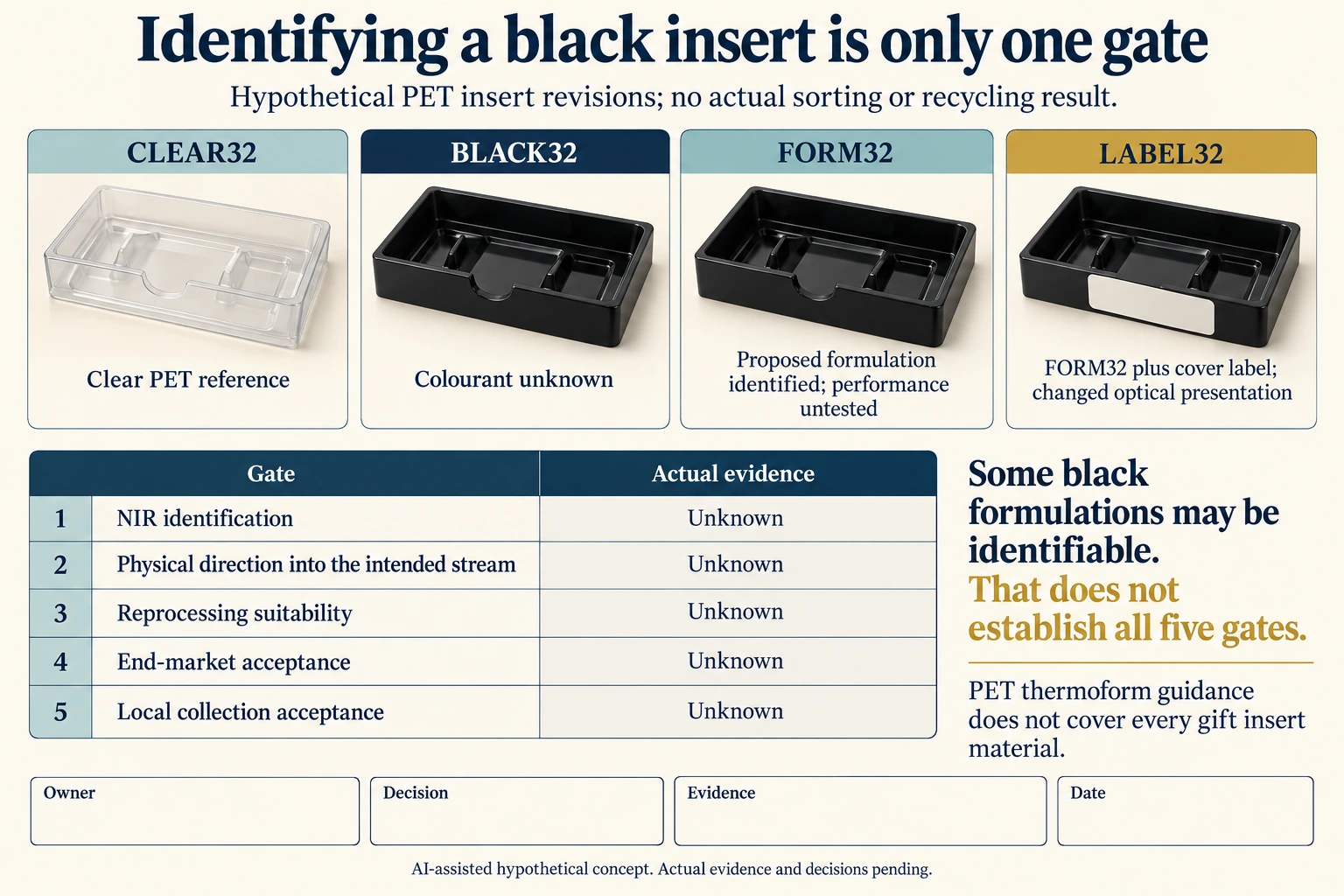
Use four hypothetical document identities to locate a revision. CLEAR32 is a clear PET insert; BLACK32 retains the intended shape and PET description but leaves its black colour formulation unknown. FORM32 identifies a proposed black formulation without assigning it a tested result. LABEL32 then adds a covering label to FORM32. The configuration names do not describe supplied materials or measured spectra.
CLEAR32-to-BLACK32 preserves a resin description, not the optical signal. BLACK32-to-FORM32 supplies a formulation identity, not a successful detector run. FORM32-to-LABEL32 changes the finished surface presented to the equipment, so a record for the earlier construction cannot silently expand to the covered one. Keep the specific formulation and whole-item construction in the question sent to the technical party.
Follow the remaining gates separately: usable NIR identification, successful physical direction into the intended stream, processing compatibility, a receiving material market and an actual local collection route. Evidence at one gate leaves the others open. In particular, a black PET item can be NIR-detectable while its colour still raises downstream market restrictions. Do not turn this revision map into a claim that either clear or black proposed inserts are recyclable.
| Hypothetical scope | Object and relationship | Input, formula or open question |
|---|---|---|
| CLEAR32_IDENTITY | FINISHED_INSERT — ASSUMED_CONFIGURATION | ClearPET; intended shape assumption only |
| BLACK32_IDENTITY | FINISHED_INSERT — ASSUMED_CONFIGURATION | Same intended shape and PET description; black colourant unknown |
| FORM32_IDENTITY | FINISHED_INSERT — ASSUMED_CONFIGURATION | Proposed black formulation identified; no actual test |
| LABEL32_IDENTITY | FINISHED_INSERT — ASSUMED_CONFIGURATION | FORM32 plus hypothetical covering label |
| CLEAR32_TO_BLACK32 | CLEAR32 — CHANGES_EVIDENCE_SCOPE | BLACK32; COLOUR_FORMULATION_CHANGED |
| BLACK32_TO_FORM32 | BLACK32 — CHANGES_EVIDENCE_SCOPE | FORM32; FORMULATION_IDENTITY_ADDED_NOT_TEST_RESULT |
| FORM32_TO_LABEL32 | FORM32 — CHANGES_EVIDENCE_SCOPE | LABEL32; SURFACE_CONSTRUCTION_CHANGED |
| GATE32_NIR_IDENTIFICATION | NIR_IDENTIFICATION — REQUIRES_SEPARATE_EVIDENCE | Actual result unknown; earlier gate is not a whole-route verdict |
| GATE32_PHYSICAL_STREAM_DIRECTION | PHYSICAL_STREAM_DIRECTION — REQUIRES_SEPARATE_EVIDENCE | Actual result unknown; earlier gate is not a whole-route verdict |
| GATE32_REPROCESSING | REPROCESSING — REQUIRES_SEPARATE_EVIDENCE | Actual result unknown; earlier gate is not a whole-route verdict |
| GATE32_MATERIAL_MARKET | MATERIAL_MARKET — REQUIRES_SEPARATE_EVIDENCE | Actual result unknown; earlier gate is not a whole-route verdict |
| GATE32_LOCAL_COLLECTION | LOCAL_COLLECTION — REQUIRES_SEPARATE_EVIDENCE | Actual result unknown; earlier gate is not a whole-route verdict |
Download the comparison and project record (.csv). It preserves the original passages, model branches and table fields alongside the added hypothetical scopes. Relationship rows are not business cases, tests or completed records. Every actual identity, quantity, material, process, specification, observation, owner, decision, evidence and date field is blank. ACTUAL_BLANK is an empty starting row; unknown fields require permitted project evidence.
For the separate question, read Recycled Content and Recyclability Describe Different Claims.
For the separate question, read Mixed-Material Gift Packaging Needs a Component Disposal Map.
Source scope checked 17 October 2026: APR RES-SORT-01 current public Version 3 is dated 23 October 2024; RES-PET-01 Version 1 is dated 18 November 2024 and concerns PET thermoforms, not every resin or gift insert. NIR-detectable black formulations exist. RecyClass European technical evaluation does not establish local collection or PPWR compliance.
Public references for that scope: APR RES-SORT-01 public protocol, APR RES-PET-01 public protocol.
Discuss this packaging specification with Packrivo. We coordinate independent suppliers. MOQ: 500 pieces per product/design; illustrative quantities are not production offers. Confirm materials, samples, price and timing for your project.