
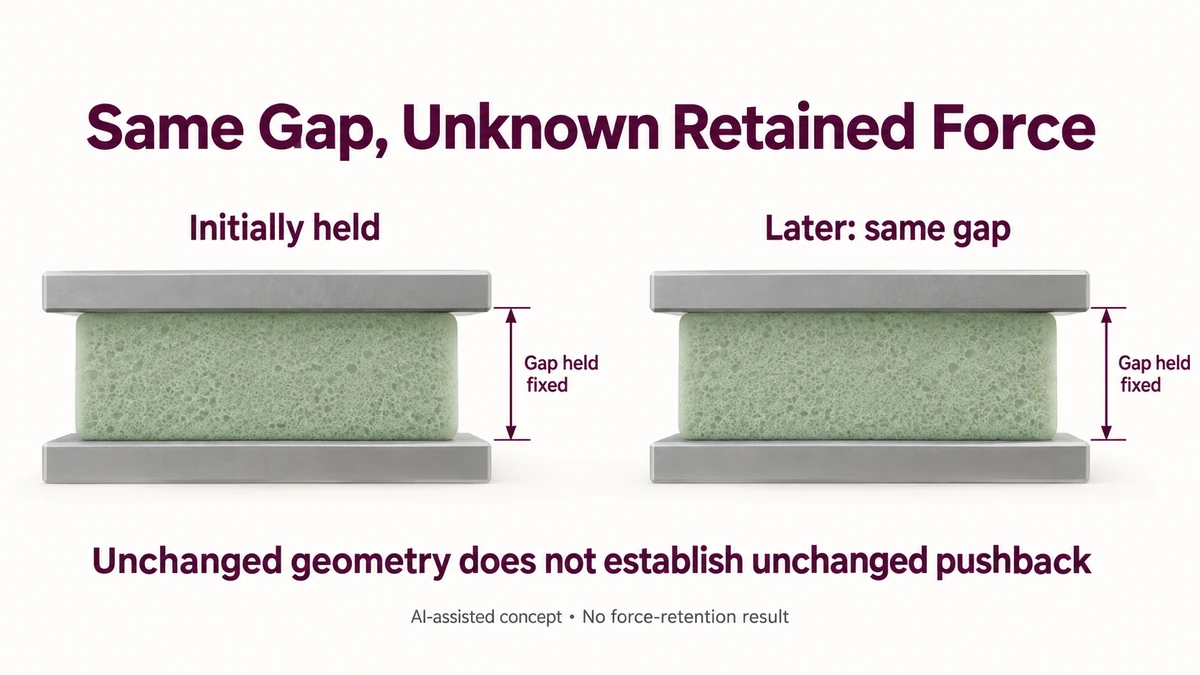
A foam pad held at one unchanged installed thickness does not necessarily maintain the same pushback force throughout storage. Geometry can remain fixed while the material’s resisting force changes with time.
For an elastomeric holder, that is the question of stress relaxation. It differs from creep under a maintained load and from recovery after the material is released. A jewellery brand deciding whether an insert will continue pressing against a product needs to identify which of those conditions its proposed holder actually imposes.
This explanation concerns a hypothetical fixed-gap arrangement. It does not establish retention, contact safety or time-dependent performance for any supplied foam grade or shaped insert.
An Unchanged Gap Does Not Freeze the Force
Imagine a flat elastomeric pad between two rigid surfaces held at a fixed separation. Initially, compressing the pad produces a reaction force. The constraint then prevents the surfaces from moving farther together or apart.
In a material that exhibits stress relaxation, the reaction can decrease while the imposed deformation remains unchanged. The material’s mechanical response is not fully described by a photograph of the gap.
Rogers Corporation’s stress-relaxation explanation describes this force change under held deformation and contrasts it with creep. Its application is elastomeric sealing, not jewellery retention; the physical distinction is useful, while product-specific lifetime and performance claims cannot be transferred to an insert.
An unchanged thickness therefore supports a geometric observation, not a finding of unchanged force. Measuring one quantity and reporting it as the other would answer the wrong question.
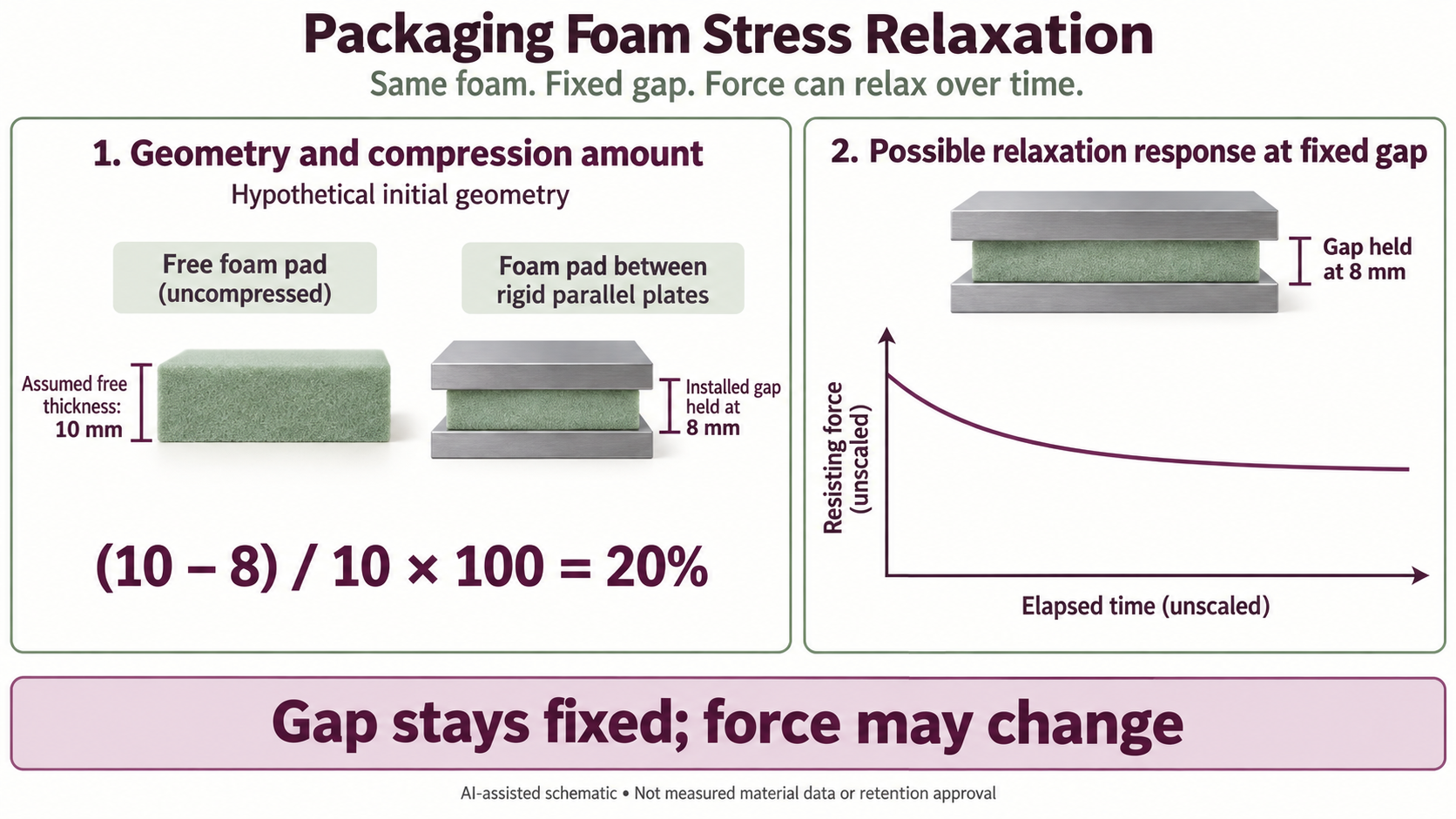
The Ten-to-Eight-Millimetre Example Establishes Only a Starting Geometry
Assume a hypothetical flat pad begins at a free thickness of 10 mm and is installed in an 8 mm gap. Its initial thickness reduction is:
10 mm − 8 mm = 2 mm
Relative to that assumed free thickness, the nominal initial compression is:
2 mm ÷ 10 mm × 100 = 20%
These are invented dimensions for an idealized example, not measurements of a Packrivo sample. The arithmetic describes the starting imposed deformation. It does not calculate the resulting force.
Suppose the rigid surfaces keep the gap at 8 mm. Looking at the arrangement later would show the same installed distance. It would not show whether the pad’s pushback remained the same, declined appreciably or met the intended retention requirement.
No loss percentage, elapsed-time threshold or final force follows from the 20% figure. The result needs a material response appropriate to the configuration and conditions, not an assumed conversion from a percentage compression point.
The foam-deflection guide explains how to connect initial geometry to a supplier’s stated compression point. This article asks the subsequent, different question: what happens to resisting force while the intended deformation is maintained?
Three Time-Dependent Questions Need Different Constraints
The distinction can be expressed by identifying what is controlled and what is observed.
| Question | Condition maintained or changed | Response of interest |
|---|---|---|
| Stress relaxation | Deformation or installed gap is held | Resisting force as time passes |
| Creep | Applied load is maintained | Continuing deformation as time passes |
| Recovery and compression set | Compression is released after a stated history | Returned shape or residual deformation |
These are different relationships, not interchangeable names for foam ageing.
In a creep arrangement, the surfaces can move as the material deforms under the load. In the fixed-gap example, their separation is deliberately constrained; a changing force is the response being investigated.
After unloading, the boundary condition changes again. The pad is no longer required to fit the maintained gap, and its returned thickness can answer a recovery question. Rogers’ compression-set discussion concerns that separate recovery-related property.
A pad that appears to recover after removal has not, through that observation alone, demonstrated sustained pushback while installed. Likewise, a retained-force observation does not establish complete recovery after release.
Identify Whether the Product Is Actually Held at a Fixed Gap
The flat-pad example simplifies the geometry to expose the distinction. A real jewellery cavity can be different.
The product may move, the receiving surfaces may deflect, and contact can occur at several curved or local regions. Its contact area and deformation need not remain uniform or fixed. A layer of wrapping, another insert component or a changing lid position may also affect the constraint.
Before treating fixed-strain information as relevant, identify which components prevent movement and where the material is compressed. A holder that merely touches a product is not automatically equivalent to a pad clamped between rigid plates.
The actual function matters too. A cavity that locates a product by shape can have a different reliance on sustained pushback from a design that depends on continuous pressure. More force is not automatically better: the product’s finish, fragile features and intended handling remain separate considerations.
Neither a material density nor an initial compression value supplies a safe contact pressure for jewellery.
A Useful Comparison Retains the Force History
If the intended holder depends on sustained force at a defined installed state, relevant evidence should describe that state and the resisting force over its evaluated exposure. It also needs the material identity and conditions under which the observation was obtained.
A qualitative drawing of a declining curve can explain stress relaxation, but it cannot rate an actual insert. Without measured force and time, it cannot say how much is lost or when a function becomes unacceptable.
Equally, a record ending at one observation period cannot establish unlimited force retention. Its conclusion remains bounded by the configuration, history and conditions actually covered.
The buyer can therefore distinguish three useful items in a supplier discussion: initial compression behavior, force retention under a relevant constraint, and shape recovery after release. Each may inform the design; none should be substituted for another.
The test-report configuration guide helps keep evidence connected to the material and arrangement evaluated. Packrivo can coordinate those construction details and questions, but does not measure or certify retained force through project coordination.
If the design requires continued pushback, an unchanged gap is not the acceptance result. The relevant question is whether the actual holder has suitable force-retention evidence under its intended constraint.
Source scope: Public manufacturer information accessed 11 October 2026. Rogers’ stress-relaxation article is dated 31 January 2025; its compression-set article is dated 8 August 2024. Their elastomeric-sealing context does not establish the response of a particular packaging foam, safe product-contact force or a holding lifetime. The 10 mm, 8 mm and 20% figures are hypothetical starting geometry only; no force, duration, specimen result or product performance has been measured.
A recovered height cannot replace the held-force record
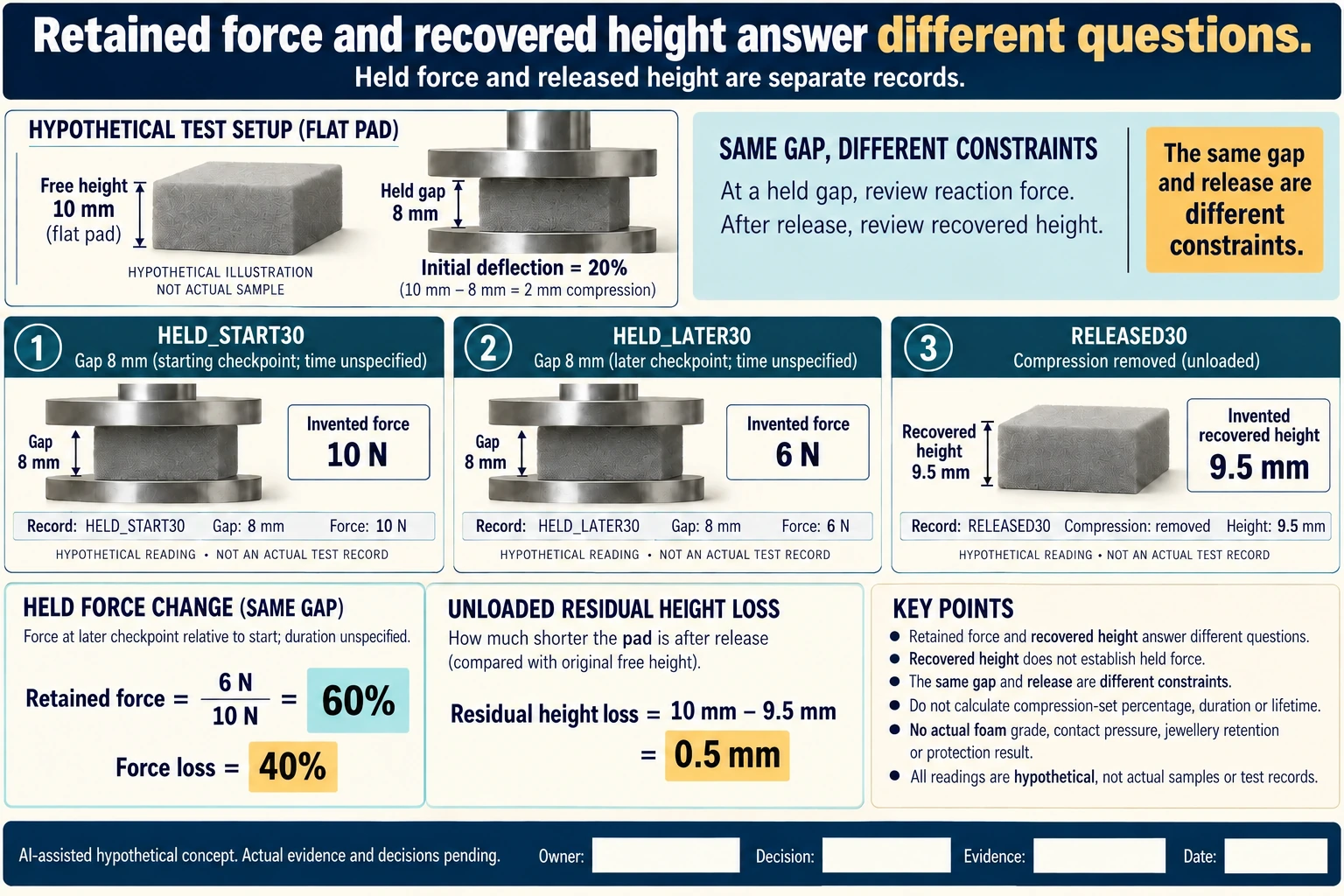
Retain the original 10 mm free height and 8 mm fixed gap only as starting geometry. In a new invented arithmetic record, HELD_START30 has 10 N reaction force at 8 mm and HELD_LATER30 has 6 N at the same gap. The checkpoints have no assigned duration or temperature, and the forces are not material data or predictions.
Scroll horizontally if columns extend beyond the view.
| Hypothetical configuration | Named object | Relationship | Input or next scope |
|---|---|---|---|
| FOAM30 | FREE_PAD | assumed input | 10 mm |
| FOAM30 | FIXED_GAP | assumed input | 8 mm |
| FOAM30 | INITIAL_GEOMETRY | calculated from | (FREE_HEIGHT-HELD_GAP)/FREE_HEIGHT*100; 20 percent |
| HELD_START30 | REACTION_FORCE | assumed input | 10 N |
| HELD_LATER30 | REACTION_FORCE | assumed input | 6 N |
| HELD_LATER30 | RELATIVE_TO_START | calculated from | LATER_FORCE/START_FORCE*100; 60 percent |
| HELD_LATER30 | RELATIVE_TO_START | calculated from | (START_FORCE-LATER_FORCE)/START_FORCE*100; 40 percent |
| RELEASED30 | RELEASED_PAD | assumed input | 9.5 mm |
| RELEASED30 | RELATIVE_TO_FREE | calculated from | FREE_HEIGHT-RECOVERED_HEIGHT; 0.5 mm |
| RELEASED30 | COMPRESSION | is | REMOVED_NOT_FIXED_GAP |
| FOAM30 | CHECKPOINT30_ID | not a | DURATION_OR_30_UNITS |
| RELEASED30 | HEIGHT_DIFFERENCE | not a | STANDARD_COMPRESSION_SET_PERCENT_OR_FORCE_RESULT |
| FOAM30 | FORCE_AND_HEIGHT_ARITHMETIC | does not establish | JEWELLERY_POSITION_CONTACT_SAFETY_OR_LIFETIME |
The invented force-retention ratio is 6 ÷ 10 =60%; the corresponding force loss relative to that starting force is 40%. Neither is the 20% geometric compression. A percentage with no named numerator and baseline could obscure that difference. Preserve the force unit, constraint and observation interval if actual evidence later becomes available.
RELEASED30 is a separate state after compression is removed. Assume a recovered height of 9.5 mm for the exercise, leaving 10 − 9.5 =0.5 mm height loss relative to the original free height. This subtraction is not a standard compression-set percentage: its compression and recovery history and applicable method have not been supplied. Nor does the returned height establish the force that existed while the gap was held.
If the purchasing requirement depends on sustained pushback, request evidence for the installed constraint and relevant exposure. If it concerns recovery after unpacking, retain that different question. Both remain separate from product position, delicate-surface contact and transport protection. Rogers’ sealing examples clarify the vocabulary but provide no actual holder grade, force history or lifetime for these invented readings.
Download the foam retained force recovered height separate calculation record (.csv). It includes the original table fields and scenarios alongside the added relationships. HYPOTHETICAL rows are editorial examples or required review scopes, not actual records. Actual quantity, configuration, component and file identities, materials, process, specification, copy, method, condition, observation, owner, decision, evidence and dates are blank. ACTUAL_BLANK is a separate empty starting row; enter permitted project evidence before using an actual record. A blank means unknown.
Use the Read Foam Compression Data Against the Intended Deflection for its separate question.
Source scope checked 17 October 2026: Rogers stress-relaxation 31 January 2025 and compression-set 8 August 2024 articles distinguish held deformation, constant load and release/recovery in their sealing/elastomer context. No actual packaging force, compression-set method, contact pressure, retention or service lifetime is established. The added configurations and calculations are hypothetical, with actual evidence and decisions pending.
Discuss this packaging specification with Packrivo. We coordinate independent suppliers. MOQ: 500 pieces per product/design; illustrative quantities are not production offers. Confirm materials, samples, price and timing for your project.