
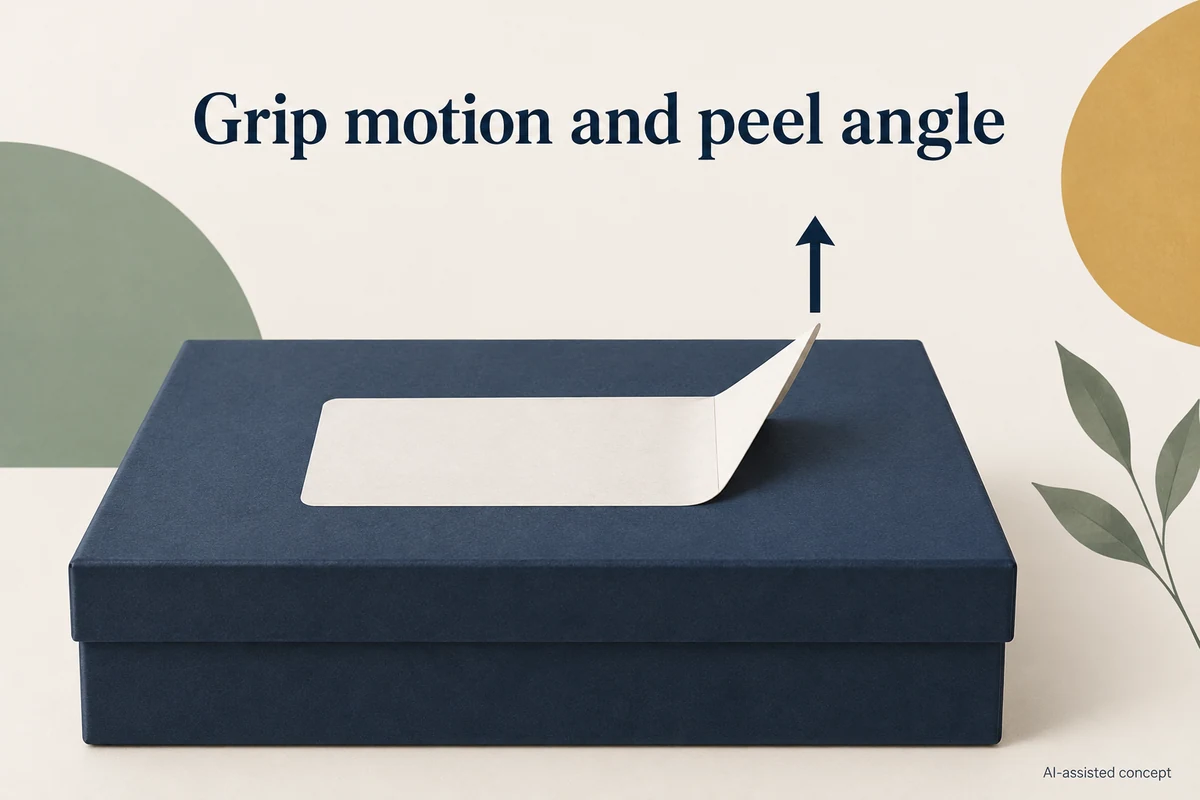
A hand moving vertically while peeling a label doesn't necessarily keep the label at a constant angle to the surface. The free end follows the grip, while the separation front moves across the surface; these are two different positions with different motions.
For a gift brand comparing label removal, the distinction matters before interpreting a changing force as inconsistent adhesive quality. The geometry of the pull can change during the observation even when the label and receiving surface remain the same.
Locate the grip and the advancing front separately
The grip is the point where the free label end is held. The separation front is where the backing and adhesive stop being attached to the receiving surface. The free arm connects those positions.
As more label detaches, the separation front advances. Its movement needn't match the distance travelled by the grip. Part of a change in grip position can alter the free-arm angle or extend the backing rather than release the same length of label.
The selected methods discussion in Rezaee and colleagues' original peel study, published in Scientific Reports on 24 December 2019, distinguishes pull motion from peel-front motion. That experimental-development context supplies a geometric explanation, not a performance result for gift-box labels.
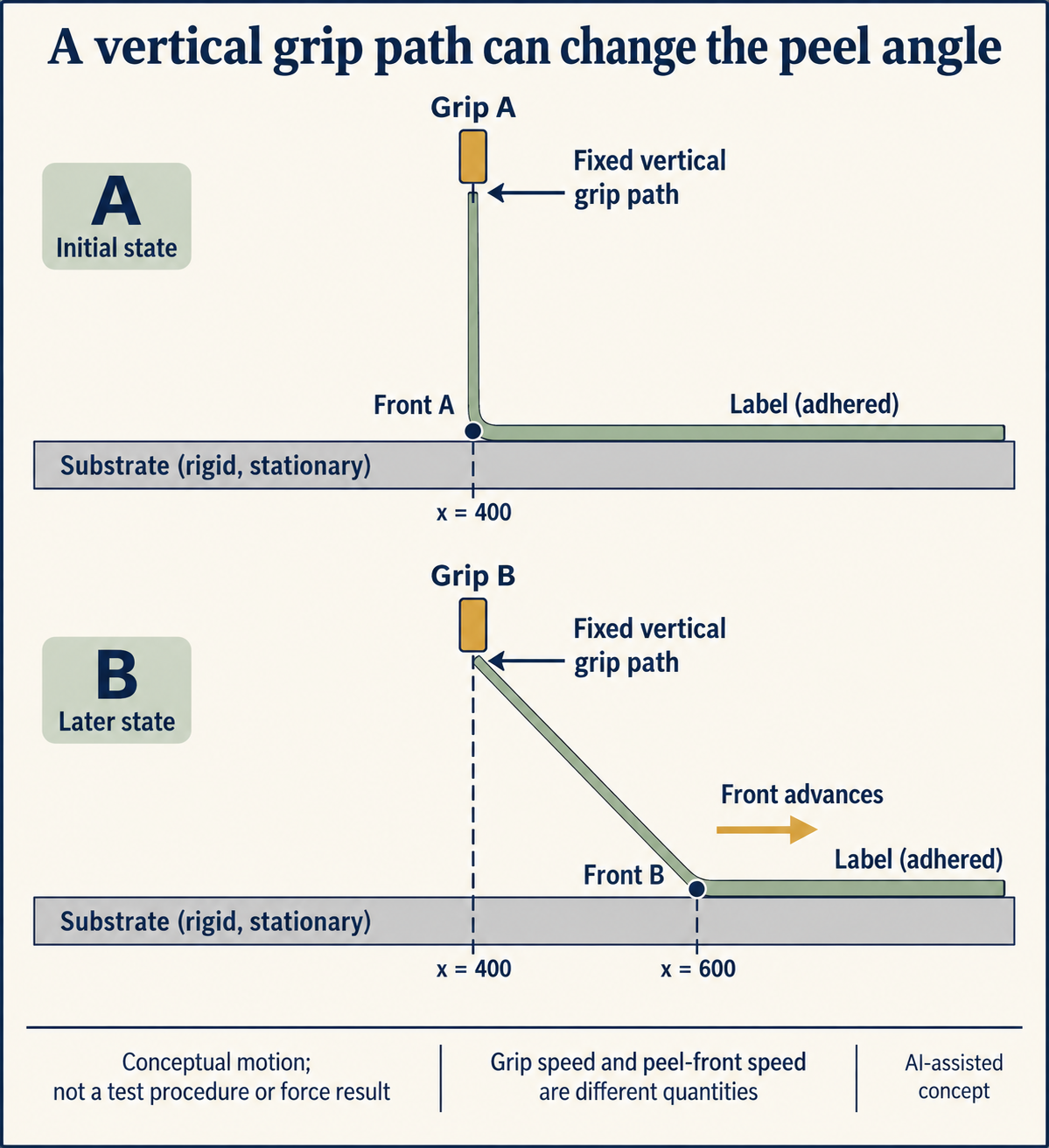
Follow two times along one vertical grip path
Imagine a label attached to a stationary flat rigid surface. In this hypothetical example, its free end begins directly above the separation front. The free arm is initially approximately perpendicular to the surface.
The grip then moves upward along the same vertical line. Meanwhile, the separation front advances across the surface to the right. A straight free arm now runs from that rightward front up toward the grip on the original vertical line.
The grip has moved only upward, but the free arm is now diagonal. The angle at the front has changed because the front and grip no longer share the same horizontal position.
This example doesn't require a force value, a speed value or a proposed fixture. It demonstrates why a photograph of an initial right angle doesn't establish the angle throughout a removal sequence.
A pull-speed label may omit the relevant motion
A reported speed may refer to the grip, the separation front or a machine's commanded movement. These descriptions are not interchangeable. Even when a grip moves at a constant speed, the advancing front can have a different motion because the free-arm geometry or backing extension changes.
For a meaningful comparison, identify what the speed describes. A video showing the held end is insufficient to establish a peel-front speed if the front isn't visible or tracked. Conversely, knowing the front's movement doesn't define the grip's complete path.
There is no general conversion here from vertical travel to released label length. Such a calculation would need a defined model and its assumptions. A brand comparing finished labels can instead keep the relevant positions visible and avoid making an unsupported quantitative claim.
Force depends on more than the adhesive name
Peeling involves the adhesive interface, backing response and geometry of the free arm. A change in observed force can therefore have more than one possible explanation. The receiving surface may also deform or lose a layer, creating a different failure path from adhesive separation alone.
The public scope of ASTM D3330/D3330M-04(2025) distinguishes specified peel arrangements for pressure-sensitive tape. It also limits how such measurements can be used. The full paid method was not reviewed, and a tape result doesn't automatically validate a finished label on a wrapped gift lid.
A comparison between two observations should identify which geometry and motion were controlled. If those conditions differ, the difference can't confidently be assigned only to the adhesive. Nor should a hand-peel force be converted into a universal adhesive score.
Separate the removal outcome from its mechanical explanation
A brand may want the gift lid to remain presentable after a temporary label is removed. That outcome is distinct from the explanation of the force recorded during removal. A label could require varying force and still leave a presentable surface, or peel smoothly while leaving residue.
Packrivo's label removal observation guide records residue, label condition and receiving-surface appearance separately. The label liner release guide addresses another interface: releasing the label from its liner before application.
Keep the current question attached to the relevant interface. Difficulty dispensing a label from its liner doesn't establish the behaviour of its later removal from a finished box.
When a removal comparison changes unexpectedly, first identify the grip path, separation-front motion, backing and surface. If the geometry changed, resolve that difference before recommending a new adhesive. A useful comparison explains which variable changed while keeping the desired post-removal outcome explicit.
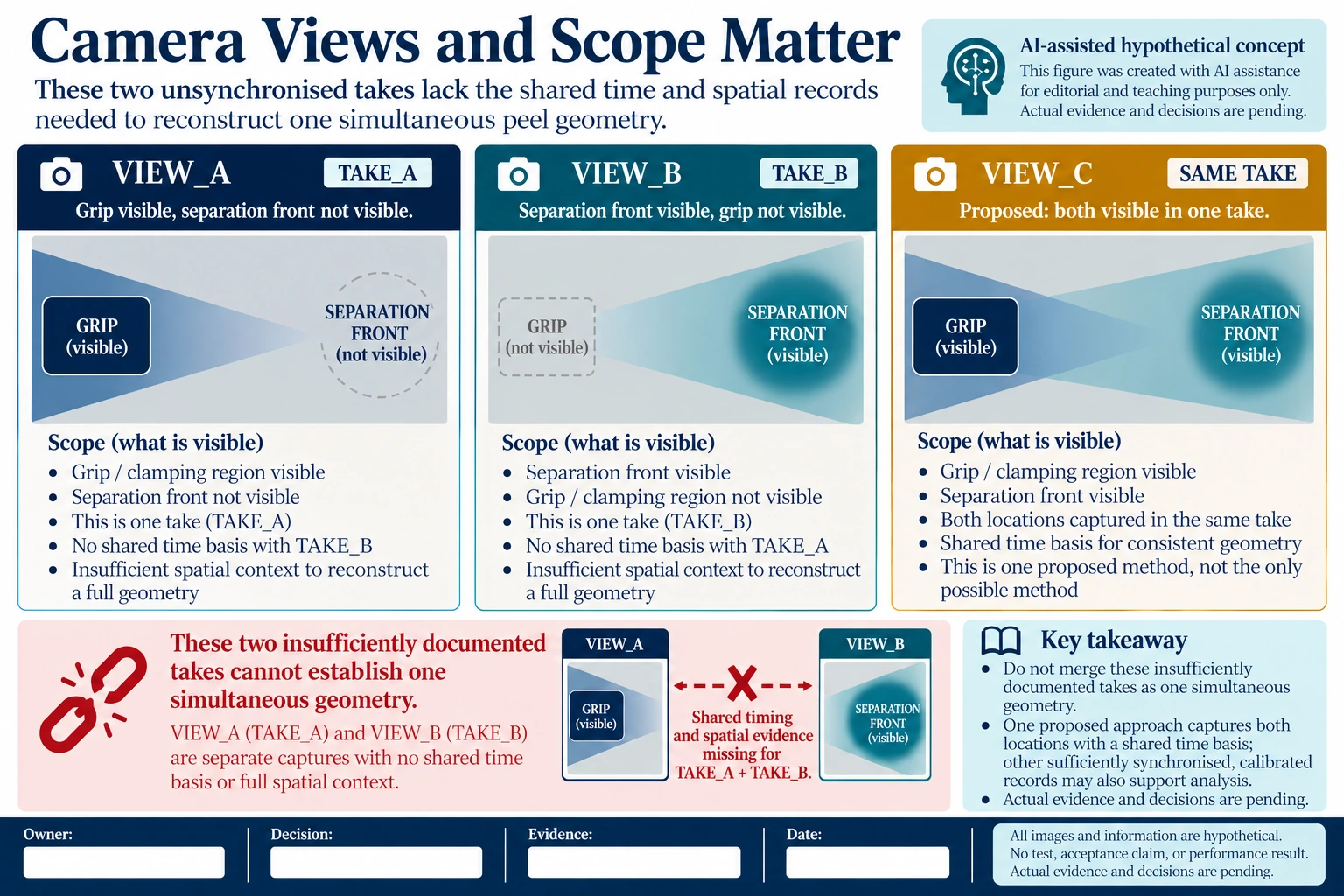
These two undocumented takes cannot establish one simultaneous peel geometry
Compare three fictional evidence scopes. VIEW_A shows the grip but crops out the separation front. VIEW_B shows the front but comes from another take. These two hypothetical takes have no shared time basis or sufficient common spatial record. VIEW_C is a proposed record showing both in one identified arrangement with a shared timing basis. None is a supplied video or a performed label test.
Scroll horizontally if columns extend beyond the view.
| Hypothetical configuration | Named object | Relationship | Input or next scope |
|---|---|---|---|
| VIEW_A | VIEW_A | belongs to | TAKE_A |
| VIEW_A | GRIP | visibility scope | VISIBLE |
| VIEW_A | SEPARATION_FRONT | visibility scope | CROPPED_UNKNOWN |
| VIEW_B | VIEW_B | belongs to | TAKE_B |
| VIEW_B | GRIP | visibility scope | UNAVAILABLE |
| VIEW_B | SEPARATION_FRONT | visibility scope | VISIBLE |
| VIEW_C | VIEW_C | belongs to | SAME_PROPOSED_TAKE |
| VIEW_C | GRIP | visibility scope | PROPOSED_VISIBLE |
| VIEW_C | SEPARATION_FRONT | visibility scope | PROPOSED_VISIBLE |
| VIEW_A_PLUS_B | THESE_UNSYNCHRONISED_TAKES_A_B | insufficient to reconstruct | ONE_SIMULTANEOUS_GEOMETRY_WITHOUT_SHARED_TIME_SPATIAL_RECORD |
| VIEW_C | BOTH_LOCATIONS | requires | SAME_ARRANGEMENT_SHARED_TIMING_EVIDENCE_PENDING |
| VIEW_C | PROPOSED_RECORD | not a | FIXTURE_SPEED_OR_FORCE_TEST |
VIEW_A cannot locate the unseen front, while VIEW_B cannot fill it for the earlier take merely because the label name matches. Combining these insufficiently documented positions would create a simultaneous geometry that the two records do not establish. This example does not assess other observation methods with sufficient common time and spatial evidence. Keep the take, frame relationship and visible locations beside any motion description.
The next request is the existing common-scope evidence, if available, or the responsible reviewer’s appropriate evidence plan. This is not an instruction to recreate a peel, improvise a fixture or assign a test speed. A grip path, front movement, free-arm geometry and backing response remain different quantities.
The original vertical-grip example remains correct. This added check concerns whether the evidence actually shows the two positions together before a force change is attributed to adhesive quality. Surface appearance, residue and label condition still need their separate outcomes; method names alone approve neither the finished label nor that attribution.
Download the peel grip separation-front shared-timing record (.csv). It includes the original table fields and scenarios alongside the added relationships. HYPOTHETICAL rows are editorial examples or required review scopes, not actual records. Actual quantity, configuration, component and file identities, materials, process, specification, copy, method, condition, observation, owner, decision, evidence and dates are blank. ACTUAL_BLANK is a separate empty starting row; enter permitted project evidence before using an actual record. A blank means unknown.
Use the Record Removal Conditions Before Asking for a Removable Label for its separate question.
Source scope checked 17 October 2026: Rezaee and colleagues, Scientific Reports, 24 December 2019, distinguish pull and front motion within their research context. ASTM D3330/D3330M public 90/180-degree method descriptions are not the complete paid methods, consumer-label approval or a cross-maker adhesive ranking. The added configurations and calculations are hypothetical, with actual evidence and decisions pending.
Discuss this packaging specification with Packrivo. We coordinate independent suppliers. MOQ: 500 pieces per product/design; illustrative quantities are not production offers. Confirm materials, samples, price and timing for your project.