
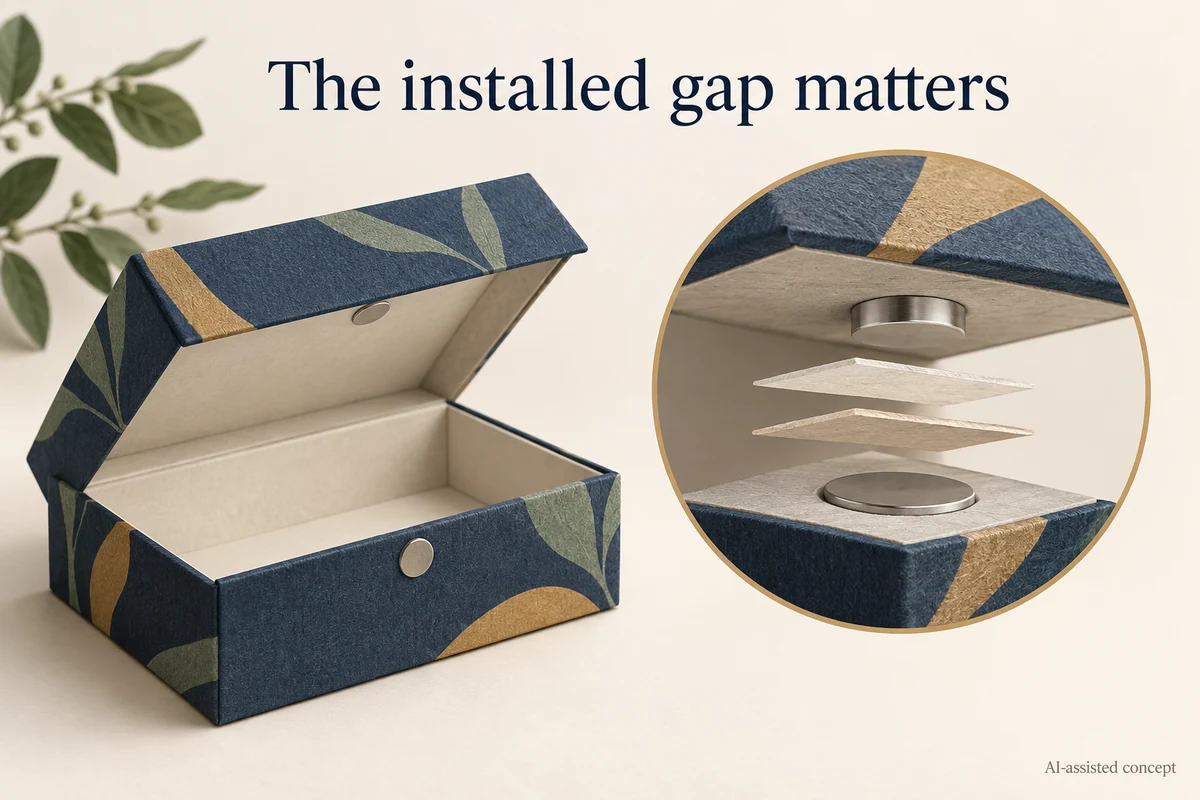
A magnetic gift-box closure acts through its installed layers and against a particular counterpart. A magnet's advertised direct-contact pull figure doesn't establish the attraction of that assembled pair, and the pair's attraction doesn't describe every force involved in opening the lid.
Before replacing a magnet to change the closure feel, identify the gap, alignment and counterpart in the actual construction. Those inputs can explain why the same magnet produces a different closure interaction in two boxes.
The counterpart belongs in the comparison
A magnet facing a steel target and a magnet facing another magnet are different arrangements. Their dimensions, positions and contact conditions matter. A specification naming only the magnet grade leaves the other half of the closure undefined.
K&J Magnetics' explanation of magnet-strength testing describes multiple pull-test configurations. Its reported product values belong to those configurations; they shouldn't be copied into a wrapped gift-box specification as installed performance.
For a confirmed magnet-to-steel construction, identify the actual steel target as well as the magnet. If a proposal changes to a magnet pair, treat it as a different architecture. Don't silently carry a value from one arrangement to the other.
Wrap and lining contribute to the installed gap
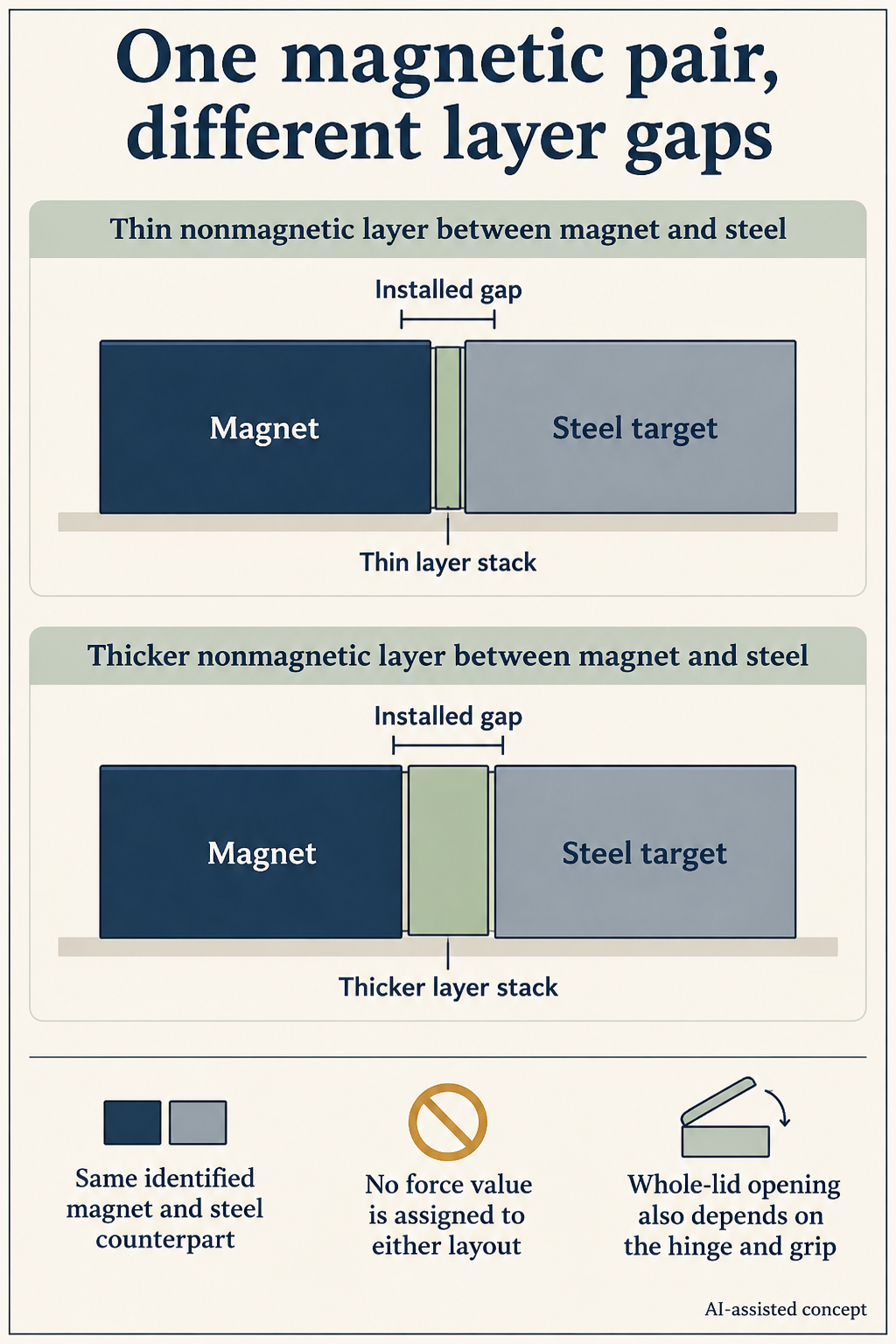
Paper wrap, lining, board and adhesive construction can separate the magnetic components even when the visible lid and base appear to touch. The relevant separation is between the interacting components, not just the gap visible at the box edge.
K&J's separate discussion of what a magnet can hold explains why distance and the loading arrangement affect the interaction. It doesn't provide a universal force law for unspecified closure components.
A thicker intervening layer stack changes the magnetic comparison. The amount of any force change depends on the actual pair and geometry, so neither a general inverse-square rule nor a proportional thickness calculation supplies a finished-box result.
Alignment matters alongside separation. A shifted target can change the arrangement while the wrap thickness stays constant. Checking only the material thickness would miss that second variable.
Follow a hypothetical layer-stack revision
Suppose a gift brand keeps one identified magnet and one identified steel target while comparing two nonmagnetic wrap constructions. The second construction adds a lining between the components. This is a hypothetical design comparison, not a test result.
The useful first drawing shows where each interacting component sits relative to the finished surfaces. It identifies which layers genuinely separate them. A decorative layer elsewhere on the lid shouldn't be added to the magnetic gap merely because it appears in the materials list.
The comparison then keeps counterpart identity and alignment fixed while changing the relevant layer stack. This isolates a geometric question: how does that installed separation affect this pair? It doesn't assign either layout a pull value or claim that one will give the desired feel.
If the supplier also moves the target, a later observation would combine two changes. Retain both changes in the comparison rather than attributing the result entirely to the lining.
This approach gives the buyer a concrete choice about which configuration to investigate next. It avoids ordering a nominally stronger magnet before understanding the installed geometry.
Lid opening introduces hinge and grip geometry
A hinged box opens by rotating around its hinge. The magnetic pair resists separation at its installed location, while the recipient applies force at a reachable lid edge or other opening feature. Those locations need not have the same distance from the hinge.
Other contacts can contribute too. A lid may meet a shoulder or rub a wrapped edge during its first movement. If the observation is whole-lid opening effort, it includes the relevant mechanism and contacts rather than an isolated straight pull on the magnetic pair.
Packrivo's jewelry box structure guide distinguishes opening formats and product-removal questions. The accessible packaging guide considers the recipient's full action. Neither a structure name nor the magnetic component rating answers that complete interaction.
Choose evidence for the variable being changed
If the proposed revision changes only the separating layers, compare the installed pair with those layers identified. If it changes the counterpart or alignment, identify the new arrangement. If the concern is the recipient's opening experience, compare the complete lid with its hinge, grip route and contents in place.
Keep these results distinct. A component pull value, an installed-pair comparison and a whole-box opening observation have different boundaries. A useful packaging brief names which of them is needed before selecting a revision.
This article addresses static closure geometry. It doesn't determine magnetic-field limits for shipping, safety around medical devices or the secure containment of components. Those questions require their own applicable evidence.
Separate layer-gap revisions from alignment revisions
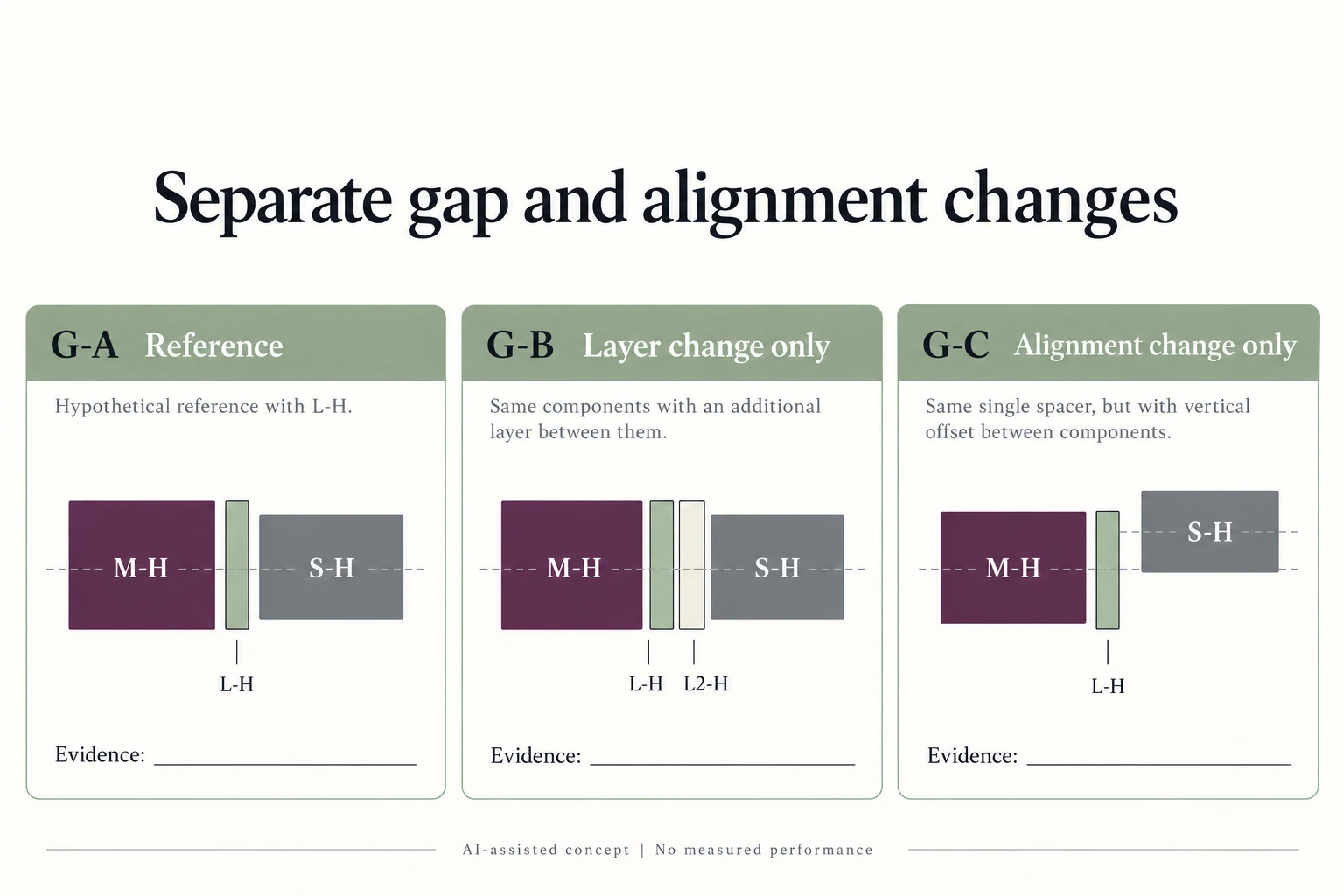
Use one comparison pair for one change. In this hypothetical magnet-to-steel architecture, M-H and S-H remain the same identified components. Layer L-H lies between them; decorative panel D-H is elsewhere and is excluded from the gap record.
Scroll horizontally if columns extend beyond the view.
| Configuration | Changed input | Unchanged reference | Open question |
|---|---|---|---|
| G-A | Reference intervening stack L-H | M-H / S-H and alignment A-H | Actual installed separation and evidence |
| G-B | Add intervening lining L2-H | Same M-H / S-H and A-H | Effect of changed separation |
| G-C | Shift target alignment to A2-H | Reference intervening stack L-H | Effect of changed alignment |
| Opening O-H | Whole lid, hinge and grip route | Configuration must be named | Recipient opening observation |
A materials list cannot locate a magnetic gap by itself. Mark the magnet, steel target and genuinely intervening layers on the section drawing. A panel outside the interaction route should remain in the package construction record without being added to the separating stack.
Do not compare G-A against a proposal that changes both lining and target location and then attribute an observation only to lining. G-B and G-C are proposed comparisons that separate those questions, not manufactured samples or a recommendation to move components.
Leave pull values, separation measurements and opening observations empty. Component direct-contact specifications and complete-lid effort retain their own geometry; neither becomes an installed G-A value by copying a number. No inverse-square or thickness-proportional force calculation is supplied.
Download the magnetic gift box closure gap record (.csv). HYPOTHETICAL rows are invented examples. Use ACTUAL_BLANK for permitted project inputs; replace that row label only when recording actual facts. Empty evidence, observation and date fields mean unknown or not performed, never acceptance. Keep checkpoints and revisions separate.
Bring the installed section and the single changed variable to the existing enquiry route before requesting a different closure component. Packrivo coordinates independent suppliers. These records establish no supplier offer, service availability or MOQ exception; its published baseline is 500 pieces per product/design.