

A visible NFC tag is not necessarily a readable NFC tag. If a gift box includes conductive foil, metallic components or jewellery close to the proposed tag, the completed package may present a different reading environment from the plain card on which the tag was first demonstrated.
Before approving the location, decide whether the tag will operate next to metal in the package’s intended use. A position on nonmetal material and a tag construction designed for metal-adjacent use are different candidates. Neither should be assumed to work in the finished package without relevant evidence.
This distinction matters for small jewellery, candle and gift brands considering NFC-enabled care cards, gift boxes or product information touchpoints. The issue is not simply whether a customer can see or reach the printed NFC symbol.
NFC Reading Depends on Magnetic Coupling
A QR code is read optically by a camera. An NFC tag communicates through a different physical mechanism.
In a typical 13.56 MHz HF/NFC system, the reader and tag contain antennas that couple through an alternating magnetic field. A passive tag draws energy from that field to operate and communicate. The orientation, antenna characteristics and surrounding materials can affect the interaction.
STMicroelectronics explains this magnetic coupling in its AN2866 application note on 13.56 MHz tag antennas, Rev. 6, September 2025.
For packaging, the important consequence is that the magnetic environment extends beyond the visible NFC mark.
A tag may be printed or attached on the outside of a lid while a conductive layer sits behind it. A metal jewellery item may occupy the space beneath that lid. The customer still has an unobstructed surface to tap, but the tag antenna is no longer necessarily operating in the same environment as it did on an isolated card.
The printed position describes where the customer is invited to tap. It does not, by itself, establish how the antenna will behave.
Nearby Metal Can Change the Antenna’s Electrical Behaviour
An alternating magnetic field can induce circulating electrical currents, called eddy currents, in nearby conductive material.
Those currents generate their own magnetic fields and can oppose part of the field responsible for coupling between the reader and tag. Conductive material can also introduce losses and change the effective electrical characteristics of an antenna.
One possible consequence is detuning: the antenna no longer responds optimally at its intended operating frequency in the new environment.
NXP’s NFC Antenna Design Made Easy, published 12 October 2021, discusses antenna geometry and metal proximity, including ferrite-backed configurations.
A more specific historical illustration appears in NXP’s AN11535, Measurement and tuning of a NFC and Reader IC antenna with a MiniVNA, Rev. 1.1, 3 November 2014.
In section 6, NXP placed an aluminium plate near a particular reader-antenna setup. The documented return-loss minimum moved to approximately 14.8 MHz rather than the intended 13.56 MHz region. The note attributes the change in antenna inductance to eddy currents associated with the metal plate.
That experiment demonstrates a real detuning mechanism. It does not measure a packaging label, predict the behaviour of thin decorative foil or establish the reading distance of a passive tag inside a gift box. Its particular circuit adjustments are not instructions for a packaging buyer.
The behaviour of an actual package depends on the materials, conductor geometry, antenna construction and relative positions involved. A metallic-looking finish is not sufficient evidence that it contains a conductive layer, and a confirmed conductive foil does not automatically mean that an NFC tag will fail.
The relevant question is whether the proposed material arrangement changes the NFC operating conditions enough to require a different tag construction or location.
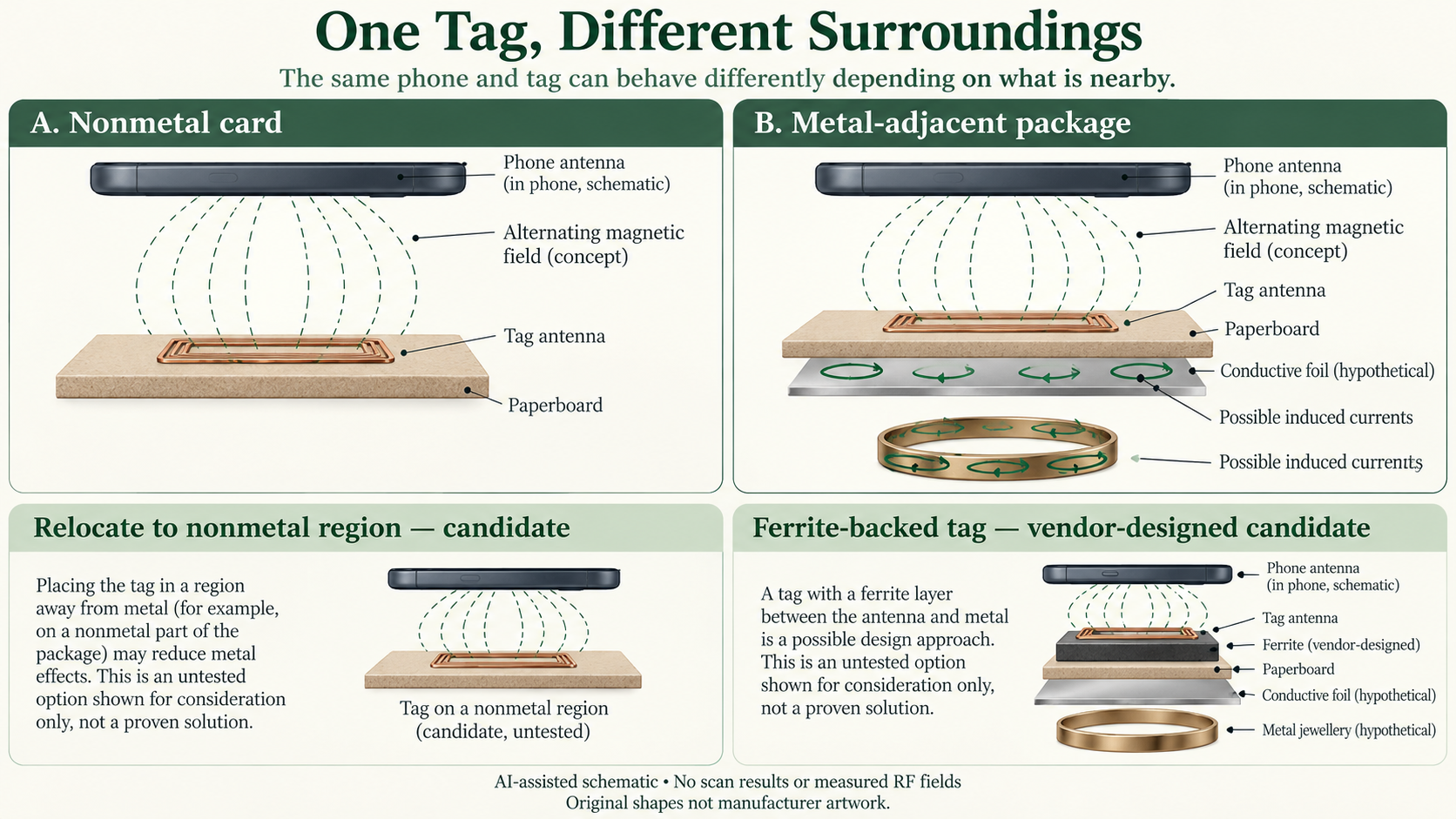
A Plain Card and a Filled Gift Box Are Different Configurations
Consider a hypothetical jewellery brand developing an NFC touchpoint for a gift box.
The brand initially considers attaching a particular passive NFC tag to a plain, nonmetal card. This provides a starting construction for discussing tag size and location.
The same tag candidate is then considered for two other packaging arrangements.
In the first arrangement, the NFC location sits beside or over a decorative layer that the supplier has confirmed contains conductive foil. The foil belongs to the actual packaging structure, not merely to a metallic-looking digital artwork preview.
In the second arrangement, the tag sits on the outside of a closed gift-box lid, with metal jewellery inside the box near the tag’s position.
These arrangements create different questions.
On the plain card, there is no identified nearby conductive packaging layer. With confirmed foil, the review must consider the foil’s actual position and extent relative to the antenna. With the filled box, the orientation and location of the jewellery also become relevant.
The metal jewellery is not necessarily positioned directly behind the entire tag antenna. Its shape and location could differ between products and packing arrangements. Those differences must not be collapsed into the assumption that every piece of jewellery has the same influence.
No phone scan, reading distance, detuning value or failure is assumed in this example. The example identifies three physical configurations, not three measured outcomes.
A result obtained on the first configuration would describe that configuration. It would not automatically approve the other two.
This is why the final contents matter even when the tag itself remains visible.
Placement and Tag Construction Offer Different Design Responses
If a confirmed conductive layer or metal item is close to the proposed tag, the brand has two broad design directions to discuss.
One is to change the tag’s location.
Moving the tag onto a nonmetal region may change its relationship to the conductive material. For example, the brand might consider a separate unfoiled card, a different lid region or another accessible part of the assembled package.
However, nonmetal mounting surface does not necessarily mean metal-free surroundings. Jewellery, a candle tin or a metal closure may still be nearby once the package is assembled. The proposed position must be considered in its actual use arrangement.
The other direction is to review a tag construction intended for metal-adjacent applications.
Certain NFC configurations incorporate ferrite material between the antenna and nearby metal to manage magnetic-field interaction. NXP discusses ferrite-backed antenna options, while STMicroelectronics illustrates ferrite-protected NFC touchpoints in its NFC Touchpoints design guidance.
A supplier-designed ferrite-backed tag is not equivalent to adding an arbitrary sheet, choosing a universal spacer thickness or assuming that the same inlay will work on every metallic substrate.
The complete proposed construction matters: tag antenna, backing material, adhesive, finished substrate, nearby conductor and the intended phone approach.
For a packaging buyer, the decision is not how to retune an electronic circuit personally. It is whether the original label candidate remains appropriate or whether the project requires a different placement or a vendor-designed metal-adjacent construction.
Both choices remain candidates until reviewed in the relevant finished arrangement.
The Final Material Stack Matters More Than the Artwork Preview
Packaging artwork may accurately show the front of a finished NFC label without showing what lies beneath or behind its antenna.
An engineering review therefore needs a physical description of the proposed assembly.
For a foil-finished lid, that description should identify the actual foil process and conductive material where confirmed, the location of the NFC antenna rather than only the printed tap symbol, and the layers separating the tag from the conductor.
For a jewellery-filled box, it must also describe where the metal product sits when the recipient is expected to tap the package.
This information helps the tag vendor evaluate the intended configuration rather than an idealised blank card.
STMicroelectronics’ AN2866 specifically identifies the tag’s surrounding environment, including metal surfaces, as a factor affecting antenna tuning. Its guidance also explains why the final label material can influence the resulting frequency.
The electrical relationship is therefore not confined to visible decorative artwork. An adhesive layer, tag support material or altered construction can matter even when the customer-facing design remains unchanged.
Packrivo’s separate guide to mapping foil against folds and glue areas addresses the physical relationship between finishing artwork and the folding or joining structure. An NFC review adds a separate electrical question: where is the actual tag antenna relative to nearby conductive material?
Passing one review cannot substitute for the other.
Evaluate the Package in the State the Customer Will Use
STMicroelectronics’ NFC Touchpoints guidance distinguishes a tag evaluated in free air from one evaluated in situ, meaning in its installed environment. It recommends checking the actual final product and touchpoint with different phones.
That distinction is especially important when a gift box changes state during packing or use.
If the intended interaction is tapping a closed box before opening it, evidence from an empty open box would not cover the final filled, closed arrangement. If the tag is instead on a care card intended to be removed and tapped separately, that use state presents another configuration.
The brand should define the intended interaction first, then obtain relevant evidence for the tag construction and package state that will actually be used.
For the hypothetical jewellery box, useful vendor review would compare the proposed tag in the assembled foil-finished and jewellery-filled arrangement, using the intended tapping face and relevant phone types and orientations. The brand and responsible technical supplier would need to agree what constitutes an acceptable user interaction before interpreting the observations.
A successful tap under one recorded condition does not establish reliable operation with every phone, every filling arrangement or every future packaging change.
Likewise, an unsuccessful tap does not establish metal as the sole cause. Tag configuration, positioning, reader behaviour and other factors may also require investigation.
Keep the NFC Decision Separate From the Digital Destination
The electromagnetic review concerns whether a phone can communicate with the tag in the intended package.
What happens after the communication succeeds is another decision.
A tag might be intended to open product care information, a gift message or another brand-controlled page. The destination still needs appropriate content, ownership and maintenance.
Packrivo’s QR code placement and link-maintenance guide addresses those website and information responsibilities for printed optical codes. Those questions remain relevant to a digital customer experience, but QR code readability cannot be used as evidence that an NFC antenna will function next to metal.
Nor does a functioning NFC tap, by itself, establish product authenticity, secure authentication or permission to collect customer information. Those would require separate decisions and appropriate technical evidence.
Decide the Metal-Adjacent Configuration Before Approval
An NFC feature on gift packaging should not be approved solely because the tag was readable on an isolated card or its printed mark remains accessible on the final design.
Where conductive foil, metal closures or metal product contents could affect the antenna, the packaging decision is to identify the actual operating environment and choose a corresponding placement or tag construction for review.
That approach does not predict failure. It prevents evidence from one physical configuration being transferred to another without justification.
For projects considering NFC-enabled packaging, Packrivo’s packaging enquiry can be used to describe the intended tag position, finish and packed contents so the relevant sourcing and supplier questions can be coordinated. NFC antenna design, performance evaluation and any technical acceptance remain matters for appropriately qualified tag vendors and reviewers.
Source/access note — Sources checked 10 October 2026. ST AN2866 Rev.6 is dated September 2025; NXP AN11535 Rev.1.1 is dated 3 November 2014 and its metal-plate illustration concerns a reader experiment, not this passive packaging tag. Public technical sources explain mechanisms, not an actual scan result or vendor guarantee.
Keep each intended NFC use state in its own row
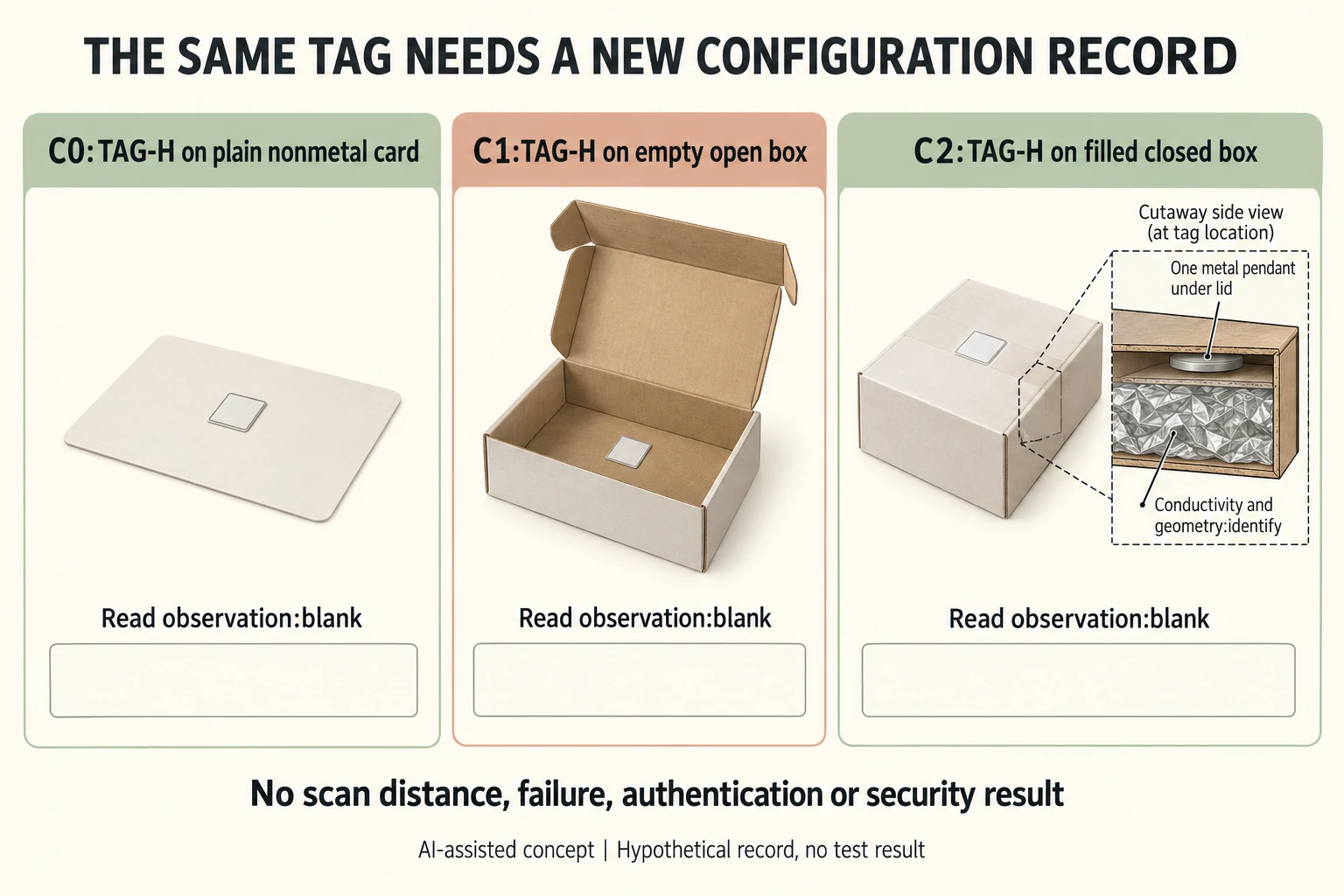
Track invented TAG-H at C0 on a plain nonmetal card, C1 on an empty open box and C2 on a filled closed box. These are different installed contexts, not a controlled metal-only experiment. Neither scan success nor failure is assumed for any row.
Scroll horizontally if columns extend beyond the view.
| Configuration | State to identify | Evidence that cannot be borrowed |
|---|---|---|
| C0 | Loose plain card | Does not approve installed box |
| C1 | Empty/open box and actual tag position | Does not cover filled/closed state |
| C2 | Filled/closed, contents and finish nearby | Needs relevant final-use observation |
| Digital/security | Destination and intended function | RF communication is not authentication or consent |
Identify the antenna location and actual surrounding materials rather than inferring conductivity from a metallic-looking illustration. The cutaway marks proposed nearby material positions, not an approved foil wrap, spacing or physical package. Changes in location, phone approach and contents must remain recorded.
Ask the qualified tag vendor to define the relevant construction and evaluation for the intended state. A future C0 read cannot fill C2's outcome; a future C2 failure would not prove metal alone caused it. Actual phone, orientation, read observation and technical acceptance are blank. No arbitrary shield, spacer thickness, tuning change, read distance or reliability probability is prescribed.
Download the NFC packaging near metal record (.csv). HYPOTHETICAL rows are invented examples. Use ACTUAL_BLANK for permitted project inputs; replace that row label only when recording actual facts. Empty evidence, observation and date fields mean unknown or not performed, never acceptance. Keep checkpoints and revisions separate.
Send the final intended tapping state, actual materials, tag construction and contents for vendor-led configuration review. Packrivo coordinates independent suppliers. These records establish no supplier offer, service availability or MOQ exception; its published baseline is 500 pieces per product/design.