
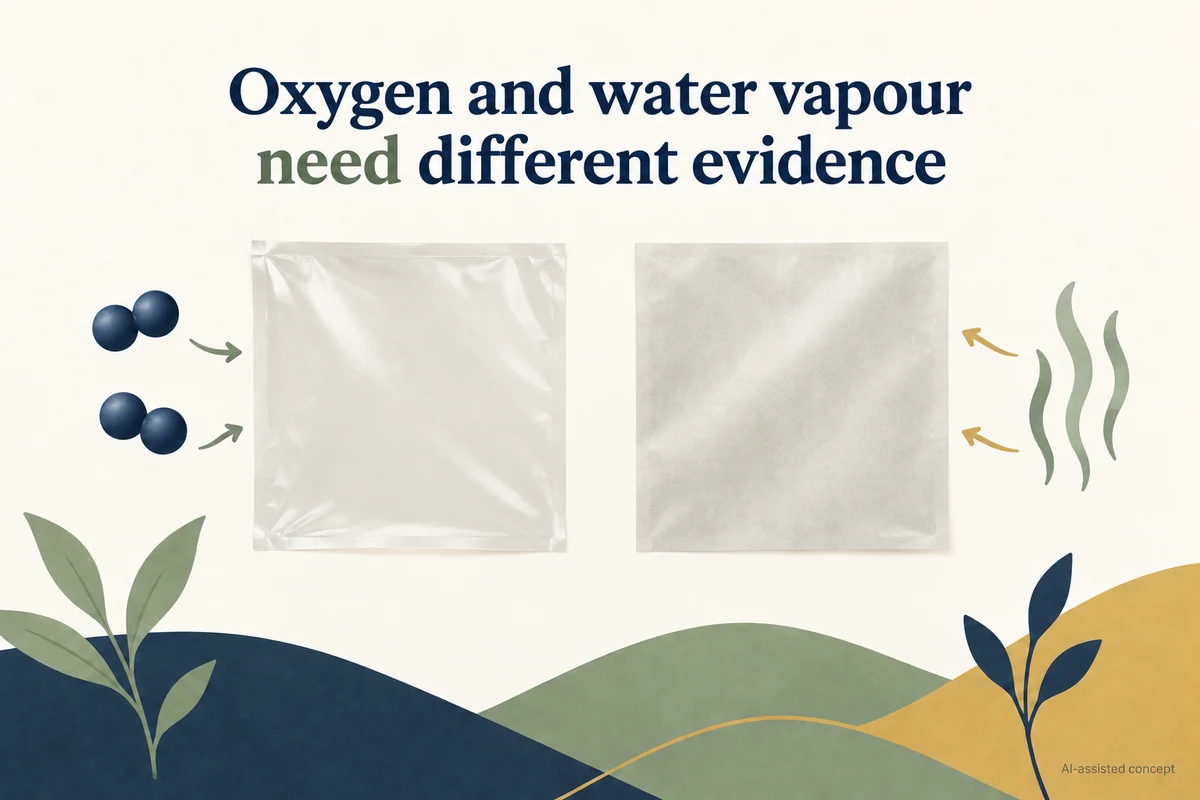
A water-vapour transmission result cannot establish a film's oxygen transmission performance. Oxygen and water vapour are different permeating species, and each result belongs to its material, method and environmental conditions.
For the additional question of a completed pack, use Film WVTR and Moisture Paths in a Finished Pouch. This separates a film-property result from the moisture paths at the pouch body, joints or opening; it does not turn either barrier rate into a finished-pack approval.
For a brand comparing protective film, first name what the proposed barrier needs to limit. A general description such as high barrier leaves that requirement unresolved, even when a supplier provides a precise-looking number.
Identify the species before comparing the rate
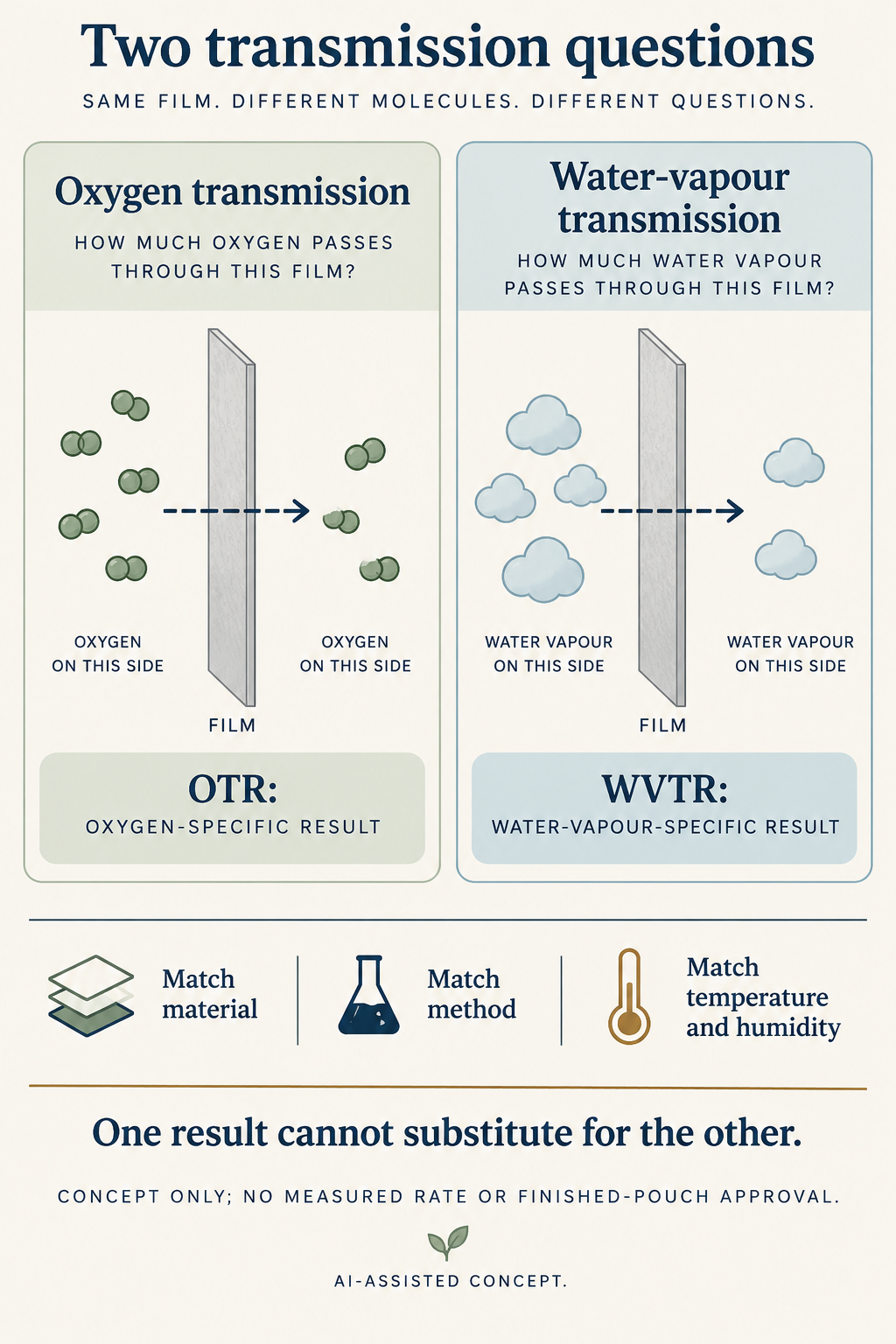
Oxygen transmission rate, often abbreviated OTR, concerns oxygen moving through the tested material. Water-vapour transmission rate, WVTR, concerns water vapour. Neither abbreviation describes every substance that could cross a packaging layer.
The public scope of ASTM D3985-24 identifies an oxygen-transmission method using a coulometric sensor. ASTM F1249 identifies a water-vapour method using a modulated infrared sensor. Their different measurement targets prevent one result from substituting for the other.
The full paid procedures were not reviewed here. The catalogue descriptions identify the questions those methods address; they provide no measured result or acceptance limit for a proposed gift pouch.
A material can interact differently with different permeants
Transmission through a polymer depends on the material and the permeating species. A wall that gives a favourable result for water vapour doesn't necessarily give a correspondingly favourable oxygen result. Different species needn't have the same interaction with that construction.
This also makes a universal barrier ranking incomplete. A supplier should identify the property being ranked rather than treating a low value for one substance as a score for all substances.
An oxygen result doesn't answer a fragrance-retention question either. A scent can involve multiple compounds, and an oxygen measurement doesn't describe all their interactions with a packaging layer. Don't add that unsupported claim to an otherwise useful oxygen specification.
Read units and conditions as part of the result
A reported rate needs a named quantity, unit and reference conditions. The number alone isn't a comparison. The film identity, tested construction, method, temperature and relevant humidity conditions should remain visible beside it.
In particular, oxygen and water-vapour results may use different quantity conventions. Copying two bare numbers into a stronger-versus-weaker table would hide what each measures. Converting a unit doesn't turn one species into another.
Likewise, two results for the same species can come from different conditions. Before treating a difference as a material improvement, establish whether the results concern comparable constructions and measurement states.
No numerical conversion between OTR and WVTR is provided by this explanation. A relationship would require suitable technical evidence for the actual materials and conditions, rather than an assumption that both are simply barrier numbers.
Follow a hypothetical protective-film proposal
Imagine a gift brand comparing two film proposals for a protective sleeve. The first provides WVTR information. The second provides oxygen-transmission information, with no water-vapour result. These are hypothetical documents, not examined supplier reports.
If the brand's immediate requirement concerns moisture exchange, the first document addresses the relevant species, subject to its conditions and material scope. The second still leaves that moisture question unanswered. The buyer hasn't received two interchangeable protection scores.
If an oxygen-related requirement is independently established, the evidence request changes. It needs oxygen-specific information for the relevant construction. The moisture document can remain useful for its own property without being repurposed.
This choice doesn't require selecting a winner prematurely. It requires matching the evidence to the stated protection job, then obtaining comparable results for that job.
Keep flat-film properties separate from finished-package performance
A transmission result for intact film doesn't automatically cover the sleeve's opening, seams or actual use. A construction can introduce other routes that aren't included in a material specimen measurement.
The packaging supplier brief helps define the proposed film and enclosure. The sample review guide provides a separate route for reviewing the actual assembly; neither supplies barrier-performance evidence itself.
Keep the species-specific material selection and the finished-enclosure question distinct. First establish what the film result measures. Then determine what additional evidence addresses the assembled package and the intended protective claim.
Sort documents by species before comparing their conditions
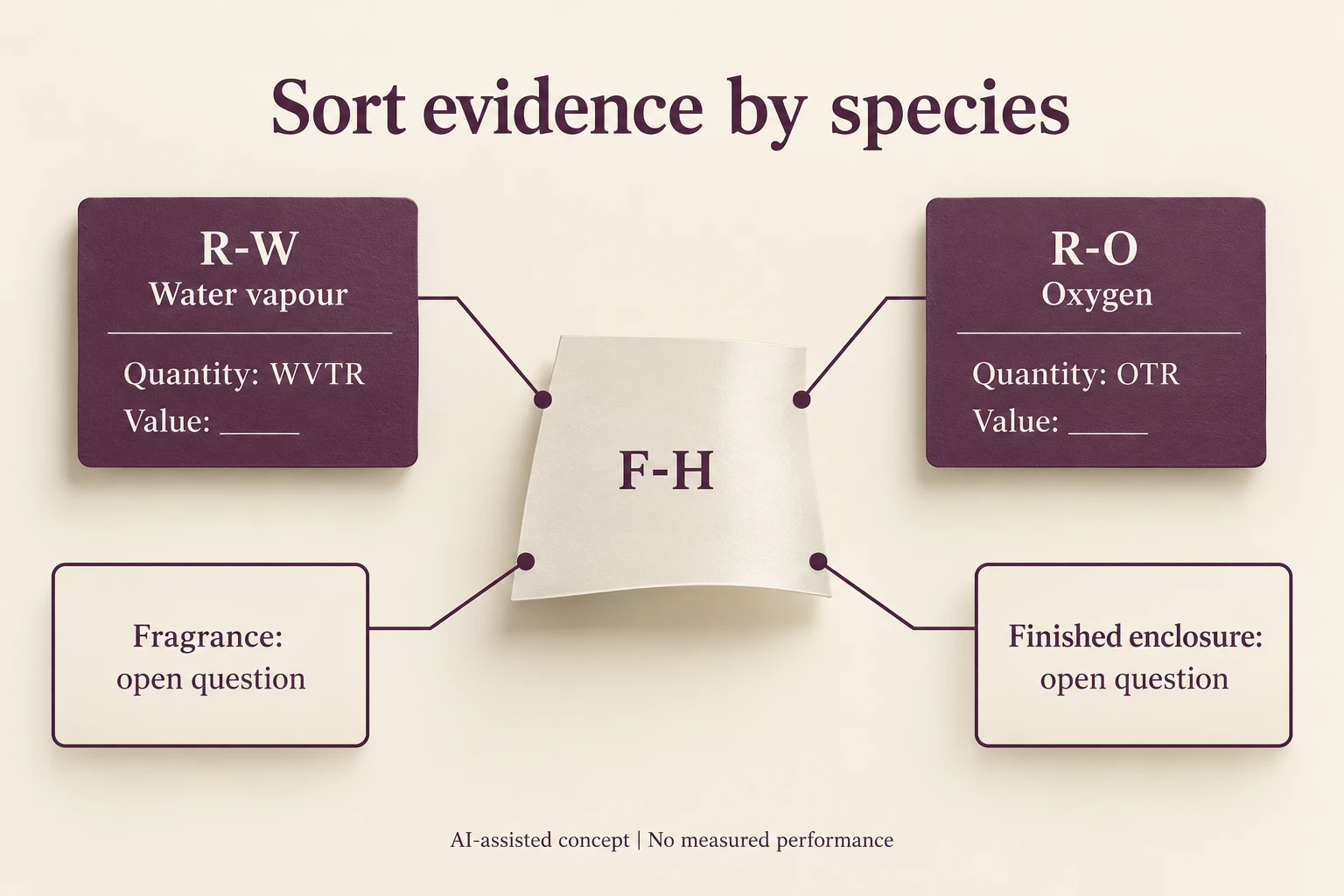
The invented document register below uses the same proposed film reference F-H. R-W addresses water vapour and R-O addresses oxygen. Their result cells are intentionally empty, so the exercise cannot rank materials or manufacture a barrier score.
Scroll horizontally if columns extend beyond the view.
| Requirement | Candidate document scope | Next decision |
|---|---|---|
| Moisture exchange | R-W: WVTR, film F-H | Check actual construction, units and environmental conditions |
| Oxygen exchange | R-O: OTR, film F-H | Check oxygen-specific basis and conditions |
| Fragrance retention | Neither scope establishes the relevant compounds | Keep requirement open |
| Finished enclosure | Film records do not identify seam/opening performance | Separate assembled-package evidence request |
First sort by permeating species. Only then compare the construction, quantity convention, unit, method and conditions within a species. A unit conversion can normalize a quantity basis when technically valid; it cannot change oxygen into water vapour.
If R-W actually names another film revision, retain that mismatch rather than marking the moisture row complete. A species match is necessary for this document-selection task but does not by itself establish applicability.
Do not combine an oxygen number and a water-vapour number into a lower-is-better ranking. This register also leaves fragrance and assembled-package questions visible instead of allowing a film result to close every protection requirement.
Download the OTR versus WVTR record (.csv). HYPOTHETICAL rows are invented examples. Use ACTUAL_BLANK for permitted project inputs; replace that row label only when recording actual facts. Empty evidence, observation and date fields mean unknown or not performed, never acceptance. Keep checkpoints and revisions separate.
Bring the actual protection requirement and document register to the enquiry already linked in the article so the relevant species and package level remain explicit. Packrivo coordinates independent suppliers. These records establish no supplier offer, service availability or MOQ exception; its published baseline is 500 pieces per product/design.