
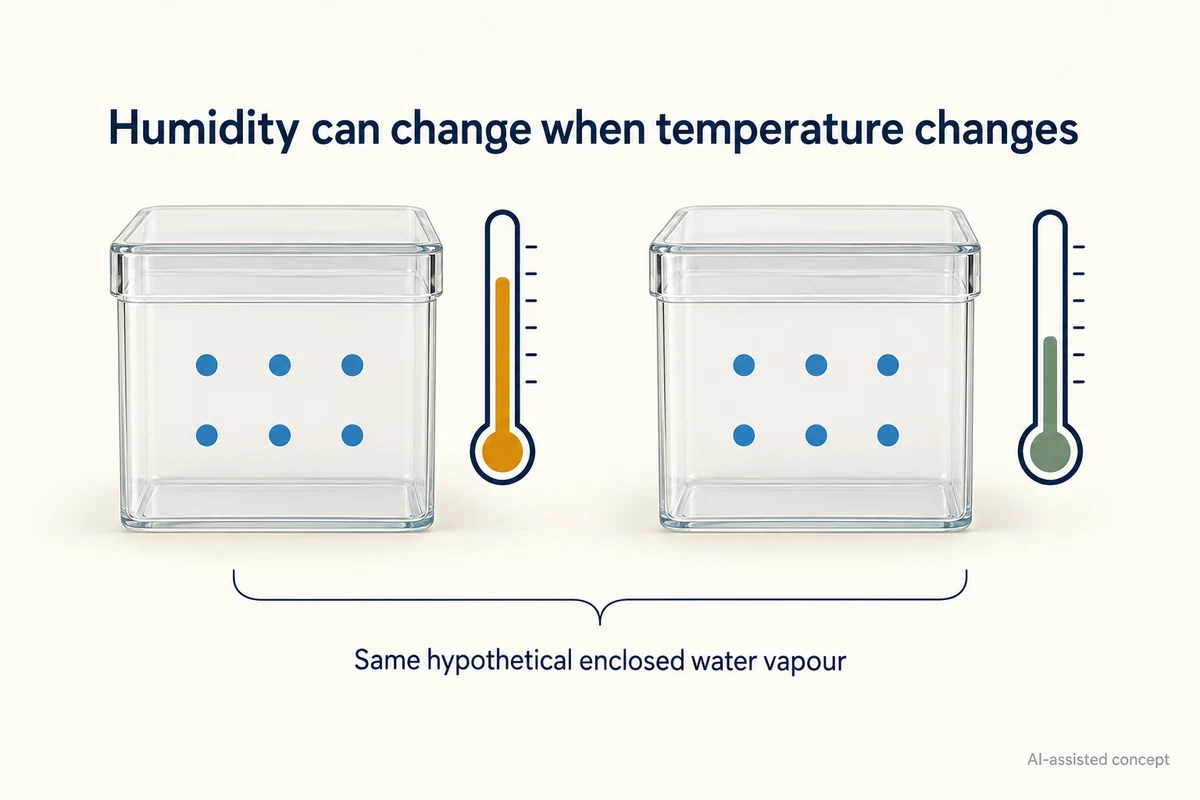
Relative humidity can rise as enclosed air cools even when no additional water enters. The reading depends on temperature as well as the gas-phase water present, so an RH change alone doesn't establish that a pouch or box has leaked.
For a gift brand investigating humidity observations, record temperature alongside RH and identify the package's contents and measurement conditions. The relevant question is what changed in the system, rather than whether one percentage is higher than another.
The percentage compares water vapour with a temperature-dependent state
Relative humidity expresses a comparison with saturation at the current temperature. It differs from simply stating how much water vapour occupies a given volume. The National Weather Service's discussion of humidity explains why cooler air can have higher RH than warmer air with the same water-vapour amount.
This relationship makes temperature part of the interpretation. A humidity percentage with no accompanying temperature can conceal a change in the reference state. It doesn't independently tell the reader how much water entered, left or moved between materials and air.
Keep the gas-phase water distinct from liquid water and moisture held by materials. Once condensation occurs or a liner exchanges moisture with the air, the gas-phase amount may change even if the package's total water has not increased.
Follow a simplified closed-container example
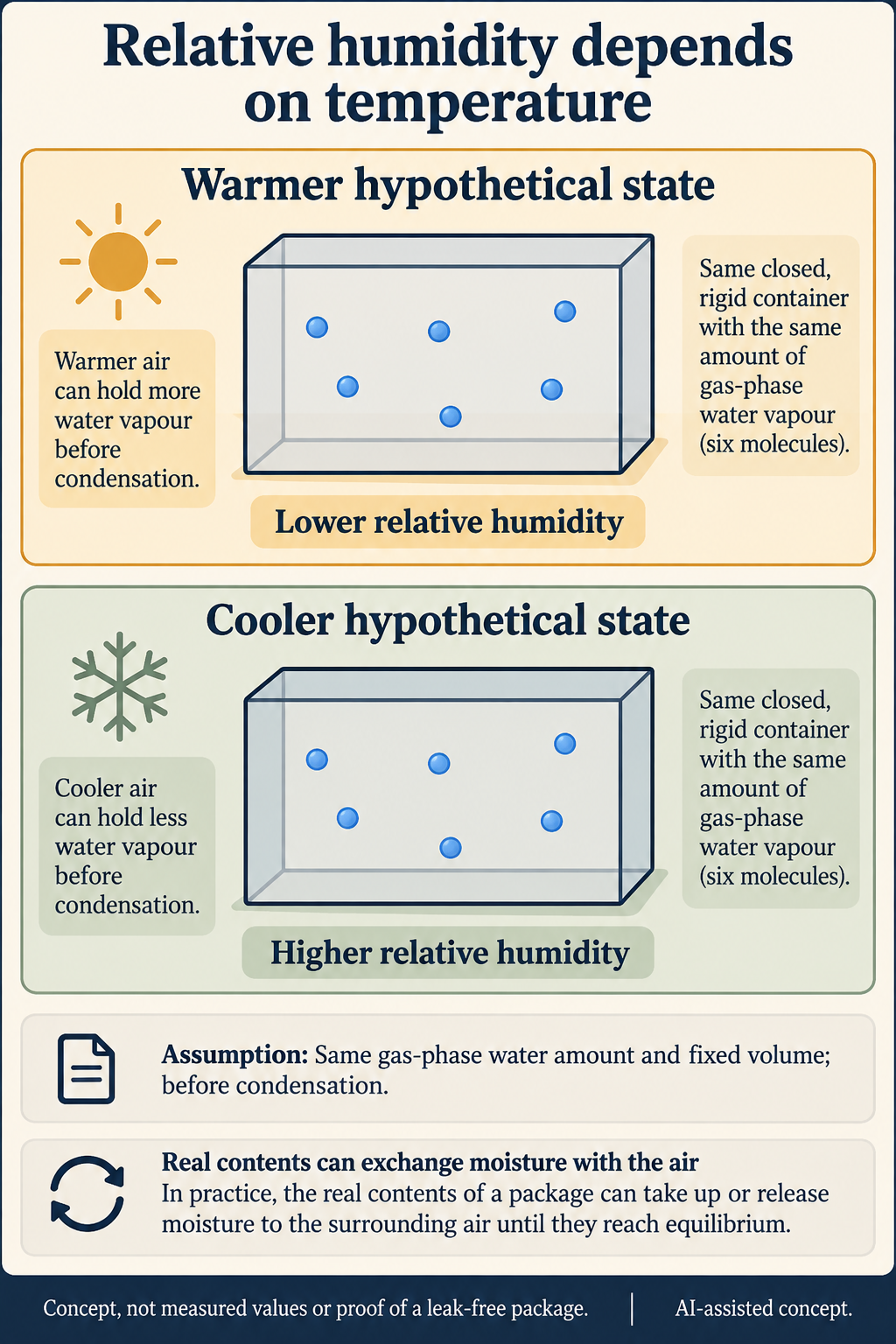
Imagine an empty rigid container with a fixed internal volume. It holds a hypothetical amount of gas-phase water vapour and is cooled without any net water exchange. The example stops before condensation, and contains no hygroscopic inserts.
Under those assumptions, cooling can raise the relative humidity. The water-vapour amount hasn't increased; the saturation comparison has changed. Warming the same simplified system can move the percentage the other way.
No temperatures or humidity values are assigned to this illustration. It explains why an RH trend can have more than one cause, not how a real shipment will behave or whether a particular closure is leak-free.
The empty-container assumptions are deliberate. A filled gift pack introduces materials and contacts that may alter the response. Treat the illustration as one possible mechanism rather than a universal forecast for packaging.
Real contents can exchange moisture with the air
Paper, fabric and moisture sorbents can exchange water with their surroundings. The Canadian Conservation Institute's silica-gel bulletin describes how moisture content and humidity relate to temperature and material state.
That conservation guidance does not establish a humidity threshold for a gift pack. It does explain why a real filled enclosure needn't follow the simple empty-container example. Its materials may buffer the air or contribute to a changed gas-phase water amount.
Air exchange through the construction can be another input. An observed RH change could involve temperature, materials, ingress or several of these together. A single reading doesn't separate them.
If a surface becomes cold enough for condensation under the relevant local conditions, water may appear as droplets. That phase change is a separate observation from the earlier rise in relative humidity. It also means the assumption of unchanged gas-phase water no longer holds.
Compare observations under identified conditions
Suppose a brand receives two humidity readings from a hypothetical packed gift: one after warm storage and one after a cooler stage. No temperature record accompanies the figures. The percentage difference alone cannot identify a leakage mechanism.
The first useful action is to recover the temperature and timing associated with each observation. Also identify where the reading was taken, which contents were present, whether the pack was opened and whether the sensing arrangement was the same.
If the brand then compares two pouch constructions, keep those conditions comparable before assigning the difference to a closure. A liner revision and a temperature change create additional explanations, even if the outside dimensions match.
This investigation doesn't require an invented safe RH limit. It requires enough context to distinguish a measurement change from a specific physical cause.
Use the reading for the question it can answer
A humidity record can describe the identified environment at the measurement position and time. It doesn't, by itself, prove seal integrity, a product's storage life or a protective result for every intended condition.
The packaging supplier brief can keep the actual materials and enclosure configuration visible. The packaging sample review guide separates the examined assembly from an unbuilt concept.
When RH changes, interpret it with temperature, material state and enclosure history. Only then can the next investigation address whether the relevant issue is thermal history, moisture exchange or a specific pathway through the package.
Unchanged total water can coexist with changed gas-phase water
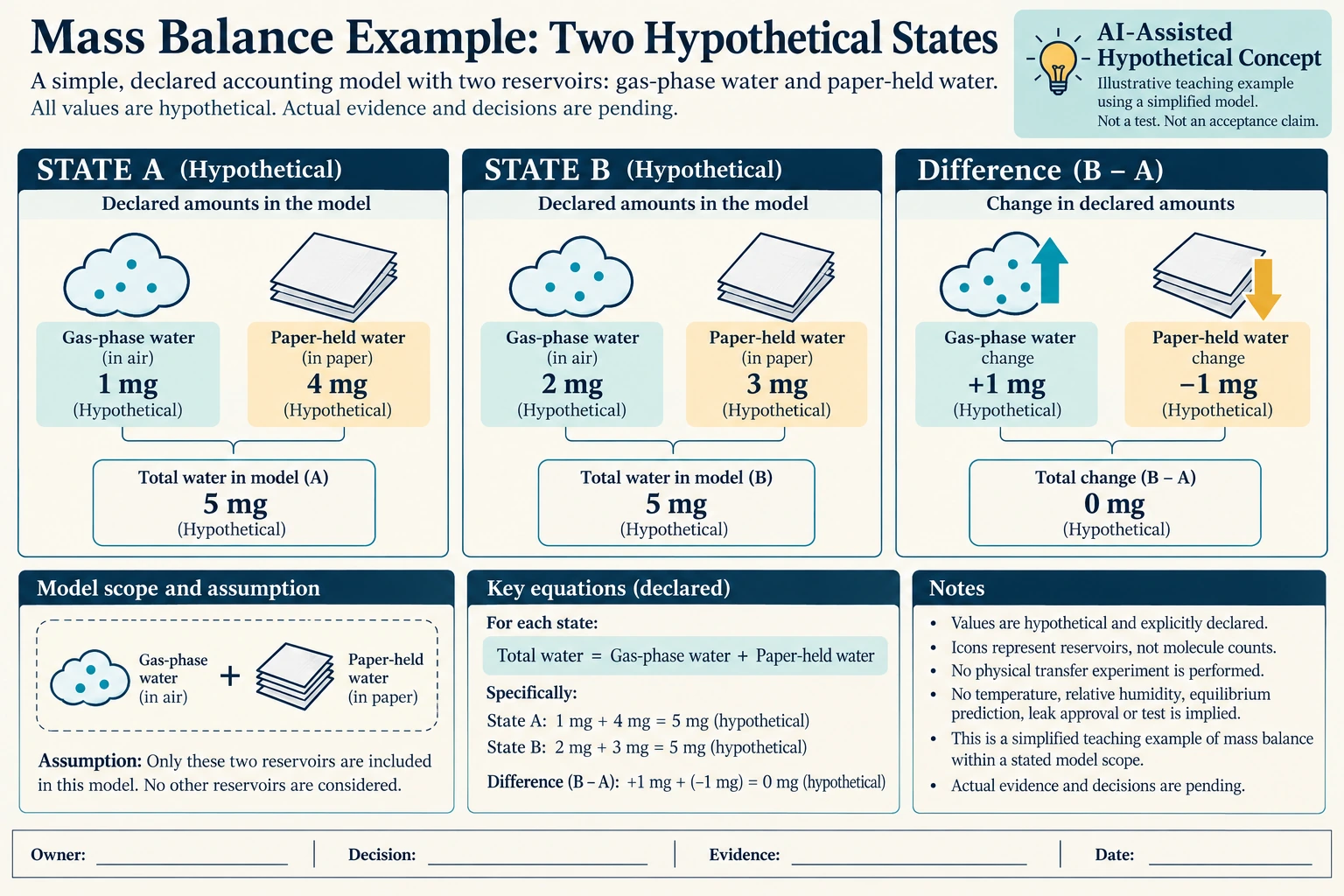
Use an entirely invented two-reservoir balance with no other water phase in the exercise. STATE_A has 1 mg gas-phase water and 4 mg held by paper, totaling 5 mg. STATE_B has 2 mg in the gas phase and 3 mg in the paper, again totaling 5 mg. The 1 mg shift changes the air’s water amount without adding water to the total model.
Scroll horizontally if columns extend beyond the view.
| Hypothetical configuration | Named object | Relationship | Input or next scope |
|---|---|---|---|
| STATE_A | TOTAL_WATER | calculated from | STATE_A_GAS+STATE_A_PAPER; 5 mg |
| STATE_B | TOTAL_WATER | calculated from | STATE_B_GAS+STATE_B_PAPER; 5 mg |
| B_MINUS_A | GAS_PHASE_WATER | calculated from | STATE_B_GAS-STATE_A_GAS; 1 mg |
| B_MINUS_A | PAPER_HELD_WATER | calculated from | STATE_B_PAPER-STATE_A_PAPER; -1 mg |
| B_MINUS_A | TOTAL_WATER | calculated from | STATE_B_TOTAL-STATE_A_TOTAL; 0 mg |
| WATER_MODEL | MODEL_BOUNDARY | assumes | GAS_PLUS_PAPER_ONLY_NO_OTHER_PHASE |
| WATER_MODEL | BALANCE | does not predict | RH_TEMPERATURE_EQUILIBRIUM_OR_LEAK |
This is not an RH calculation, a measured paper response or a prediction of exchange direction. Temperature, equilibrium and material properties have not been assigned. The example simply prevents a changing gas-phase amount from being automatically described as net ingress. A real closure could still leak; the balance has not tested it.
The original empty fixed-volume example instead holds gas-phase water approximately constant before condensation. Adding a paper, fabric or sorbent reservoir changes that premise. Retain the distinction between total water, vapour and material-held water before trying to interpret an RH trend.
For an actual investigation, request the temperature, sensing position, timing and contents history under an appropriate review. Do not choose desiccant quantity or a safe RH from this balance. CCI Bulletin 33’s conservation discussion is useful context: its first edition 2018, second 2020 and revision 2023 differ from the webpage date 22 February 2024. None establishes a gift-pack humidity recipe.
Download the package total water gas phase material mass balance record (.csv). It includes the original table fields and scenarios alongside the added relationships. HYPOTHETICAL rows are editorial examples or required review scopes, not actual records. Actual quantity, configuration, component and file identities, materials, process, specification, copy, method, condition, observation, owner, decision, evidence and dates are blank. ACTUAL_BLANK is a separate empty starting row; enter permitted project evidence before using an actual record. A blank means unknown.
Use the Agree Conditioning Before Comparing Packaging Samples for its separate question.
Source scope checked 17 October 2026: NWS humidity principles and CCI Technical Bulletin 33 support conditional temperature and material-exchange questions. CCI first edition 2018, second edition 2020 and revision 2023 differ from its 22 February 2024 webpage date. No actual RH, sorption curve, ingress result or desiccant prescription was established. The added configurations and calculations are hypothetical, with actual evidence and decisions pending.
Discuss this packaging specification with Packrivo. We coordinate independent suppliers. MOQ: 500 pieces per product/design; illustrative quantities are not production offers. Confirm materials, samples, price and timing for your project.