
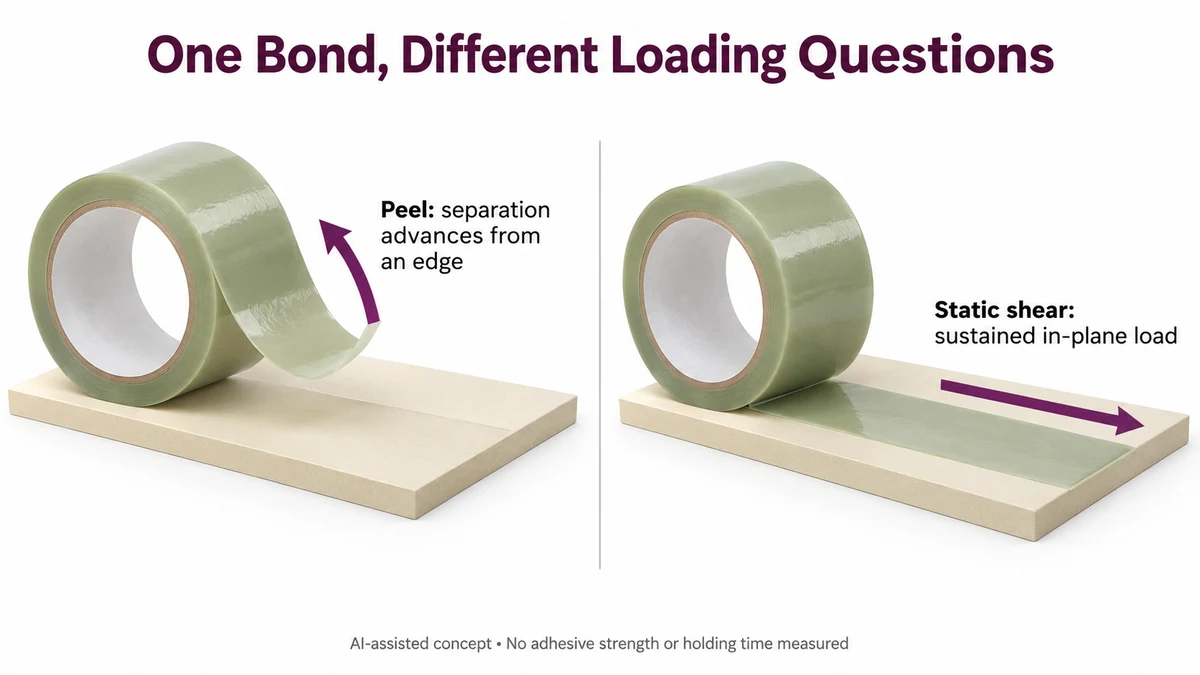
A tape’s resistance to being peeled away does not establish how long it will remain in place under a sustained load parallel to its bonded surface. Peel and static shear describe different demands on a pressure-sensitive bond.
For Pressure-Sensitive Paper Sealing Tape Fits the Carton and Dispensing Method, identify whether the proposed carton joint loads the tape in peeling, sustained shear or another route. The product concept does not supply test values or establish suitability for the actual carton surface and storage conditions.
For a gift-box sleeve, identify the load the joint must resist during use before selecting the relevant evidence. A useful peel result can leave a sustained-holding requirement unanswered, and the reverse substitution is no more reliable.
The example below is hypothetical. No tape, adhesive, force threshold or holding time has been evaluated.
Peeling Advances a Separation Front
During a peel action, separation can progress along the bonded area from a free edge. The tape backing bends and the relation between the applied action and the moving bond front matters.
That arrangement differs from asking whether a bonded area remains in place while a load acts mainly parallel to the receiving surface. Naming both results “adhesion” does not make their loading histories equivalent.
The public description of ASTM D3330/D3330M-04(2025) identifies peel-adhesion assessment for pressure-sensitive tape. Its stated specimen and geometry belong to that result; a peel value is not a universal functional strength score for every use of the tape.
It does not follow that a tape which is difficult to peel is the appropriate choice for a particular sleeve joint. The use requirement and the actual receiving surface still need a relevant basis.
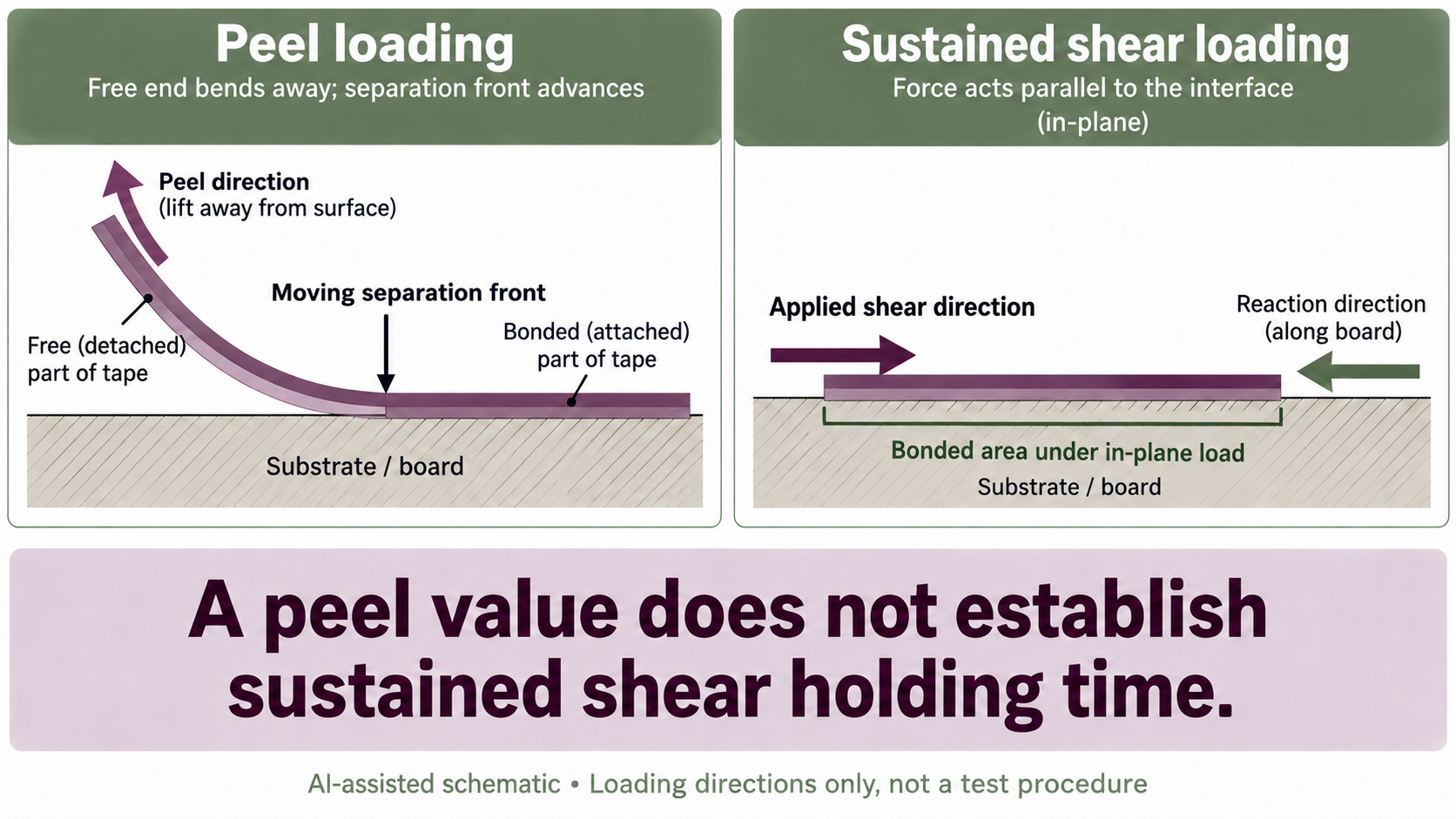
Static Shear Introduces Sustained In-Plane Loading
For a mainly shear-loaded joint, the imposed load acts along the bonded interface rather than deliberately lifting a free edge through a peel route. When that load is maintained, elapsed exposure becomes part of the question about remaining adhered or retaining position.
ASTM D3654/D3654M-06(2024) describes sustained parallel loading in its public scope. It includes relevant surface-specific packaging contexts, while a standard-panel result does not automatically establish behavior on another receiving construction.
The actual tape backing, adhesive, bonded area, substrate and conditions remain important. No universal conversion changes a peel value into a shear holding time.
This article also does not propose a hanging-weight procedure. The public scope distinguishes the question; it does not provide the full paid method or an acceptance condition for the sleeve.
One Hypothetical Sleeve Joint Can Have Two Jobs
Imagine a paperboard sleeve whose overlap is secured with pressure-sensitive tape. During its intended storage, the overlap is assumed to remain under a mainly in-plane load. When someone deliberately opens it, a free edge may be pulled through a peel action.
The first job is maintaining the secured overlap under the relevant sustained loading. The second is the response during the intended opening. Neither event has been performed in this example.
Suppose a supplier can provide a favorable peel-adhesion result on an identified surface. That information could help with a suitable peel comparison. It would not establish the duration for which the sleeve joint resists its different storage load.
If a relevant shear result were available instead, it would not establish clean removal, the required peel action or the appearance of the paperboard after opening.
The useful conclusion is to keep the two requirements separate. It is not to select the tape with the highest number in an unrelated report.
Real Joint Geometry Can Introduce Mixed Loading
The mainly in-plane example is a simplification. A curved sleeve, eccentric load, lifted corner or flexible receiving panel can introduce a peel component alongside shear.
Thus calling a joint “an overlap” does not prove that its bond experiences only shear. The actual load path and geometry have to be identified before a particular specimen result is treated as representative.
The opposite limitation applies to an opening demonstration. Observing a moving edge does not reconstruct every sustained load that the joint experienced beforehand.
Where the two stages or components matter, the technical party should establish which evidence addresses each one. A single unexplained adhesion figure cannot select between them.
Surface and Time Belong to the Result’s Meaning
A tape result retains the receiving construction and conditions it covers. A bare test panel is not automatically equivalent to printed, coated or wrapped paperboard, and an initial bond observation does not describe an unspecified later exposure.
These qualifications do not make the data useless. They identify the limits within which the data can inform the actual joint decision.
The label-removal observation guide concerns residue and surface condition after the intended removal. That endpoint differs from maintaining the bond during a sustained shear load.
The liner-release guide separates release from the liner from adhesion to the final package. Neither a release value nor easy dispensing establishes peel or sustained shear performance on the sleeve.
Choose Evidence for the Load the Bond Must Actually Resist
For a proposed packaging joint, describe its construction and identify whether the unresolved function concerns a moving peel front, sustained parallel loading or a mixture of modes. Keep the opening and storage stages distinct when both matter.
The supplier or qualified technical party can then identify relevant evidence and an appropriate acceptance basis. No holding duration, strength threshold or safe load follows from the comparisons in this article.
Packrivo can coordinate the surface, construction and use questions. It does not test or certify adhesive holding performance through project coordination.
Peel and static shear are different loading questions. A result becomes relevant when its load, surface and exposure match the job the bond must perform.
Source scope: Public ASTM catalogue information accessed 11 October 2026. The official entries identify D3330/D3330M-04(2025), updated 14 August 2025, and D3654/D3654M-06(2024), updated 29 October 2024, as active. The generic D3654 endpoint failed while its exact reapproval page was accessible. Full paid procedures were not obtained, and no actual adhesive, holding time, package result or peel-to-shear conversion is established.
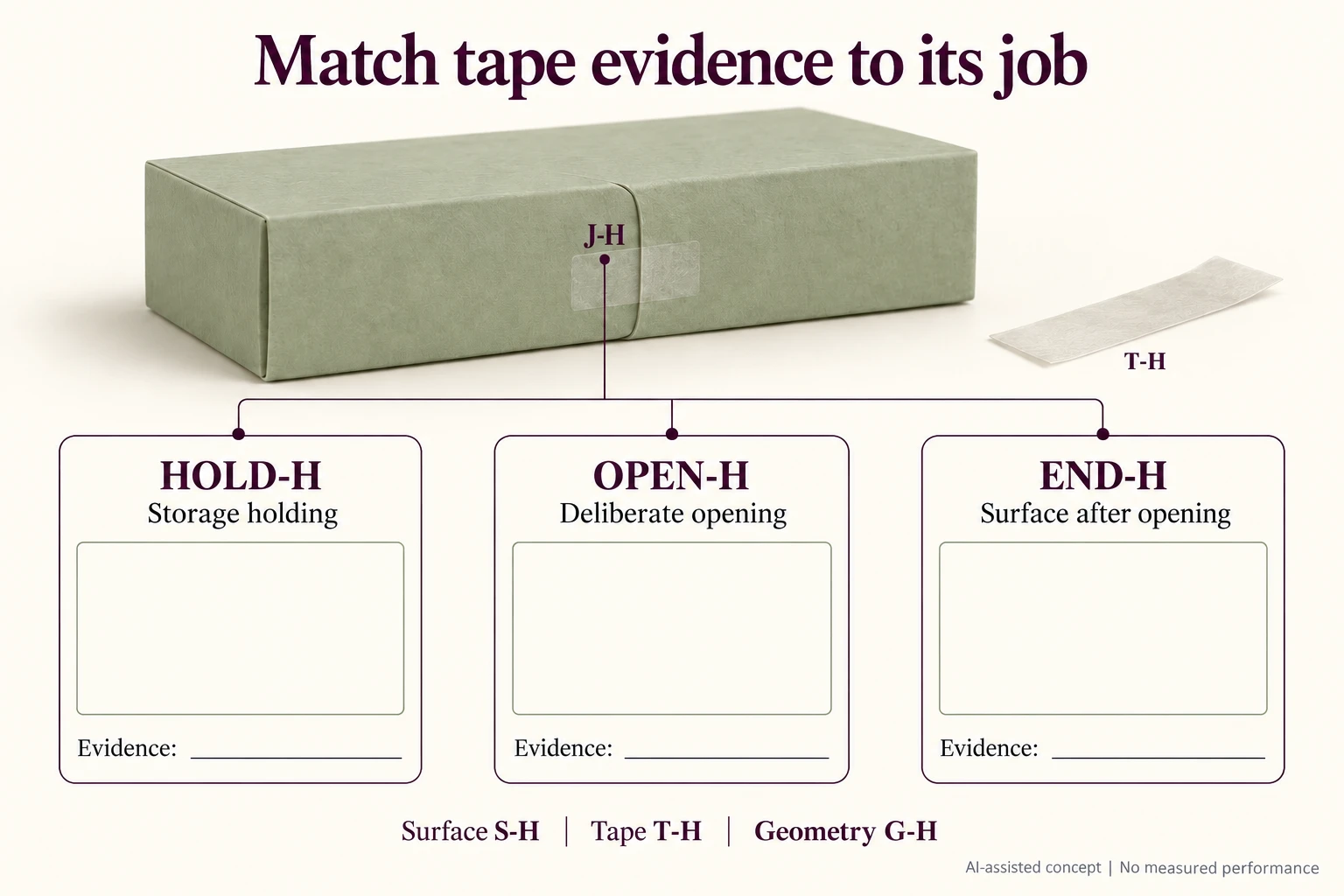
Split the storage job from the deliberate opening job
One hypothetical pressure-sensitive overlap J-H can have two intended stages. A document for a peel action and a document for sustained in-plane loading belong in different rows, even when the tape reference is unchanged.
Scroll horizontally if columns extend beyond the view.
| Job | Proposed demand | Evidence request |
|---|---|---|
| HOLD-H | Maintain overlap under sustained mainly in-plane load | Actual substrate, area, exposure and applicable shear scope |
| OPEN-H | Deliberate opening with a moving peel front | Actual peel arrangement and relevant result |
| END-H | Paperboard condition after opening | Separate residue and appearance observation |
| MIX-H | Curvature or lifted edge changes load mode | Identify mixed geometry before transferring a result |
Keep the finished receiving surface S-H beside the tape backing and adhesive identity. A standard-panel result must not silently become a result on printed or coated S-H. The method name alone does not establish that applicability.
Record a holding duration only when an actual scoped document supplies it. Do not turn a peel quantity into time, choose a generic hanging weight or set a buyer-created threshold. The register is for matching evidence to the joint’s job, not performing a method.
A revision that changes a free edge or overlap curvature can change the load mode while leaving the tape grade unchanged. Preserve the geometry revision and keep clean removal, holding and intended opening as separate acceptance questions.
Download the peel adhesion versus static shear record (.csv). HYPOTHETICAL rows are invented examples. Use ACTUAL_BLANK for permitted project inputs; replace that row label only when recording actual facts. Empty evidence, observation and date fields mean unknown or not performed, never acceptance. Keep checkpoints and revisions separate.
Bring the joint geometry and separate holding/opening jobs through the enquiry already linked above so the technical source can identify the relevant evidence. Packrivo coordinates independent suppliers. These records establish no supplier offer, service availability or MOQ exception; its published baseline is 500 pieces per product/design.