
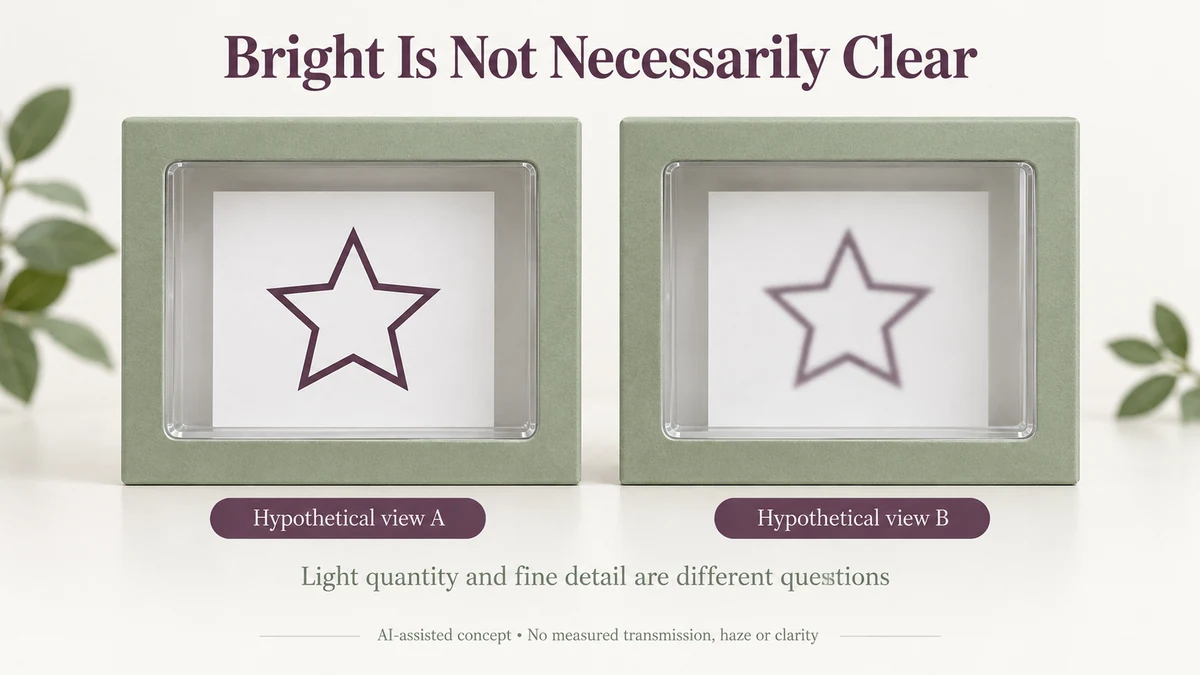
A window that admits plenty of light does not necessarily show fine product detail clearly. The amount of transmitted light and the way that light is scattered answer different optical questions.
Use the Windowed Folding Carton to identify the viewing opening, patch and product position that the sample must represent. The concept does not establish light transmission, haze or visibility of the detail required by your buyer.
For a jewellery or gift brand, first decide whether the window needs to reveal a silhouette, preserve colour and contrast, or show small features. A single transmittance percentage cannot settle all three requirements, and the final product-to-window arrangement remains important.
The comparisons below are hypothetical. No film has been measured, no candidate has been ranked and no optical acceptance threshold is proposed.
Light Quantity Is Different From Image Information
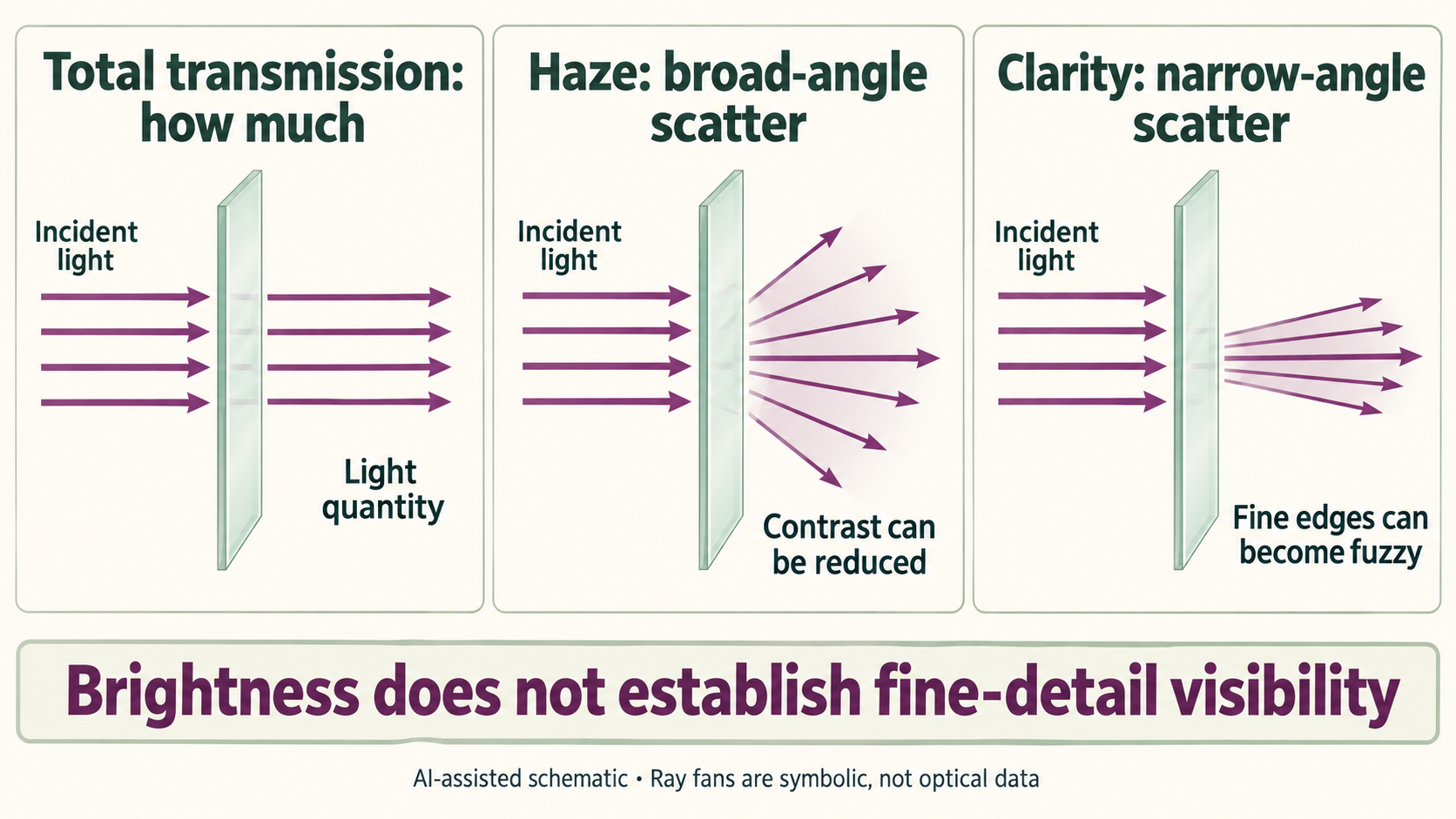
Total transmittance concerns the light passing through a material relative to the incident light under a specified measurement basis. It does not say that all transmitted light continues in the same direction.
Scattering redistributes light. A view can remain bright while losing useful contrast or edge definition. Reading a high transmission figure as “the product will look sharp” substitutes an image-quality conclusion for a light-quantity result.
BYK-Gardner’s public transparency paper separates total transmission, wide-angle haze and narrow-angle clarity. It also explains that the object’s distance from the transparent material can influence fine-detail appearance. These are useful distinctions, not measured properties of a particular packaging window.
The public scope of ASTM D1003-21 addresses luminous transmittance and wide-angle scattering for appropriate planar transparent specimens. A reference to that method should not be renamed as proof of every narrow-angle clarity effect or of the installed package’s complete appearance.
Contrast and Sharpness Can Fail in Different Ways
A milky appearance can reduce the difference between a dark feature and its lighter background. Separately, a feature can look fuzzy because its sharp boundary is no longer conveyed distinctly through the material.
Both can make a small product harder to inspect, but they are not identical descriptions. The useful observation is the particular information being lost, not simply that one film looks “less transparent.”
| Viewing requirement | Information the buyer needs to preserve |
|---|---|
| Recognizing an outline | The visible shape against its background |
| Comparing a coloured area | Its appearance and contrast in the intended view |
| Seeing fine detail | Distinct small boundaries and features |
This is a decision map, not an instrument specification. It explains why a window chosen only from light throughput can leave the actual shopper-view question open.
Two Equally Bright Hypothetical Views Can Still Differ
Imagine two film proposals for the same small gift-box opening. Behind each is the same simple star outline on an otherwise plain display card.
Keep the card position, window-to-card distance, background and viewing arrangement the same in the comparison. Suppose both views appear similarly bright, but the star’s fine boundary appears less distinct through one proposal.
No real specimens or matched transmission readings are supplied here. The example only illustrates why overall brightness and the visibility of detail cannot be treated as the same finding.
The less distinct hypothetical view does not identify a material defect, coating problem or manufacturing cause. Several construction and surface conditions can influence an actual window’s appearance. The observation establishes which viewing requirement needs further consideration.
Nor does enlarging the die-cut opening automatically improve the optical behavior of the film remaining in that opening. Opening geometry and material appearance are separate parts of the proposal.
The Product’s Position Belongs to the Viewing Requirement
A window specimen viewed with an object close behind it may not represent a product placed farther inside an assembled box. The distance can alter how a transmitted detail is perceived, depending on the optical behavior of the material.
That does not mean that moving every product closer will solve every clarity problem. The intended product position, holder, opening and viewing direction need to remain part of the comparison.
The transparent-window proof guide explains a matched product-behind-window review. The window-patch positioning guide addresses the physical opening and patch boundary. Optical quantities add an explanation of why the same construction view can retain brightness yet lose specific visual information.
A flat-film result can support a material comparison under its stated conditions. It cannot alone reproduce the complete assembled product view, including curvature, installation, illumination and product spacing.
Ask for the Property That Matches the Required View
If the goal is simply to recognize a broad silhouette, fine-detail visibility may not control the decision. If the selling point depends on a small decorative feature, a light-throughput number may be insufficient.
The buyer can specify the visual task and ask which optical evidence addresses it, then consider the proposed product view. Where a report supplies only total transmission, retain the unknowns about contrast and clarity instead of converting the figure into a blanket appearance approval.
Packrivo can coordinate window construction and supplier questions. It does not conduct optical testing or certify a film’s viewing performance through project coordination. The appropriate technical parties must establish the relevant measurement basis and acceptance conditions.
Choose the information the window must reveal, then choose the evidence. Passing light and preserving fine product detail are different requirements.
Source scope: Public information accessed 11 October 2026. BYK-Gardner’s selected transparency explanations were available in its public PDF; a date encoded in the filename was not treated as an established publication date. ASTM’s official catalogue lists D1003-21 as active, updated 7 June 2021; a later retrieval attempt failed, and the complete paid method was not obtained. No transmission, haze or clarity values, material recommendation or real packaging result is established.
Choose the visual task before filling an optical field
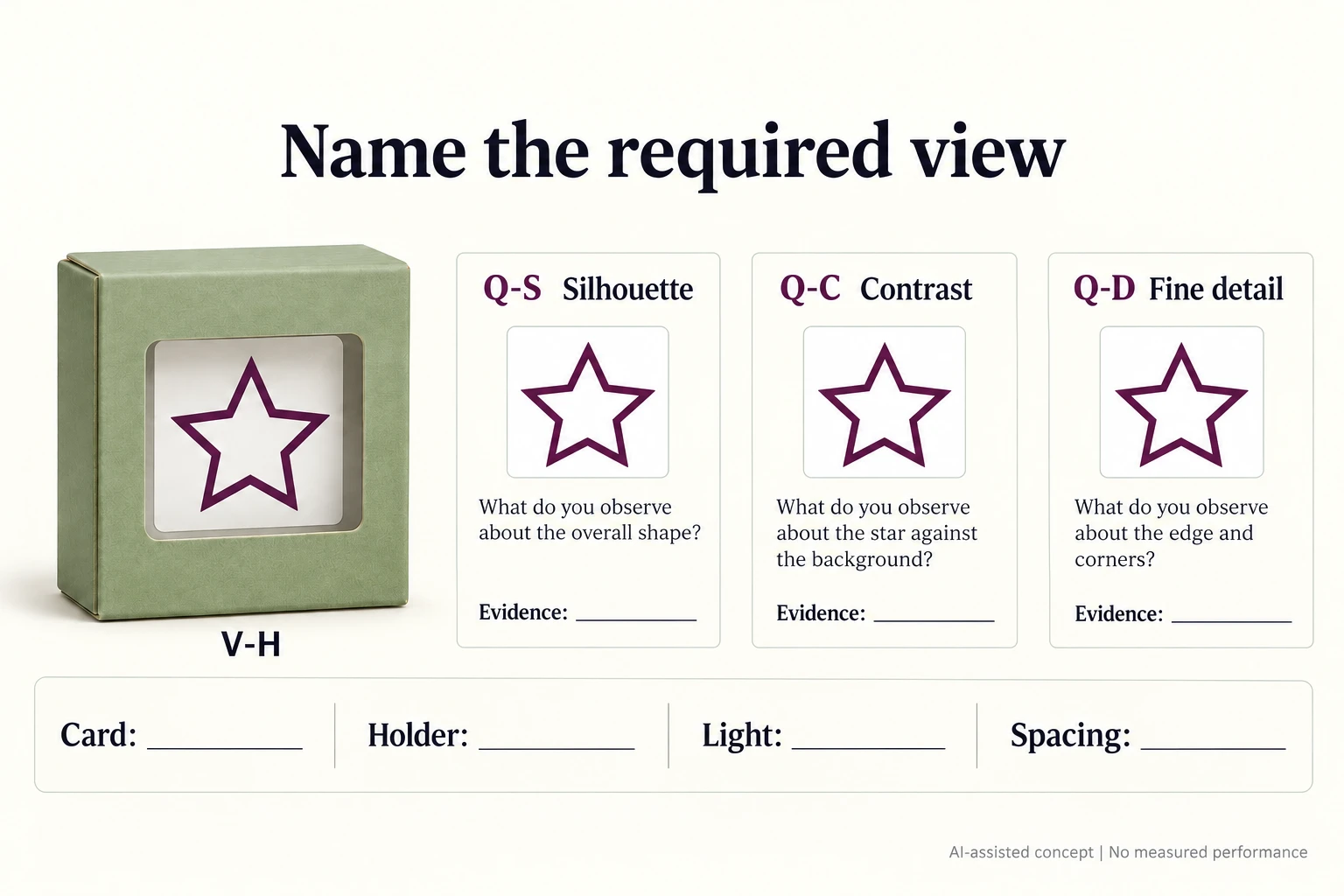
A window review can remain useful without inventing percentages. The invented star-card arrangement V-H below gives each required viewing task its own evidence question and keeps the product-to-window configuration visible.
Scroll horizontally if columns extend beyond the view.
| Task ID | Information required | Evidence still needed |
|---|---|---|
| Q-S | Recognize the broad star silhouette | Relevant assembled-view observation |
| Q-C | Distinguish the star from its background | Relevant contrast/view and optical scope |
| Q-D | Resolve the small star boundary | Fine-detail scope plus product spacing |
| V-H | Same card, holder, light and viewpoint | Actual identities, spacing and any mismatch |
A document supplying total transmission can populate only its named property field. It does not populate the Q-D observation or a narrow-angle clarity result. Keep the reported property, method and assembled-view observation in separate columns.
If the holder moves between proposals, record a new V-H revision before discussing the difference. A change in film and object distance together cannot isolate a film contribution. No ordinary review photograph here is converted into an instrument value.
The teaching image deliberately leaves both star cards equally drawn. It identifies tasks and configuration fields without simulating measured blur, haze or transmitted energy. The supplier can identify which additional evidence is relevant to the intended task.
Download the packaging window clarity versus haze record (.csv). HYPOTHETICAL rows are invented examples. Use ACTUAL_BLANK for permitted project inputs; replace that row label only when recording actual facts. Empty evidence, observation and date fields mean unknown or not performed, never acceptance. Keep checkpoints and revisions separate.
Bring the viewing task and complete product-behind-window arrangement through the existing enquiry route before comparing proposed optical evidence. Packrivo coordinates independent suppliers. These records establish no supplier offer, service availability or MOQ exception; its published baseline is 500 pieces per product/design.