
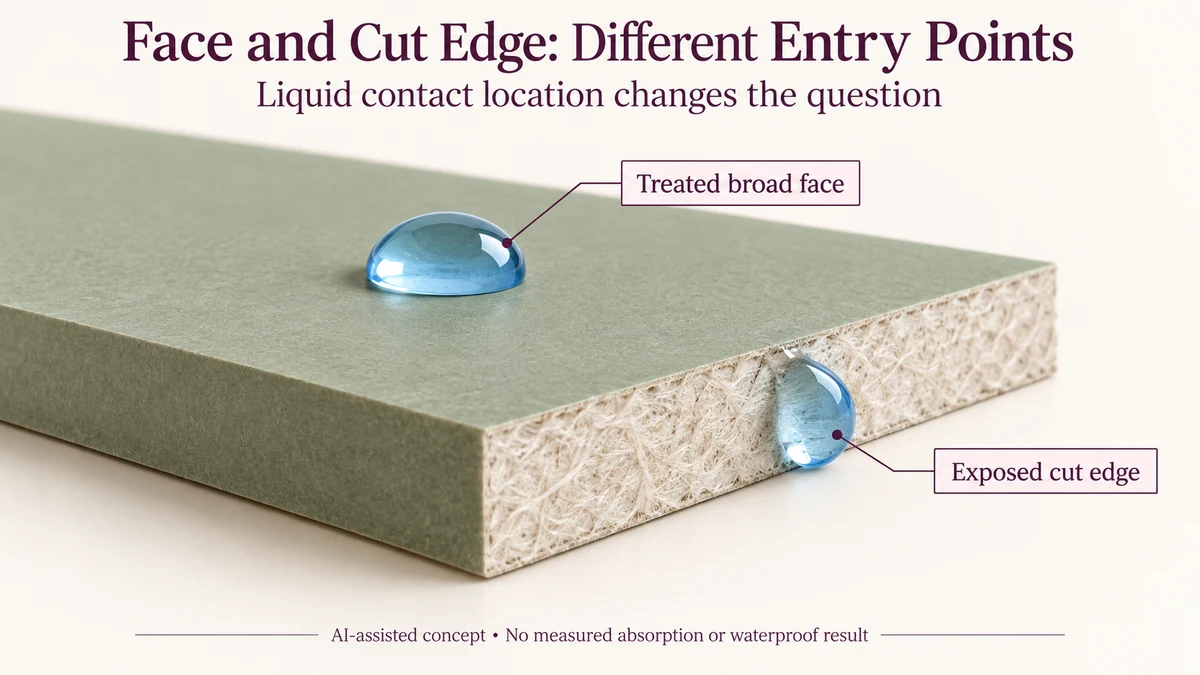
A treated paperboard face and its exposed cut edge are different entry locations for liquid water. Evidence that describes the broad face cannot automatically establish what happens when water meets the edge of a converted sleeve.
For a Folding Carton, show the finished face and exposed cut edge as different contact locations in the supplier brief. A surface treatment on the face cannot be assumed to establish water resistance at the converted edge.
For a gift brand, the practical question is which part of the finished construction can contact liquid in the intended use. Choosing a board or finish only from a face-absorption figure may leave the relevant cut-edge question unanswered.
This article describes possible paths in a hypothetical decorated sleeve. No material has been soaked, no absorbed quantity or penetration distance has been measured, and no waterproof performance is claimed.
Cutting Can Expose a Different Part of the Board
The broad face can carry a coating, print, sizing or other treatment. A cut through the construction exposes its thickness and internal layers at the edge. A face treatment does not automatically cover that newly exposed section.
Liquid contacting the face therefore encounters a different arrangement from liquid contacting the edge. The precise routes depend on the actual board, treatment, cut and fluid; an illustration cannot establish that every edge will absorb at the same rate or behave alike.
The distinction is visible in Holmen’s general paperboard technical information. Its water-absorption definitions describe a surface-focused Cobb evaluation separately from an edge-focused Wick evaluation. Those descriptions belong to the manufacturer’s stated material context, not an absorption result for this sleeve.
The separate evaluation boundaries matter more to the buyer than treating one result as a universal water-resistance score.
Liquid Can Follow the Porous Structure From an Accessible Edge
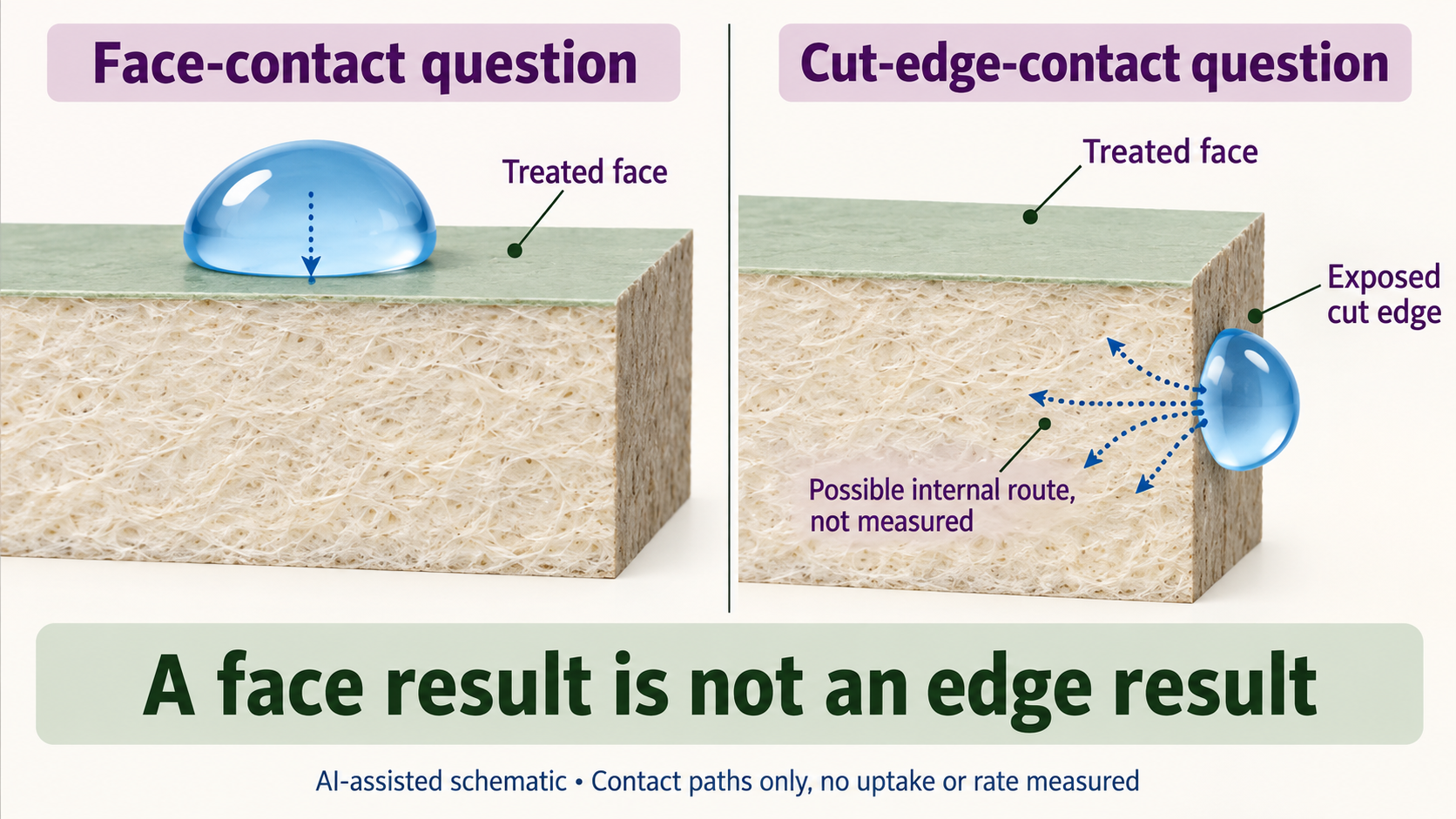
Paperboard is a fibrous, porous construction. Where the particular liquid wets accessible internal surfaces, capillary action can provide a route into that structure. This is a liquid-contact question; the route does not require a drop first to cross the treated broad face.
The public abstract of research on liquid penetration in paper examines capillary penetration within a paperboard microstructure. It supports treating the internal structure as relevant, without supplying a rate or acceptance limit for a proposed gift sleeve.
An institutional record for paperboard edge-wicking research also identifies the cut-edge flow problem. Its particular liquid-packaging research conditions are not an appropriate test recipe or performance prediction for decorative packaging.
These sources do not justify a universal statement that water will travel a specified distance in a specified time. The actual construction, accessible pores, surface treatment and fluid behavior still matter.
A Face Drop and an Edge Contact Ask Different Questions
Imagine a paperboard sleeve with a decorated, treated outer face and a visible raw edge where it has been die-cut.
In one hypothetical contact, a drop rests on the broad decorated face. In another, liquid reaches the raw cut edge. Neither is a performed experiment, and no outcome is assigned to either contact.
The first question concerns what the face construction does under its relevant liquid contact. The second concerns access at the exposed thickness, including the internal structure behind the face treatment.
Even if a relevant face result showed limited uptake, the cut-edge response would remain unestablished without an appropriate basis. That is an evidence gap, not a finding that the edge fails.
A supplier’s description of a coated face should therefore be read alongside the converted geometry. The word “coated” does not identify whether the cut section receives any treatment or whether the finished sleeve has a relevant liquid-contact result.
Cobb and Edge-Wicking Results Cannot Be Renamed as Each Other
A reported absorption value needs its evaluation boundary. Was liquid exposed to a defined face area, or was the investigation arranged to examine entry at the edge? What material and conditions does the result actually describe?
The boundary is part of the meaning of the result. A face-focused measurement is not an edge measurement merely because both involve water and paperboard.
Changing units would not repair that mismatch. Surface exposure and edge exposure involve different accessible geometry and stated procedures. Two numerical results cannot be treated as equivalent by converting their units alone.
The public manufacturer descriptions are useful for recognizing that separation. This article does not reproduce a hot-water procedure, prescribe a home soaking test, or provide a threshold for accepting a decorated sleeve.
If the application raises an edge-contact concern but the available information only covers the face, the responsible technical party needs to establish whether suitable edge-specific evidence exists or is needed.
Keep Liquid Uptake Separate From Vapour Transmission and Appearance
Liquid reaching an exposed edge is not the same mechanism as water vapour moving through an intact film. A vapour-transmission value cannot, by itself, describe how a paperboard cut edge behaves when physically contacted by liquid.
Likewise, a whiteness or opacity figure describes an optical question, not resistance to liquid entry. An unmarked dry sample does not demonstrate its response to a contact that has never been evaluated.
The test-report configuration guide helps keep reported properties tied to the construction actually evaluated. The packaging conditioning guide provides a complementary exposure-history context; it does not establish a cut edge’s liquid uptake.
For a converted sleeve, first locate plausible contact at the face, edges, folds and interfaces. Those locations may present different constructions. Do not infer a whole-sleeve result from a single property without checking what it covers.
Choose Evidence for the Location That Can Actually Get Wet
The buyer’s useful next decision is whether the proposed construction has relevant evidence for its intended contact path. If the concern is liquid at an exposed edge, a face-only report may be insufficient for that specific question.
A material or design change can alter the exposed route, but adding an edge treatment is not a universal solution. The actual treatment, construction, appearance and intended use need their own technical consideration.
Packrivo can coordinate those specifications and questions with the proposed supplier. It does not establish absorption performance, prescribe a liquid-contact test or certify the finished sleeve as waterproof.
Locate the entry point before choosing the evidence. A treated face and an exposed cut edge are not interchangeable boundaries for a liquid-water decision.
Source scope: Public sources accessed 11 October 2026. Holmen’s technical PDF is issued 10 December 2025; only the relevant public property definitions were used here. The 2006 original research and the 2012 edge-wicking study were read at public abstract/repository scope, not as complete methods or transferred performance results. The repository’s later record-creation date is not the study’s publication date. No uptake, flow rate, swelling, durability or actual packaging result has been measured.
Mark the contact location on the converted sleeve
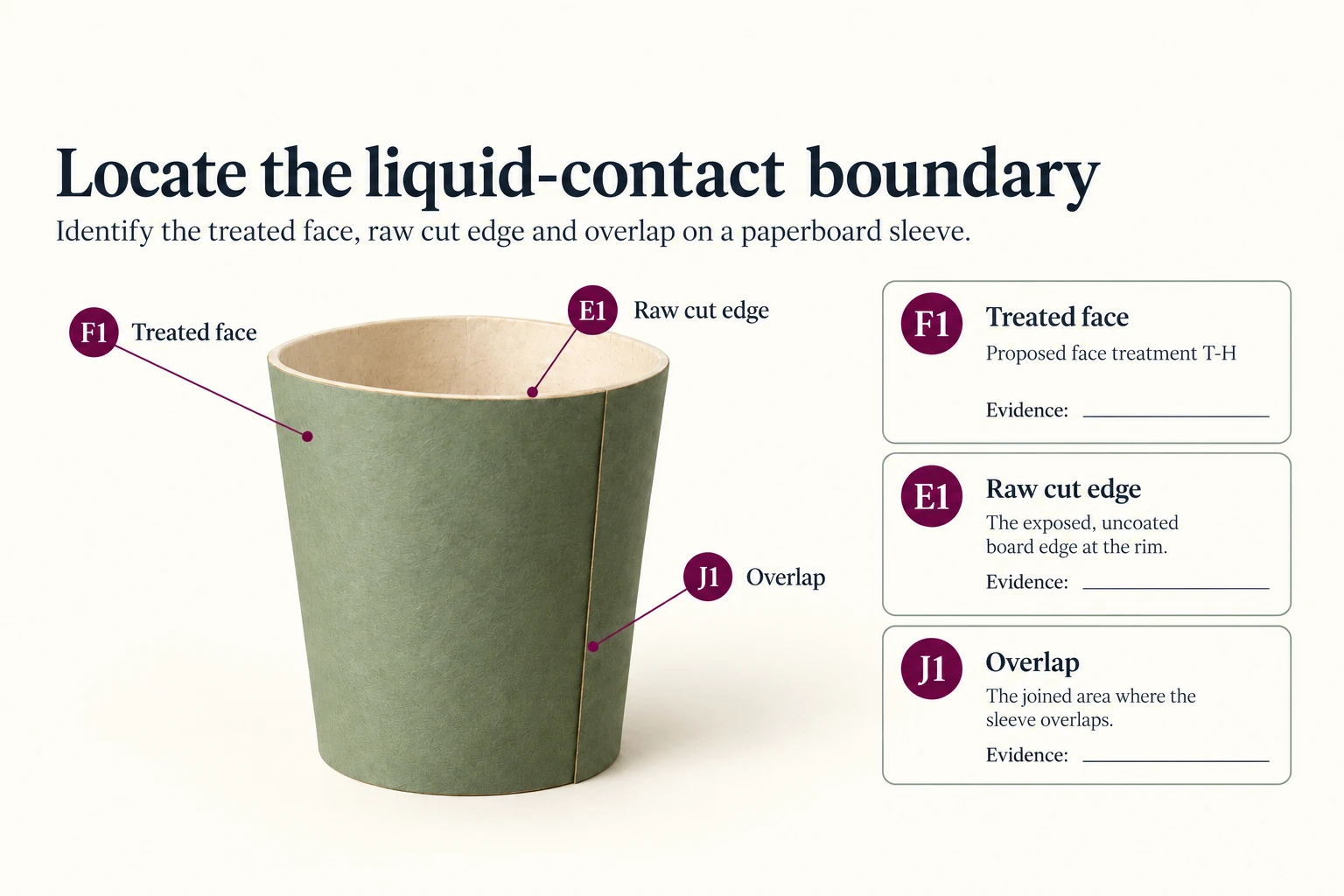
The same decorated sleeve can raise separate face and edge questions. In this invented route map, F1 is the outer face, E1 the raw die-cut edge and J1 the assembled overlap. These are locations to identify, not demonstrated entry paths.
Scroll horizontally if columns extend beyond the view.
| Location | Proposed contact boundary | Evidence to keep separate |
|---|---|---|
| F1 | Decorated outer face, treatment T-H | Face-related water evidence for that construction |
| E1 | Exposed cut thickness beside F1 | Edge-specific scope and converted material identity |
| J1 | Overlap/interface in formed sleeve | Assembled interface description and relevant evidence |
| E1 revised | Proposed edge treatment T-E | New configuration; no waterproof inference |
Draw the location on a dry construction reference or drawing. A location map does not require applying water, cutting a new specimen or repeating a hot-water method. Leave actual contact, uptake and observed change blank when none has occurred.
Check which face a material document represents and whether the converted edge exists in that specimen. Matching the base-board name is insufficient when treatment, printing or cutting changes the boundary. Attach that applicability question to F1 or E1 rather than assigning one score to the sleeve.
If a proposed treatment covers E1, preserve the earlier untreated-edge record and add a revision. The added treatment creates another configuration with its own appearance and contact questions; it is not a completed remedy.
Download the paperboard edge water absorption record (.csv). HYPOTHETICAL rows are invented examples. Use ACTUAL_BLANK for permitted project inputs; replace that row label only when recording actual facts. Empty evidence, observation and date fields mean unknown or not performed, never acceptance. Keep checkpoints and revisions separate.
Bring a marked sleeve drawing and the location-specific evidence gap to the enquiry linked in the original article. Packrivo coordinates independent suppliers. These records establish no supplier offer, service availability or MOQ exception; its published baseline is 500 pieces per product/design.