
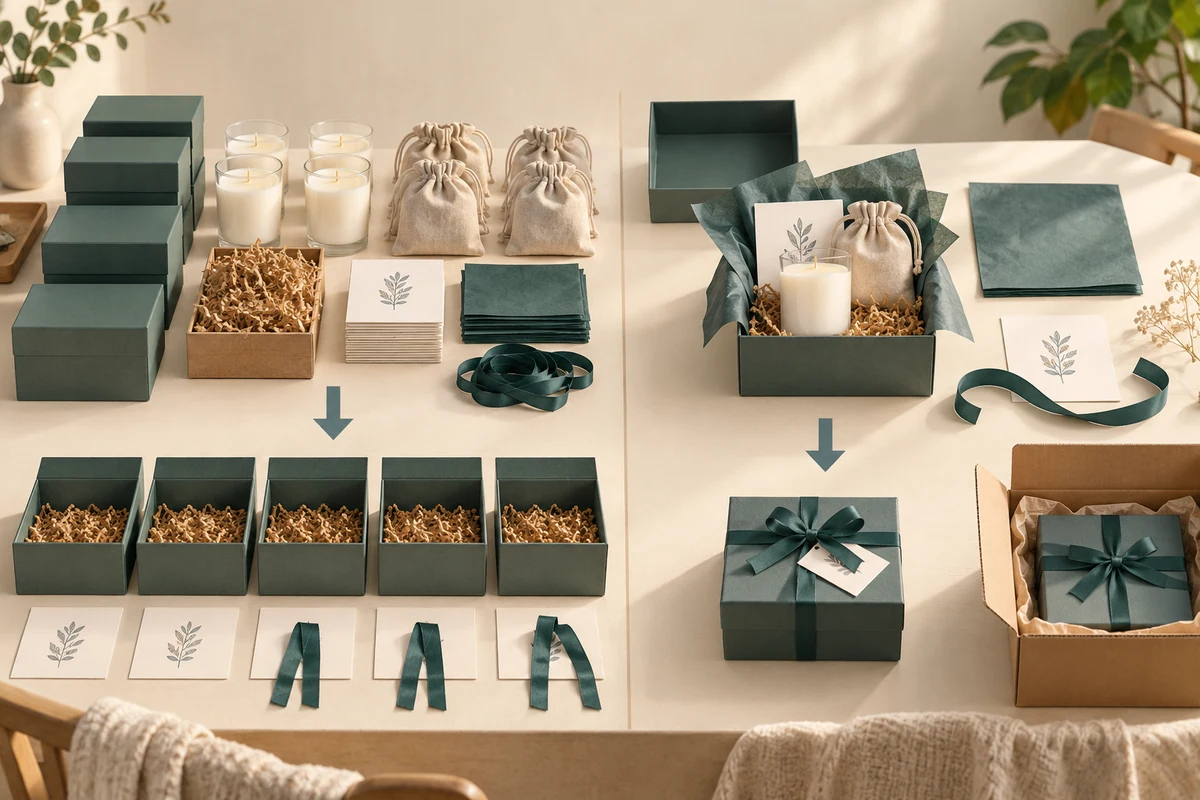
Batch packing and one-gift-at-a-time packing expose different work-in-progress and matching paths. Compare the same required operations while tracing where products and messages wait. Neither arrangement is automatically faster or more accurate; the useful choice depends on actual handling and evidence.
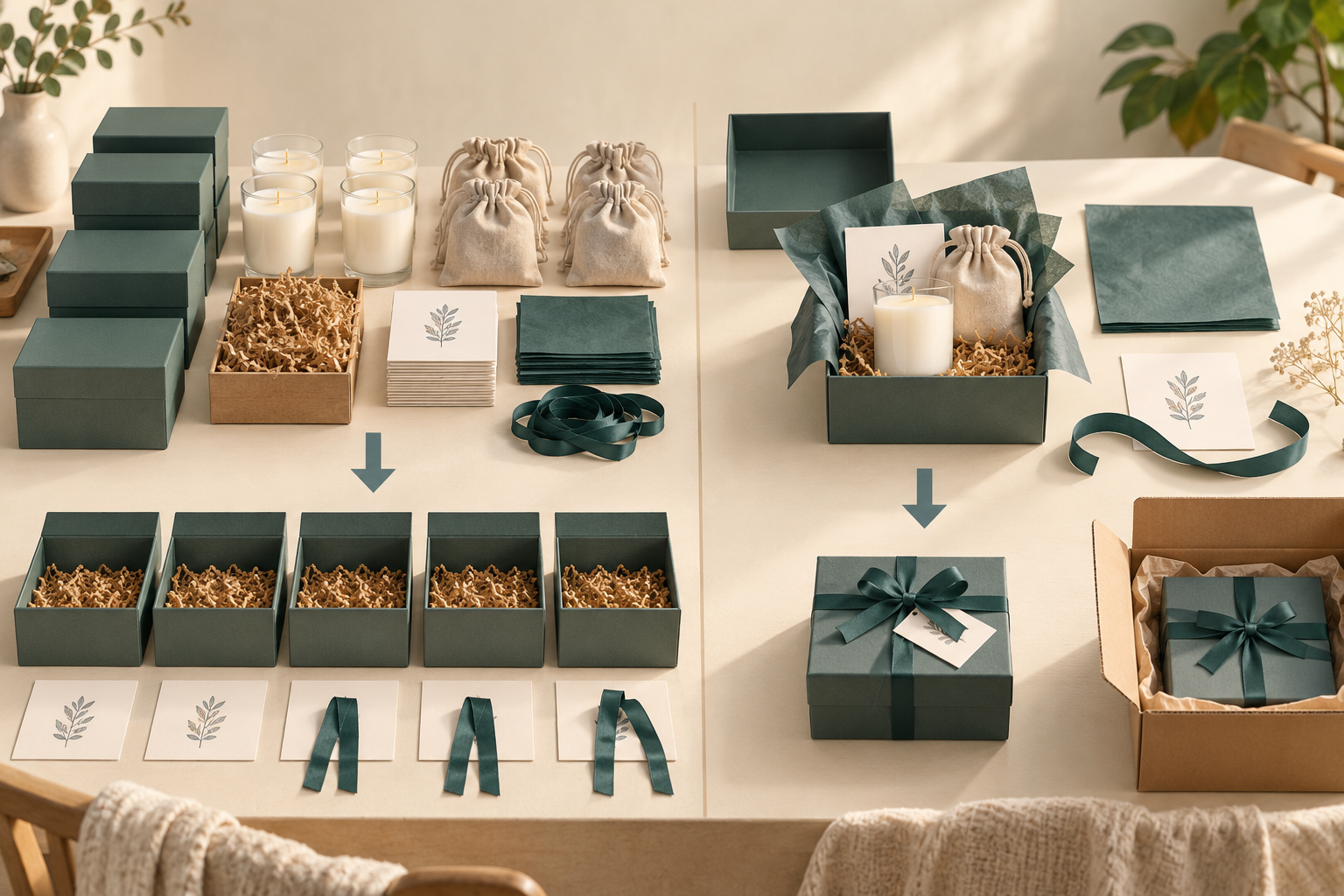
Keep the required combination unchanged
Use the same products, packaging versions and gift-message service in both routes. The component variant map identifies permitted combinations so a process comparison does not accidentally compare different gifts.
Describe batch stages in physical terms. “Pick ten, load ten, then add ten cards” creates different unfinished states from completing one order before starting the next.
Trace a fictional ten-gift job
Assume ten gifts have different private messages. All products and packaging are available. No measured error frequency or cycle time is assigned.
Scroll horizontally if columns extend beyond the view.
| Route | Intermediate state to identify | Matching exposure to examine |
|---|---|---|
| Batch-staged | Ten picked product groups awaiting loading | Product groups need retained order identities |
| Batch-staged | Ten printed cards awaiting placement | Each card must remain linked to its gift |
| One-gift completion | One active product group and card | Other order materials should stay outside the active position |
Batching may make repeated operations convenient, but the later merge must preserve all ten identities. One-gift flow can narrow the active matching task while introducing repeated material retrieval or device changes. Those are candidate observations, not proven advantages.
Keep the unfinished units distinguishable
Define where each intermediate gift waits and what identifier stays with it. A finished exterior can look identical across recipients, so color alone may not explain which message belongs inside.
If a card is reprinted, identify which intermediate gift it affects. Withdraw its obsolete copy under the actual workflow. A batch’s new print output should not leave both versions available for insertion.
Observe a change between variants as well. Common boxes may remain at the bench while specific inserts or cards must change. Preserve the physical state of unfinished work when starting the next variant.
Compare the whole route
For a trial, record component retrieval, device setup, intermediate storage, matching and completion. An assembly stage that looks faster may have moved its preparation into an earlier batch task rather than removed it.
Choose the route using the full work and observed difficulties. The output is a process map identifying waiting material and matching points, with any timing or error claim limited to its actual evidence. It should not turn an illustrative ten-order comparison into a measured improvement percentage.
Sources and scope
Australian Government supports the stated general concepts within this scope: General inventory categories, reorder points and stocktake. Access checked 14 October 2026.
OSHA supports the stated general concepts within this scope: US warehousing ergonomic hazards. Access checked 14 October 2026.
The worked scenario is original editorial analysis with assumed inputs, not a supplier offer, customer record or measured Packrivo result. Commercial feasibility and physical suitability remain project-specific.
Preserve the affected gift when its message changes
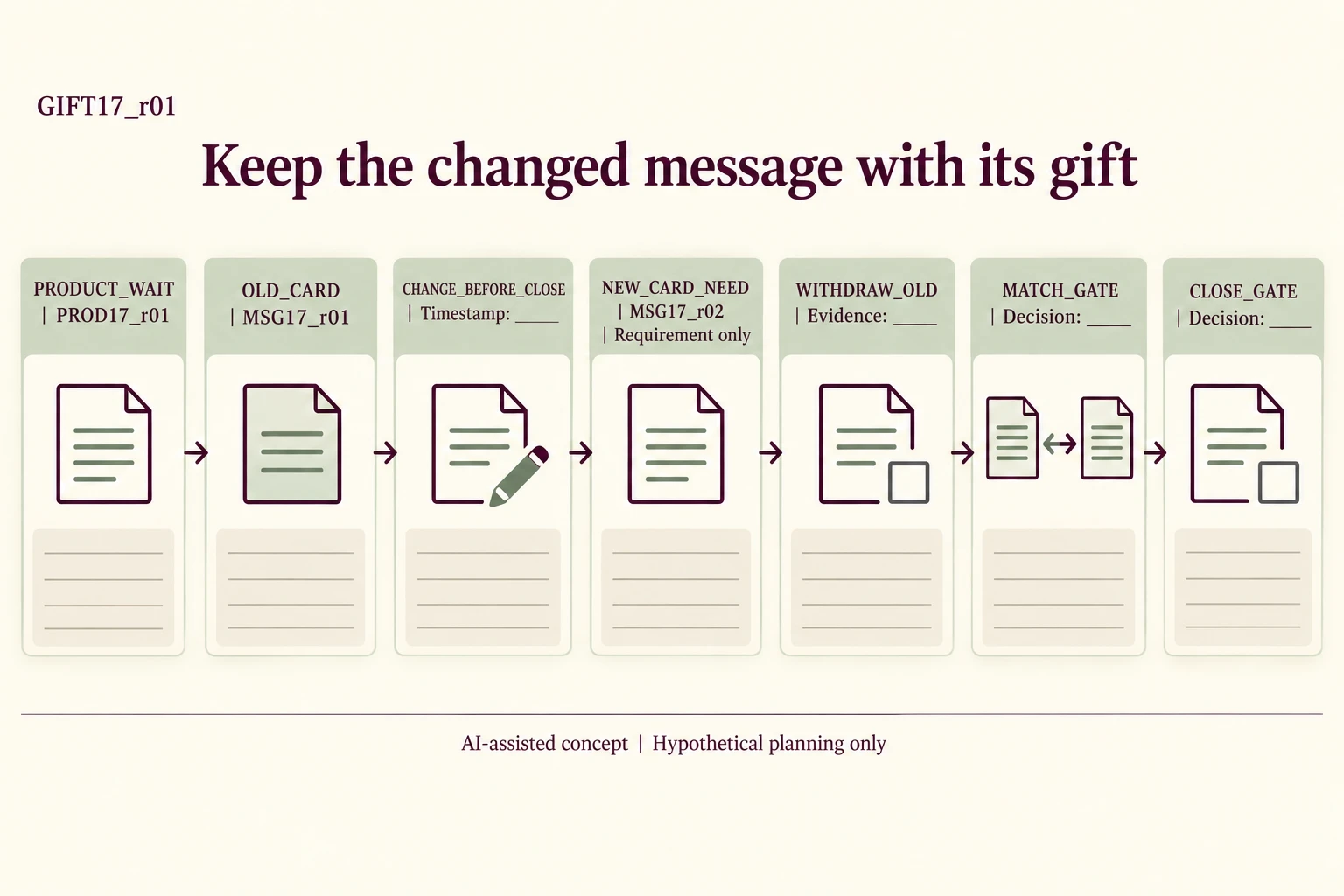
Use one hypothetical affected gift, GIFT17_r01, rather than inventing an error-rate trial. PROD17_r01 waits while a proposed before-closure message change moves the required card from MSG17_r01 to MSG17_r02. No recipient names or message text are used.
Scroll horizontally if columns extend beyond the view.
| Scope ID | Exact entity | Stage / role | Hypothetical basis |
|---|---|---|---|
| PRODUCT_WAIT | PROD17_r01 | WAITING | One affected hypothetical gift, not a ten-order timing trial |
| OLD_CARD | MSG17_r01 | SUPERSEDED_REFERENCE | Earlier message version; no personal text recorded |
| CHANGE_BEFORE_CLOSE | MSGCHANGE17_r01 | BEFORE_CLOSURE | Proposed message change; actual timestamp unknown |
| NEW_CARD_NEED | MSG17_r02 | REPRINT_REQUIREMENT | New version required, not confirmed printed |
| WITHDRAW_OLD | MSG17_r01 | OBSOLETE_COPY_CONTROL | Actual withdrawal and evidence remain unknown |
| MATCH_GATE | GIFT17_r01 | BEFORE_COMPLETION | PROD17_r01 plus current MSG17_r02; actual match unknown |
| CLOSE_GATE | GIFT17_r01 | AFTER_MATCH_REVIEW | Actual closure decision remains unknown |
CHANGE_BEFORE_CLOSE is a stage boundary with no invented timestamp. NEW_CARD_NEED is a requirement, not printed output. WITHDRAW_OLD independently records the obsolete-copy control; changing the file does not prove the earlier physical card was removed.
MATCH_GATE and CLOSE_GATE remain separate unknown decisions. A current message requirement does not prove it is paired with the right product, and a match does not record closure. The worksheet establishes no faster route, actual error, completed gift or actual withdrawal.
Download the batch packing versus single order record (.csv). HYPOTHETICAL rows are invented examples. Use ACTUAL_BLANK for permitted project inputs; replace that row label only when recording actual facts. Empty evidence, observation and date fields mean unknown or not performed, never acceptance. Keep checkpoints and revisions separate.
Bring the exact scope rows and unresolved evidence in a Packrivo enquiry. Replace planning inputs with actual authorised records before treating the scenario as an available arrangement. Prepare a Packrivo packaging enquiry. Packrivo coordinates independent suppliers. These records establish no supplier offer, service availability or MOQ exception; its published baseline is 500 pieces per product/design.
What this changes in a packaging enquiry
Before buying a multi-variant packaging kit, identify which parts can be prepared in batches and which must remain matched to individual products. Ask for component identification and the delivered grouping. A batch-packing plan should not silently turn a quote for loose parts into a quote for pre-matched sets.