

Changing the number of trade items in an orderable case can require a new GTIN for the affected higher packaging levels. Define the case before reviewing its label: a six-unit case and a twelve-unit case describe different configurations even when every consumer unit inside remains unchanged.
The relevant public reference is the GS1 GTIN Management Standard, release 1.1, ratified September 2023. Section 2.8 addresses pack/case quantity. Its rules must be considered with the other applicable GTIN rules and any stricter local requirements.

Keep the consumer unit, case and transport instance distinct
The consumer unit is the item offered at that level. An orderable case can be a higher-level trade item with its own defined contents. An individual logistic unit has a different identification role.
A case GTIN identifies a trade-item class. An SSCC identifies a particular logistic unit in the applicable logistics process. The GTIN and SSCC distinction explains why repeating a case GTIN does not individually identify two separately handled transport units.
Changing a case configuration is therefore different from creating another physical example of an unchanged case. Do not use a fresh SSCC to avoid reviewing whether the case trade-item definition has changed.
Compare a six-unit case with a twelve-unit case
This hypothetical example assumes an unchanged consumer candle gift, A. No GTINs have been allocated, and neither case has been developed or tested.
Scroll horizontally if columns extend beyond the view.
| Level | Earlier configuration | Proposed configuration | Identity question |
|---|---|---|---|
| Consumer unit | One unchanged gift A | The same gift A | Check all relevant rules; case count alone does not change A |
| Orderable case | Six units of A | Twelve units of A | Review the changed case under section 2.8 |
| Existing higher levels | Defined around the earlier case | Defined around the revised hierarchy | Identify the affected levels and review their GTIN records |
| Individual transport unit | A particular handled unit | Another particular handled unit | Keep logistic-unit identification separate |
Section 2.8 states that a changed number of trade items in a case, or a changed case count in a predefined pallet configuration, requires a new GTIN. The standard specifies unique GTINs at existing hierarchy levels above the consumer trade item or base unit for this change.
That does not mean every ordinary courier carton must have a case GTIN. First determine which levels are defined trade items in the actual trading arrangement.
Update the definition before updating the artwork
The barcode owner needs the earlier contents, proposed contents, quantities and hierarchy levels. Identify whether the case is ordered or invoiced as a unit and which trading partners use its data.
After the allocation decision, connect the accepted identity to the correct case artwork and product records. A label that accurately says “12” does not establish that its identifier has also been reviewed. Conversely, allocating a new identifier does not confirm the physical printed symbol’s quality.
Retain the old configuration and the date the new definition enters use. Decide how partners distinguish old and new cases during any coexistence period. Do not silently replace an old case record while examples of that configuration remain in circulation.
Use the rule within its stated scope
The open official reference was checked on 14 October 2026. This article uses its case-quantity rule, not an inaccessible decision-tool page or a paid standard inferred from a summary. Brand-owner discretion, regional requirements and other change triggers remain relevant.
Packrivo can coordinate the packaging, quantity and artwork questions in a packaging project inquiry. Actual GS1 allocation and trading-partner acceptance belong to the brand’s responsible identification owner or specialist.
Keep the old case factor while old case stock remains
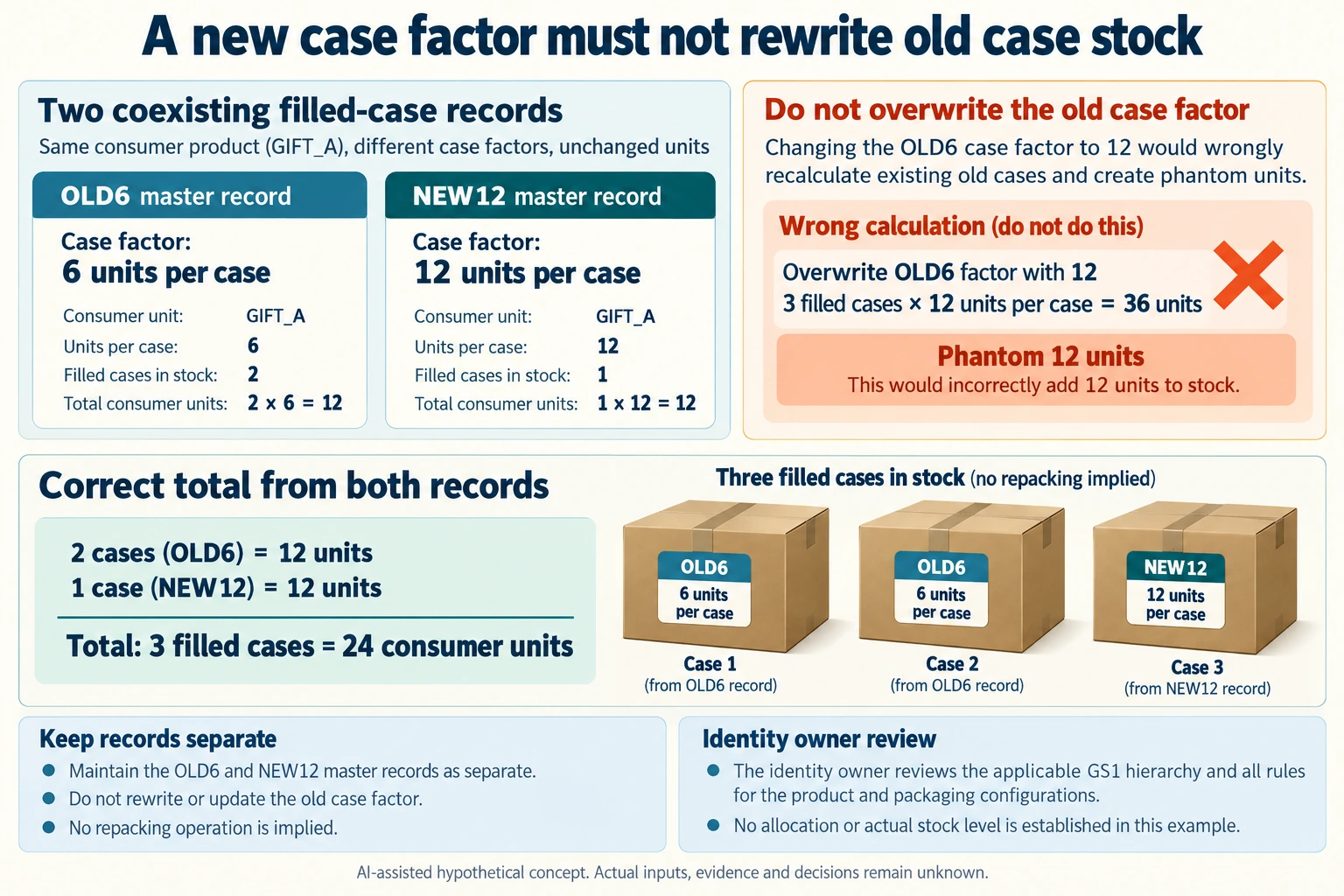
A case-quantity change can leave old and new classes in stock at the same time. Assume a fictional register holds two filled OLD6 cases, each containing six unchanged GIFT_A consumer units, and one filled NEW12 case containing twelve. This is a simultaneous stock record, not an instruction or permission to repack anything.
Scroll horizontally if columns extend beyond the view.
| Hypothetical scenario | Item or operation | Planning relationship | Assumed input or calculation |
|---|---|---|---|
| CASE_CLASSES33 | OLD_CASES | assumed input | 2 filled_cases |
| CASE_CLASSES33 | OLD_FACTOR | assumed input | 6 consumer_units/case |
| CASE_CLASSES33 | NEW_CASES | assumed input | 1 filled_cases |
| CASE_CLASSES33 | NEW_FACTOR | assumed input | 12 consumer_units/case |
| OLD6_33 | UNCHANGED_GIFT_A | calculated from | OLD_CASES*OLD_FACTOR; 12 consumer_units |
| NEW12_33 | UNCHANGED_GIFT_A | calculated from | NEW_CASES*NEW_FACTOR; 12 consumer_units |
| CASE_CLASSES33 | FILLED_CASE_COUNT | calculated from | OLD_CASES+NEW_CASES; 3 filled_cases |
| CASE_CLASSES33 | CONSUMER_UNIT_TOTAL | calculated from | OLD_UNITS+NEW_UNITS; 24 consumer_units |
| WRONG_OVERWRITE33 | RETROSPECTIVE_FACTOR_OUTPUT | calculated from | CASES_TOTAL*NEW_FACTOR; 36 consumer_units |
| WRONG_OVERWRITE33 | OVERCOUNT | calculated from | WRONG_UNITS-CORRECT_UNITS; 12 consumer_units |
The correct register has three filled cases and 24 consumer units: two times six plus one times twelve. If someone overwrites the old case factor with twelve and applies it to all three cases, the register displays 36 consumer units. The extra twelve are a data error, not received or recovered stock. Preserve each class and its content factor while that class remains in the records.
The identity owner must review the actual trade-item hierarchy under GS1 section 2.8 and all other applicable rules. The base-unit N/A entry in that rule is not blanket permission to reuse every identity. No real GTIN, SSCC, scan or barcode artwork is assigned here. The assortment article separates pieces within a set; the logistics-unit article separates physical shipment identities; the partial-case article concerns changed support after units are removed. This example concerns a retrospective case-factor overwrite.
Download the old new case quantity conversion factor inventory record (.csv). It includes the original table fields and scenarios alongside the added relationships. HYPOTHETICAL rows are editorial examples or required review scopes, not actual records. Actual quantity, configuration, component and file identities, materials, process, specification, copy, method, condition, observation, owner, decision, evidence and dates are blank. ACTUAL_BLANK is a separate empty starting row; enter permitted project evidence before using an actual record. A blank means unknown.
Use the Gift-Set Barcode Identity Follows the Sold Assortment for its separate question. Use the Partial Case Repacking After Wholesale Unit Removal for its separate question. Use the A Case GTIN and a Logistic-Unit SSCC Identify Different Kinds of Thing for its separate question.
Additional official reference: GS1 GTIN Management Standard, Release 1.1. Rule-specific public guidance supports an identity-owner review, not automatic artwork, stock or barcode approval.
Source scope checked 17 October 2026: GS1 GTIN Management Standard Release 1.1, ratified September 2023, section 2.8 addresses case quantities and existing higher trade-item levels. Consider all applicable rules and local requirements. This record assigns no identifiers or actual hierarchy verdict. The added configurations and calculations are hypothetical, with actual evidence and decisions pending.
What this changes in a packaging enquiry
Before changing the quantity in a wholesale case, give the barcode owner the proposed trade-item hierarchy and give the packaging supplier the physical pack specification. Keep identification approval separate from carton sizing and artwork placement. The example does not authorize a new GTIN or establish a commercial case quantity.
Discuss this packaging specification with Packrivo. We coordinate independent suppliers. MOQ: 500 pieces per product/design; illustrative quantities are not production offers. Confirm materials, samples, price and timing for your project.