

Connect gift-pack size options to the contents they have actually been approved to hold. Labels such as Small and Medium cannot tell a buyer whether two products share one presentation. Build the selection guide from accepted configuration records and leave unsupported combinations outside the offered promise.
The guide comes after physical fit work. It translates that work into a customer choice; it cannot approve a new combination because its total bare dimensions appear small enough.

Define the option as a complete arrangement
State which product units, inserts, cards and decoration belong in each option. Identify whether the buyer receives one shared gift presentation or separate packs. Optional cards or bags may alter the arrangement and need their own eligible configuration.
The jewelry structure selection guide addresses opening, fit and removal. Its physical review remains the basis for choosing an option. A storefront label should refer to that identified configuration rather than a loose box nickname.
Build a hypothetical contents-to-option table
Assume a fictional brand has completed the relevant reviews for two arrangements: Pack S contains one necklace, while Pack M contains one necklace and one pair of earrings. A two-necklace arrangement has not been reviewed. These are assumed inputs, not actual accepted samples or an existing service.
Scroll horizontally if columns extend beyond the view.
| Customer’s intended contents | Pack S | Pack M | Selection response |
|---|---|---|---|
| One necklace | Accepted in this example | Not specified | Offer the defined single-necklace option |
| One necklace and one earring pair | Not accepted here | Accepted in this example | Offer the defined paired presentation |
| Two necklaces | Unreviewed | Unreviewed | Resolve another route; do not infer eligibility |
Two small necklace boxes might appear to occupy less space than a necklace and earrings. That observation does not establish contact, orientation, removal or closure for the different combination.
If the seller really offers separate wrapping, it can present that approved route. Otherwise, an unreviewed combination should remain a service question rather than receive an improvised substitute.
Keep photographs and descriptions tied to the option
Show the actual component combination for each offered choice. State whether a message card is included automatically, supplied only when requested or unavailable. A photograph that adds unrelated props needs a clear treatment so buyers can understand what they receive.
Etsy’s gift-service guidance provides an example of describing the wrapping and supplying an optional photo. It does not establish an automatic contents-validation feature or prove that either hypothetical option fits.
Give the packing team the same option reference shown to the buyer. If the customer chooses Pack M but the work instruction only says “gift wrap,” the qualified arrangement can be lost between selection and pack-out.
Update the guide when the configuration changes
Assign an owner to the eligibility table. A changed jewelry card, added accessory or different product envelope can reopen fit and change which option is offered. Keep earlier accepted rows intact where their dependencies remain unchanged.
The buyer-facing guide should say what can be selected now, with a clear route for unsupported contents. It should not promise a future alternative as if it already exists.
Packrivo can coordinate the fit references and option-specific supplier questions through a packaging project inquiry. Public platform guidance was checked on 14 October 2026; no actual option, fit result or software rule has been implemented for this example.
Publish eligibility without inventing a physical size relationship
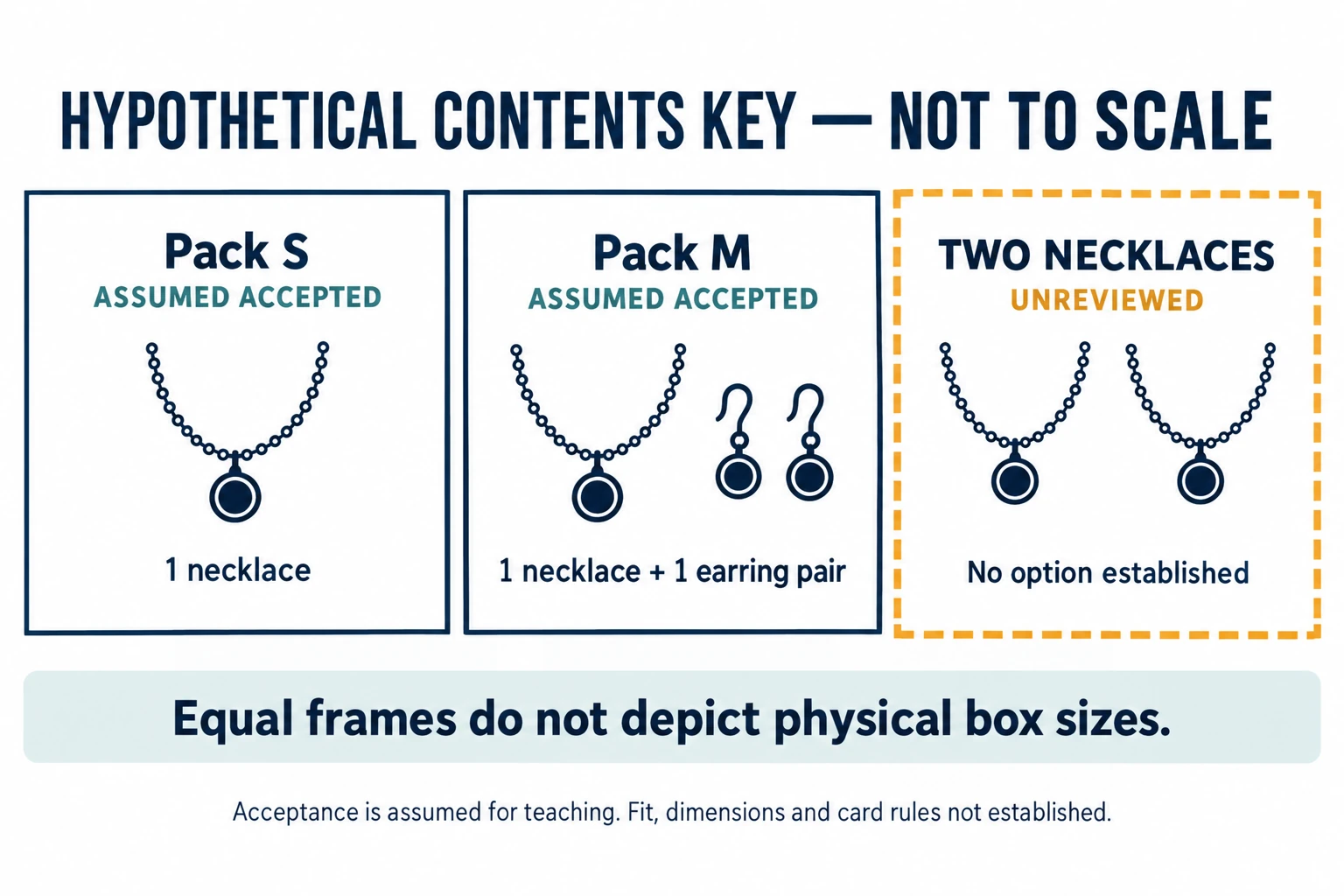
A gift packaging size guide should keep assumed accepted contents separate from unknown dimensions. In the fictional S/M example, acceptance is an input assumed for teaching, not a physical result obtained by Packrivo. No dimensions are available to justify a scale comparison of these boxes or products.
Scroll horizontally if columns extend beyond the view.
| Configuration reference | Intended contents | Eligibility in this invented example | Card/service rule |
|---|---|---|---|
| S-H | One necklace | Assumed accepted for Pack S only | Not specified; confirm before offering |
| M-H | One necklace plus one earring pair (two earrings) | Assumed accepted for Pack M | Not specified; confirm before offering |
| N2-H | Two necklaces | Unreviewed in both options; no size selected | Unresolved with the whole configuration |
Use the schematic as a contents key, not a silhouette to measure. Equally sized frames deliberately do not depict the actual exterior dimensions of S and M. The two-necklace branch remains outside both accepted examples even if the drawn icons look small. Ask for the configuration record, relevant loaded sample, insert identity and accepted card rule before creating a real storefront offer. A buyer-facing choice and the packing instruction should carry the same configuration ID; “gift wrap” alone loses which contents and included parts were allowed. If a card is optional, define the complete option with and without it rather than implying it always fits.
Download the gift packaging size guide record (.csv). Example rows are explicitly hypothetical. Use ACTUAL_BLANK for your own permitted project entries; replace that row label only when recording actual inputs. Blank evidence or observation fields mean unknown or not performed, never approval. Keep revisions and checkpoints separate.
For a scoped packaging inquiry, send the actual accepted configuration matrix, component identities, included-card rules and unsupported customer combinations. Send the identified configuration and open questions to Packrivo. Quantities in this record are planning demand, not quoted purchase quantities, MOQ exceptions or confirmed service availability.
What this changes in a packaging enquiry
Give each selectable pack size its accepted contents and component references before presenting it as an order option. Ask suppliers to quote those defined configurations rather than S/M/L labels alone. A dimensional concept or one fitting product cannot establish suitability for the entire product range. A relevant configuration to compare is the Jewelry box with fitted insert; it is a concept reference, not confirmed suitability.