

Measure a packaging improvement against a defined old operating baseline before claiming a saving. Keep the order work, quantity, service conditions and included tasks comparable. A shorter visible packing step can be outweighed by new setup work or a different mix of orders in the observation period.
State the outcome being evaluated: employee time, material use, usable output, recipient task or another defined requirement. One favorable measure does not establish that the whole new configuration should be retained.

Freeze the work covered by both observations
Name the product and packaging versions, operator conditions, start and finish, completed quantity and interruptions. Identify preparation, retrieval, replenishment and rework where they belong to the intended process.
The packing-trial timing method preserves scope and interruptions in a local observation. A sustained operating comparison needs its own appropriate evidence, but should retain those same distinctions rather than rename unlike durations as packing time.
Do not compare a period dominated by simple single-item orders with one containing many premium gift services and attribute the difference only to packaging. Separate order groups or obtain a more comparable observation.
Include setup in a hypothetical time comparison
Assume two periods each complete 200 identical gift orders under otherwise comparable stated conditions. The old route takes 300 employee minutes. The new route’s repeated packing work takes 260 minutes, but it introduces fifty additional employee minutes of setup. These numbers are invented.
Scroll horizontally if columns extend beyond the view.
| Defined work | Old route | New route |
|---|---|---|
| Repeated packing work | 300 minutes | 260 minutes |
| Additional setup within the comparison | 0 minutes in this stated baseline | 50 minutes |
| Total defined employee work | 300 minutes | 310 minutes |
The repeated step is forty minutes shorter, while total defined work is ten minutes greater. Describing the new route as saving forty minutes would omit its setup. Actual existing setup in the old route would also need inclusion if the stated zero were wrong.
The table establishes no real labor rate, payroll saving or statistical confidence. It demonstrates why the work definition changes the result.
Keep other outcomes and confounders visible
A new configuration might still meet an important requirement even where this time comparison is unfavorable. Better product access, an accepted service change or another actual outcome needs its own evidence and decision weight.
Record material use and released output under their appropriate units. If fewer gifts become usable, a lower total material spend may not represent a lower cost for the same delivered requirement.
Official inventory guidance supports reviewing records and results. Cash-flow guidance separates money movements and estimates. Neither source establishes a packaging-improvement rate or proves causation from the hypothetical before-and-after table.
Decide whether to retain, adjust or revert
Return the matched baseline, changed tasks, raw observations, other relevant outcomes and unresolved differences. The responsible owner can then decide whether the new route meets the agreed objectives or needs another revision.
The sample-revision method preserves a correction and its affected physical functions. Economic preference cannot replace those configuration reviews, and a successful sample correction cannot prove an operating saving.
Packrivo can coordinate the supplier and packaging questions through a packaging project inquiry. Public guidance was checked on 14 October 2026. No actual Packrivo improvement, customer outcome, saving or conversion effect is reported here.
Report employee work and elapsed completion as different measures
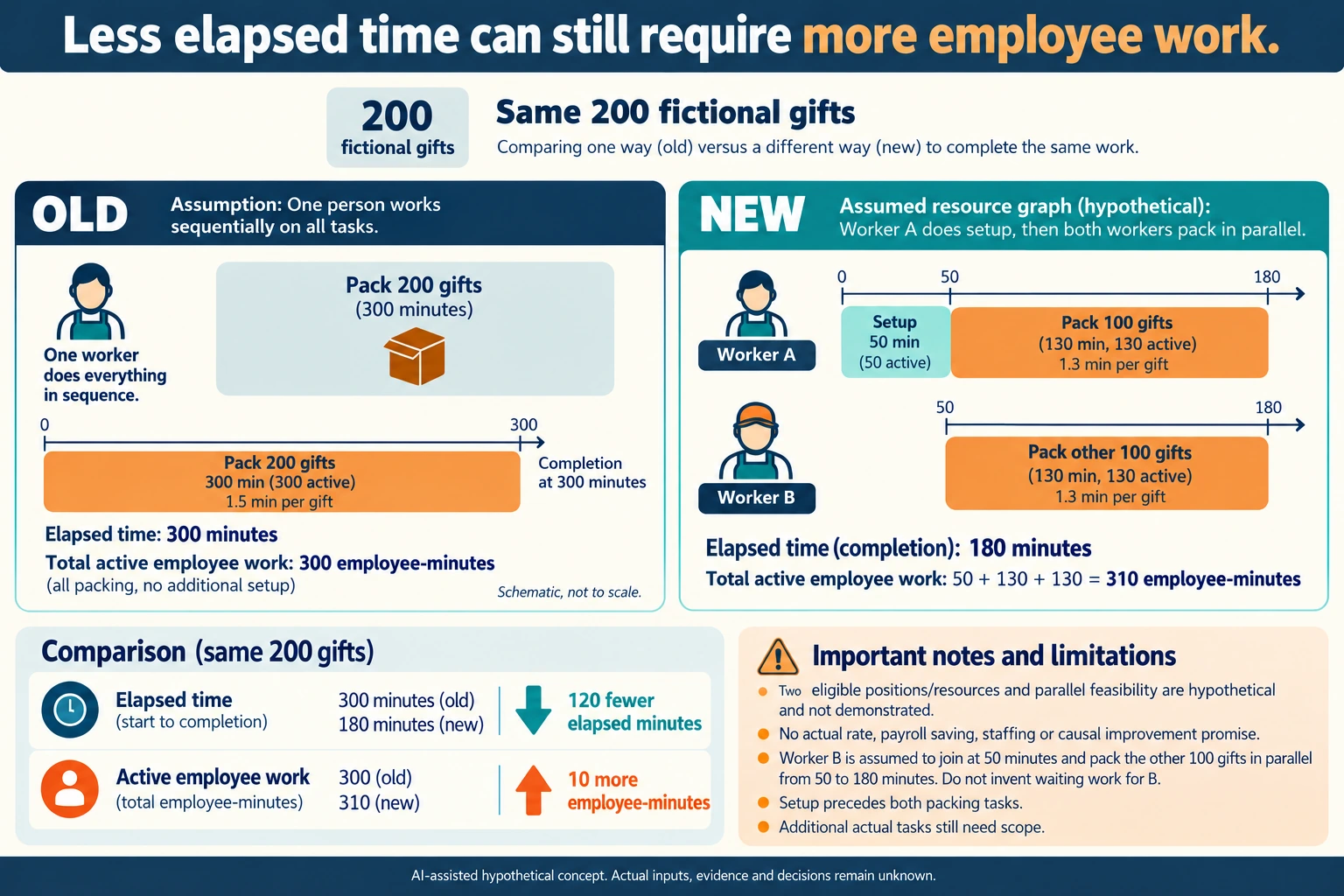
Keep the original 200-gift work totals: 300 employee-minutes in the old stated baseline and 260 repeated packing minutes plus fifty setup minutes in the new route. Add explicit resource assumptions. Suppose one person performs all old work sequentially, with zero additional setup in that baseline, giving 300 elapsed minutes as well as 300 active employee-minutes.
Scroll horizontally if columns extend beyond the view.
| Hypothetical scenario | Item or operation | Planning relationship | Assumed input or calculation |
|---|---|---|---|
| PARALLEL35 | HYPOTHETICAL_PER_GIFT_WORK | calculated from | O_NEW_REPEATED/O_GIFTS; 1.3 employee_minutes/gift |
| PARALLEL35 | A_PACKING_WORK | calculated from | PACK_A*RECURRING_PER_GIFT; 130 employee_minutes |
| PARALLEL35 | B_PACKING_WORK | calculated from | PACK_B*RECURRING_PER_GIFT; 130 employee_minutes |
| PARALLEL35 | A_FINISH_FROM_START | calculated from | O_NEW_SETUP+A_PACK_TIME; 180 elapsed_minutes |
| PARALLEL35 | B_FINISH_FROM_START | calculated from | O_NEW_SETUP+B_PACK_TIME; 180 elapsed_minutes |
| PARALLEL35 | LAST_COMPLETION | calculated from | max(A_END,B_END); 180 elapsed_minutes |
| PARALLEL35 | TOTAL_ACTIVE_EMPLOYEE_WORK | calculated from | O_NEW_SETUP+A_PACK_TIME+B_PACK_TIME; 310 employee_minutes |
| PARALLEL35 | OLD_ONE_PERSON_SEQUENTIAL_ELAPSED | calculated from | O_OLD_TOTAL; 300 elapsed_minutes |
| PARALLEL35 | ELAPSED_REDUCTION | calculated from | OLD_ELAPSED-NEW_ELAPSED; 120 elapsed_minutes |
| PARALLEL35 | ACTIVE_WORK_INCREASE | calculated from | ACTIVE_WORK-O_OLD_TOTAL; 10 employee_minutes |
For the new hypothetical arrangement, worker A performs the fifty-minute setup first. Then A packs 100 gifts and worker B packs the other 100 in parallel. At the invented 1.3 active minutes per gift, each packing task takes 130 minutes. Both start at minute fifty and finish at minute 180. B joins at fifty; the model does not hide an assumed earlier waiting assignment.
Elapsed completion falls from 300 to 180 minutes, a difference of 120. Active employee work is fifty plus 130 plus 130, or 310 minutes: ten more than the old 300. Reporting only the shorter elapsed window would therefore misdescribe the employee-work result even though setup is included.
Two eligible work positions, resources and a feasible division are hypothetical conditions, not a demonstrated arrangement. Include any actual transfer, preparation, waiting or other work that belongs to the chosen measure. This comparison supplies no staffing instruction, payroll saving, production rate or causal proof; the station-balance record asks a separate question about a serial line’s limiting stage.
Download the packing active employee work elapsed time comparison record (.csv). It includes the original table fields and scenarios alongside the added relationships. HYPOTHETICAL rows are editorial examples or required review scopes, not actual records. Actual quantity, configuration, component and file identities, materials, process, specification, copy, method, condition, observation, owner, decision, evidence and dates are blank. ACTUAL_BLANK is a separate empty starting row; enter permitted project evidence before using an actual record. A blank means unknown.
Use the Record a Packing Trial Without Promising a Universal Speed for its separate question. Use the Adding Packing Operators Requires a Task Balance Across Stations for its separate question. Use the Peak-Season Packing Plans Need a Training and Familiarisation Allowance for its separate question.
Source scope checked 17 October 2026: General inventory and cash-flow guidance supplies neither this resource graph nor a packing-improvement rate. Both metrics require their own work definition; no actual trial, safe layout, payroll effect or causal result is established. The added configurations and calculations are hypothetical, with actual evidence and decisions pending.
What this changes in a packaging enquiry
Before claiming that a packaging change saves money or time, compare the same included work and quantity, including setup and any work transferred to the supplier. Ask for the actual proposed delivered state and charges. A shorter observed task is not automatically a net saving or a supplier performance commitment.
Discuss this packaging specification with Packrivo. We coordinate independent suppliers. MOQ: 500 pieces per product/design; illustrative quantities are not production offers. Confirm materials, samples, price and timing for your project.