

Compare packaging rework using the number of units that become accepted for the intended use, not merely the number processed. The authorized corrective operation, its cost and the final acceptance decision need separate records. A cheap attempt can become an expensive recovery route when few units are released.
Begin with a counted, identified held batch. The responsible technical and acceptance owners must establish whether a corrective operation is permitted before the buyer evaluates its economics. This article prescribes no repair method.

Divide the recovery cost by accepted recovered units
Assume a hypothetical batch contains 100 held empty boxes. An authorized rework attempt costs $0.30 per box processed. Processing all 100 therefore costs $30. No real batch, technical authorization or supplier price supports these inputs.
Scroll horizontally if columns extend beyond the view.
| Hypothetical result after the agreed review | Accepted recovered units | Rework cost per accepted recovered unit |
|---|---|---|
| 80 boxes accepted | 80 | $30 ÷ 80 = $0.375 |
| 50 boxes accepted | 50 | $30 ÷ 50 = $0.60 |
| No boxes accepted | 0 | No recovered-unit cost can be calculated by division |
If an equivalent qualified replacement costs an invented $0.50 per unit, the first recovery scenario warrants further cost comparison. The second already exceeds that unit figure before additional costs. In the zero-recovery scenario, the $30 remains an incurred cost even though it yields no accepted units.
Any comparison must include actual additional materials, sorting, handling, transport and review work. If a replacement route also has fixed charges or a minimum quantity, those belong in its separate scenario.
Keep expected yield distinct from observed recovery
An expected 80% recovery can help estimate a proposed operation. It is not evidence that eighty boxes will be accepted. Record the basis of that assumption and test how the decision changes with a lower accepted quantity.
After the operation, retain counts for processed, accepted, rejected and still-held units under the agreed disposition rules. For the eighty-accepted scenario, twenty boxes remain outside accepted stock unless a separate decision establishes their status.
The incoming batch acceptance record explains requirement, inspection basis and scoped disposition. Use the responsible process rather than inventing a new acceptance limit to make the economic result look favorable.
Compare routes that deliver the same usable requirement
Specify the required accepted quantity and date. Recovering eighty boxes may leave twenty to source separately if the operation needs 100. Include that shortage in the route comparison rather than presenting $30 as the cost of solving the whole requirement.
Official inventory guidance distinguishes stock stages and encourages current records. The cash-flow planning guidance concerns cash timing. Neither establishes a repair yield, a supplier credit or the accounting treatment of this hypothetical work.
Costs already paid may matter to the business’s full history, while the next decision may compare only genuinely avoidable future costs. State which calculation is being made and avoid treating retained stock value as a guaranteed cash recovery.
Return a bounded rework decision
Give the buyer the authorized operation, expected and observed acceptance quantities, complete route costs and the remaining requirement. Record who may stop the operation or release recovered units.
Packrivo can organize those supplier and packaging questions through a packaging project inquiry. Public business guidance was checked on 14 October 2026. A favorable calculation cannot make unsafe, unsuitable or unauthorized goods acceptable.
Cost the remaining accepted-stock requirement
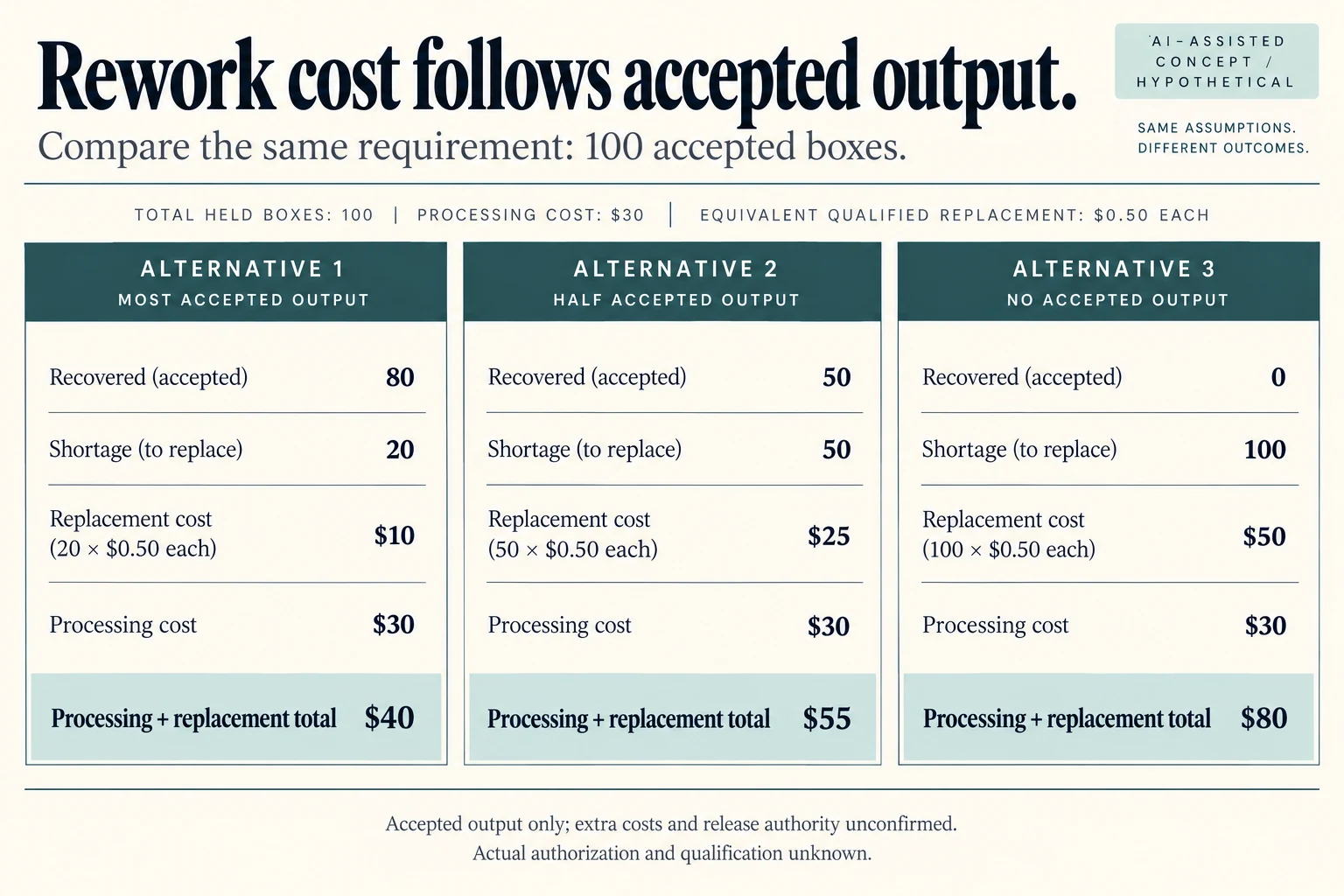
Extend the original hypothetical recovery outcomes to a common requirement of one hundred accepted boxes. Retain the invented $30 processing cost and $0.50 equivalent qualified replacement input. Replacement availability, minimum and fixed charges remain unknown.
Scroll horizontally if columns extend beyond the view.
| Scenario scope | Exact object or route | Hypothetical input or output | Calculation or record boundary |
|---|---|---|---|
| Remaining requirement | YIELD80 | 20 accepted boxes | 100 accepted required – 80 |
| Replacement cost | YIELD80 | 10.0 USD | (100-80)*.50 |
| Combined route cost | YIELD80 | 40.0 USD | 30+(100-80)*.50 |
| Remaining requirement | YIELD50 | 50 accepted boxes | 100 accepted required – 50 |
| Replacement cost | YIELD50 | 25.0 USD | (100-50)*.50 |
| Combined route cost | YIELD50 | 55.0 USD | 30+(100-50)*.50 |
| Remaining requirement | YIELD0 | 100 accepted boxes | 100 accepted required – 0 |
| Replacement cost | YIELD0 | 50.0 USD | (100-0)*.50 |
| Combined route cost | YIELD0 | 80.0 USD | 30+(100-0)*.50 |
Eighty recovered boxes leave twenty to replace: $30 plus $10 gives $40 for the stated hundred-box requirement. Fifty recovered boxes give $55, and zero recovered boxes give $80. The latter still incurs the processing cost; its recovered-unit cost remains undefined rather than zero.
These totals exclude the separate additional materials, sorting, handling, transport and review lines in the worksheet. Rejected and still-held counts remain separate unknowns within the quantity outside accepted stock. A favorable total cannot release goods, approve the operation or establish the required delivery date.
Download the packaging rework cost record (.csv). It covers the original scenarios and this added comparison. HYPOTHETICAL rows are invented planning examples. Actual quantity, value, configuration, method, owner, observation, condition, decision, evidence and dates are blank because no actual project record has been obtained. Copy a relevant row and replace its type with ACTUAL only when entering permitted project evidence; keep the example and actual record separate. ACTUAL_BLANK is an empty starting row. A blank is unknown, never approval.
The related Incoming Packaging Inspection: Check the Batch Before Packing guide concerns a separate requirement. Use this record for the specific comparison above rather than treating that guide as evidence of a completed result.
Keep genuinely avoidable costs separate using the commitment and stopping-cost comparison. Compare any changed commercial scope through the supplier change-quote comparison.
Source scope checked 16 October 2026: the original public references remain within their stated general guidance or manufacturer-example scope. The new numbers and task records are original hypothetical analysis, not observed supply, trials, inventory, prices or performance.
What this changes in a packaging enquiry
Use accepted recovered units, rather than attempted rework units, when comparing a replacement packaging purchase with rework. Specify the parts and checks needed to return each unit to the intended accepted configuration. The illustrative recovery yield is not a supplier rework capability or a promised saving.
Discuss this packaging specification with Packrivo. We coordinate independent suppliers. MOQ: 500 pieces per product/design; illustrative quantities are not production offers. Confirm materials, samples, price and timing for your project.