

Allocate scarce packaging at the order level before promising dispatch. A count of complete matched packs establishes a resource limit, but it does not decide which customer orders receive that resource. The business must choose its actual priority and partial-fulfillment policy and preserve any permitted alternative.
Start with stock genuinely available for the required configuration. Held, committed or mismatched components cannot be made available by adding them to a convenient total.

Define the policy before applying the counts
Record each order’s required presentation, committed quantity and actual deadline. Identify whether partial fulfillment is permitted and who may authorize a substitution or changed handover promise.
The component-combination map supplies the correct packaging identities. The gift-service fulfillment guide explains why the physical presentation and order promise must stay connected. Neither selects a business priority among competing orders.
Do not make an unapproved replacement pack count as the specified service. Keep the alternative’s review and customer communication route visible before including it in an allocation.
Compare a hypothetical sixty-pack shortage
Assume sixty matched packs are available and three fictional orders need ninety in total. Order A requires forty by Monday, B thirty by Tuesday and C twenty by Monday. No actual customer or commitment supports the example.
Scroll horizontally if columns extend beyond the view.
| Order | Required packs | Stated deadline | Allocation under the assumed earliest-deadline, whole-order rule |
|---|---|---|---|
| A | 40 | Monday | 40 |
| B | 30 | Tuesday | 0 pending another authorized route |
| C | 20 | Monday | 20 |
Under that stated rule, A and C consume all sixty packs. B remains unsupported by this stock. A different policy could produce a different result; the calculation does not authorize the example’s priority for a real business.
For comparison, a hypothetical proportional allocation rounded as A 27, B twenty and C thirteen also consumes sixty. Every order then remains incomplete. That route is unavailable if the actual service forbids partial fulfillment.
Reconcile allocation with the dispatch promise
Record accepted alternatives, later stock with an actual availability date and any order whose promise needs review. A supplier dispatch notice is not the same as material released for packing at the required location.
Shopify’s inventory-state documentation distinguishes available quantities from committed, unavailable and incoming product stock. It does not allocate a packaging BOM automatically. Use the actual component records and service system rather than assuming the platform supplies this worksheet’s logic.
Keep the decision owner explicit. Packaging staff can report a shortage, while the authorized business owner decides the commercial policy and required communications. No external customer messages are implied by this planning example.
Return an order-by-order result
Show the stated rule, matched stock, full or partial allocations and remaining gaps. Retain the quantity reserved for each order so the same scarce pack is not promised twice.
Packrivo can coordinate the component supply questions through a packaging project inquiry. Public platform guidance was checked on 14 October 2026. This example supplies no real customer priority, replacement approval or dispatch commitment.
Name the whole-order objective and its tie-break
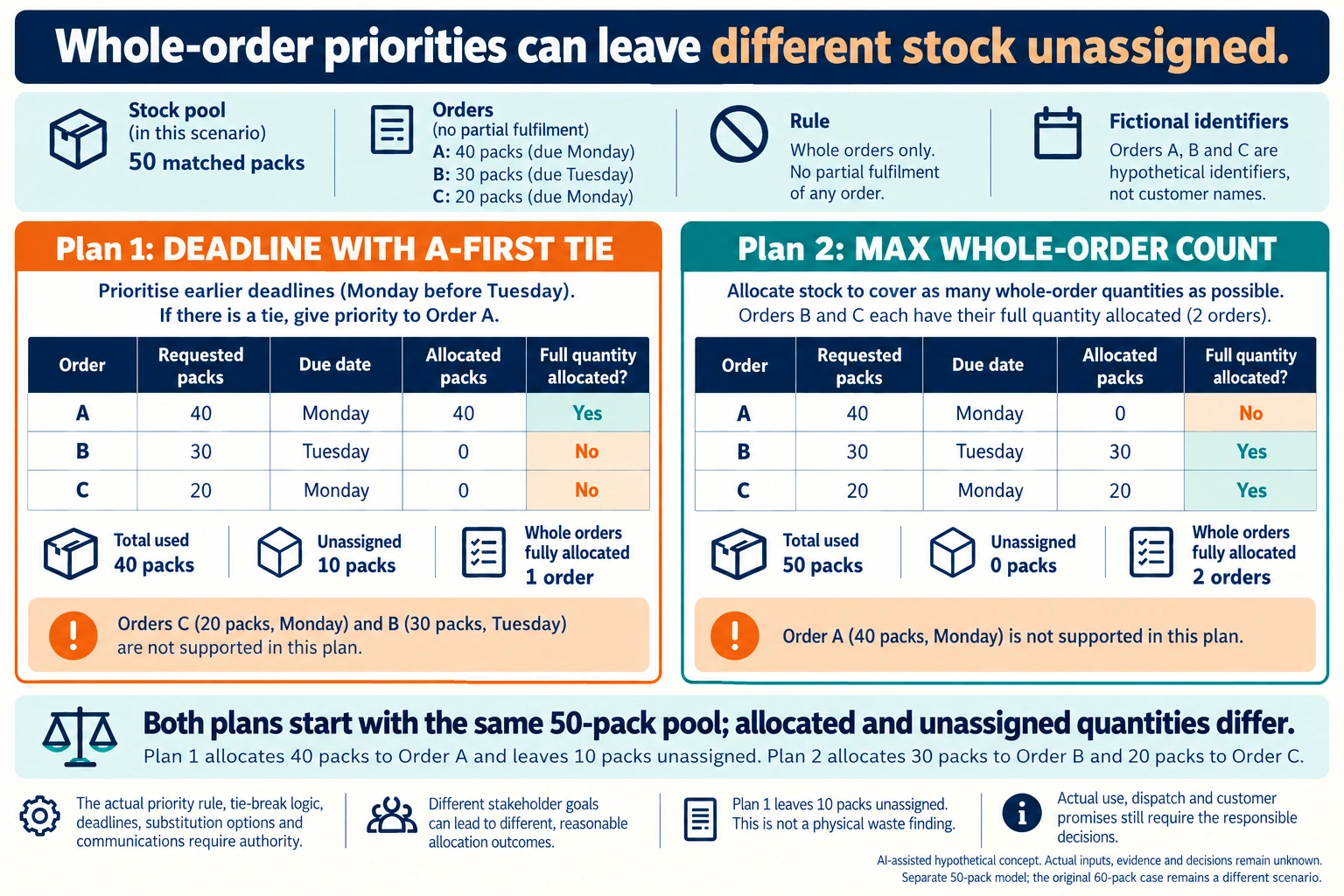
Use a new fifty-pack shortage, separate from the original sixty-pack case. Keep A at forty packs due Monday, B at thirty due Tuesday and C at twenty due Monday. Assume whole-order allocation only. The selected business objective and the tie between A and C must be stated before applying the arithmetic.
Scroll horizontally if columns extend beyond the view.
| Hypothetical scenario | Item or operation | Planning relationship | Assumed input or calculation |
|---|---|---|---|
| A_FIRST35 | A_GAP | calculated from | O_A-A_FIRST35_A; 0 packs |
| A_FIRST35 | B_GAP | calculated from | O_B-A_FIRST35_B; 30 packs |
| A_FIRST35 | C_GAP | calculated from | O_C-A_FIRST35_C; 20 packs |
| A_FIRST35 | PACKS_ALLOCATED | calculated from | A_FIRST35_A+A_FIRST35_B+A_FIRST35_C; 40 packs |
| A_FIRST35 | UNASSIGNED_PACKS | calculated from | NEW_STOCK-A_FIRST35_USED; 10 packs |
| A_FIRST35 | WHOLE_ORDER_QUANTITIES_FULLY_ALLOCATED | calculated from | floor(A_FIRST35_A/O_A)+floor(A_FIRST35_B/O_B)+floor(A_FIRST35_C/O_C); 1 order |
| MAX_COUNT35 | A_GAP | calculated from | O_A-MAX_COUNT35_A; 40 packs |
| MAX_COUNT35 | B_GAP | calculated from | O_B-MAX_COUNT35_B; 0 packs |
| MAX_COUNT35 | C_GAP | calculated from | O_C-MAX_COUNT35_C; 0 packs |
| MAX_COUNT35 | PACKS_ALLOCATED | calculated from | MAX_COUNT35_A+MAX_COUNT35_B+MAX_COUNT35_C; 50 packs |
| MAX_COUNT35 | UNASSIGNED_PACKS | calculated from | NEW_STOCK-MAX_COUNT35_USED; 0 packs |
| MAX_COUNT35 | WHOLE_ORDER_QUANTITIES_FULLY_ALLOCATED | calculated from | floor(MAX_COUNT35_A/O_A)+floor(MAX_COUNT35_B/O_B)+floor(MAX_COUNT35_C/O_C); 2 orders |
Under an earliest-deadline policy with an explicit A-before-C Monday tie-break, A receives forty. The remaining ten cannot cover either whole order B or C. One order’s full quantity is allocated and ten packs remain unassigned; C’s Monday twenty and B’s Tuesday thirty remain unsupported.
A maximum-number-of-whole-orders objective instead allocates twenty to C and thirty to B, using all fifty and covering two order quantities. It leaves A’s forty-pack Monday requirement unsupported. This count advantage does not authorise deprioritising A or make that policy better for the actual business.
Allocation covers quantities from this fictional packaging pool; it does not complete physical fulfilment, verify product readiness or change a customer promise. Unassigned packs are not automatically waste or approved for another purpose. Keep all three order gaps, the permitted partial-allocation policy and the owner’s decision with the record.
Download the packaging whole order allocation deadline tie break record (.csv). It includes the original table fields and scenarios alongside the added relationships. HYPOTHETICAL rows are editorial examples or required review scopes, not actual records. Actual quantity, configuration, component and file identities, materials, process, specification, copy, method, condition, observation, owner, decision, evidence and dates are blank. ACTUAL_BLANK is a separate empty starting row; enter permitted project evidence before using an actual record. A blank means unknown.
Use the Shared Gift Boxes with Separate Insert Stocks for its separate question. Use the Keep Box Insert and Sleeve Variants Matched During Packing for its separate question. Use the Fulfilment Location Rules Affect the Availability of Gift-Ready Orders for its separate question.
Source scope checked 17 October 2026: Shopify’s five product inventory states are not an automatic packaging BOM, business priority or whole-order allocation policy. All priorities, gaps and order identities here are hypothetical; no external customer message was sent. The added configurations and calculations are hypothetical, with actual evidence and decisions pending.
What this changes in a packaging enquiry
Apply the chosen order-allocation rule before converting the packaging shortage into a purchase. Send the supplier the specific approved component and date at which additional complete gifts are needed. A priority rule can distribute existing stock but cannot create a feasible replenishment or substitute configuration.
Discuss this packaging specification with Packrivo. We coordinate independent suppliers. MOQ: 500 pieces per product/design; illustrative quantities are not production offers. Confirm materials, samples, price and timing for your project.