
Keep the gross cash payable on a UK domestic packaging invoice separate from any VAT confirmed as eligible to reclaim. The invoice can require the same payment whether its VAT is fully recoverable or not. Recovery is a tax eligibility and records decision, not an automatic reduction in the supplier’s amount due.
Identify the domestic scenario and the actual invoice
This article considers an ordinary illustrative UK domestic packaging purchase. It does not calculate import VAT, postponed VAT accounting, overseas tax or the treatment of a particular buyer. Packrivo’s sourcing coordination does not establish a supplier’s VAT status or provide a personalized tax determination.
Retain the quoted net amount, VAT line and gross total as separate fields. Confirm the actual supplier document and applicable treatment instead of adding an assumed VAT rate to an incomplete offer. The complete-set quote method still determines which packaging and services the amount covers.
HMRC’s guidance describes reclaiming business-purchase VAT for VAT-registered businesses, with conditions and restrictions. Registration alone does not resolve the purchase’s eligibility. Business use, taxable or exempt activities, the accounting scheme and supporting evidence can change what is reclaimable.
Calculate gross payment before any recovery
Suppose a fictional, fully paid domestic invoice shows GBP 500 net packaging and an assumed GBP 100 VAT. The gross payment is GBP 600. These numbers do not establish the applicable rate for actual packaging or describe a real supplier invoice.
For the illustration, assume the responsible VAT review has separately confirmed either full recovery of the GBP 100 or no recovery. The two cases use the same invoice and payment amount.
Scroll horizontally if columns extend beyond the view.
| Planning field | Full recovery assumed confirmed | No recovery assumed confirmed |
|---|---|---|
| Net invoiced packaging | GBP 500 | GBP 500 |
| Assumed invoiced VAT | GBP 100 | GBP 100 |
| Gross invoice cash paid | GBP 600 | GBP 600 |
| Separately confirmed reclaimable VAT | GBP 100 | GBP 0 |
| Gross purchase amount less reclaimable VAT | GBP 500 | GBP 600 |
The last row is 600 minus 100 or 600 minus zero. It separates the purchase amount after the stated recovery assumption from the initial GBP 600 cash movement. It is not a determination of expense recognition, inventory valuation or the date money returns to the bank.
If eligibility has not been reviewed, keep it unresolved. Do not label the unknown amount recoverable merely because an invoice has a VAT line. Equally, do not turn “not yet checked” into confirmed nonrecoverability. Preserve the GBP 600 payment requirement while the separate tax question is answered.
Require the evidence that supports the claim
HMRC requires valid VAT invoices and supporting records. Its records guidance says an invalid invoice, pro-forma invoice, statement or delivery note cannot support reclaiming VAT. A supplier’s initial quotation therefore does not by itself settle the recovery field in this worksheet.
The general reclaim guidance also distinguishes personal-use proportions, partial exemption and Flat Rate Scheme restrictions. This short model does not calculate those rules. Ask the responsible accountant or VAT adviser to confirm the applicable treatment and retain the evidence beside the invoice reference.
A decision about full recovery in the hypothetical table must not be copied to every later order. A different supplier, document, use or scheme may need another review.
Keep return treatment separate from cash receipt timing
HMRC describes reclaiming through a VAT return. That does not promise a separate GBP 100 refund on the purchase day. Record actual return treatment and any cash consequence through the appropriate tax process; do not enter an invented receipt date to make a purchasing forecast balance.
The useful buyer output is a gross-payment figure, a separately supported recoverability amount and an explicit unresolved-status field. That lets a purchasing discussion preserve the invoice cash requirement without confusing it with an assumed tax benefit.
Source scope: HMRC’s business-expense VAT reclaim guidance and VAT records guidance were checked on 15 October 2026. Apply the current rules to the actual business and transaction with qualified advice; this hypothetical worksheet supplies no tax entitlement, supplier VAT claim or refund guarantee.
Keep a VAT-adjusting credit separate from its cash settlement
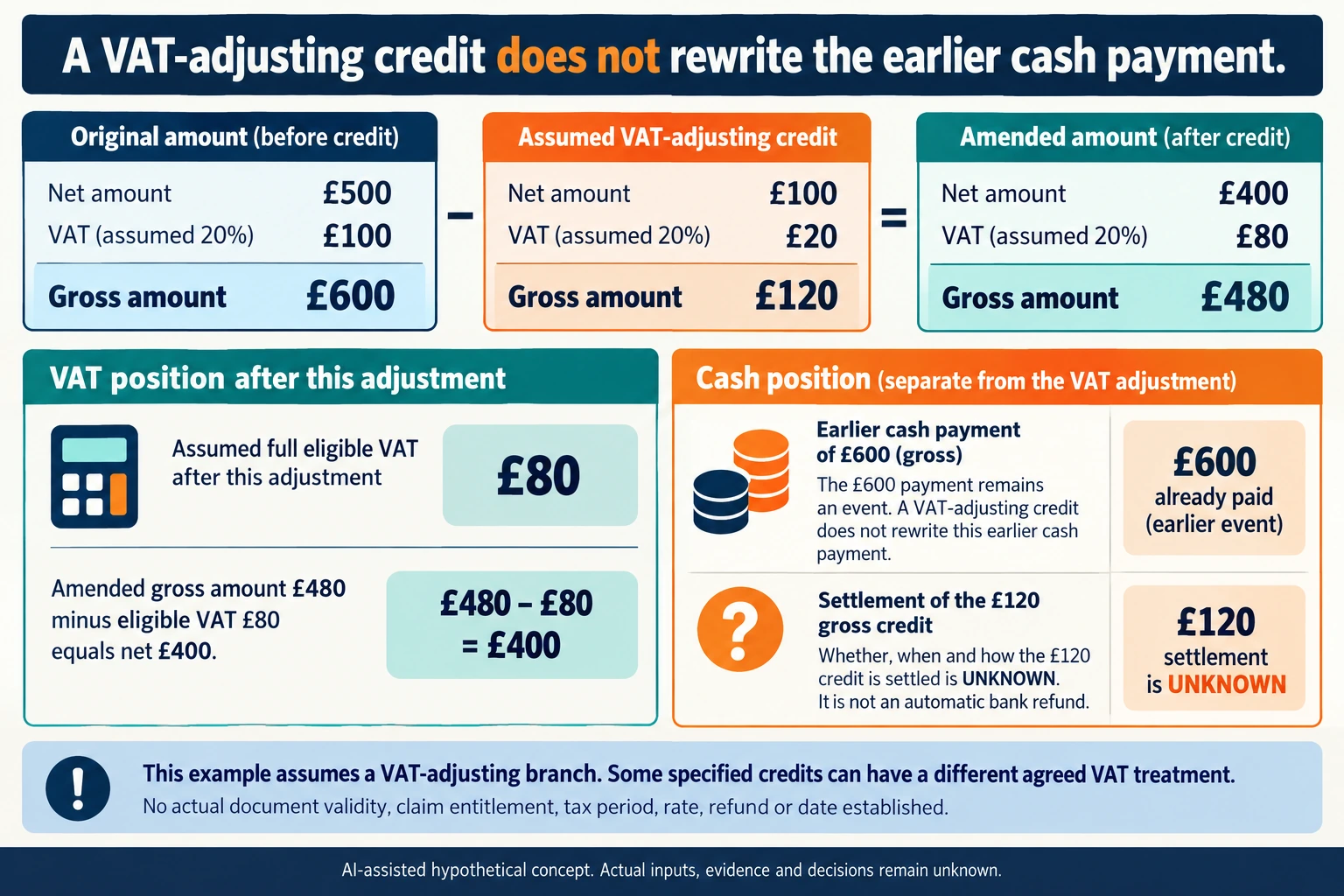
Retain the original GBP 500 net, GBP 100 VAT and GBP 600 paid invoice example. Add a clearly conditional amount record: assume the responsible review identifies a VAT-adjusting credit of GBP 100 net plus GBP 20 VAT, or GBP 120 gross. These are educational inputs, not an actual tax invoice, valid credit note or entitlement determination.
Scroll horizontally if columns extend beyond the view.
| Hypothetical scenario | Item or operation | Planning relationship | Assumed input or calculation |
|---|---|---|---|
| VAT_CREDIT35 | GROSS_CREDIT | calculated from | CREDIT_NET+CREDIT_VAT; 120 GBP |
| VAT_CREDIT35 | AMENDED_NET | calculated from | O_NET-CREDIT_NET; 400 GBP |
| VAT_CREDIT35 | AMENDED_VAT | calculated from | O_VAT-CREDIT_VAT; 80 GBP |
| VAT_CREDIT35 | AMENDED_GROSS | calculated from | O_GROSS-CREDIT_GROSS; 480 GBP |
| VAT_CREDIT35 | ASSUMED_FULL_ELIGIBLE_VAT_AFTER_ADJUSTMENT | calculated from | O_FULL_RECOVERY-CREDIT_VAT; 80 GBP |
| VAT_CREDIT35 | AMENDED_GROSS_LESS_ELIGIBLE_VAT | calculated from | AMENDED_GROSS-RECOVERY_AFTER; 400 GBP |
| VAT_CREDIT35 | IMPLIED_BY_FICTIONAL_AMOUNTS | calculated from | O_VAT/O_NET*100; 20 percent_not_actual_rate |
| VAT_CREDIT35 | IMPLIED_BY_FICTIONAL_AMOUNTS | calculated from | CREDIT_VAT/CREDIT_NET*100; 20 percent_not_actual_rate |
| VAT_CREDIT35 | IMPLIED_BY_FICTIONAL_AMOUNTS | calculated from | AMENDED_VAT/AMENDED_NET*100; 20 percent_not_actual_rate |
The amended amounts are GBP 400 net, GBP 80 VAT and GBP 480 gross. In this separately assumed full-recovery branch, eligible VAT after the adjustment is GBP 80 and amended gross less that amount is GBP 400. The 20% ratio implied by these invented amounts is not a finding of the rate applicable to actual packaging.
The earlier GBP 600 cash payment remains an event. A GBP 120 gross credit is not proof that GBP 120 reached the bank, nor does the amended GBP 480 rewrite the earlier payment. Keep actual settlement route, amount and date unknown until supported. This model specifies a VAT-adjusting route; HMRC describes other agreed treatment in specified full-recovery circumstances, so do not apply it to every commercial credit.
The short records guide quoted above states the normal documentation requirement. The fuller VAT Notice 700, sections 19.5.3–19.5.5, describes limited alternative-evidence cases: first request a valid invoice, then establish the relevant conditions and satisfactory evidence where it cannot be obtained. HMRC discretion is not guaranteed, and a quotation or pro-forma document alone does not close the review. Actual document validity, tax period, recoverability and settlement need qualified confirmation.
Download the packaging VAT credit note cash recovery adjustment record (.csv). It includes the original table fields and scenarios alongside the added relationships. HYPOTHETICAL rows are editorial examples or required review scopes, not actual records. Actual quantity, configuration, component and file identities, materials, process, specification, copy, method, condition, observation, owner, decision, evidence and dates are blank. ACTUAL_BLANK is a separate empty starting row; enter permitted project evidence before using an actual record. A blank means unknown.
Use the Packaging Set Quote Comparison: Components and Units for its separate question. Use the Packaging Sample Fee Credits and Production Payments for its separate question.
Additional official reference: HMRC VAT Notice 700: selected credit and evidence sections. The selected official sections inform the stated qualification and conditional VAT-adjusting scenario; they do not approve an actual claim or settlement.
Source scope checked 17 October 2026: Current HMRC VAT Notice 700 selected sections 18.2.1, 18.2.3, 18.2.6, 19.6.1, 19.8 and 19.5.1 / 19.5.3–19.5.5 were read for the stated bounded questions. The page was first published 17 December 2014 and last updated 25 June 2026; update history is not a new legal effective date. This is the explicitly VAT-adjusting hypothetical branch, not every credit, import/PVA calculation, actual claim, tax period or refund approval. The added configurations and calculations are hypothetical, with actual evidence and decisions pending.
What this changes in a packaging enquiry
Keep the supplier invoice's gross cash requirement separate from any VAT recovery confirmed for the actual buyer and transaction. Use that distinction when comparing the purchasing cash calendar. This UK domestic example does not determine the tax treatment of a China-to-destination order or supply tax advice.
Discuss this packaging specification with Packrivo. We coordinate independent suppliers. MOQ: 500 pieces per product/design; illustrative quantities are not production offers. Confirm materials, samples, price and timing for your project.