

Track consigned finished gifts separately from sales settlement and additional presentation materials used by the retailer. Delivering a gift to a store does not, under a consignment arrangement, mean the store has sold it. Rewrapping an existing gift also does not create another sale merely because it consumes a fresh box.
The actual agreement governs ownership, payment and treatment of unsold or damaged goods. This article supplies a quantity model for a hypothetical arrangement, not legal or accounting advice.

Confirm the arrangement before naming the stock
Shopify’s consignment inventory guide describes retailers holding goods that the supplier retains ownership of until sale under the arrangement. It recommends connecting receiving, sales, returns and remaining stock records, while acknowledging that actual accounting depends on jurisdiction and circumstances.
A wholesale purchase follows a different commercial route. Do not apply a consignment worksheet merely because gifts sit at an independent retailer. Identify the real contracting parties and their agreed definitions first.
Record the finished gift as the sold unit. List its presentation components separately where spare boxes, cards or sleeves can be consumed without an additional product sale.
Reconcile one hypothetical retailer balance
Assume a brand sends 100 finished gifts to a shop. During the agreed reporting period, thirty are sold, five are returned to the brand and two remain physically at the shop on hold. All events and quantities below are invented.
Scroll horizontally if columns extend beyond the view.
| Gift-stock event | Units |
|---|---|
| Finished gifts delivered | 100 |
| Recorded customer sales | 30 |
| Returned to the brand | 5 |
| Remaining at the retailer | 65 |
| Included in that remainder but held | 2 |
| Remaining available under the assumed decision | 63 |
The retailer still physically holds 65 gifts. Only 63 are available in the scenario. The thirty recorded sales are the quantity relevant to the agreement’s sale-based settlement, subject to its actual terms.
Now assume the shop uses four spare presentation cartons to replace damaged outer gift cartons on gifts already counted in the inventory. Those four material issues are not four more gift sales. If an affected gift remains on hold, replacing its carton does not automatically release it.
Give spare packaging its own reconciliation
Record spare materials delivered, applied, returned and remaining, with their exact compatible gift version. A box and sleeve can be physically present but unsuitable for a product variant at the store.
The permitted component-combination map provides a useful identity basis for those replacement pieces. Keep that reference linked to the retailer’s material stock rather than identifying a spare only by its color.
The parties also need an agreed answer for discarded packaging and withdrawn gifts. Do not infer a payment liability, reimbursement or permitted reuse from the physical count. Those decisions belong to the actual agreement and relevant advisers.
Request a reconciliation the parties can both follow
Return separate totals for sold gifts, physical retailer-held gifts, held units and spare materials consumed. Identify any unexplained difference and the period cutoff. Keep corrections tied to their source rather than silently changing the earlier sales report.
Packrivo can help coordinate the packaging versions and spare-material questions through a packaging project inquiry. It does not offer a consignment program or set retailer commissions through this example. The original Shopify guide, updated 19 July 2026, was checked on 14 October 2026.
Repeated reboxing consumes materials without adding gift sales
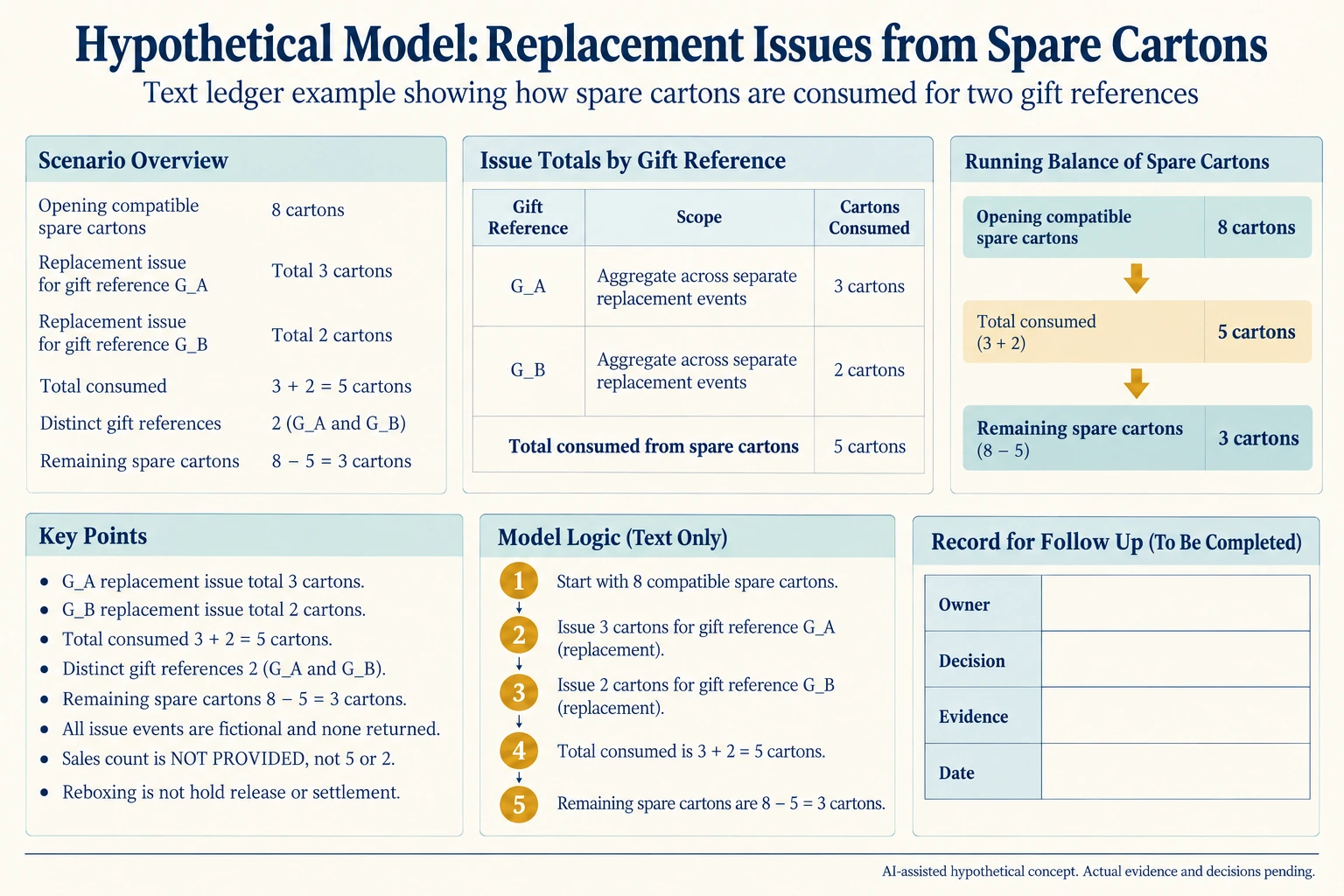
Use a new hypothetical spare-material ledger, separate from the original hundred-gift balance. Start with eight compatible spare cartons. Issue three cartons to gift reference G_A over separate replacement events, and two to G_B. Assume all five issued cartons are consumed and none is returned to spare stock.
Scroll horizontally if columns extend beyond the view.
| Hypothetical configuration | Named object | Relationship | Input or next scope |
|---|---|---|---|
| SPARE_LEDGER | COMPATIBLE_SPARE_CARTONS | assumed input | 8 cartons |
| SPARE_LEDGER | G_A_REPEATED_ISSUES | assumed input | 3 cartons |
| SPARE_LEDGER | G_B_REPEATED_ISSUES | assumed input | 2 cartons |
| SPARE_LEDGER | CARTONS_CONSUMED | calculated from | G_A_ISSUED+G_B_ISSUED; 5 cartons |
| SPARE_LEDGER | G_A_AND_G_B | assumed input | 2 gift references |
| SPARE_LEDGER | SPARE_CARTONS | calculated from | SPARE_OPEN-CONSUMED; 3 cartons |
| COUNTEREXAMPLE | UNDERCOUNTED_CONSUMPTION | calculated from | CONSUMED-NAIVE_COUNT; 3 cartons |
Five cartons were consumed, two distinct gift references were affected, and three spare cartons remain. Assuming only one carton per distinct gift would count two cartons and understate consumption by three. Conversely, counting five material issues as five gift sales would invent a sales event that this ledger does not contain.
The repeated issues raise a different buying question from a simple remaining-stock count: should the responsible team investigate why the same gift needed another carton before replenishing the same material? The count identifies repeated consumption, not its cause, liability or reimbursement.
Keep the compatible carton revision and issue-event history. A new carton does not release a held gift or create a settlement amount. Shopify’s commercial consignment guide explains an arrangement and recommends stock records; the actual agreement, accounting treatment and responsibility remain outside this invented ledger.
Download the consignment reboxing material issue count unique gifts record (.csv). It includes the original table fields and scenarios alongside the added relationships. HYPOTHETICAL rows are editorial examples or required review scopes, not actual records. Actual quantity, configuration, component and file identities, materials, process, specification, copy, method, condition, observation, owner, decision, evidence and dates are blank. ACTUAL_BLANK is a separate empty starting row; enter permitted project evidence before using an actual record. A blank means unknown.
Use the Keep Box Insert and Sleeve Variants Matched During Packing for its separate question. Use the Packaging Stock Reconciliation Before Reordering for its separate question.
Source scope checked 17 October 2026: Shopify consignment guide updated 19 July 2026 is commercial education, not an accounting standard or legal ownership ruling. This new spare-carton ledger establishes no actual sales, settlement, cause or liability. The added configurations and calculations are hypothetical, with actual evidence and decisions pending.
What this changes in a packaging enquiry
Convert the consignment balance into demand for additional boxes, cards or sleeves only where the retailer actually consumes those parts. Keep that material demand separate from finished-gift sales and settlement. Confirm the replacement component version and actual ownership terms before deciding who orders it.
Discuss this packaging specification with Packrivo. We coordinate independent suppliers. MOQ: 500 pieces per product/design; illustrative quantities are not production offers. Confirm materials, samples, price and timing for your project.