

When a product is discontinued, calculate its final packaging requirement from the remaining goods and actual permitted sales. Separate that requirement from dedicated surplus and components that may have another approved use. A past reorder quantity or general instruction to “use the leftovers” cannot resolve the stock exit.
Confirm what discontinuation means for the actual product. Remaining orders, a final authorized selling period and a complete withdrawal can create different requirements. The business owner must establish that scope before the packaging count is fixed.

Stop new commitments only under the actual order terms
Identify outstanding packaging orders and which lines are still needed. A decision to stop selling the product does not automatically cancel a supplier commitment. Record requested amendments and the actual agreed response separately.
Review the remaining product and packaging identities together. Product-specific wording or a shaped insert may prevent a component from serving another item even where its condition appears good.
The leftover packaging register provides condition and version status. This stock-exit model adds finite remaining product demand and the quantities left when that demand ends.
Calculate a hypothetical terminal requirement
Assume a fictional brand has sixty remaining products authorized for final sale, 140 dedicated boxes and 100 common cards. For arithmetic, each completed gift uses one box and one card. No real stock or permitted use supports the scenario.
Scroll horizontally if columns extend beyond the view.
| Stock line | Opening units | Final gift requirement | Units remaining afterward |
|---|---|---|---|
| Product | 60 | 60 | 0 |
| Dedicated box | 140 | 60 | 80 |
| Common card | 100 | 60 | 40 |
The eighty boxes have no remaining demand from this discontinued product in the example. The forty cards may have another use only if their actual content, configuration and condition permit it. Labeling them “common” is a planning assumption, not approval.
If only fifty of the sixty products remain eligible, revise the terminal requirement before allocating material. A known physical product count and the quantity permitted for sale need not be identical.
Compare exit routes without inventing a recoverable value
The owner can assess an actually permitted final use, authorized reassignment, supplier return proposal or another supported disposition. Keep unavailable or unconfirmed routes out of the comparison.
Do not relabel product-specific boxes automatically, assume a refund or call remaining packaging a tax write-off. The relevant commercial agreement, content requirements and advisers determine those consequences.
Official cash-flow guidance concerns cash movements and clearly identified estimates. It does not establish the stock’s accounting value or a recoverable sale price. Any illustrative cash scenario should state actual costs and confirmed proceeds separately.
Give each remaining line a next decision
Return the final product requirement, dedicated surplus, potentially eligible shared components and outstanding supplier commitments. Name who authorizes reassignment or other disposition, with unresolved facts kept visible.
The initial quantity-planning method deals with launch designs and surplus before purchase. A discontinued product has a different endpoint: its future demand has ended rather than remained a forecast supporting another reorder.
Packrivo can organize the component and supplier questions through a packaging project inquiry. Public business guidance was checked on 14 October 2026. This hypothetical example reports no actual discontinuation, refund, legal resale assessment or disposal outcome.
Retain the contingent final requirement before exiting stock
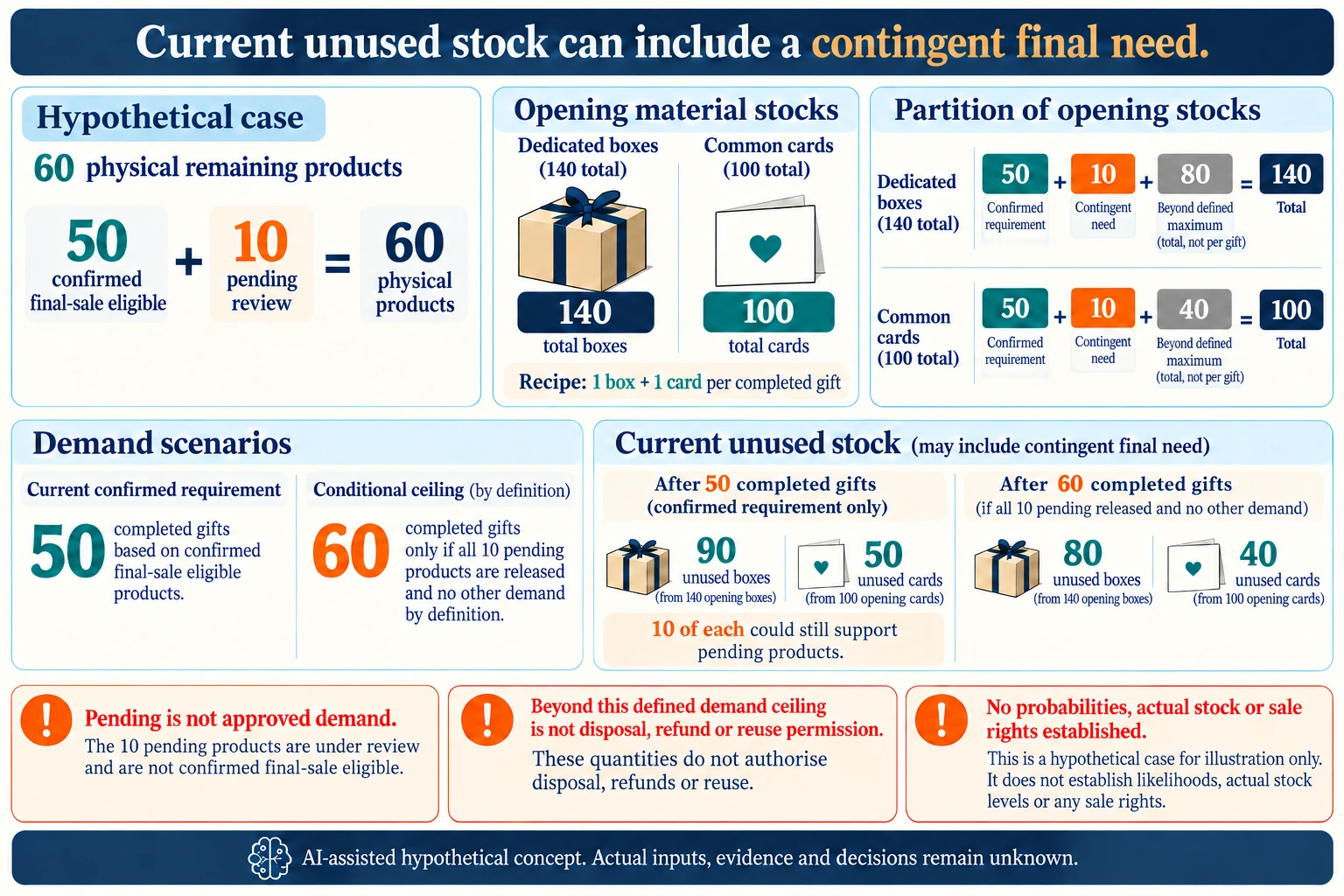
Keep the original fully eligible sixty-product example. For a separate planning case, divide sixty physically remaining products into fifty confirmed eligible for final sale and ten awaiting review. Retain 140 dedicated boxes and 100 common cards, with one of each required per completed gift. Assume no additional demand from this product after these sixty; no real sale permission or stock record supports the example.
Scroll horizontally if columns extend beyond the view.
| Hypothetical scenario | Item or operation | Planning relationship | Assumed input or calculation |
|---|---|---|---|
| EXIT35 | PHYSICAL_PRODUCTS | calculated from | CONFIRMED+PENDING; 60 products |
| EXIT35 | CONFIRMED_GIFT_REQUIREMENT | calculated from | CONFIRMED*O_GIFT_PER_PRODUCT; 50 gifts |
| EXIT35 | CONTINGENT_GIFT_REQUIREMENT | calculated from | PENDING*O_GIFT_PER_PRODUCT; 10 gifts |
| EXIT35 | CONDITIONAL_FINAL_DEMAND_CEILING | calculated from | CONFIRMED_GIFTS+CONTINGENT_GIFTS; 60 gifts |
| EXIT35 | CURRENT_UNUSED_BOXES | calculated from | O_BOXES-CONFIRMED_GIFTS*O_BOX_PER_GIFT; 90 boxes |
| EXIT35 | CURRENT_UNUSED_CARDS | calculated from | O_CARDS-CONFIRMED_GIFTS*O_CARD_PER_GIFT; 50 cards |
| EXIT35 | BOXES_BEYOND_DEFINED_MAXIMUM | calculated from | O_BOXES-CEILING*O_BOX_PER_GIFT; 80 boxes |
| EXIT35 | CARDS_BEYOND_DEFINED_MAXIMUM | calculated from | O_CARDS-CEILING*O_CARD_PER_GIFT; 40 cards |
| EXIT35 | BOXES_CONTINGENT_ON_PENDING | calculated from | (CEILING-CONFIRMED_GIFTS)*O_BOX_PER_GIFT; 10 boxes |
| EXIT35 | CARDS_CONTINGENT_ON_PENDING | calculated from | (CEILING-CONFIRMED_GIFTS)*O_CARD_PER_GIFT; 10 cards |
| EXIT35 | OPENING_BOXES_RECONCILED | calculated from | CONFIRMED_GIFTS*O_BOX_PER_GIFT+BOX_CONTINGENT+BOX_BEYOND_MAX; 140 boxes |
| EXIT35 | OPENING_CARDS_RECONCILED | calculated from | CONFIRMED_GIFTS*O_CARD_PER_GIFT+CARD_CONTINGENT+CARD_BEYOND_MAX; 100 cards |
Fifty confirmed gifts require fifty boxes and fifty cards. That leaves ninety boxes and fifty cards currently unused. If all ten pending products are later released, the defined terminal requirement rises to sixty, leaving eighty boxes and forty cards. Ten of each currently unused component therefore remains contingent on the pending-product decision.
The box partition is fifty confirmed requirements, ten contingent requirements and eighty beyond the defined maximum, totalling 140. The card partition is fifty, ten and forty, totalling 100. Pending products are not confirmed demand, but the current fifty-gift instruction is also not proof that every unused component has no possible terminal requirement.
Give the owner both the confirmed requirement and the conditional ceiling before an irreversible exit decision. Quantities beyond that ceiling still have no automatic disposal, refund, reassignment or accounting treatment. The leftover-version register concerns a component’s suitability; this case bounds demand from products whose final-sale eligibility is not fully resolved.
Download the discontinued product packaging contingent final demand record (.csv). It includes the original table fields and scenarios alongside the added relationships. HYPOTHETICAL rows are editorial examples or required review scopes, not actual records. Actual quantity, configuration, component and file identities, materials, process, specification, copy, method, condition, observation, owner, decision, evidence and dates are blank. ACTUAL_BLANK is a separate empty starting row; enter permitted project evidence before using an actual record. A blank means unknown.
Use the Leftover Packaging: Check Versions Before Reordering for its separate question. Use the Packaging Project Stop Costs by Commitment Stage for its separate question.
Source scope checked 17 October 2026: General inventory and cash-flow guidance does not approve final-sale eligibility, supplier cancellation, refunds, disposal, reassignment or stock valuation. The finite demand ceiling is a defined hypothetical scope. The added configurations and calculations are hypothetical, with actual evidence and decisions pending.
What this changes in a packaging enquiry
Calculate the final packaging requirement before committing to another supplier lot for a discontinued product. Separate unavoidable committed quantities, eligible leftover components and any replacement-service need. The stock-exit example does not establish a right to cancel an order or reuse branded packaging for another product.
Discuss this packaging specification with Packrivo. We coordinate independent suppliers. MOQ: 500 pieces per product/design; illustrative quantities are not production offers. Confirm materials, samples, price and timing for your project.