

Allocate demand across old and new packaging versions before setting a changeover date. Identify which orders each version is actually permitted to serve and keep their component combinations separate. New stock arriving does not automatically make old stock unusable, while physical old stock does not automatically remain eligible.
In this guide
- Define version eligibility before allocating demand
- Follow a hypothetical two-period changeover
- Connect the switch condition to the packing bench
- Review changes within the coexistence window
- Keep a changed eligibility case separate from the original bridge
- Bring the specific open question to the project brief
The coexistence plan begins with accepted use decisions. It calculates how those eligible quantities can be consumed over the transition, not whether an earlier artwork or configuration may still be supplied.

Define version eligibility before allocating demand
List each complete packaging version and its permitted products, channels and companion components. A shared box exterior can conceal a changed insert or care card. Keep the exact combination in the planning record.
The component-variant matching method establishes the permitted combination and packing identification. A demand allocation should point to those references rather than describe two groups only as “old” and “new.”
Record held or unreviewed stock separately. A gradual transition cannot authorize a configuration whose use remains unresolved.
Follow a hypothetical two-period changeover
Assume 120 old-version packs remain approved only for Channel A. Two hundred new-version packs are approved for Channels A and B. The demand and approvals below are invented.
Scroll horizontally if columns extend beyond the view.
| Period and allocation | Old packs used | New packs used | Old stock remaining | New stock remaining |
|---|---|---|---|---|
| Opening eligible stock | 0 | 0 | 120 | 200 |
| Period 1: A needs 100, B needs 80 | 100 for A | 80 for B | 20 | 120 |
| Period 2: A needs 60, B needs 60 | 20 for A | 40 for A plus 60 for B | 0 | 20 |
The first period preserves new stock for the channel the old version cannot serve. The second consumes the twenty eligible old packs before the defined switch. The example ends with twenty new packs, not forty or an assumed old-stock write-off.
Another approved allocation could be chosen for commercial or operational reasons. The table demonstrates eligibility constraints and stock conservation, not a universal instruction to use every older version first.
Connect the switch condition to the packing bench
State when each permitted configuration is used. A condition such as “old version for eligible A orders until its identified stock reaches zero” is different from an unconditional calendar switch.
Account for unfinished packs during a physical changeover. Keep version-specific parts distinguishable, remove superseded instructions and identify which common components may remain. Those operations should follow the actual packing process.
The leftover version and condition register supplies the earlier disposition basis. Its keep or hold status must remain connected to the transition, even where the quantity plan would be more convenient without it.
Review changes within the coexistence window
A new product, channel requirement or component substitution can change eligibility before the old stock is exhausted. Update only the affected allocation and configuration questions while retaining valid decisions for unchanged rows.
Official inventory guidance supports maintaining current quantity, location and stock-type records. The two-period model is original hypothetical arithmetic. It does not establish that any real older packaging remains commercially or legally suitable.
Bring the accepted version references, eligible demand and proposed switch condition to a packaging project inquiry. Packrivo can coordinate supplier questions; actual use approval and operating release remain with their responsible owners. Public guidance was checked on 14 October 2026.
Keep a changed eligibility case separate from the original bridge
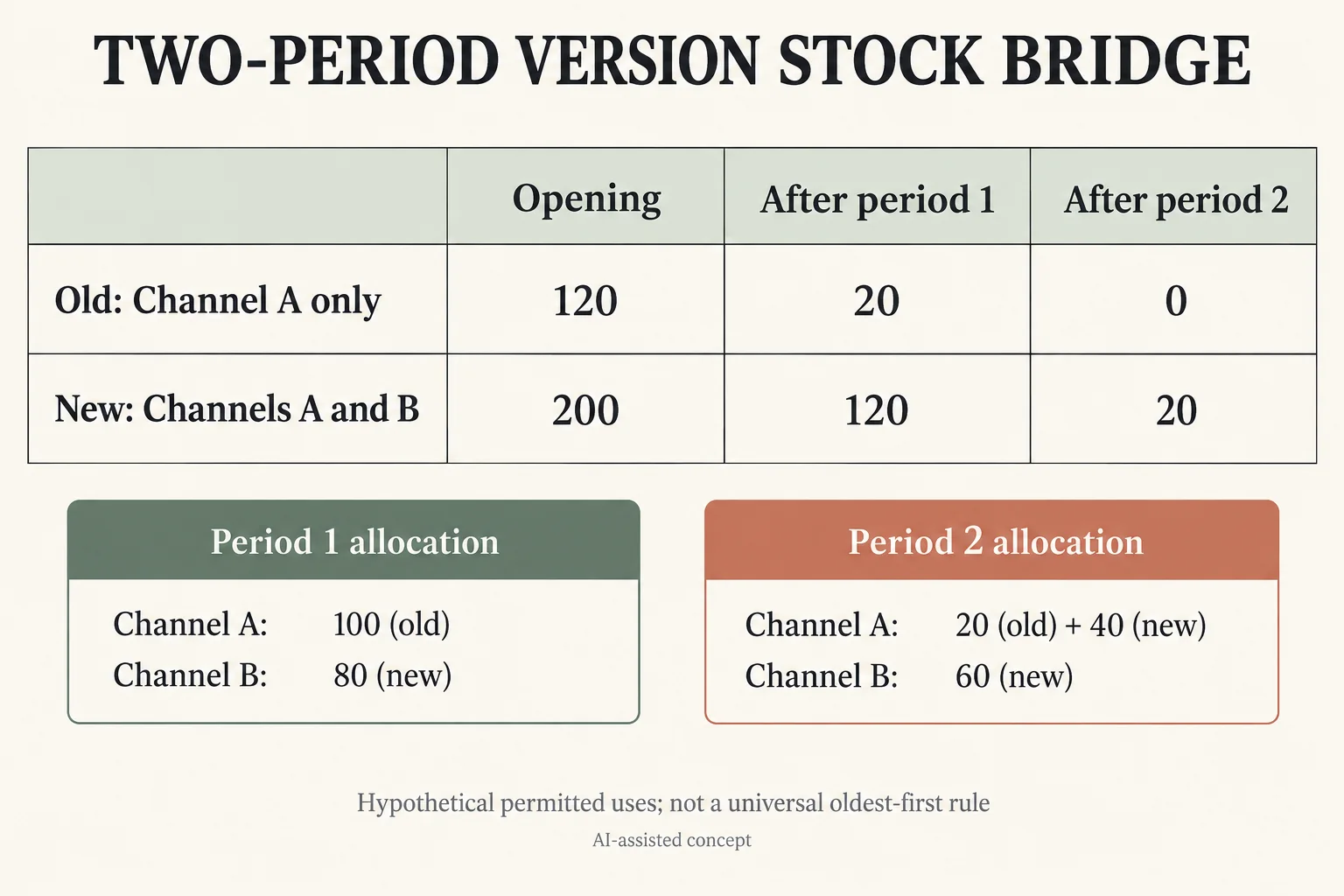
The original two-period table assumes all twenty old packs remaining after period one are still approved for Channel A. If that assumption changes, preserve the original scenario and calculate a separate branch. Physical stock and eligible stock need not be the same count.
For a separate invented case, suppose ten of those twenty old packs become held before period two. They remain physically present, but only ten old packs can serve A in that scenario. Period-two demand remains sixty for A and sixty for B.
Scroll horizontally if columns extend beyond the view.
| Separate changed scenario | Old used | New used | Physical old balance | New balance |
|---|---|---|---|---|
| Period two with ten old held | 10 for A | 50 for A plus 60 for B | 10 held; not eligible under this branch | 10 |
The arithmetic is 120 new packs at the end of period one minus 110 used in this changed branch, leaving ten new. It does not alter the original example’s twenty-new-pack ending. The ten held old pieces are a separate physical balance, not silently discarded or reassigned.
Return both the current eligibility decision and the selected allocation to the bench. Identify which instructions apply and what happens to unfinished work when the version changes. A calendar date by itself does not identify the approved companion insert or card.
The permitted component matching map defines the combinations. This stock bridge allocates only eligible combinations across periods; it does not grant continued use of superseded or held stock.
Download the packaging changeover plan record (.csv). This file contains field definitions, clearly fictional teaching entries and a blank actual-project row. Keep unknown evidence open rather than copying the example as an approval.
Bring the specific open question to the project brief
For a two-version changeover, send channel acceptance for each revision, period demand, physical balances and held quantities; ask which eligibility change needs a revised allocation. Send the current configuration, actual records available, quantity by design, destination and the unresolved question through Packrivo’s packaging inquiry. Packrivo coordinates sourcing and project questions with independent suppliers; the responsible parties confirm materials, service, methods and commercial terms.
What this changes in a packaging enquiry
Give the supplier separate old-version and new-version quantities and the date each is needed, based on their actual product and channel eligibility. Identify shared components explicitly. A planned changeover date does not make old boxes suitable for the revised product or release unused new artwork.