
A packaging quantity discount should be evaluated against the purchase lots needed to satisfy plausible demand. Compare total committed cash and remaining units at each demand level. Dividing the larger purchase by its headline quantity can hide the cost of buying boxes you won’t use during the planning period.
Keep the design and purchasing rules fixed
Use the same component, approved configuration and supplied state for both offers. Differences in inserts, print or delivery are separate decisions. Record the actual minimum purchase, price break and any recurring setup or freight charge.
The quantity-by-design worksheet establishes what the launch needs. This comparison begins with that demand and asks which offered lot covers it sensibly. A forecast is an input, so retain a lower-demand case rather than treating every purchased box as a future sale.
A lower unit price can require more cash
Assume, solely for this exercise, that identical suitable boxes can be bought in lots of 500 at $1.20 each or 1,000 at $0.85 each. Repeat purchases retain those invented prices. Setup, freight and holding costs are omitted from both routes.
Scroll horizontally if columns extend beyond the view.
| Period demand | 500-unit lot route | 1,000-unit lot route |
|---|---|---|
| 400 uses | Buy 500; spend $600; 100 remain | Buy 1,000; spend $850; 600 remain |
| 500 uses | Buy 500; spend $600; 0 remain | Buy 1,000; spend $850; 500 remain |
| 800 uses | Buy two lots; spend $1,200; 200 remain | Buy one lot; spend $850; 200 remain |
At 400 uses, cash committed per used box is $1.50 for the smaller lot and $2.125 for the larger lot. At 800 uses, the larger lot requires $350 less purchase cash under these assumptions.
The model changes in steps. Once demand exceeds 500, the smaller-lot route needs another permitted lot. It would be misleading to price 800 uses as 800 multiplied by $1.20 if the offer only allows complete 500-unit purchases.
Test the leftovers before assigning them value
Remaining units may be useful later, but their future use needs a compatible product and current artwork. A dated message or a planned product change can narrow that horizon. Storage and replenishment work may also change the difference between offers.
Show residual stock by version and quantity. If you add a salvage or later-use value, identify its basis and give a second scenario without it. Don’t make a discount look profitable by assuming every surplus unit will eventually be consumed.
Demand probabilities require evidence. A new brand can compare named low, central and high cases without pretending they form a statistical forecast. An actual order history can improve those scenarios later.
Find the purchase boundary
List the quantities at which another permitted lot becomes necessary, then calculate cash for each route around those boundaries. Add actual recurring charges and storage constraints before deciding. The result is a demand range where each offer is preferable under stated assumptions, rather than a universal instruction to buy more.
Sources and scope
Australian Government supports the stated general concepts within this scope: General inventory categories, reorder points and stocktake. Access checked 14 October 2026.
Australian Government supports the stated general concepts within this scope: Cash inflows/outflows and clear labeling of estimated figures. Access checked 14 October 2026.
The worked scenario is original editorial analysis with assumed inputs, not a supplier offer, customer record or measured Packrivo result. Commercial feasibility and physical suitability remain project-specific.
Check the first unit beyond the purchase boundary
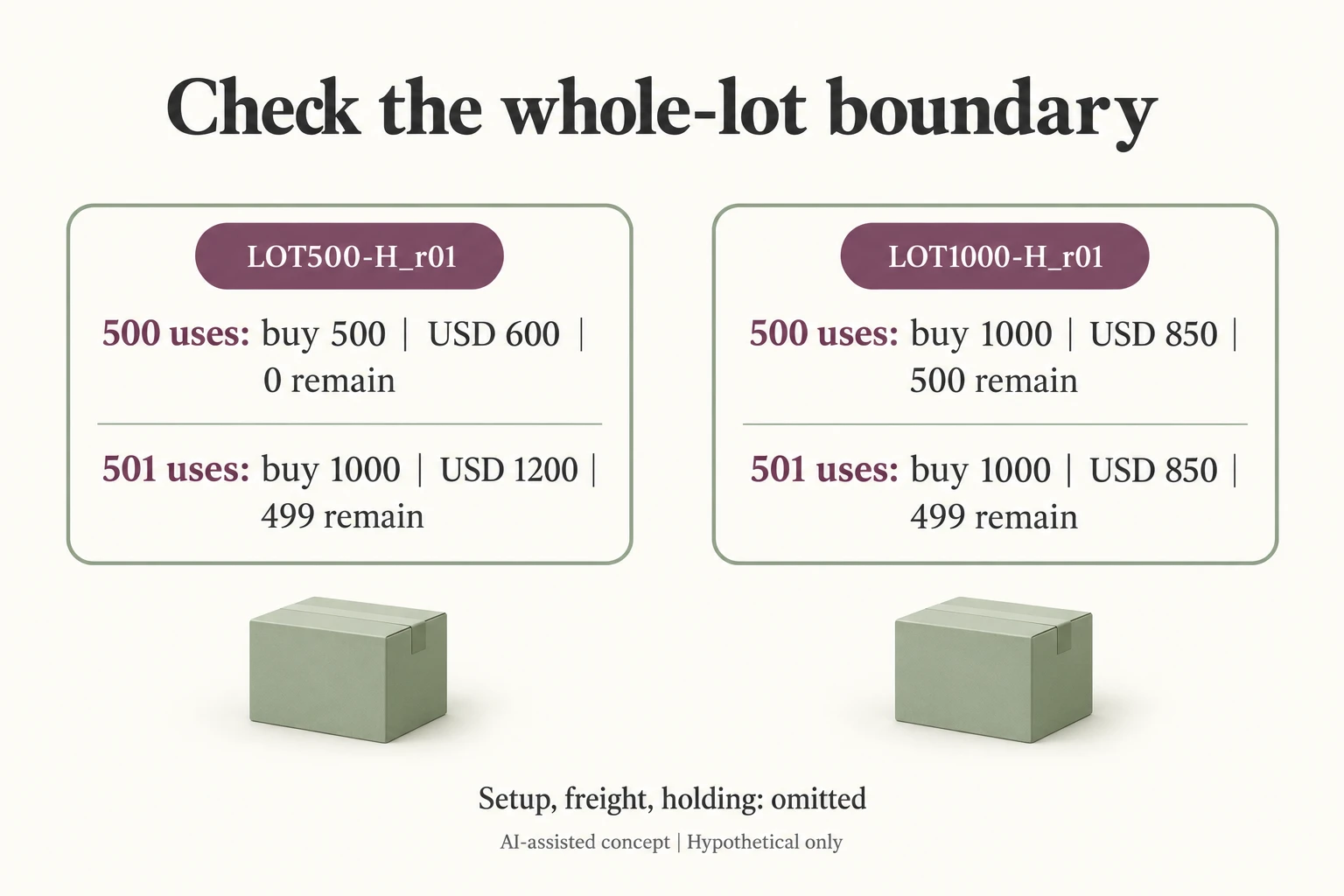
The original fictional lot rules stay unchanged: repeatable 500-unit lots at $1.20 and 1,000-unit lots at $0.85, with setup, freight and holding omitted. This additional boundary check compares 500 and 501 uses without assigning demand probabilities.
Scroll horizontally if columns extend beyond the view.
| Uses | LOT500-H_r01 | LOT1000-H_r01 |
|---|---|---|
| 500 | 1 lot; 500 bought; $600; 0 remain | 1 lot; 1,000 bought; $850; 500 remain |
| 501 | 2 lots; 1,000 bought; $1,200; 499 remain | 1 lot; 1,000 bought; $850; 499 remain |
| Change at boundary | One extra use triggers another full lot | No new lot under the stated rule |
The required lot count is the smallest whole number of permitted lots covering the assumed uses. For 501 uses, the 500-lot route therefore purchases 1,000, not 501. Its $1,200 minus the other route’s $850 is $350 under these exact omissions.
LOT500-H_r01 and LOT1000-H_r01 name new hypothetical offer-rule records; they are not actual supplier terms. If a real offer changes repeat pricing, setup or permitted top-up quantity, revise the rule record before recalculating the boundary.
At 501 uses both routes leave 499 units, but equal leftovers do not establish equal freight, storage effort or future usability. Those remain unpriced and no resale or eventual-use value is assigned. The boundary locates a cash step rather than proving a universal purchasing recommendation.
Download the packaging quantity discount costs record (.csv). HYPOTHETICAL rows are invented examples. Use ACTUAL_BLANK for permitted project inputs; replace that row label only when recording actual facts. Empty evidence, observation and date fields mean unknown or not performed, never acceptance. Keep checkpoints and revisions separate.
Bring the exact permitted lot rules and near-boundary demand cases through the packaging enquiry before ranking a unit-price discount. Packrivo coordinates independent suppliers. These records establish no supplier offer, service availability or MOQ exception; its published baseline is 500 pieces per product/design.