

A packaging redesign can recover its change cost only through enough future use of the revised arrangement. Compare the remaining use horizon with one-time design, sample and tooling costs, then include any stock made unusable by the change. Use measured marginal savings rather than a visual impression of simpler assembly.
Use Packaging Improvements Need a Like-for-Like Operating Baseline to define the old and proposed operating work behind a redesign saving. Apply the remaining-use horizon only after identifying that like-for-like difference; an assumed saving is not a measured improvement.

Name the operation the redesign changes
Identify whether the proposal removes a separate component, changes forming work or alters another actual task. Keep fit, presentation and delivery requirements fixed where they are meant to stay the same.
A shorter local trial can support a planning assumption only within its stated setup. It does not guarantee the same production result across other operators or volumes. Retain the complete operation and any added work when calculating a per-pack difference.
The tooling-scope method helps identify which tools the change affects. A revised dimension may need a new cut tool while leaving another decorating tool unchanged. Don’t charge every old tool again or assume every one can be reused.
Calculate the use needed to recover the change
Consider invented USD inputs: $600 total change cost and $0.20 less recurring cost per completed pack. No actual measured saving or supplier price is asserted.
Scroll horizontally if columns extend beyond the view.
| Remaining future uses | Modeled recurring reduction | Change cost | Amount still unrecovered |
|---|---|---|---|
| 1,800 | $360 | $600 | $240 |
| 3,000 | $600 | $600 | $0 |
| 4,000 | $800 | $600 | Change cost recovered; $200 modeled difference |
The break-even quantity is $600 divided by $0.20, or 3,000 uses. At a remaining horizon of 1,800, the recurring reduction cannot recover the change cost in this model.
If the redesign also makes an assumed $200 of existing stock unusable, the modeled exposure becomes $800. Its crossing moves to 4,000 uses. That stock value needs an actual basis; it isn’t automatically the full earlier purchase amount.
Keep uncertainty beside the result
A recurring reduction of $0.10 rather than $0.20 doubles the 600-dollar crossing to 6,000 uses. This simple sensitivity check can matter more than adding a long decimal to the central estimate.
Some redesigns change quality, protection or brand presentation. Those effects need their own evidence and decision; this cash model does not assign invented values to them. A cheaper operation with an unresolved fit problem is still unresolved packaging.
The model also omits discounting, financing, tax and accounting treatment. It compares stated cash-related costs and use counts for a defined period, rather than promising a financial return.
Make the finite horizon part of the brief
Record the expected remaining design life, the operation being changed and the trial needed to substantiate its difference. Request actual change costs against that configuration. The next decision should state whether the supported future use can recover the modeled cost, and what happens if the horizon or saving is smaller.
Sources and scope
Australian Government supports the stated general concepts within this scope: General inventory categories, reorder points and stocktake. Access checked 14 October 2026.
Australian Government supports the stated general concepts within this scope: Cash inflows/outflows and clear labeling of estimated figures. Access checked 14 October 2026.
The worked scenario is original editorial analysis with assumed inputs, not a supplier offer, customer record or measured Packrivo result. Commercial feasibility and physical suitability remain project-specific.
Separate stock exposure from the redesign charge
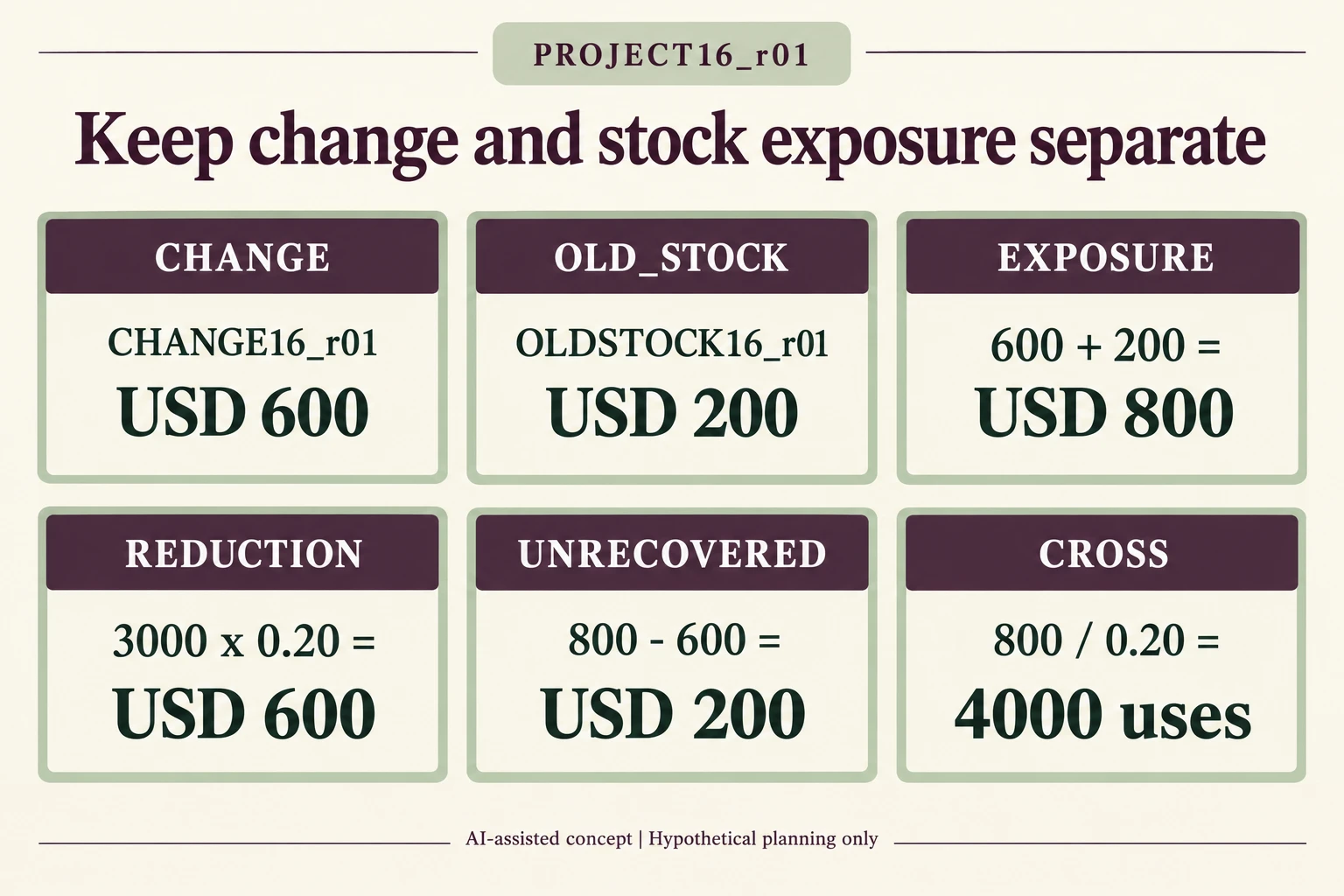
This register follows only the original $800 combined-exposure scenario: an invented $600 change charge plus $200 of stock made unusable. A hypothetical 3,000 remaining uses at $0.20 recurring reduction is the selected horizon.
Scroll horizontally if columns extend beyond the view.
| Scope ID | Exact entity | Stage / role | Hypothetical basis |
|---|---|---|---|
| CHANGE | CHANGE16_r01 | INPUT | Assumed one-time change cost |
| OLD_STOCK | OLDSTOCK16_r01 | INPUT | Assumed unusable-stock exposure; not automatic accounting write-off |
| EXPOSURE | PROJECT16_r01 | CALCULATION | 600 + 200 |
| REDUCTION | PROJECT16_r01 | FINITE_HORIZON | 3000 x 0.20 |
| UNRECOVERED | PROJECT16_r01 | FINITE_HORIZON | 800 – 600 |
| CROSS | PROJECT16_r01 | CALCULATION | 800 / 0.20 |
CHANGE and OLD_STOCK are different inputs, not two names for the same charge. EXPOSURE sums them once to $800. REDUCTION gives $600, leaving UNRECOVERED at $200 for this horizon. CROSS is $800/$0.20=4,000 uses; it is a model boundary rather than a forecast.
All USD inputs are assumptions, with no actual savings, stock valuation or supplier charge confirmed. The named stock exposure needs its own basis before the model is used commercially. Actual values, decisions, evidence and dates remain empty; fit and protection acceptance are not supplied by this cost calculation.
Download the packaging redesign cost record (.csv). HYPOTHETICAL rows are invented examples. Use ACTUAL_BLANK for permitted project inputs; replace that row label only when recording actual facts. Empty evidence, observation and date fields mean unknown or not performed, never acceptance. Keep checkpoints and revisions separate.
Use the named scope rows and unresolved evidence to prepare a project enquiry. Replace planning assumptions with actual authorised records before a commercial or use decision. Packrivo coordinates independent suppliers. These records establish no supplier offer, service availability or MOQ exception; its published baseline is 500 pieces per product/design.