
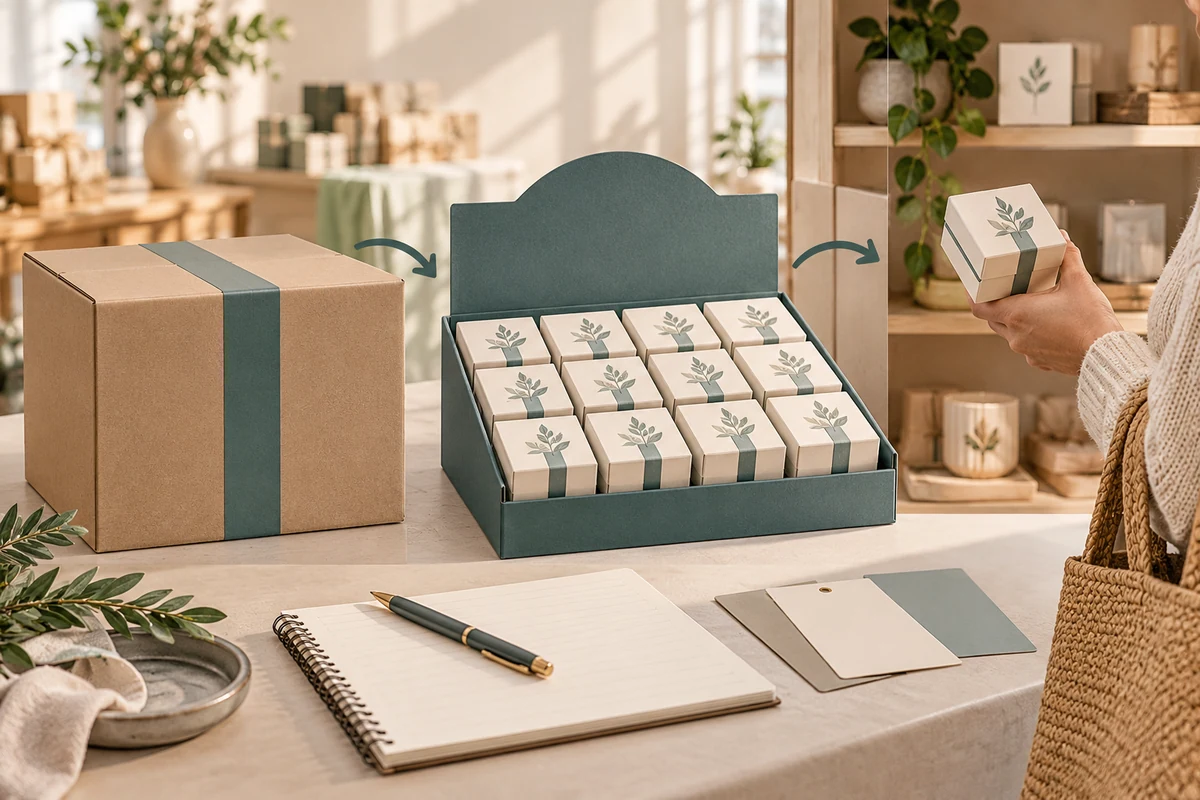
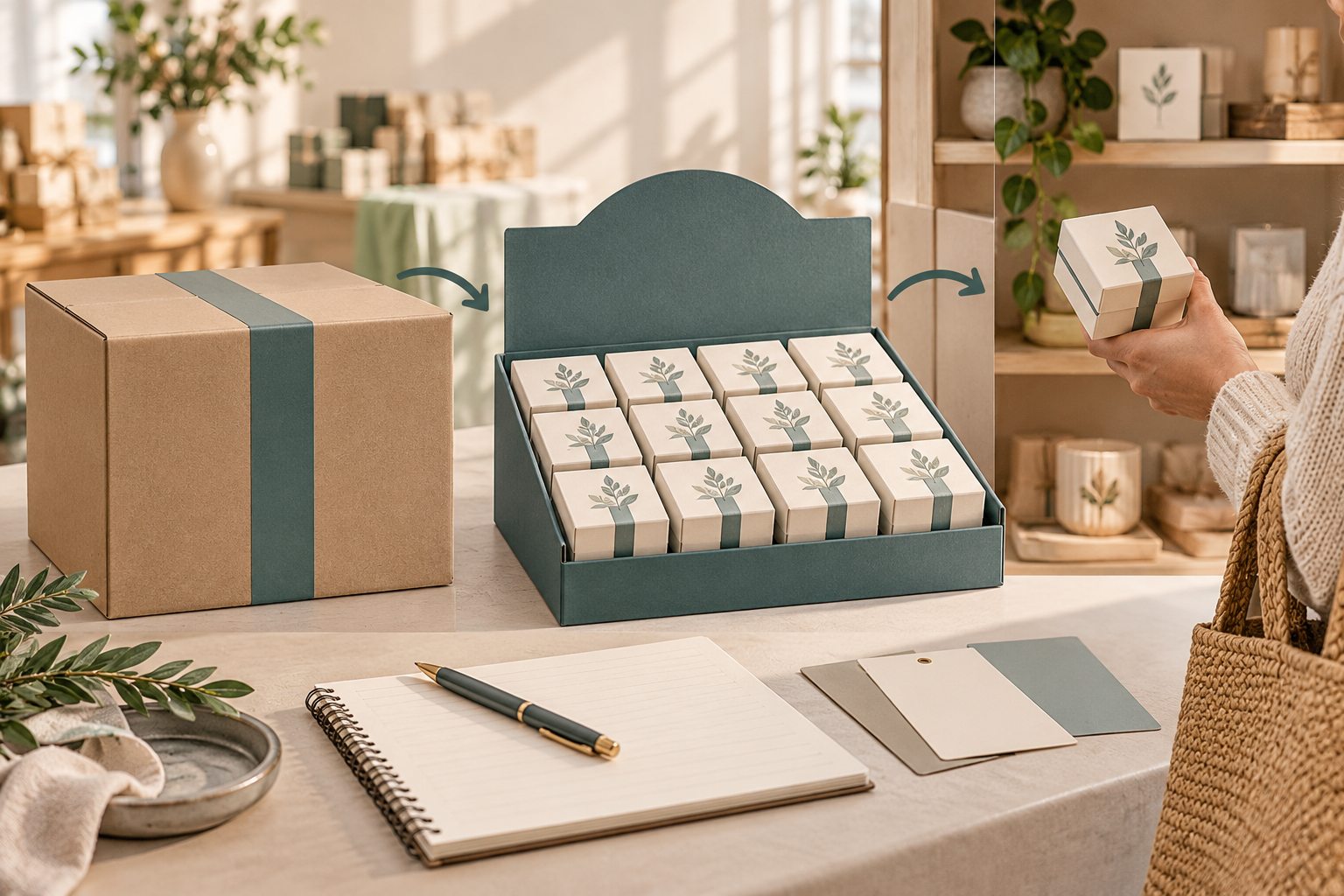
A shelf-ready case is worth comparing when it can replace a defined store operation, such as transferring individually packed gifts into a display. Evaluate the complete transport-to-shelf sequence and its cost. A faster-looking opening feature alone does not establish that the store or brand gains a benefit.
The retailer must first accept the proposed shelf arrangement. A case that opens neatly can still occupy the wrong footprint, hide product information or leave stock difficult to replenish. Keep those requirements separate from the labor calculation.
Make the two routes end at the same shelf state
Use the same number of sale-ready units and the same required final presentation. A conventional route might involve opening an outer carton, removing protective materials and transferring twelve retail packs into a separate fixture. A convertible route might leave those twelve packs in a case that becomes their display.
List what staff actually remove, reposition and discard. Include the preparation required before dispatch too. If a special case requires another loading action at the brand’s packing location, the store’s shorter task has not made that upstream work disappear.
Smurfit Westrock’s retail-ready packaging page describes transport and display functions combined in its own products. That establishes an example of the category, not the performance, availability or cost of a proposed Packrivo configuration.
A shorter store task can still cost more
The following comparison uses invented inputs for one twelve-unit case. Both routes are assumed to reach the same accepted retail display state. No work study or protective evaluation has been performed.
Scroll horizontally if columns extend beyond the view.
| Comparison item | Ordinary case | Convertible case |
|---|---|---|
| Store work per case | 90 seconds | 30 seconds |
| Assumed labor valuation | $18 per hour | $18 per hour |
| Calculated store labor | $0.45 | $0.15 |
| Additional case purchase cost | Baseline | $0.45 above baseline |
Sixty seconds less store work corresponds to $0.30 at the assumed labor value. The additional case cost is $0.45, so this limited model leaves the convertible route $0.15 higher per case. Other agreed costs could change the comparison.
The labor value is an illustrative valuation. It does not show that the retailer’s payroll falls by $0.30, that another employee becomes unnecessary or that sales improve. Also establish who pays for the case and who receives any operational benefit.
Check the structural transition before buying it
Record the closed transport state, the opening action and the final display state. Identify which panels stay, whether a tear creates an exposed edge and what still retains the retail units. The display must support the retailer’s intended customer access and refill task.
Use the partly stocked refill method to assess replenishment after the case has become a display. An opening demonstration on a full new case cannot answer that later operation.
Ask the supplier and retailer to review the same complete proposal. An appealing concept cannot establish transit protection or shelf suitability. Material, closure and distribution evidence must match the configuration actually being purchased.
Keep or separate the two functions
The decision can favor an ordinary shipping case and reusable store fixture when the display lasts through several deliveries. It can favor a convertible case when the agreed operation and overall costs support that arrangement. Neither result follows automatically from the words “shelf-ready.”
Bring the paired operation sequences, actual retailer requirements and missing cost lines to a packaging project inquiry. Packrivo coordinates sourcing questions; this hypothetical calculation is not a quotation or measured saving. Public manufacturer information was checked on 14 October 2026.
Add upstream work to the shelf-ready case comparison
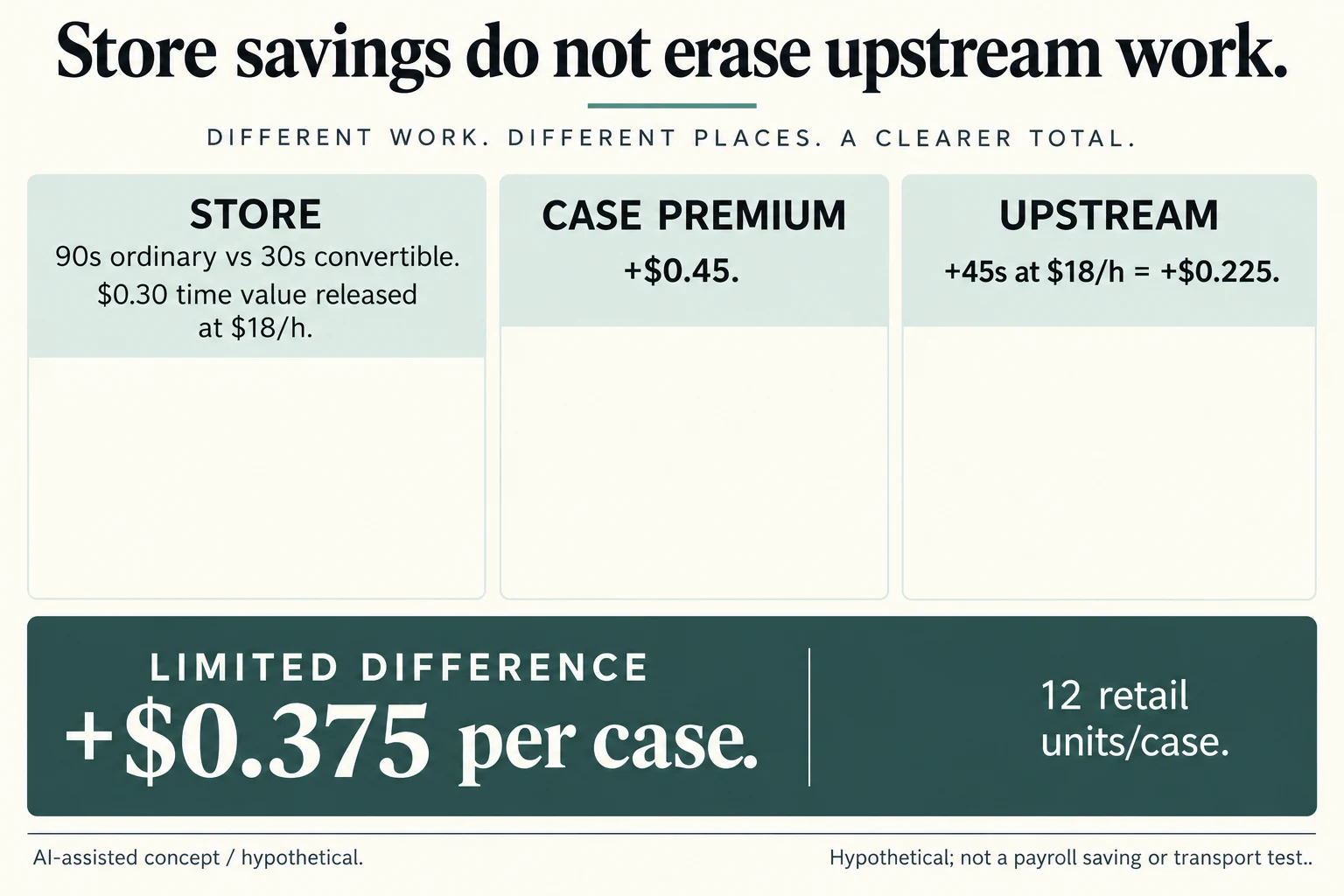
Assume a new hypothetical convertible-case proposal adds forty-five seconds of loading work before dispatch. Apply the same invented $18/hour value while keeping the original ninety-versus-thirty-second store comparison and $0.45 case premium.
Scroll horizontally if columns extend beyond the view.
| Scenario scope | Exact object or route | Hypothetical input or output | Calculation or record boundary |
|---|---|---|---|
| Additional brand work | CONVERTIBLE | 45 seconds per case | New hypothetical extra 45 seconds loading work not in original store time |
| Upstream time value | CONVERTIBLE | 0.225 USD per case | 45/3600*18 |
| Revised difference | COMPARE18 | 0.375 USD per case | .45-.30+.225 |
The additional upstream work is valued at $0.225 per case. Adding it to the original $0.15 limited disadvantage gives $0.375 per case, before other actual costs. It does not cancel the sixty seconds of store work released; it shows why the brand and store must compare all included tasks and who pays them.
Record transport, opening, display, customer access and partly stocked refill as separate scopes. The economic comparison cannot approve exposed edges, unit retention or the retailer’s shelf arrangement. A reusable fixture paired with an ordinary case remains a distinct alternative with its own actual purchase and reuse terms.
Download the shelf ready packaging costs record (.csv). It covers the original scenarios and this added comparison. HYPOTHETICAL rows are invented planning examples. Actual quantity, value, configuration, method, owner, observation, condition, decision, evidence and dates are blank because no actual project record has been obtained. Copy a relevant row and replace its type with ACTUAL only when entering permitted project evidence; keep the example and actual record separate. ACTUAL_BLANK is an empty starting row. A blank is unknown, never approval.
The related Plan Refilling Before Approving the Display Layout guide concerns a separate requirement. Use this record for the specific comparison above rather than treating that guide as evidence of a completed result.
If a second handling layer is proposed, use the inner-pack handling comparison. An equipment purchase needs the separate equipment payback model.
Source scope checked 16 October 2026: the original public references remain within their stated general guidance or manufacturer-example scope. The new numbers and task records are original hypothetical analysis, not observed supply, trials, inventory, prices or performance.
What this changes in a packaging enquiry
A shelf-ready packaging enquiry should show the sale-ready unit, the arriving case and the shelf state after opening. Ask the supplier to identify the tear/opening route, display conversion and included assembly. Compare these operations with the ordinary-case route before treating a shorter store task as an overall saving. A relevant configuration to compare is the Counter Display Cartons: Plan Setup, Refilling and Access; it is a concept reference, not confirmed suitability.
Discuss this packaging specification with Packrivo. We coordinate independent suppliers. MOQ: 500 pieces per product/design; illustrative quantities are not production offers. Confirm materials, samples, price and timing for your project.