
Staged packaging procurement can reduce the amount committed initially while repeating setup and validation work. Compare only stages the actual supplier offers, with separate commercial terms and evidence requirements. A small sample request does not establish that production can be ordered below its applicable minimum.

Separate sample evidence from production stages
Sampling answers defined fit, appearance or process questions. A production stage concerns quantities purchased under an agreed scope. The sample and production unit map keeps those decisions from being merged into a single vague “trial order.”
Before calculating a staged route, confirm the permitted design grouping and quantity for each stage. A later run may also need fresh commercial confirmation even if the artwork is unchanged.
The first commitment can fall while total setup rises
Assume a fictional offer permits two successive 500-unit production stages of the same approved design. Each stage has $100 setup and a $1 per-piece amount. An alternative single 1,000-unit run has one $100 setup.
Scroll horizontally if columns extend beyond the view.
| Modeled route | Initial production commitment | Total for 1,000 units if completed |
|---|---|---|
| Two stages of 500 | $100 + $500 = $600 | $1,200 |
| One stage of 1,000 | $100 + $1,000 = $1,100 | $1,100 |
Staging reduces the assumed initial commitment by $500. Completing both stages costs $100 more because setup repeats. The arithmetic does not establish offered prices or a Packrivo quantity exception.
If the second stage is never authorised, the scenario contains only the first stage’s defined commitment. Any retained tools, stock or unpaid obligations still depend on the actual terms. Don’t call the unplaced second stage a refunded order.
Preserve the later readiness work
The later stage needs a current product and packaging baseline. Changes in the insert, material or artwork can require different evidence and a revised offer. An earlier successful fit observation doesn’t automatically approve a changed configuration.
Repeated freight and receiving costs may further change the total. Include them against the actual staged delivery plan rather than assuming the two runs ship as one.
Demand uncertainty belongs beside the commitment decision. Use named consumption cases without inventing probabilities that justify staging or consolidation.
Choose a feasible sequence
Request the allowed production stages, what each price includes and which evidence permits the next instruction. The output is an initial exposure, a completed-route total and a list of future conditions. This keeps a smaller first step visible without disguising its repeated work or implying guaranteed flexibility.
Sources and scope
Australian Government supports the stated general concepts within this scope: General inventory categories, reorder points and stocktake. Access checked 14 October 2026.
Australian Government supports the stated general concepts within this scope: Cash inflows/outflows and clear labeling of estimated figures. Access checked 14 October 2026.
The worked scenario is original editorial analysis with assumed inputs, not a supplier offer, customer record or measured Packrivo result. Commercial feasibility and physical suitability remain project-specific.
Keep the second instruction conditional
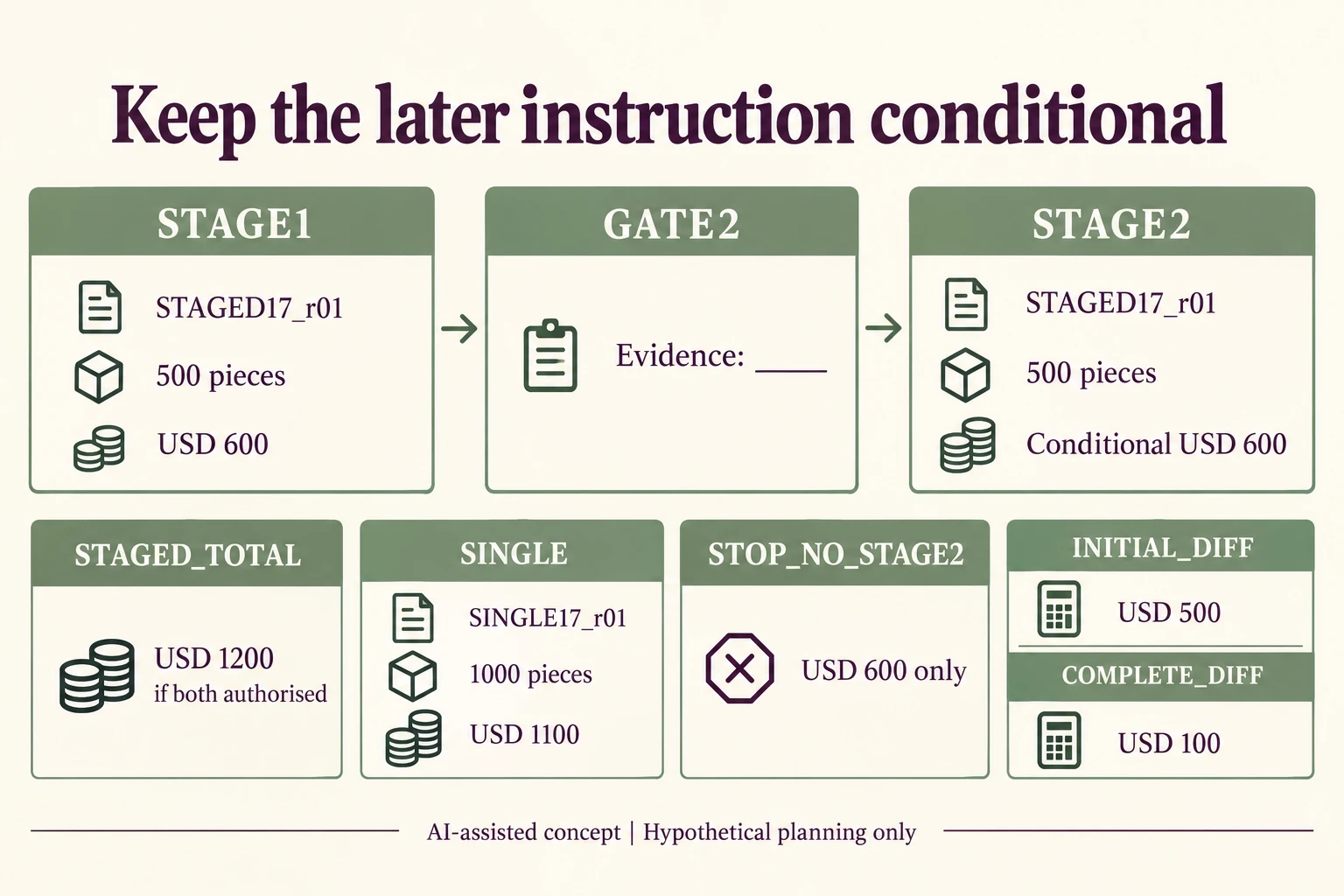
Follow the original fictional two-stage offer with exact new identities STAGED17_r01 and SINGLE17_r01. Each staged run is 500 pieces with $100 setup and $1 per piece; the single run is 1,000 with one $100 setup. These are assumed production terms, not a sample policy or actual offer.
Scroll horizontally if columns extend beyond the view.
| Scope ID | Exact entity | Stage / role | Hypothetical basis |
|---|---|---|---|
| STAGE1 | STAGED17_r01 | FIRST_COMMITMENT | 100 setup + 500 x USD1 |
| GATE2 | STAGED17_r01 | BEFORE_SECOND_INSTRUCTION | Current scope and commercial permission unknown |
| STAGE2 | STAGED17_r01 | SECOND_CONDITIONAL_COMMITMENT | 100 setup + 500 x USD1; conditional, not an order |
| STAGED_TOTAL | STAGED17_r01 | IF_BOTH_STAGES_AUTHORISED | 600 + 600 |
| SINGLE | SINGLE17_r01 | ONE_COMMITMENT | 100 setup + 1000 x USD1 |
| STOP_NO_STAGE2 | STAGED17_r01 | SECOND_STAGE_NOT_AUTHORISED | Only first defined commitment; not a refunded second order |
| INITIAL_DIFF | COMPARE17_r01 | INITIAL | 1100 – 600 |
| COMPLETE_DIFF | COMPARE17_r01 | COMPLETED | 1200 – 1100 |
STAGE1 and STAGE2 are distinct commitments separated by GATE2. The completed staged route totals $1,200 only if both are authorised. SINGLE totals $1,100. The initial comparison is $500 lower for staging; its completed-route difference is $100 higher.
STOP_NO_STAGE2 is a separate terminal scenario with only the first $600 commitment. It does not describe a cancellation or refund of a second order. Actual qualification, authorisation, evidence and dates remain blank; no smaller production minimum or guaranteed later flexibility follows.
Download the staged packaging procurement record (.csv). HYPOTHETICAL rows are invented examples. Use ACTUAL_BLANK for permitted project inputs; replace that row label only when recording actual facts. Empty evidence, observation and date fields mean unknown or not performed, never acceptance. Keep checkpoints and revisions separate.
Bring the exact scope rows and unresolved evidence in a Packrivo enquiry. Replace planning inputs with actual authorised records before treating the scenario as an available arrangement. Prepare a Packrivo packaging enquiry. Packrivo coordinates independent suppliers. These records establish no supplier offer, service availability or MOQ exception; its published baseline is 500 pieces per product/design.