

Gift readiness follows the arrival and release of every required component, not the first packaging shipment. Calculate complete-set capacity at each relevant date, then deduct completed or committed work consistently. Expected arrivals remain planning assumptions until they become usable stock.
In this guide

Combine material quantities with dates
Give each component a version, per-set use and arrival status. Keep transit, receipt and approval distinct where they affect packing readiness. A carton at the receiving door may still contain material awaiting identification or review.
The approval dependency worksheet establishes which decisions must close. This calculation adds how many gifts the released materials can support as those events occur.
A box-first shipment produces no gifts initially
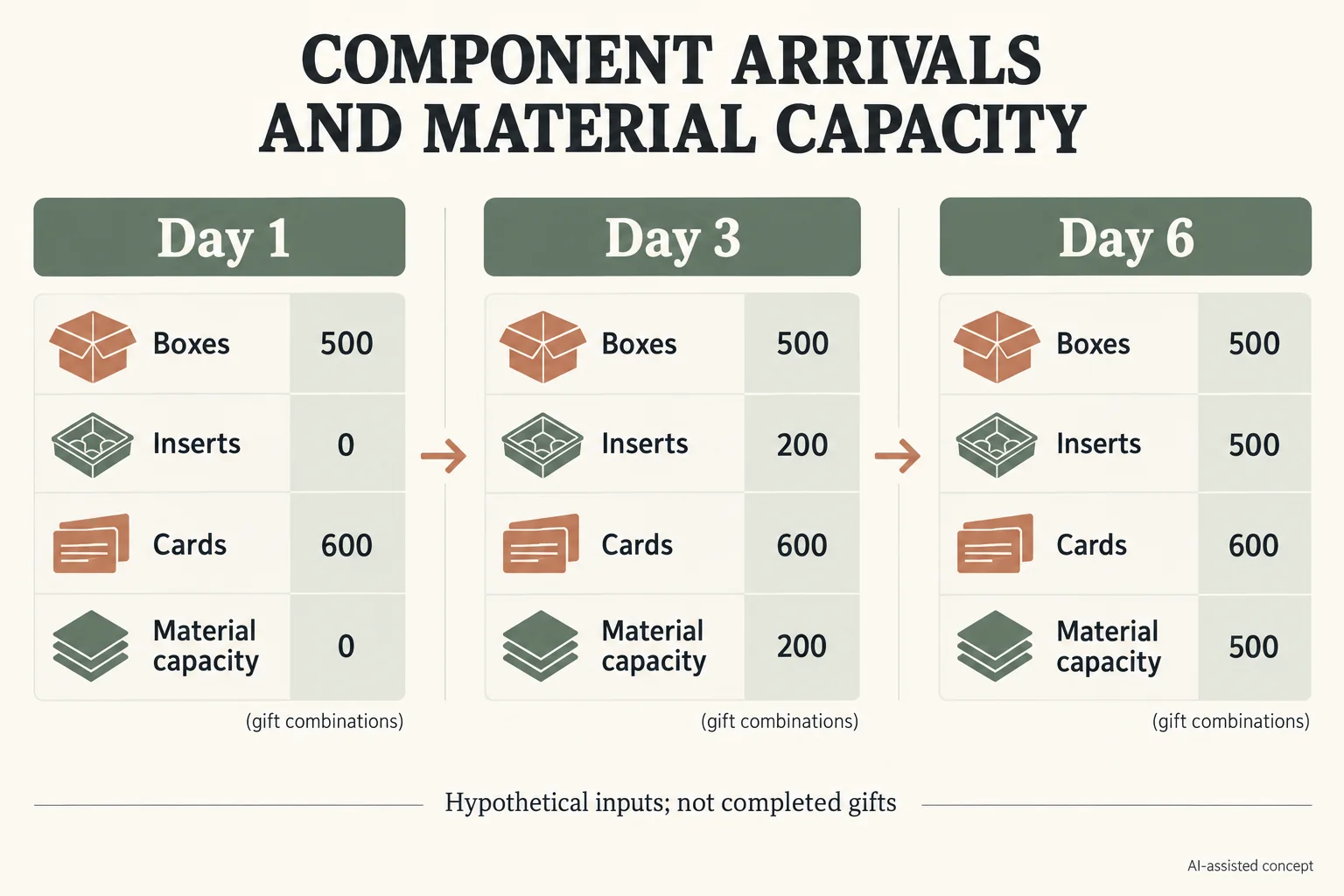
Assume one gift needs one box, one insert and one card. All receipts below are hypothetical and become approved usable stock on their stated days.
Scroll horizontally if columns extend beyond the view.
| Day | Cumulative boxes | Cumulative inserts | Cumulative cards | Total material capacity |
|---|---|---|---|---|
| 1 | 500 | 0 | 600 | 0 gifts |
| 3 | 500 | 200 | 600 | 200 gifts |
| 6 | 500 | 500 | 600 | 500 gifts |
On day 1, the boxes and cards cannot make a complete gift without inserts. The first 200 complete combinations exist on day 3. Another 300 become possible when the remaining inserts arrive on day 6.
If 150 gifts are dispatched on day 4, day 6 leaves 350 additional material combinations. Either subtract dispatched use from every relevant component or subtract it from the correctly calculated cumulative capacity. Don’t do both.
Place commitments on the same timeline
A promise for 300 gifts by day 4 is not supported by this arrival scenario. An earlier product shipment does not solve the packaging constraint. Identify which component and readiness date create the gap.
If the second insert receipt is merely estimated, show a delayed case. Moving it to day 8 shifts those additional 300 combinations; it doesn’t retroactively alter the first day-3 quantity.
Assembly capacity and product availability remain separate requirements. The table establishes material readiness, not completed packs or a guaranteed dispatch schedule. A large day-6 material release may still need substantial packing time.
Request the date that matters
Ask each component owner for the arrival state and the evidence needed before use. Update the timeline with actual released quantities as they become known. The output should name the date and count of feasible complete combinations, along with the unconfirmed arrivals or labor needed to turn them into shipped gifts.
Keep one consumption boundary through the delivery timeline
The first table uses cumulative receipts before any consumption. Once packing begins, keep a second view showing the balance after recorded use. Mixing cumulative receipts for boxes with remaining stock for inserts can produce a count that no actual arrangement supports.
Continue the same invented one-box, one-insert, one-card example. The following balances assume the day-3 receipts were released for use and 150 complete gifts were dispatched on day 4. There are no other reservations or losses in this simplified exercise.
Scroll horizontally if columns extend beyond the view.
| Moment | Boxes remaining | Inserts remaining | Cards remaining | Additional material combinations |
|---|---|---|---|---|
| After 150 gifts on day 4 | 350 | 50 | 450 | 50 |
| After the further 300 inserts on day 6 | 350 | 350 | 450 | 350 |
The day-6 answer is 350 additional combinations. Starting instead from the cumulative day-6 capacity of 500 and subtracting the 150 already used reaches the same result. Subtracting 150 again from the remaining-stock answer would count the same dispatch twice.
For each planned arrival, ask for the component version, quantity, date basis and release condition. “At port,” “delivered” and “released for packing” describe different events. Record a confirmed date only when the responsible source has supplied it; otherwise retain the estimate and its next update owner.
The complete gift pack inventory method handles the general per-set calculation. This timeline adds dates and actual consumption to that method. Check packing labour and product availability separately before turning a material combination count into a customer dispatch promise.
Download the packaging component delivery dates record (.csv). It contains field definitions, clearly hypothetical examples and a blank actual-project row. Replace the invented entries; a blank field is unknown, not an approved result.
Send the specific open decision with the brief
Bring the current record, packaging configuration, actual evidence available and the unresolved question to Packrivo’s packaging inquiry. State who must answer and which next step remains on hold. Packrivo coordinates sourcing and project questions with independent suppliers; this record is not a manufacturing or fulfilment service commitment.
Sources and scope
Australian Government supports the stated general concepts within this scope: General inventory categories, reorder points and stocktake. Access checked 14 October 2026.
Shopify Help Center supports the stated general concepts within this scope: Shopify state definitions only. Access checked 14 October 2026.
The worked scenario is original editorial analysis with assumed inputs, not a supplier offer, customer record or measured Packrivo result. Commercial feasibility and physical suitability remain project-specific.
What this changes in a packaging enquiry
Put the date each component becomes usable beside its purchasing quantity. When comparing suppliers, ask for separate box, insert and card milestones and any assembly or inspection dependency. An earlier box delivery is not an earlier complete-gift delivery when the other required components remain unavailable.