

Choose a wholesale case multiple by following the retailer’s stock through several receiving cycles. Demand, stock carried forward and order frequency belong in the calculation. A convenient carton count for one shipment can create awkward leftovers or a receiving pattern the store cannot support.
Begin with the unit the retailer actually orders. Six finished candle gifts, six empty presentation boxes and six mixed gift sets are different requirements. Keep the consumer unit unchanged while comparing case quantities, so the decision remains about replenishment rather than a new assortment.

Follow stock into the next receiving cycle
Consider a hypothetical retailer selling 18 identical gift units each fortnight. Assume those sales occur, the units are suitable for the channel, and the brand can offer cases of either six or twelve. These are planning assumptions, not actual demand or available supplier configurations.
The first order looks simple: three six-unit cases supply 18 units, while two twelve-unit cases supply 24. The six extra units in the second option still exist when the next order is placed.
Scroll horizontally if columns extend beyond the view.
| Case multiple | Cycle | Opening stock | Units received | Assumed sales | Closing stock |
|---|---|---|---|---|---|
| 6 | First fortnight | 0 | 18 | 18 | 0 |
| 6 | Second fortnight | 0 | 18 | 18 | 0 |
| 12 | First fortnight | 0 | 24 | 18 | 6 |
| 12 | Second fortnight | 6 | 12 | 18 | 0 |
Both plans deliver 36 units over the two fortnights. The twelve-unit case creates a larger first receipt and requires the buyer to account for six carried units before ordering again. Ordering 24 every fortnight would create another outcome entirely.
The arithmetic isolates case rounding. It assumes no loss, return, held stock or unexpected sales. Add those events as separate quantities when they occur.
Compare the receiving pattern as well as the total
A smaller case can make a particular replenishment quantity easier to order, but it may create more cases to open and count. A larger case may be acceptable if the retailer has somewhere suitable to keep the surplus and uses it before the next receipt.
Ask the store which receiving days it can support, how many sales units it wants per delivery and whether orders must contain whole cases. Confirm whether a case is split immediately among departments or remains an identifiable storage unit.
Compare weekly and fortnightly options using the same demand horizon. Changing both the case size and total assumed sales would make it difficult to see which decision caused the difference. The channel packaging comparison explains the shared customer-facing layer; the case-cycle calculation concerns the stock sent to replenish it.
Return a case proposal the retailer can evaluate
Send the proposed multiple, consumer-unit identity, receiving frequency and a two-cycle stock table together. Add the largest planned receipt and the retailer’s known storage or handling restrictions. Leave an unconfirmed restriction open rather than inventing a convenient backroom capacity.
The Australian Government inventory guidance recommends tracking stock, sales and restocking requirements. This original packaging example applies those ideas to case multiples; it does not forecast sales or set a universal case size. Source checked 14 October 2026.
Once a different case quantity is chosen, its commercial and identification consequences need their own review. Packrivo can help organize the sourcing brief and remaining supplier questions through a packaging project inquiry. Case availability, construction and order terms remain project-specific.
Extend the stock carry into a third receiving cycle
Add a third hypothetical fortnight with the same eighteen-unit demand and no losses, returns or holds. The third opening balance is zero in both original routes; the twelve-unit case still needs a twenty-four-unit receipt to meet the new eighteen-unit requirement.
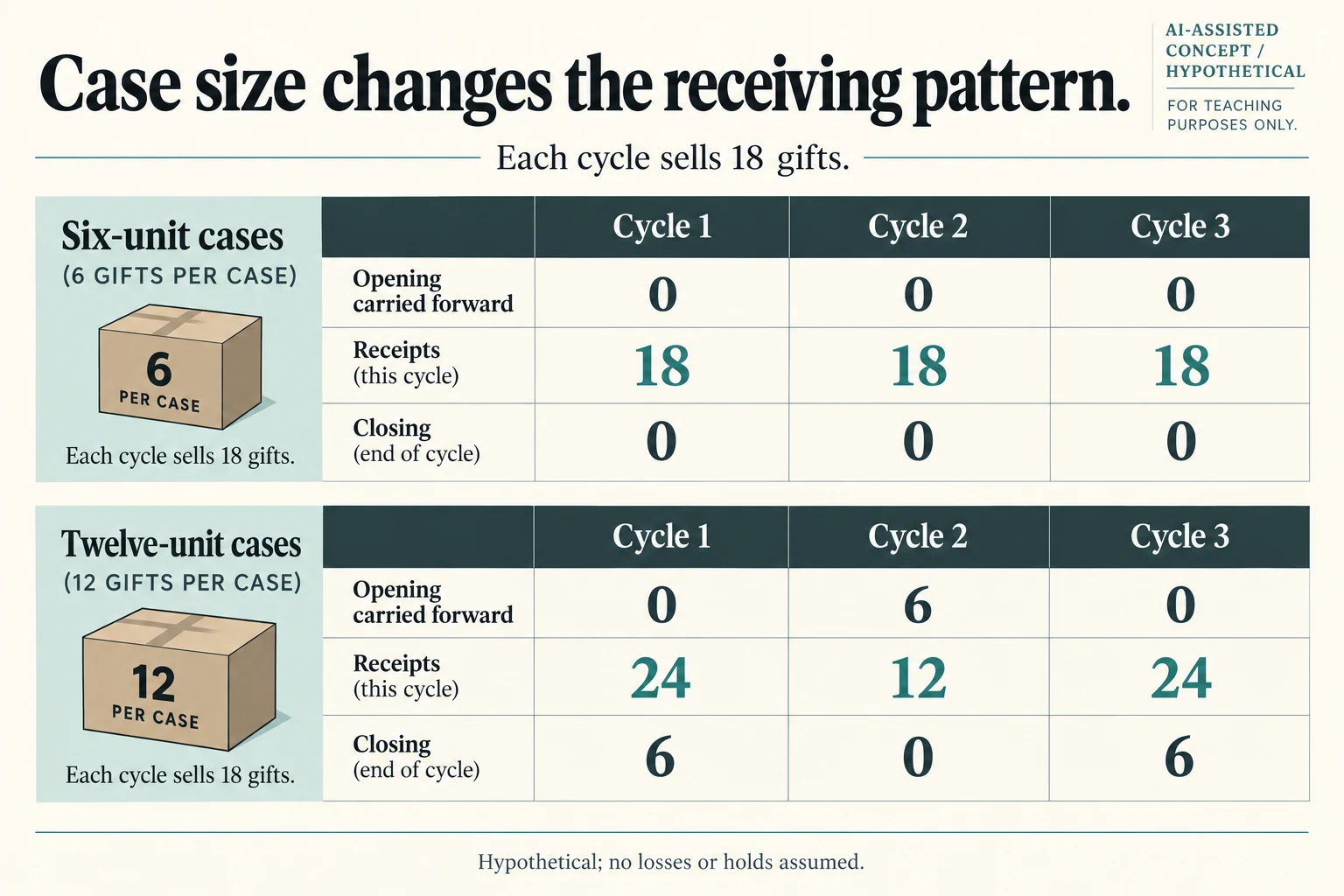
Scroll horizontally if columns extend beyond the view.
| Scenario scope | Exact object or route | Hypothetical input or output | Calculation or record boundary |
|---|---|---|---|
| Open | C6_T3 | 0 retail gifts | Opening equals second-cycle closing |
| Received | C6_T3 | 18 retail gifts | Third-cycle whole-case receipt |
| Sales | C6_T3 | 18 retail gifts | Same 18 gift demand |
| Close | C6_T3 | 0 retail gifts | 0+18-18 |
| Cases received | C6_T3 | 3 cases | 18/6 |
| Open | C12_T3 | 0 retail gifts | Opening equals second-cycle closing |
| Received | C12_T3 | 24 retail gifts | Third-cycle whole-case receipt |
| Sales | C12_T3 | 18 retail gifts | Same 18 gift demand |
| Close | C12_T3 | 6 retail gifts | 0+24-18 |
| Cases received | C12_T3 | 2 cases | 24/12 |
| Three cycle receipts | C6 | 54 retail gifts | 18+18+18 |
| Three cycle receipts | C12 | 60 retail gifts | 24+12+24 |
Six-unit cases receive eighteen and close at zero again. Twelve-unit cases receive twenty-four and close at six. Across three periods, that is fifty-four units received for the six-unit route and sixty for the twelve-unit route, with the latter six still in stock. Equal sales do not guarantee equal receipts at every cutoff.
The CSV keeps every cycle’s opening, receipt, sales, closing and case count independent. Losses, returns, holds, unexpected sales and weekly alternatives have separate blank scopes rather than assumed zero in an actual record. Confirm the receiving and storage arrangement before treating either cadence as available.
Download the wholesale case pack quantities record (.csv). It covers the original scenarios and this added comparison. HYPOTHETICAL rows are invented planning examples. Actual quantity, value, configuration, method, owner, observation, condition, decision, evidence and dates are blank because no actual project record has been obtained. Copy a relevant row and replace its type with ACTUAL only when entering permitted project evidence; keep the example and actual record separate. ACTUAL_BLANK is an empty starting row. A blank is unknown, never approval.
The related Ecommerce vs Retail Packaging: What to Share and What to Change guide concerns a separate requirement. Use this record for the specific comparison above rather than treating that guide as evidence of a completed result.
When cases contain different variants, add the mixed-case demand model. Keep the retailer’s intermediate handling layer in the inner-pack handling decision.
Source scope checked 16 October 2026: the original public references remain within their stated general guidance or manufacturer-example scope. The new numbers and task records are original hypothetical analysis, not observed supply, trials, inventory, prices or performance.
What this changes in a packaging enquiry
Specify the retailer's intended receiving unit before asking for an outer-carton quote. State the sale-ready units per case, any inner packs and the delivery cycle used in your demand plan. A modeled case multiple is not a supplier carton capacity, agreed overdelivery term or confirmed retailer requirement. A relevant configuration to compare is the Regular Slotted Shipping Cartons: Size Around the Inner Pack; it is a concept reference, not confirmed suitability.
Discuss this packaging specification with Packrivo. We coordinate independent suppliers. MOQ: 500 pieces per product/design; illustrative quantities are not production offers. Confirm materials, samples, price and timing for your project.