

Choose mixed wholesale cases by comparing their fixed assortment with the retailer’s demand for each variant. A mixed case may reduce the number of stock lines handled at dispatch, yet force the store to receive units it cannot use in the same replenishment period. Keep total units and variant quantities visible together.
Establish whether the retailer can order a different mixture or must accept a predefined case. Supplier availability and retailer permission are separate questions; a convenient ratio on a planning sheet confirms neither.

Compare the variant vector, not only the case count
The following invented example concerns two finished candle gifts, A and B. Assume the retailer needs 18 of A and six of B. All offered configurations below are hypothetical candidates, not confirmed supply options.
Scroll horizontally if columns extend beyond the view.
| Candidate case arrangement | Cases ordered | A received | B received | Surplus above stated demand |
|---|---|---|---|---|
| Mixed case containing 6 A and 6 B | 3 | 18 | 18 | 12 B |
| Single-variant cases containing 6 units | 3 A cases and 1 B case | 18 | 6 | None in this scenario |
| Mixed case containing 9 A and 3 B | 2 | 18 | 6 | None in this scenario |
The first proposal supplies the required A quantity but triples the required B quantity. Comparing only “three cases versus four cases” would hide those twelve extra B units.
A ratio that fits this period can miss the next one. If demand changes to equal quantities, the nine-to-three case could create a different imbalance. Test the ratio against more than one credible replenishment scenario before treating it as the standard case.
Include the receiving decisions
A retailer might send complete single-variant cases to separate departments. A mixed case requires someone to identify and separate the contents, unless the agreed store operation keeps that mixture together.
Write down that receiving route. State whether units move directly to the shelf, remain in an inner pack or enter variant-specific backroom locations. Product identification must survive the move, particularly where closed gift packs look similar.
The loaded carton orientation map addresses the physical positions of retail units inside an outer carton. Here, the assortment decision comes first; a correct layout for the wrong mixture still supplies the wrong stock.
Count any added inner packs or labels rather than assuming a mixed case has fewer materials. The complete packing arrangement still needs its own fit and distribution review.
Agree the ordering unit explicitly
Return a description such as “one case contains six A and six B,” with the exact variant references. Ask whether partial cases, changed mixtures or substitutions are permitted. If the answer is unknown, keep it outside the available ordering choices.
Do not describe a mixed shipment as a new fixed retail gift set merely because several products share a shipping case. Consumer assortment identity and higher-level trade-item identification require their own applicable review.
The Australian Government inventory guidance supports following what sells and grouping records by product or location. The ratio table is original hypothetical arithmetic; it supplies no forecast or universal wholesale arrangement. Source checked 14 October 2026.
Bring the demand split, proposed case mixtures and store receiving method to a packaging project inquiry. Packrivo can coordinate the supplier questions around the selected arrangement without assuming a particular mixed-case service exists.
Retest a mixed case when demand becomes equal
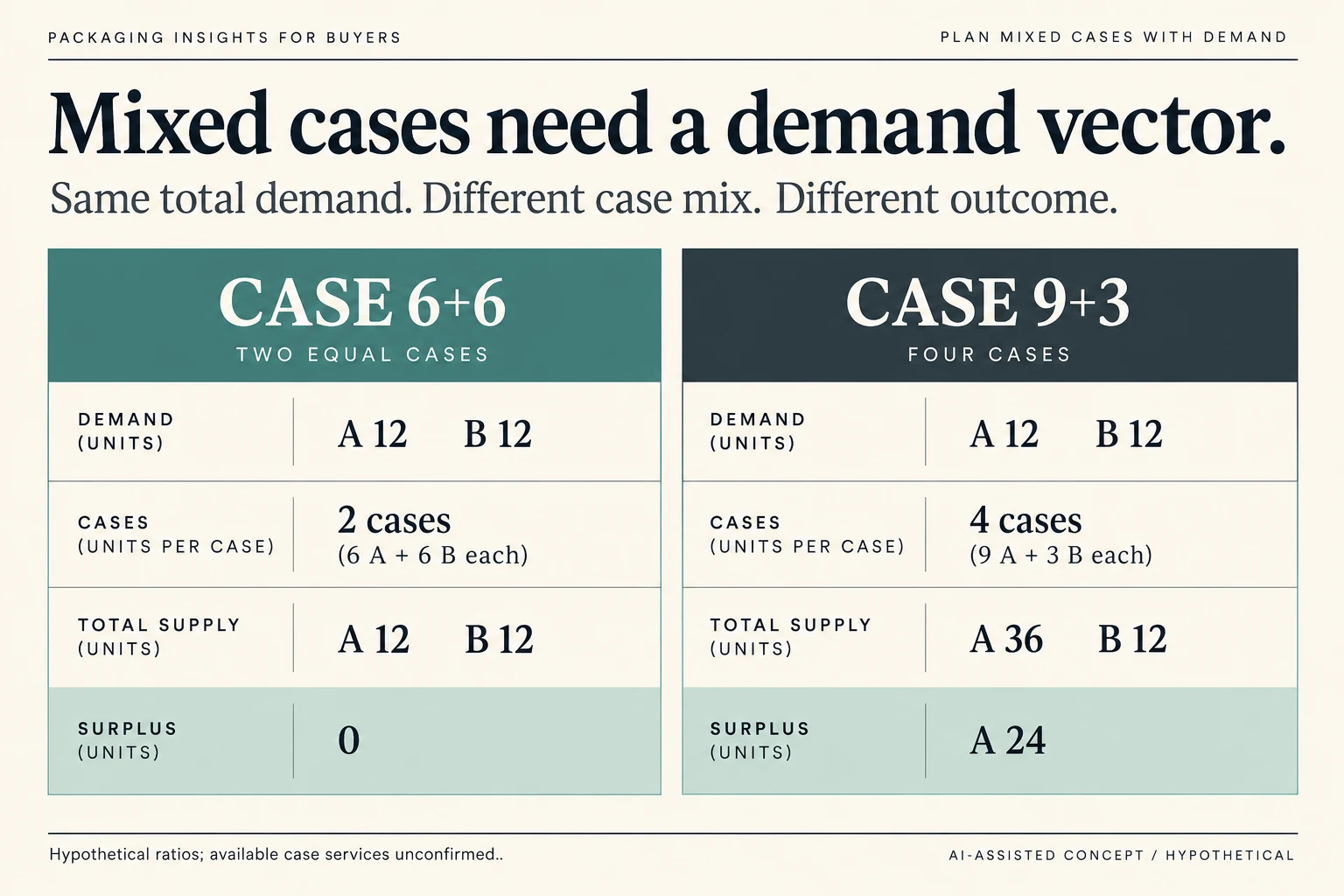
Use a new hypothetical demand of twelve A and twelve B gifts. Keep the original six-plus-six and nine-plus-three case definitions. This sensitivity changes the demand vector, not the available service: neither case arrangement has been confirmed by a supplier.
Scroll horizontally if columns extend beyond the view.
| Scenario scope | Exact object or route | Hypothetical input or output | Calculation or record boundary |
|---|---|---|---|
| Demand | EQUAL18 | 12 A gifts | New alternative 12 A |
| Demand | EQUAL18 | 12 B gifts | New alternative 12 B |
| Cases | EQUAL6 | 2 cases | Whole cases enough for 12 B |
| A | EQUAL6 | 12 A gifts | 2*6 |
| B | EQUAL6 | 12 B gifts | 2*6 |
| Surplus a | EQUAL6 | 0 A gifts | 12-12 |
| Cases | EQUAL9 | 4 cases | Whole cases enough for 12 B |
| A | EQUAL9 | 36 A gifts | 4*9 |
| B | EQUAL9 | 12 B gifts | 4*3 |
| Surplus a | EQUAL9 | 24 A gifts | 36-12 |
Two six-plus-six cases meet the twelve/twelve requirement exactly. Four nine-plus-three cases are needed to reach twelve B, bringing thirty-six A and leaving twenty-four A above demand. A ratio that fitted the original eighteen/six demand becomes the less balanced alternative here.
The record retains both original single-variant orders separately and gives each receiving route and permission its own row. Store shelf entry, retained inner groups and backroom separation are alternatives, not three operations automatically performed on every case. Unknown partial-case, mixture-change and substitution permissions stay blank.
Download the mixed wholesale case assortment record (.csv). It covers the original scenarios and this added comparison. HYPOTHETICAL rows are invented planning examples. Actual quantity, value, configuration, method, owner, observation, condition, decision, evidence and dates are blank because no actual project record has been obtained. Copy a relevant row and replace its type with ACTUAL only when entering permitted project evidence; keep the example and actual record separate. ACTUAL_BLANK is an empty starting row. A blank is unknown, never approval.
The related Record Orientation When Retail Packs Share an Outer Carton guide concerns a separate requirement. Use this record for the specific comparison above rather than treating that guide as evidence of a completed result.
Carry the selected assortment into the receiving-cycle stock model. If groups stay together after receipt, use the inner-group handling decision.
Source scope checked 16 October 2026: the original public references remain within their stated general guidance or manufacturer-example scope. The new numbers and task records are original hypothetical analysis, not observed supply, trials, inventory, prices or performance.
What this changes in a packaging enquiry
Ask for the exact variant quantities and physical grouping in each proposed wholesale case. Compare the resulting component demand, surplus and receiving work with the retailer's actual mix. A case containing enough total pieces may still leave the wrong variant balance for the packaging or sales requirement.
Discuss this packaging specification with Packrivo. We coordinate independent suppliers. MOQ: 500 pieces per product/design; illustrative quantities are not production offers. Confirm materials, samples, price and timing for your project.